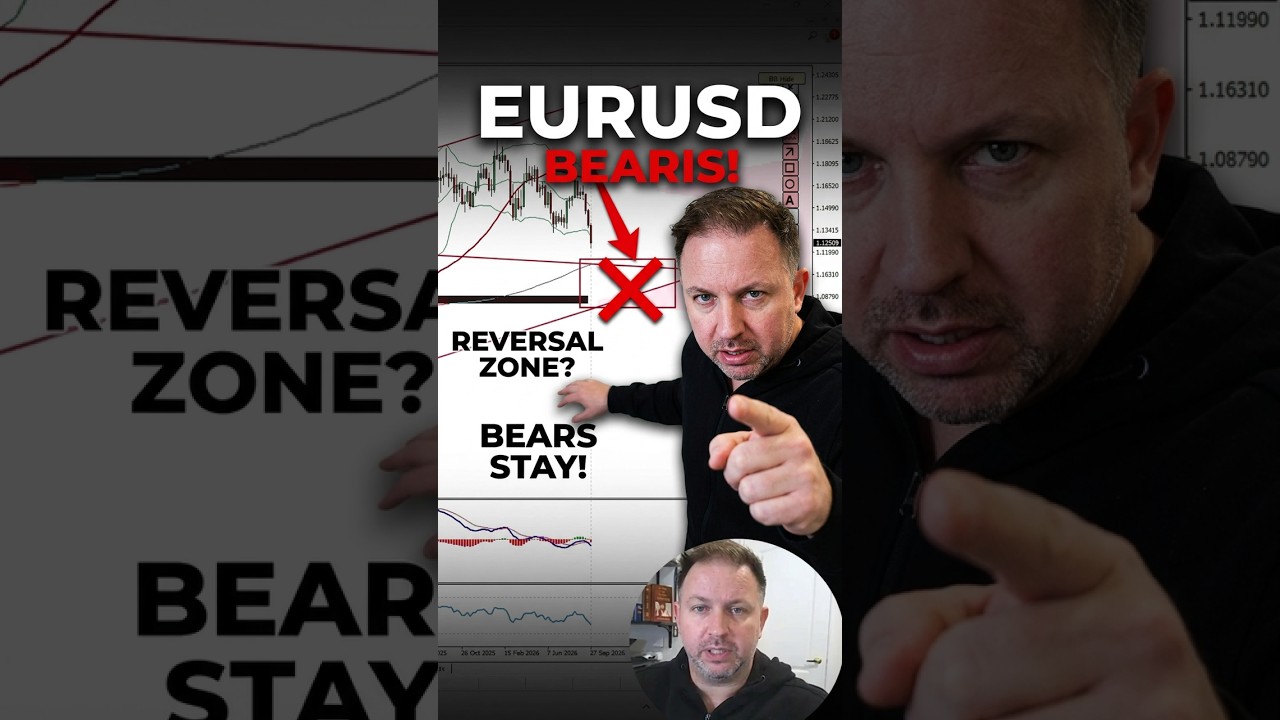
Vladimir Ribakov, a certified financial technician, breaks down why divergence traders lose money. The three biggest mistakes: entering before confirmation, trading lower timeframes against higher-timeframe signals, and skipping the retest before entry. Price typically revisits the divergence zone before a reliable move.
Chapters
Divergence trading could be one of the best weapons in your trading arsenal, but like every weapon, it also could be very dangerous if you do not use that right. And in this video, I want to break down the most common mistakes traders do when they attempt trading the divergences. Let's begin. So what's up, traders? Vladimir here from Home Trader Club. If you don't know who I am or you are new to our channel, watch this video a little bit about my story, about my experience, and who I am. I'm internationally certified financial technician with over the 2 decades of experience in this trading business, in this world. So when I speak my charts When I share the things for you, you can imagine that I do understand a thing or two. I've been around for enough time to know what works, what fails, and where are the mistakes that traders actually do. The reason is very simple. I myself was doing the same mistakes and even more terrible. Again, watch my story in the video I recommended. You would understand what I went through and all my bad mistakes. And yet here I am after 2 decades. Probably for a reason. So in this video, I want to break down mistakes you probably did, you might be doing still when it comes to divergence trading. By the way, if you have no clue about divergences, please watch this video. It will give you all the information you might need. And if you want to learn much more, all the possible things about the divergences and not only, then I invite you to our club, the Home Trader Club, where you would be able to enjoy our complete courses, comprehensive media zone, and of course enjoy our real-time trading opportunities and trading education as they are delivered to you. And also I want to remind you that we teamed up for our community with one of the best top leading brokers in this industry, AvaTrade. What does it mean to you? You can get absolute complete ultimate unlimited access, unlimited access to all of our features in Home Trader Club, plus the Trade Copier project that we have with AvaTrade. So if you have account with AvaTrade, or if you don't, make sure you do trade with AvaTrade. Contact me after that. These are the steps. Just follow the link below this video, uh, get your account, get it ready to trade, get unlimited access to Home Trader Club. So what are the mistakes traders do when it comes to divergence trading? Once again, if you have no clue what divergence Divergences, watch the recommended video right here, and you can learn everything, of course, in Home Trader Club, as I mentioned before. So the idea here is very, very simple. Divergence is when market and indicators are not aligned, when the market shows one thing but the indicator shows different thing. This is a divergence condition, and this is something you— most traders are scared of and/or attempt to trade it absolutely wrong. So the first mistakes traders do is actually attacking too early. Take a look on this gold. What do I mean by too early? Let's break it down how it was developing here. So gold was making this divergence. At that point, it was very, very, very good and very obvious. It actually started to make the move down and then attempted to make another peak, as you can see here. At that time, look what starts to happen. The market starts to create some bearish candles. And if you take a look on the MACD moving averages, it looked like we are about to peak here, right? The MACD was slowing down and it was going very, very good as this is a long divergence. But at that point, I remember that because I got tons of discussions and people waiting here, time to sell, time to sell, time to sell. And I was also waiting for sell setup there, saying that for full transparency, of course, but was waiting for a trigger which never came. And why it's so critical? Because this divergence never completed. What does that mean? There was never tick to the downside on the moving average and the cross, and the price never confirmed a divergence. What does that mean, price never confirmed divergence? Usually on the lower time frame, you would start to see like fake peaks and divergences by itself and attempts to make the reversals and create lower lows. It never created— it was just a range before the buyers took a major control. So the very first mistakes, uh, mistake traders do is they assume there will be divergence before it kicks in and before it is confirmed, uh, and the lower time frame support the price reversal, and they just attack hoping for the good. Uh, unless you have a hard protection, this could be very Very pricey and costly, and that's something you would want to avoid. So this is the first mistake, and the second mistake traders do is they trade against higher time frame divergence too early. What do I mean by that? Take a look on this four-hour chart trade example. So what do you have here? We have a bearish divergence here, clearly developing. From higher highs on the chart to lower highs on the MACD. This is a trade which we, by the way, enjoyed from right here on Trading Club, the Home Trader Club. We initially made this management when we started to see some signs against, uh, right here moving risk-free. But I want to explain this bearish decision here and actually why At that point, there were so many mistakes done by traders, and I know that because people were asking me in the group, is it time to buy, buy, buy, buy, buy? So here is the sell. Of course, we got the higher highs on the chart versus lower highs on the MACD. This is a bearish divergence. Okay, now look what happens here. I will put a vertical line here and look what starts to happen. Gold, everybody wants to buy, right? Because it can theoretically Run like crazy to the upside. But look what starts to happen here. We start to have we got the four-hour chart divergence. We also have one-hour chart divergence from higher highs on the chart to lower highs on the MACD. Then we got lower lows on the chart and lower lows on the MACD. That's a synchronization again. So when that happens, do not rush to buy on the lower time frames before you reach key levels on the time frame where the divergence was initiated, which is the 4-hour chart. So when we go to the 15-minute time frame here, from this point it starts to drop. At that point I got conversation, okay, that's it, it's enough for the drop, it's time to start looking for the buys. And people were actually got interested in this kind of divergence. They saw, that's it, the 4-hour chart is over. So yes, this one bounced, no doubt. But it doesn't mean the 4-hour chart is over. And then every bullish divergence here, uh, people are convinced that this is time to buy. And when you see it only bounces a little bit before more and more and more and more sellers come in, then people were convinced that now it's a bullish divergence, time to buy. As you can see, again, nothing happens. At that point before the key level is reached. And this is a very, very important tip I want to give you. So when there is divergence, in most of— if the divergence kicks in, because sometimes it's not, it's not like it's a holy grail, no, absolutely not. Divergences could fail. But if divergence kicks in, then the low in between the divergences is usually retested. Since the divergence started here from this high through this high, you got lower highs on the MACD from here, then this low is usually the one that should be retested. Only when it is there, uh, down to potentially the next key low, only then this is your area right here to start looking for potential bounces and buys. Before that, every little buy you will try here on the lower time frame would be a bet and in most cases would fail to deliver. So when it comes to divergence, do not buy when it's too early. So don't drop to lower time frame ignoring the higher time frame. If the 4-hour chart is bearish divergence, wait for at least the lows here. But because the divergence was from these peaks, once again, one 2, 1, 2. Then this low is the one of interest. Only when it is there, then you can start talking about some buy opportunities. And actually, when you go to the 15-minute time frame now, as it reached the 4-hour chart low, look what happens. Higher— lower lows on the chart, higher lows on the MACD. This is exactly the bounces you are looking for and you could be trading. Why? Because the 4-hour chart low of the, of the divergence— this is the divergence— was retested. Now it becomes zone of interest. It does not guarantee that there will be some buy here, but if there is, these are actually the moments that you could be looking for the buys. So these are the most common mistake traders do, which was important for me to upload it and to show you, and hopefully you will avoid it. Because why to do these mistakes, right? Divergence could be again one of the best weapons in your trading arsenal, but every weapon is dangerous if used wrongly. So make sure you use that wisely and you use it correctly. That's it for this video. As always, I hope you find value watching that. If you do, please don't forget to like, uh, hit the like button below this this video. If you are new to our channel, please consider to subscribe. And I want to invite you once again to Home Trader Club. Get your access to full courses, real-time trading education, real-time trading opportunities, so much more. Follow the link below this video in the description. Thanks for watching. Best to you and yours, and I'll see you soon with more. Good trading. Bye for now.