Your Business Reviews Suck (And Your Customers Know It)
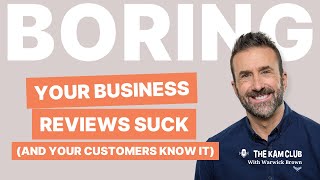
This YouTube podcast episode (host Warwick Brown, guest James Ward of ClientShare) analyses why Quarterly Business Reviews (QBRs) often fail to deliver value. They identify core problems: QBRs are frequently a tick-box exercise, lack demonstrated value and innovation, contain low-quality or incorrect data, and are time-consuming to produce. The discussion traces the 20+ year evolution from scarce data to demands for recommendations, highlights several survey statistics about buyer frustration, and previews solutions (covered in Part 2) including a three-part process to build better reviews.
Questions this video answers
July 7, 2025
James Ward; he leads ClientShare
88% (as cited in the discussion)
About three quarters (≈75%)
77% (as cited by James Ward)
Chapters
And as a key account manager, I've frequently just been left to figure it out for yourself. But today we are very fortunate to have with us a very special guest who's going to help us unravel the mystery of business reviews. Welcome, James, to the CampCloud podcast, a show where we help key account managers grow their accounts, retain their accounts and build a successful career in key account management.
Thank you, Warwick, and thank you for having me here today. So my name is James, James Ward and I lead an organization called clientshare and we proudly help some of the world's largest companies retain and grow contracts. And we do that through helping them through the minefield of quarterly business reviews. So we provide a software tool that helps leading organizations create business reviews, deliver them to key recipients, manage how the process happens, and measure net promoter, score CSAT and act on any feedback across the review. So really it's a way of managing and measuring the whole business review process for large organizations.
And not enough people out there are focused on business reviews. I have to say, you know, if you look at how they're produced and you know, the insights that you get from them and how best to use them, I feel like it's. Nobody's really talking about it in, in any kind of depth. So you've done some interesting research and I will put a link to the research that clientshare has done all about QBRs and trends and insights about the future and the current state of them. Some of the stats that I saw was, you know, 80% of buyers feel like suppliers aren't really sh showing up and showing up enough value and innovation. They often feel like QBIs are a tick box exercise. And if you're a key account manager, I'm sure, you know, like I have experienced, trying to get clients that pin them down to do a review can be really challenging. I've often done annual reviews in May because clients don't want to meet me and I'm like, why don't you want to meet me? But clearly the value of the business review is not there. So what's your view about common mistakes suppliers make and why they think QBRs are sort of like this operational just paint by the numbers exercise. What more could they be doing?
Well, I suppose first and foremost the problem you highlight is real. It's not something which is just sort of loosely spoken about because it sounds like it's something that's nice to fix. It's a real problem that's affecting relationships between buyers and suppliers and is fundamentally hurting businesses on Both sides, actually. Right. So you enter into an agreement with a supplier because they're the best in class and you want them to deliver something for you and unlock value for the services they're delivering. And if over a time period you can't unlock that value, as a buyer you're leaving money on the table. And likewise as a supplier, you want to deliver the services you're contracted to, but you want to give more. You want to unlock your value, your innovation. And if you can't unlock that, then you're leaving money on the table. So poor reviews are fundamentally leading to business results not being as good as they could be. So that's the statement you make about it being a problem is absolutely spot on. And the research we've just completed, the qbr, the QBR frustration and last year we did something called the QBR delusion was through the lens of buyers. So companies who are buying services. And the research we did this year, the polar opposite it was the view of the supplier was really wanted to see how the two sort of faced off against each other. And the most common mistakes that we see in QBRs today are pretty similar on both sides of the fence. But fundamentally sort of the biggest thing that stands out above all else is there isn't enough value and innovation shown in the QBR. So the stat you showed earlier, 88% of buyers feel like suppliers aren't showing enough value and innovation is the one that sort of underpins so much about what happens and what that therefore leads to is about the same percentage. Three quarters of companies feel that the QBR is dangerously heading towards becoming a tick box exercise. So if you can't show value, if you can't show innovation to something which is a, you know, a strategic part of your business relationship, then you have a fundamental problem. So demonstrating value and innovation underpins everything as to why, why the business meeting needs to happen in a better format.
I mean it sort of begs the question, are they even relevant anymore? Because I've been doing these for 20 years plus 20 years, they look exactly the same as they did 20 years ago. It's a table full of numbers and some pie charts.
Yeah.
And that's it. And then as a key account manager, I'm not an analyst, right. But over the years I've learned what to look for. But the insight is not something that's automated. It's not something that comes with the numbers. You have to figure that out for your, for yourself.
Let's take a look at what's actually happened to businesses over that 20 year time period. So most organizations 20 plus years ago were in some form of first or second generation outsourcing of services. Yep. So whether it's front office or back office services, most companies have begun that journey of saying, you know what, we can lift and shift this either on site to another supplier or we can, you know, potentially near shore it or then even in some cases we can offshore it. So that evolution had begun 20 or so years ago, which meant that the first generation of or second generation of services that people were buying when the, when the whole marketplace changed. Actually the biggest challenge suppliers had then was finding some data about what they were doing anyway. It suddenly went from all being in house to suddenly let's create some information about the services we're delivering. So 20 plus years ago or maybe 30 years ago as well. Actually the first problem companies had then was just finding information. That was the first challenge they had. Get me some information on the services. Ten years ago, you then onto second or third generation outsourcing where companies would have gone through various different iterations of, you know, we now outsource all of our IT to so and so company and manufacturing to XYZ company, our BPO services elsewhere. And that next generation, it wasn't so much about get me the data, it was much more about get that data in a presentable format and make sure it's really ready, available and make sure that you've got that data available. And I've got a story behind it. Yep, a story behind the data. It's not here's the numbers, it's here's the numbers and here's what the numbers are telling us. Fast forward five years, you've then got organizations saying, yeah, thanks for the numbers, thanks for telling the story at the bottom of the slide about what the numbers tell us. I now want some insight, Yep, I want insight now as to about what the numbers and the story is telling us and then come all the way forward to today. All of that is a given. I want the numbers, I want the data, I want the information. But what buyers are desperate for is tell me what to do, tell me what to do with all this information, give me recommendations. And that last bit is the recommendations because you're the subject matter experts in the services you supply to us, where the innovation and the value needs to come in. And the reason why it feels it's stuck in a time warp is everyone wants to be at stage four where they can just talk about what should happen next. But they are still in many cases Struggling to get stage one right in the first place. Get their data in the right format, get the insights there, tell the story and then talk about recommendations. So that evolution over 20 years is actually completely echoed in the way that companies are still presenting data, because it is stuck in a time warp.
You know, when I first started doing keycap management in sort of the early noughties, sort of early 2000s as a supplier, I held all the data. Clients didn't have any of that information. So when I would come to a business review, they'd be like so grateful to find out what they were doing in terms of spend and transaction volume. Fast forward, as you say. Then we kind of shifted from boring reports like literally like tables to let's do presentations and trying to find ways to automate that. Eventually we got PowerPoint slides that had charts and nothing else. So it's like, okay, well where's. How am I supposed to interpret all this? Then we sort of moved into more account planning and kind of there was never a real link between the two. You would say let's do this, but often wasn't back with data. And even as long, little as five years ago, still struggling with the output in a way that's consistent, in a way that's easy for account managers to produce. Because for me the biggest challenge is If I've got 20 accounts, which even as a key account manager, you could possibly have that many. And my boss is like Warwick, you need to do all 20 reviews every quarter. I'm basically spending all my time, I might as well start, you know, I would not have even done Q1 by now because the data takes a couple of weeks. We're recording this at the end of April. Data takes a couple of weeks to clean and you produce all the documents and the PowerPoints and all that. Then I've got to go deliver them and also polish them up. They don't come out of the box ready to go. I could be doing my Q1 reviews right up until June if I've got 20 clients. And so the production side is wild and you have the boss with this unrealistic expectation, you need to deliver these reviews and then you have the clients not wanting to do them and you're just chasing your tail trying to pin them down. And in between, you're trying to whip these half baked reviews that the product team gave you or the IT team gave you into shape and you just want to like to look for the nearest bridge.
About 77% of the buyers will say that one of their biggest Frustrations is, is the materials they get are a poor quality. Right. So the information that's shared with them isn't good enough. Yeah. And there's nothing worse than a buyer sitting down for a very large contract or even a mid sized contract and they open up page one of that review and the data's wrong because the meeting is only going one direction from there it's only going to go in one direction. I mean, there are many ways that we can talk about, you know, how you build, use the right building blocks to put a review together in the first place to save bundles of time for account managers, which is a key thing. But one of the key things you have to note is your organization has got to find the right way to get the data right in the first place. And my strongest piece of advice around that is less is more. It is. A number of years ago I knew a man who conducted an experiment on a 70 page slide deck for a very large banking relationship whereby each quarter they took out 10 pages and saw what and the client ever noticed. This was the thing, right? The client had said for two, three years, oh, that's interesting, why don't you report on that next month or next period? And then just bit by bit, more got added in, more got added in, more got added in, more got added in. Which means you suddenly get this deck that builds up and up and up, that never gets looked at, has got more opportunities to go wrong and takes hours and hours and hours to produce. So, you know, without getting all Simon Sinek on it, the whole idea of starting with why, you know, starting that whole QBR not with data is one of the key things that a good business practice needs to do. And too often we see organizations talk about it, but how that then translates through to how key account managers behave is often very, very different. And far too often key account managers are more comfortable talking about the operational data that sits inside a contract or a business relationship than they are talking about starting a meeting by saying, so this is how we've helped you try and achieve your company's objectives over the past quarter. But going back to where I start in this point, get the data right and have less. Have less data.
Yeah, I agree. I used to have a deck that was 60 slides long, plus another hundred in a slide brief and every client would get that many. It would, you know, it's produced by automation. But just me removing slides took the best part of like a day per customer, you know, and trying to tell the story. But I agree with you, I Think access to data, access to reporting. Most clients now have self service reporting tools on platforms and things like that. They've got portals. So you don't need to re, you don't need to go over, you know, you can have a quick table of snapshot data then you can say, all right, of all of this stuff, here's three things I think we should talk about today that are going to make the biggest impact about how we should move. You know, what we should do next doesn't have to be every single thing and go through every slice and dice available of the data.
I do agree that the format, I totally agree about the format changing but I do also think, I don't 100% agree that most organizations have got the content already. So we've been, you know, we've been involved in, you know, the best part of, you know, quarter of a million business reviews have gone through our system. And I can assure you that most, many, many, many huge global organizations, the bigger the contract gets, the more people are still churning out PowerPoint to create content. It is if you step outside of the, for example there's some industries which by the very nature of the services they provide stuff is automated and online. So if you take IT services for example, you've got all sorts of data because it's help desk tickets, it's, you know, it's management of tickets, all sorts of IT service management. If you look at other very large industries where it's less data structured but it's still huge service lines, facilities management, contract catering, logistics, BPO manufacturing, there often isn't as much data. And that's why you see account managers basically robbing Peter to pay Paul internally to try and create these decks in the first place. And they don't have the expertise of creating content. So I, you know, the amount of time people spend on business reviews that whether you pick this up in the research or not, but there's a, there's a terrifying stat and of course it depends on the size of organization. And the caveat is, you know, we work typically with large organizations, 100 million revenue and above and very often with a billion and plus. So a lot of this data is skewed towards that. But the mean average of days spent on creation of QBRs is 9 days per QBR, right? 9 days per client. Yeah, per client. Now some of this I say is skewed towards someone who's got a contract worth 2,3 million pounds a year. But that is a phenomenal amount of time preparing information for a one hour meeting.
Yeah, it's crazy and not even any demonstrable ROI or value from it. So if we so I think we can agree QBRs fundamentally are challenging to produce and interpret and derive recommendations from it. So where do we go next? I mean. Well, I hope you enjoyed that conversation with James Heroes. I have split this episode into two parts because there was so much gold I didn't want you to miss a thing. So head on over to part two with James where we talk all about the solutions to building successful business reviews. He shares his three part process which helps you build wealth, class business reviews and actually brings you some time back. We're going to talk about most overrated best practices as well as the one question that gets clients talking and a rapid fire round as well. So I don't want you to miss that. Head on over to part two. I'm going to see you there.
More from Warwick


🔥 The Most UNDERRATED QBR Skill (Game Changer!) #business #customersuccess #meetings #clients
Sales Skills Are Transferable—9 Growth Industries in 2025 (And How to Break In)



Ready to level up your productivity game? 🔥 Check out this tool I use to simplify my work.

Can you tell the difference? Replaced my Logitech C920 webcam with a Logitech Brio 4K #tech