1,000 Hours of studying the best Personal Brands in 42 mins
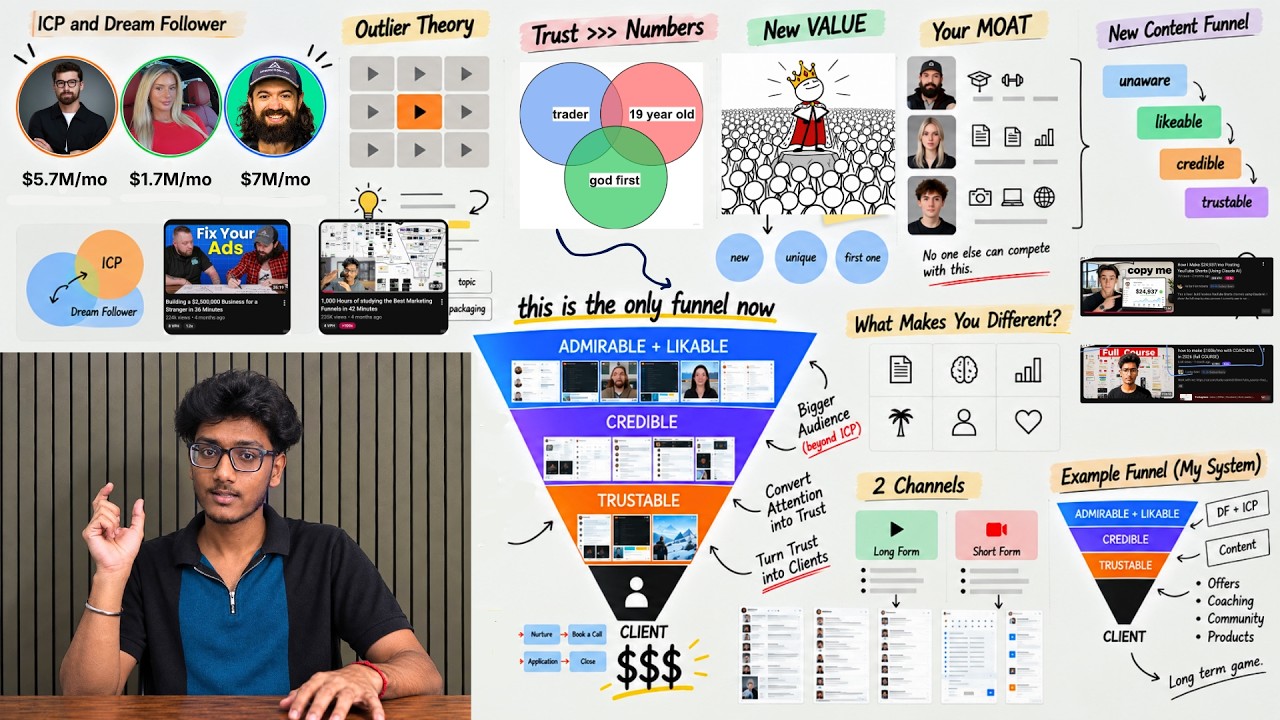
In this 42‑minute video, Wasif Ali Khan distills insights from analyzing 57 high‑earning personal brands (earning $100K‑$1M per month) into a step‑by‑step playbook for coaches, consultants, and online entrepreneurs. He begins by contrasting the traditional ICP‑only content approach with the "Dream Follower" strategy, showing how broadening the target audience can explode reach and lead volume. He then introduces the Outlier Theory – a research‑first method for spotting and replicating viral ideas, complete with a scoring system and rules for first‑mover advantage. The video stresses that trust, not vanity metrics, should be the primary KPI, and outlines three content pillars (personality, mechanism/value, and offer‑focused) that balance emotional appeal with logical proof. Khan argues that delivering "new or unique value" – insights that only the creator can provide – is essential for differentiation. He explains how to construct a personal moat by cataloguing one‑of‑a‑kind traits, stories, results, and beliefs, and how this feeds into a four‑stage content funnel (admirable → likable → credible → trustable). He advocates documenting everyday work as authentic content, and recommends a two‑channel strategy: a brand‑wide channel for Dream Followers and an ICP‑focused channel for conversion. Finally, he lists the five highest‑converting content formats (mechanism + income proof, full free course, roadmap, case‑study‑style breakdown, origin story) and provides a call‑to‑action for a free 3‑hour course and one‑on‑one consulting. The overall message is that systematic research, unique positioning, and a trust‑first funnel outperform vanity‑driven, trend‑chasing tactics.
Chapters
In the last 12 months, I've analyzed over 57 different personal brands making anywhere between $100,000 a month all the way up to $1 million a month. In today's video, I'll show you the most important lessons that I've learned in the last 12 months analyzing these personal brands for coaches, consultants, and online entrepreneurs. Because the thing is, there has been a major shift in the industry. The content strategy that used to work before and the content strategy is working right now are completely different. If you think posting a Euro summer vlog will get you more sales, Let's be honest, it's not gonna happen. And if you still think the Iman Gadzhi setup with red and blue lights in the background will give you more authority, you are cooked. Or you might be following the mainstream advice of just give more value, but then you realize you are just another source of information for your audience because everyone and their grandma is giving too much value. So why would your audience will listen to you at all? Or they take your value, but they never buy from you. I will share 9 to 10 actual actionable lessons going over content strategies, unique positioning, formats, ideation, packaging, basically everything that you need to build a successful personal brand that your audience trusts and actually buys from. And each lesson is in extreme detail so you can apply it in your content today. And all the lessons are either taken from my own content, my client's content, or a personal brand that I have analyzed making over 6 figures a month. And if you want my help to start or scale your info coaching consulting business or fixing your content, you can click on the first link in description and you can book a one-to-one call directly with me. So let's start with the first lesson, which is the difference between ICP and Dream Follower. And this is the most important concept for getting more views. And just after making this single switch in my content, I had my most viral video of this channel, which is right now at around 240,000 views, right? So all you have to understand here is a Dream Follower is kind of a niche up from our ICP. So if you are only posting ICP content right now, you are very fixated on a single type of content. So Dream Follower is just niching up your targeting audience, right? So what happens is if you are an online entrepreneur, maybe a coach, consultant, or anything related to info, the only content advice you see these days is only post for your ICP, views doesn't matter, solve specific problems. Now, some of the advice is true, but the problem with this kind of advice is if you follow that blindly, you will have very low reach because you are only targeting your ICP. You'll have a non-existent brand and you will get average results. So the thing is you are posting content for ICP to get more the leads, but now you are getting low reach, so you will be getting low leads, right? So this is what happens if you are only posting ICP content. The only fix is all you have to do is just start targeting your dream follower. Now what a dream follower is and how to target it. So let's say right now you are only posting the ICP content, you are following the mainstream advice. And what happens is, let's say this is your niche and there are 3 to 4 kinds of people who want to buy your offer, who are interested in whatever you are selling. But the problem is you are only making ICP content. So now your content never reaches to these people who can buy your offer. Instead, in Dream Follower content, what you do, you just make content for the entire niche in general. Now it's a little bit more nuanced than that. But I'll just show you the difference after making a single switch, what happened in my content. So this is the before video. This is the ICP-focused video. This is for coaches, consultants, or anyone in the info industry. So the video is Info is Broken, Here's How to Crack It. Now it was kind of a free course going over like some different, different tactics. But when I switched to the Dream Follower content, I got 235,000 views and it's a 100x outlier. You can clearly see the difference in targeting. I was getting around 300-400 views whenever I'm making ICP-focused video. Once I switched to the dream follower video, and for me, my dream follower was anyone interested in marketing. Once I made a video for anyone interested in marketing, I got more leads for my specific offer for coaches, consultants, and info offers because the thing is marketing. It is marketing and it is info coaches, consultants. If I make content for this audience, obviously they are also going to be interested in that, right? So that's what happens whenever you are targeting dream follower, right? ICP is a built-in part of it, right? And here you can see if you are targeting ICP, you are just fighting for this little pond. But if you are making dream follower content, you can easily fish in the whole League. And who a dream follower actually is— a dream follower is someone who can potentially become your client. They are not going to buy your services, your offer right now, but they have the potential to become your client, right? And in simple words, you can say they aspire to be like you based on the identity. If I give an example, so let's say you are a 7-figure trader, you are making content, you run a trading coaching business or mentorship business, right? Your ICP is either beginner traders, you are helping beginners start trading, or you are helping intermediate traders make consistent profits. Like, these are the core 2 offers you can provide to your audience. Now, a dream follower for you can be anyone who want to make money online or anyone who want to make a side income. So you see, anyone who want to make money online and then trader, SMMA, marketing agencies are just a little part of it. So we are targeting a larger total addressable market and then your ICP is just a natural part of it. So just by doing that, you increased your total addressable market. And as I said, ICP is a part of Dream Follower. So just by making this single switch in your content, you will increase your reach and you will increase the number of ICP leads that you are getting on a month-on-month basis as well, right? So you'll get more leads and you will grow your brand as well. That is the most important thing because what happened with me, I was making very, very valuable videos, but I was not getting views. Literally, I was getting 200, 300 views. Now, the benefit of ICP content is you will close leads even with 100 views. But what if you can get 10,000 views on this course? I'll get 20 clients from a single video, 20 high-ticket clients. That is the difference. That is the switch that you need to make in your content. If you are not growing your brand right now, you are struggling, very low quality leads and just low number of leads, all you have to do is just start targeting your dream follower. And if you are watching till here, I have a special gift for you. So last month I released this 3-hour free course for coaches, consultants, and anyone in the info industry. And it goes over everything, literally how to make your offer, the entire content strategy for YouTube, Instagram, and TikTok, how you'll get hot leads from the content, the sales funnels, the sales process, data tracking, delivery, everything you need to scale your business to $100K a month. So watch this after you finish this one. And all you have to do is just go onto the description and it is the second link in description. It's a full free 3-hour course for you if you are watching till now. Now let's move on to the second lesson, which is the outlier theory. Now, if you don't know anything about content strategies, ideation, packaging, like you are literally a beginner, a noob, a complete noob, you just have to understand the outlier theory and you will be 50% there, right? So if you want to get 10 times faster results on every platform, what you have to do is just stop guessing the most important parts of the video. or the content that you're posting, right? And if you understand this theory, you can use it for ideation. You can use it for title thumbnail on YouTube, the hooks and intro on Instagram Reels and YouTube videos as well. And all we are doing here in the outlier theory is finding videos that outperforms that creator's average. So for example, on an average, a creator is getting 10,000 to 15,000 views, like 10K, 12K, 7K, and all of a sudden you see a video of the creator getting 157,000 views. Now that's an outlier, right? So as I said, all of these are the average. And then here you see a video popped off from a small creator. Now what it means, what the entire outlier thing means, this means the video idea or the YouTube video, the Instagram reel that this creator posted, the idea is very interesting. The idea is unique, but it's completely new. But what's most important is the audience just literally loved this idea, right? For YouTube, the title plus thumbnail is working. The click-through rate is above average. The retention is also above average because that's how these platforms work. Because if you get more people to stay longer on a video, they will push the video to more and more people. There are a lot of things that matters as well, but this is basically the core. If you are getting people to stay on the video, like for example, this video of mine which has 240,000 views, It has like 2.5 minutes of retention, right? So this is not a lot, but that's all you need, right? And the audience just literally loved this video. The CCN, what basically means is your core audience, like people who watches your content regularly or your regular viewers, just loved this video. The casual audience, the audience watches like not regularly, but once in a while, they also loved it. And the new audience also loved it. And that's exactly what we want, right? We want an idea which is interesting, unique, and new. We want the title and thumbnail that's already proven to work. We want above average retention, and we want our audience, like the core casual new audience, to love this idea, right? But most of the coaches and online entrepreneurs, if you are posting content right now, what do you guys do? You just guess it, right? You guess the most important part of a video. So all you do is think about, okay, a client conversation. Or, you know, you just think, okay, it is valuable for the audience, then you make the video and it just flops. And honestly, it's not gonna work out like this. If you are guessing the most important parts of the video, which is, for example, if we talk about YouTube, the most important part of a video is first of all, the idea has to be interesting, then the title plus thumbnail, which is the packaging, and the intro. If you nail these 4 things, your video will blow up. Or your video will reach the right people no matter what, right? But if you are just guessing these most important things, this is not going to work out right now. For outlier theory, there are some rules and tips that I have for you guys. In outlier theory, research is key because first one wins. If you are the 10th guy who is copying an outlier, this is not going to work out. First one always wins in outlier theory. And for that, you have to spot trends. You have to spot outlier videos. Before anyone else in your niche. That's why we have an entire research team and their entire job is to just be on the platform all the day and just find outlier ideas, trends, what's going on in other niches. We track multiple different niches in the same time so we can exactly see what's popping off, what's working in this niche, this niche, and what concepts we can take from other niches as well. Research is key. Spend the most amount of time researching. You will find amazing outliers and then you just have to steal it and apply it in your niche and boom, you are ready to go. Then the second thing is not every outlier works. Outliers also have a score. So for our research, the team actually have a score based on our internal criteria on 0 to 10. So if an outlier is below 5, we don't waste our time on that. The score has to be 5+. Now I can't tell you exactly like what the criteria is, what are the things that we look for to score this, but the most important thing you have to look for is the date the video was published or uploaded. So if a video is, let's say, 10+ months old, the chances are it's already been used again and again and again in almost every niche because a lot of people use this theory. Like the biggest YouTubers also use this and the biggest guys in your niche are already using it. So chances are the video has already been used and if you make it, it's not going to work out. Then one more thing is if the creator has less than 10K subs or I say less than 50K, then the video is amazing. But if it's above 50K, maybe sometimes the subscriber base also plays a role. But if it's below 50K, the video is amazing. The idea is amazing. Title, thumbnail, everything is on point. All you have to do, just steal it and then apply it to your niche. And now the most important lesson for outlier theory is just you should never use it every time for everything, because if you do that, what happens? You just start becoming a copycat. You doesn't have your originality, your own factor in your personal brand. Okay? We use it for the title, thumbnail, and packaging. The intro, the idea, the entire content is still ours, right? So we just use it for the packaging. Okay? The thumbnail and the title. So we can make sure that the reach of this video is maximized. Okay? And if I give you an example of how this outlier theory works, So I came up with this format of 1,000 hours of doing XYZ like this. This was the format and it performed really well on my channel. Okay. Then what happened? A lot of other guys started copying me because obviously they are also researching outliers all the time. So what happened after this video performed well on my channel? Dan Martell made a similar video to this. So 1,000 hours of learning Claude 4 in 15 minutes. You can see the exact same format. Then Richard Yu did this, 1,000 hours of studying the best digital product businesses. He literally like just copied it. Okay, and it did really well for him. You can see like 183K views, and it was outlier on his channel as well. Now after that, everybody kind of started hopping on this trend. You can see 10,000 hours of studying the best viral hooks, 1,000 hours of studying the best startups, XYZ, blah blah blah. But they didn't get the expected results. Like as I said, research is key, and the first one wins in the outlier theory. This was a live example of it. So we have to be in the top 2 to 3 guys And the first one in your niche, because I was the first one in the marketing niche to make this video, and then other people started copying it in different, different niches. But we don't want to be here because now the audience have probably seen this video enough time in their feed, right? And it's not interesting anymore. So this is the outlier theory, and this is amazing if you are just starting out on YouTube, on Instagram, on any platform. And it especially works for YouTube and Instagram amazingly well, so you can definitely rely on it. Okay, now the next lesson is trust is way more important than numbers. If you are a coach, consultant, or online entrepreneur, you have to live by this rule whenever you are making any piece of content. Because what happens a lot of the time, you guys start acting like content creators where you are only maximizing for views. You are just too focused on the numbers, right? So you have to understand the only reason you are posting content is to build trust. It's not to go viral. It's not to get the YouTube play button. The only reason you are here on any platform The purpose of this platform is to build trust so your ideal client can find your videos, find the content that you're posting, get nurtured by it, starts trusting you, and eventually buys the product that you are selling. That's our entire goal. We don't want to be the number one YouTuber or we don't want to get to the million subscriber mark. No, it doesn't matter because we have businesses. We are a business owner. We are running actual businesses in the backend. So getting a million views on a video doesn't matter for you. What matters is getting 10 sales from a single video, 10 high-ticket clients from a single video, right? So don't get too caught up in the numbers. And this is the kind of difference when you are making content for views or whenever you are making content for trust. So for views, what those guys do, they hop on trends all the time. The only thing they are focusing on is just views. There is no content structure and they are copying outliers all the time. There is no personal touch in their content. Like they are literally copycats copying this video, this video, this trend. And maximizing views, but it doesn't matter. So what it looks like to build trust with the audience, you focus more on nurturing the actual audience that you have. You share your story, you share behind the scenes, you use outliers, but most of the time it's only for packaging, not for even ideation. You have your own original ideas, you have your own part, and your content is an extension of who you are, how you think, your story, all these things, right? You are posting for your dream follower and your ICP. You don't want to get the 10 million view video. What you want is you attract a lot of dream followers and then you nurture your ICP with the content and you are focusing on solving real problems for your ICP. This is what it looks like to build trust with your content, not just focusing on views. To do that, there are mainly 3 types of content or 3 pillars that you guys need to focus on. First one is the personality pillar. This is where you share your personality or who you are as a person, specifically on Instagram. Right? So what are your beliefs, your morals, your values, or how you do certain things, your hobbies, et cetera, et cetera, like who you are as a person. You just show it 10 to 20% of the time, not all the time, because if you do all the time, then you are just a content creator yapping about stuff. Most of the content will still be the mechanism or the value content that solves actual problem for real people, for your DreamFollower, for your ICP, right? Mechanism is basically your way of doing things, your value that only you can say. Then the offer-focused content, it is basically the bottom-of-funnel content like the case study videos and videos where your only focus is to get some sales, not to nurture, not to attract new people. Why we need these 3 pillars? Because our brain has basically 2 parts. Whenever we are buying anything online, we have to justify. The first one is logic and the second one is emotion. If your content is only focused on emotion, it's not going to work out because they logically cannot justify it. But if your content is only purely logic, then they start comparing you with 100 other people that they watch value content from, right? So you have to be unique in your personality. You already are. And then you justify it logically with your value or your specific mechanisms as well, right? So that's how you focus more on trust rather than numbers or vague metrics. And the next lesson is new value, new or unique value. So just take a look at this picture. It will give you the context or what I'm trying to say. New value is the easiest way to stand out in any niche because if you are giving the same value or information or tactics as everyone else in your niche or your competition, your audience starts getting frustrated. They'll be like, okay, this is the same advice that that guy told me, then that guy told me, how is it different or how his offer is different? You are not going to grow your brand and you are not going to get sales as well. Like if you are not standing out, how they will buy from you because now they have 100 other options, right? Because you are telling the same tactics as 100 other people. So the sale becomes very, very difficult. So to counter that, all you have to do is just give them new value, new information, new tactics, or unique tactics, right? And as I say always, best value comes from your own experience. I'm making this video because I've analyzed 57 different personal brands in the last 12 months. My own content, my client's content, and only I can make this video, right? And the best value is the value that only you can tell to your audience. Nobody else can, right? And obviously it comes from your experience. So to do that, you just have to have different tactics or new tactics like new experiences so that you can tell your audience like something new and then you can stand out, right? So it either has to be new, it either has to be unique, or you have to be the first one. You don't have to come up with the new value all the time because You cannot just generate new tactics, right? It has to be new, unique, or the first one. Let's say you bought a coaching program worth $100,000, right? And you are a 7-figure trader. Then you take the lessons from that paid program and then you pass out on your audience. That is something unique. And you'll be the first one in your niche to do something like that because how many people investing $100K in a coaching and then giving the sauce for free? So the value is new or the value is unique. And you are the first one to do that as well. So as I said, you don't always have to generate some new value or come up with something new just for the sake of it. You can always try to be the first one and then you will take all the credit, right? That's what happens. The first guys always wins, right? You can make the best training on offer, but whenever we think about offer, we think about Hormozi, okay? $100 million offers and that's it, right? So the first guys gets the credit. Most of the time. Okay, so to give you an example of new and unique, you can see the video of Hormozi building a $2.5 million business for a stranger is 36 minutes. Who else can make this video? No one else can, right? And people also know the context of Hormozi. Okay, he's running a business that is doing $250 million a year and he does his stuff, achieved great things, and now he's making this video. So nobody else can compete with him based on the results. And the value that he has. Because as I said, only he can make this video because he has the new experiences, different experiences, and unique experiences, right? And then I was the first one to make this video in my niche, 1,000 hours of studying the best marketing funnels in 42 minutes. So I get all the credit for that. So just to summarize this, all you have to do is just post new value, a different value, and where it comes from, it comes from your own experiences, and it is the value that only you can tell to your audience, okay? So this was our 4th lesson. Now, next lesson, is the most important lesson of this video, and it is the only way we are going to survive in this AI era. We have to build moat, and this will take your influence to the next level. And this is how people build true brands, and it is the common thing across the best personal brands of our time. And how you build your moat is basically finding out the things only you have or you can talk about, because then nobody else can compete with you. On being you, right? Because you have some certain things, certain characteristics, certain achievements that only you can talk about. So for example, Hormozi, we know his story from sleeping on gym floors to $250 million a year, the results Alex has, his info like the content, books, courses, his zone of genius, marketing and sales, advertising, his personality, beliefs, values, etc. We know all these things about Hormozi. Now just tell me any guy who can compete with Hormozi on being Hormozi. Nobody else can, right? Because Hormozi has 5 to 10 different things that only he has or only he can talk about in his content. Same thing for Shelby Saab, right? Nobody else can compete with her because only she has some certain things and certain results, certain achievements, right? So no one else can compete with them. You have to find your own moat. So you have to find what makes you different and unique than any other person online. It can be your story, it can be your experiences, it can be your client results, it can be your lifestyle, your morals, your beliefs, your physique. It can be anything, but it has to be unique that no other person online has. And then you talk about these things, and when you mix these things up, nobody else can compete with you. You will build a true personal brand, right? And once you find these things out, you start showing them in your content. So for example, Shelby Saab, Her story, like from party girl, then door-to-door sales, and now making million dollars a month with her coaching business, right? Nobody else has a similar story. So now nobody else can compete with Shelby Sapp. So you have to find these things, what makes you unique, and then start showing them in your content. Like Hormozi talks about story all the time, from sleeping on gym floors to making $250 million a year businesses, sharing lessons, all these different things. Now this ties back into new value as well. Because he has some unique achievements, unique results, or unique story, he can talk about the unique experiences that he has. And then obviously unique experiences basically means unique value that you can give to your audience. So that is how you build your moat and that is how you stand out in any niche. And then that is exactly how you build a one-by-one positioning. How you find the one-by-one positioning? You find the reasons people should give a shit to listen to you. That only you have. Okay, I'll repeat. Find the reasons people should give a shit to listen to you that only you have. And once you find these things, once you start showing them in your content, now you are building a true personal brand because now it has a true personal element. Personal basically means your element. So that is how we build a personal brand. And it works really well on Instagram because on Instagram you can test a lot of different formats, a lot of hooks. And a lot of ways that you can convey your story, your results, your unique things. So that is how you build your moat or like a one-on-one brand. Now let's move on to the most saucy part of the video, which is basically the new content funnel. So there are 4 stages of buying when it comes to content. First one is admirable, then second one is likable, third one is credible, and the fourth one is trustable. So first you have to make content that shows that you are admirable. Just give them the reason to listen to you in the first place. Then you show what makes you likable as a human being. Then you show your value, the mechanisms that you have, and then you become trustable, right? But what most people or most online entrepreneurs, coaches, consultants, info guys are doing, they just jump directly into the credible part most of the time. But then nobody want to listen to your value if you are not admirable or if you are not likable. And this is gonna shift your entire perspective about content. So let's start with the admirable part. How you become admirable or how you show it in your content? You just give them a reason or some reasons to care about you in the first place, right? You are giving them the context. So for example, for Hormozi, if you didn't know that he was sleeping on the gym floor and now he has a $250 million a year business, if you didn't know about his books, his content, would you truly listen to what he has to say? No, because we don't know the context. We don't have any reason to listen to him or what he has to say, right? And that is the most important part. You have to give them the reasons to care about you or give them the context, right? How you find the reasons or how you find the context, you have to figure out what you have done in your entire life that your client wants for themselves. Maybe it's the business that you built, the results, the journey, the freedom, the comeback. Find out what you have that your clients aspire And that is the biggest reason that you become admirable to your clients, right? And then you can also ask your past clients why they did pick you over everyone else and write down their exact words, not what you assume, but the exact words that they say. And then you have to dig deeper on the vague ones. When they say, okay, I chose you because you are a cool guy, but then what do you mean by a cool guy? So you have to dig deeper on the vague ones. And once you find out these things, you can use it in your content because now you know why your clients choose you. So you just have to show those things in your content. And then you turn each answer into a storyline for content. Not just a list of achievements or flexing, but a story, right? That is how you become admirable. Then the second stage is becoming likable. Basically what makes you likable as a human being, as a real person. And then you start showing these things. Maybe it's your values, your morals, your beliefs, your worldviews. Maybe it's how you deliver your services, how you help your clients. It can be anything, but it has to show your actual traits that you are doing. Because the first rule that you have to live by using the content strategy that we talked about in the video is just show, don't tell. Because if you tell, you are just another yapper. But if you show that you care about your clients, you show the values that you have, you show the morals, you show the beliefs. Now we are talking right now. We are building influence. Okay? And a tip for you is just find out your stance, like your one-of-one stance or what you disagree with that most of the people in your niche agrees with. So it instantly gives you unique positioning. Okay, this guy is different, right? And it also makes you likable because you are different than all the other gurus, right? So find out what makes you likable as a real human being and then start showing these things in your content. Now the third stage is credible. This is the value and proof content that we all guys are posting all the time. But then, as I said, we have to give them the context first. Why should they listen to you or me in the first place? Because we are admirable and then we are likable. Now we are giving them the value, okay? Where you show raw moments with your clients. And this only works if they have the context. Now they have the context because we are posting likable content and admirable content. Now they know about a story, who we are as a human being, our results, etc. Now if you give value, it just lands differently. They just listen to you more carefully and they just have a different perspective from any of your competitors, right? Again, the same example, Alex Hormozi and Shelby Saab, why their value hits different? Because we knew their context, right? And this is the biggest shift that I will be doing in my content because till now, I was focusing more on the value side, but after studying the best personal brands, I realized that I also need to show these things in my content. So this is what I will be working on from now on. And then last thing is being trustable. How you build trust or how you be a trustable person? When you accumulate these 3 stages for long enough, like the credible, likable, and admirable stage, when you do them consistently, you will build trust. That is the only way to do it. There is no fast forward. Or shortcut to build trust, right? So what your content funnel will look like right now, the most saucy part of the video is your admirable and likable content is the top of funnel. This is where you share your story values with open loops. It reaches beyond your ICP and grows the brand as well. And this is the exact content that will target your dream follower. Hopefully now the things will start making sense for you. Then the credible content is obviously the value and the proof content that we post all the time. Middle of funnel, value plus proof content, it speaks directly to our ICP. Then trustable content where we share client results, offers, processes, and it is whenever we have to make some sales or making direct call to action. Top of funnel is the content that is targeting dream follower. Middle of funnel is the content that's targeting our ICP. We are growing our brand, getting more reach, And then we are getting more sales because we are targeting or talking to our ICP directly as well. And then we are also posting bottom of funnel content. So whenever a dream follower enters here, they watch your story values and basically what kind of a person you are. Then the ICP content, if they are your ICP, they will watch that. Then your call to action content or trustable content, and then they become your client. So these are the 4 stages. Of how they will buy from you. So hopefully it made sense about the Dream Follower and ICP now. And that is the only content funnel that you guys need. Okay. Now the next lesson is basically life is content. The best content is the life that you are already living or the things that you are already doing on a day-to-day basis. But before going on to that, I want to touch a little bit more about the positioning side, how we build unique positioning. So the easiest way to find out your unique positioning is figure out 3 to 4 things that you have. It can be results, trades, your personality, anything. So the 3 to 4 things, when you separate those things, they are normal, like any person can have that, but combined, only you have the combo, right? So if I give an example, let's say you are a trader, okay? You are a trader, that is the first trait, or you are a, let's say, profitable trader, okay? Then the second thing is your age. You are 19 years old, okay? And the third thing is you put God first always. So now one is your personality trait, one is your age, and one is your result. Combine them, you will have a killer combo. But if you separate those things, they are normal. Like, we can find profitable traders online, uh, we can find 19-year-old guys online, we can find people who put God first. But now, 19-year-old trader who put God first, like, that is an amazing positioning, right? So the combo, this part, like the combo of 3 to 4 things, only you should have that, right? And that's how you become a true one-on-one in any niche, right? Another thing you can try is implementing buyer mirror in your onboarding process. So just don't guess your positioning if you already have paying clients from your content. Ask, just ask your clients, why me? How I do that, whenever I sign a new client, we have an onboarding flow. And in the onboarding flow, we have a form with 15 questions. And all the 15 questions is about the content, my positioning, why they choose me, what my first piece of content did they watch, how long they've been following me, all these things. So I can get clear on the positioning that I need to be focusing on. So all you need to do is whenever your 3 to 5 clients, fill out that form where you have all the information of why they choose you, you literally just need to double down on this and that's it, right? You don't have to guess your positioning at all. Okay? But if you don't have that, or if there is like a lot of people out there with the same thing, you can just try this one, 3 to 4 things that only you have the combination of. Okay? That is how you build a true one-on-one positioning and then it leads to an influential personal brand. Okay, now let's move on to the main lesson, which is life is content. The best type of content is documenting. Literally, the best type of content is just documenting what you are already doing. So for example, let's say you are a coach, you are running the coaching call. What you have to do is just record it, right? Because you'll be doing the coaching call anyways. You record it, you turn it into content, One coaching call can be turned into 5 to 10 different reels with you and the A-roll and then a couple of B-rolls. Okay? And then your content brings in more clients and it's just a flywheel. You record the things that you do on a day-to-day basis, you turn it into content, and then content brings in more clients. Okay? The thing is you are doing the work anyways, so you might as well just record it and then upload it on different platforms. So let's say if you upload a coaching call on YouTube, That is the best middle of funnel and bottom of funnel content. They can literally get a taste of what it likes to work with you and how happy your clients are on a coaching call. Okay? And let's say you are recording yourself with a separate camera whenever you are running coaching calls, you can turn it into 5 to 10 different reels and this will be the best content because it is the best quality. You are in your zone of genius. You are the most authentic that you can be because you are literally doing your stuff and there is someone else recording you. There's no script. You cannot make something up. They are all natural, right? And then you literally don't have to spend any time on it. You are doing the work anyways. You might as well just record it and upload it on different platforms. You have probably seen this guy, Greg Levesque. He's crushing it on YouTube and all he is doing is documenting his week, documenting his day, and then sharing some lessons in between. That's it. That is the entire content strategy. But then we know the context that he is the founder of Bloom Nutrition. They are doing, I guess, $100 million a year, or I don't know the exact number, but he is crushing it with his company. We know the context. Whenever he posts a lesson, we just listen to it more carefully because we know who he is and the value he is giving is truly unique because only he can talk about the stuff that he's talking about, right? And also Hormozi uses this a lot on Instagram, like the documenting content. He's doing these advisory calls or these advisory meetings. So the thing is, he will be doing these advisory meetings in his headquarters anyways. So what he's doing, he set up different cameras and then whenever something interesting comes up, they just clip it and post it on Instagram. So he's posting content, it's value content, it's also interesting, it's also authentic. And as I said, this is the best quality of content. So just do this shift, you are going to crush it with this. Now, the last lesson is just having 2 channels. This is my prediction that this is going to be the next content funnel because the biggest guys are already started doing it. The biggest content guys, they already started doing it. What the 2-channel strategy is, is we have different channels. One channel that targets the dream follower and another channel that targets the ICP. The dream follower channel or the main channel, it grows your brand. We are focusing on views. Growing our brand, and then ICP brings in more revenue for the business in the backend, right? I wouldn't recommend it in the beginning because it's just too much work or you need a lot of team members, but it is the best way to scale your business, right? And why we do it, whatever we post on it, obviously it targets the Dream Follower. So the Dream Follower builds the awareness plus context about you. So you get a lot of new people into your top of funnel and then the ICP channel where all you are doing is giving them value, the mechanism, and you are doing Like the selling here, not like exactly selling, but I would say nurturing, right? You are nurturing the people or filtering out the people from your dream followers because ICP is a part of dream follower. Okay, so let's say this is the dream follower content. This is our ICP. These 3 people will be interested in watching your ICP video and then one of them will buy. That is just an example, right? Dream follower gets new people, grows your brand, and the ICP content on the ICP channel will nurture them and sell them on your offer. That's why every big entrepreneur has a separate business channel. Now I just have a little bonus for you guys. It is the best formats for revenue. So if you are posting on YouTube, you are going to love it. So it is taken from a newsletter. It is not mine. So it is a software Trackio that tracks sales from YouTube. So they posted these revenue numbers and showed us the best formats if you want to bring in more sales. Best content you can do is mechanism plus income proof. So how I make XYZ using your mechanism, that is the format. So how I made $24,937 posting YouTube Shorts using Claude AI. So the format is how I make X dollars doing Y mechanism plus income proof. And this is by far the best format on YouTube that you can do if you want to get more sales. The second best format is free training and full course. I just did it recently and My God, like this video crushed it. I got the most amount of sales from a single video from this free course. Okay? And you can also watch it if you are a coach, consultant, or anyone related to info. I explained offers, content, funnels, sales process, like literally everything that you need to scale your business to $100K a month, right? And this is the second best format that you can do if you want to get more sales. Now it depends on niche to niche. Let's say for your niche, might be this video will do well, but all of these 5 formats literally crush it when it comes to getting more sales. Okay, then the 3rd format is a roadmap from 0 to X videos. Like if I wanted to make my first $100K a month, I would do this. Or if I wanted to do this, then I would do this. Basically you are giving them a roadmap. It is like a course, but not a full course, like not in detail. It's just a blueprint. You can see the blueprint and it just Think of it like a roadmap from 0 to X in terms of money, right? Because we are talking about revenue. And after this one, the next best format for getting more sales is case study and just results. Jeremy Haynes does this a lot, basically breaking down the results of your clients. The best thing you can do, make them feel like it's not a case study at all because case studies are really boring. Nobody's going to watch them, right? So just find packaging like this where it feels like it's a podcast or it's a breakdown. Not a case study, and the last format is your origin story where you tell your entire story. How I went from zero to twenty million at twenty-three, and this video is done by TGR, and he literally crushed it with this one. Okay, so these are the five best formats. Like first one is mechanism plus income proof. Second one is full course. Third one is roadmap. Fourth one is case studies, and the last one is origin story. Okay, so these were the best lessons that I've learned by analyzing fifty-seven different personal brands in the last twelve months, and take the lessons. Lessons that I've shared with you, like the new content funnel, the documentation thing, new value, and apply it in your content, you will see the difference. You will get more leads, high-quality leads, and you will grow your brand as well. And if you want my help to start or scale your info coaching consulting business or fixing your content, you can click on the first link in description. You can book a one-to-one call directly with me. So that's it from my side for this video. Now you can go on and watch this free course right here.