how to make $100k/mo with COACHING in 2026 (full COURSE)
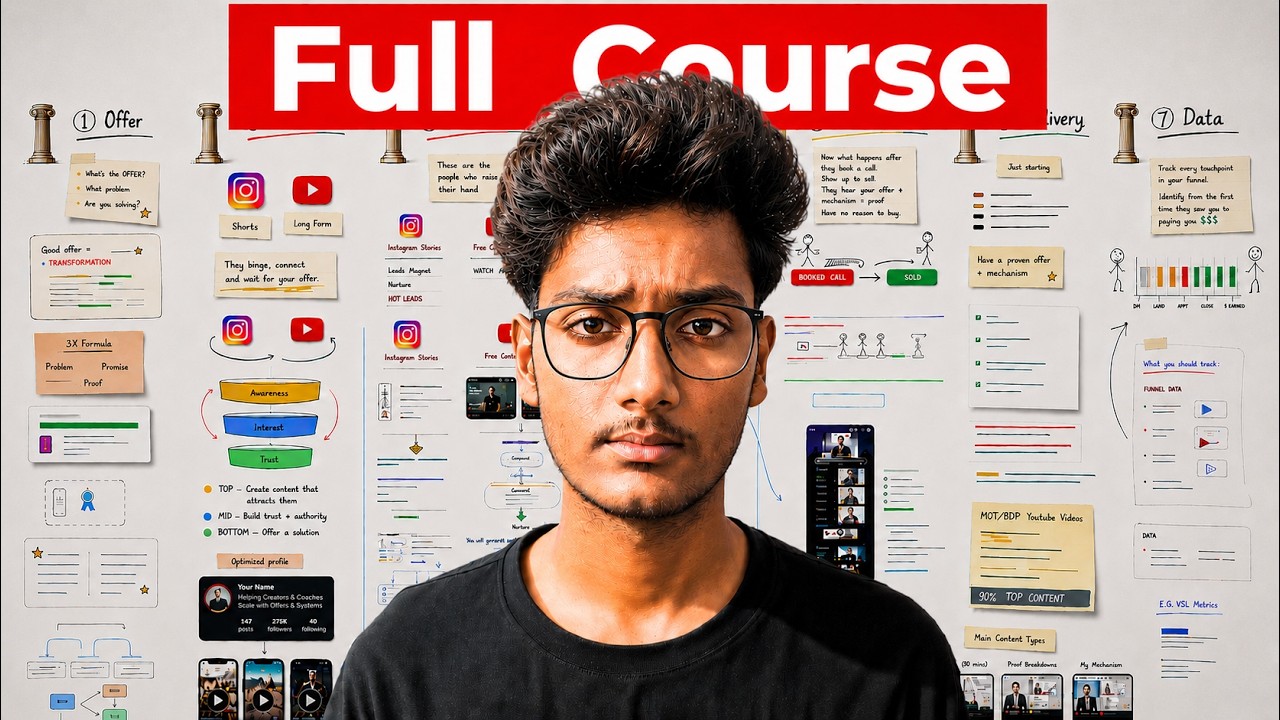
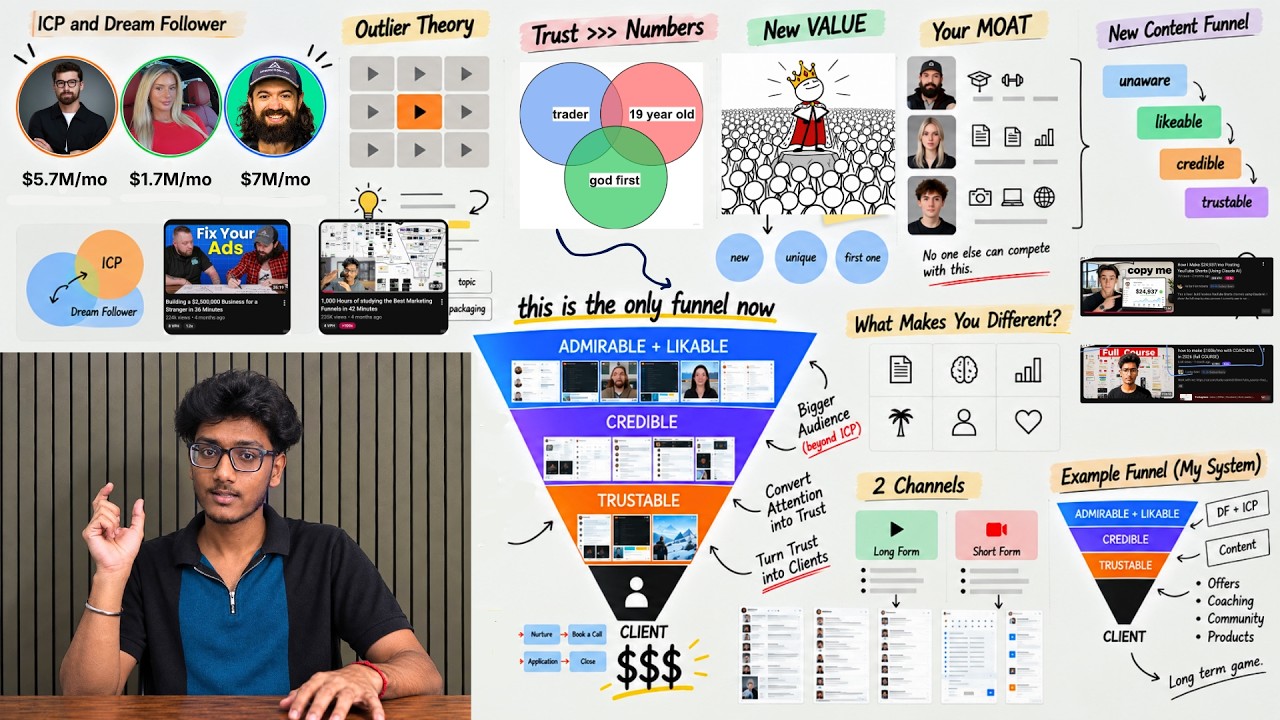
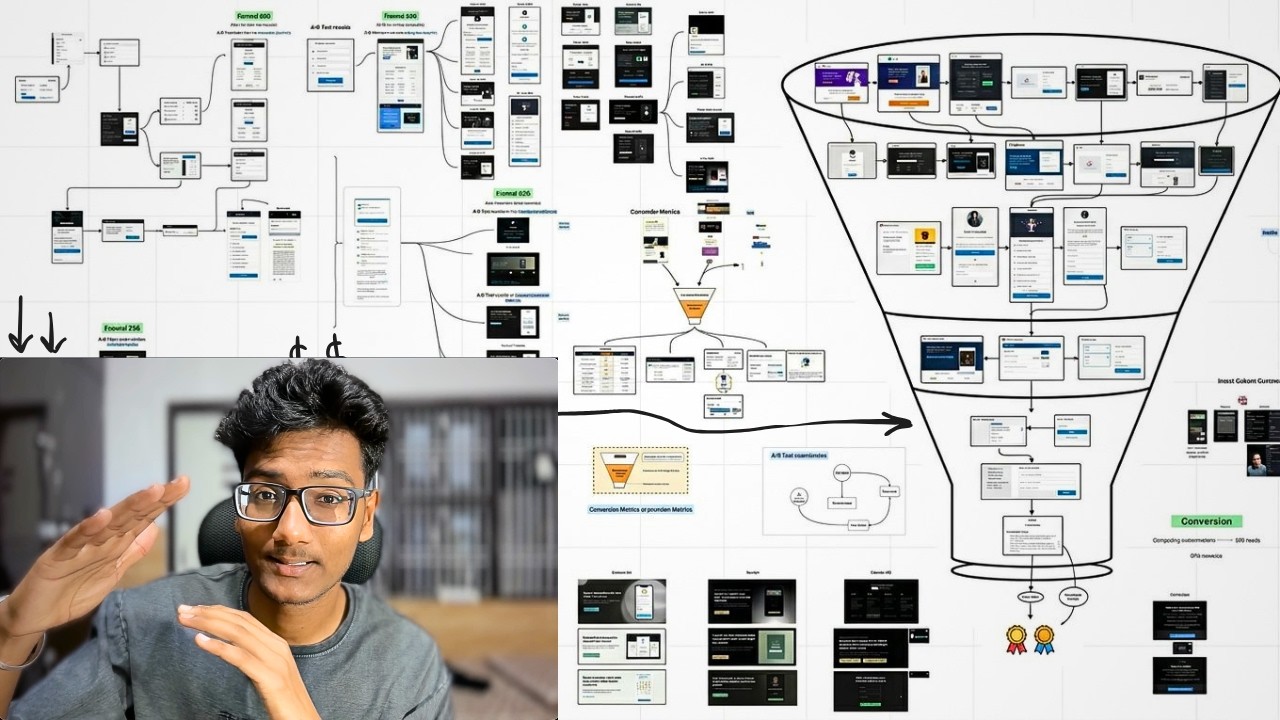
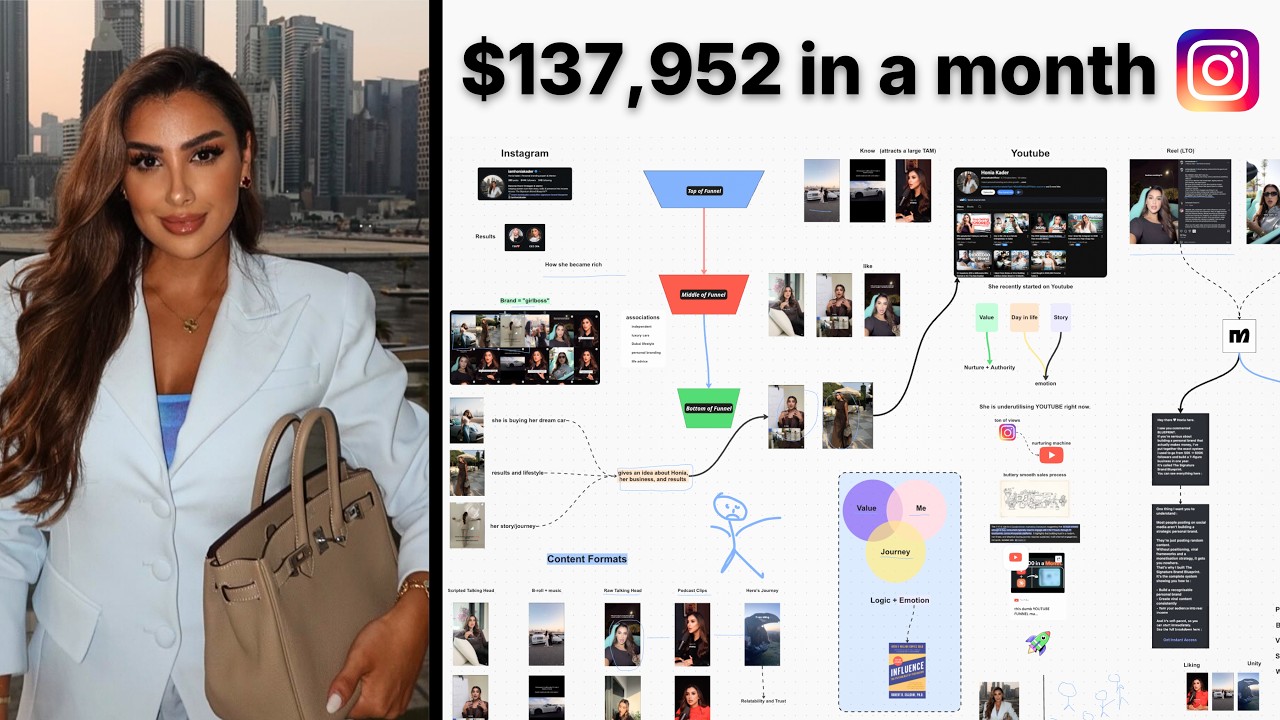
In this comprehensive 2‑hour course, Wasif Ali Khan walks viewers through a step‑by‑step system for scaling an information‑coaching business to $100,000 per month. He begins by explaining why Instagram carousel posts are the most effective content format for attracting high‑intent prospects, detailing carousel length, hook structure, and two primary call‑to‑action styles. He then shifts to YouTube, teaching how to turn a long‑form free‑course video into a powerful lead‑magnet funnel that positions the creator as an authority and nurtures prospects before a sales call. The course maps the client journey, shows how to package a 2‑plus‑hour free course, and outlines the two core funnel options – a Video Sales Letter (VSL) call funnel and a webinar funnel – with templates for landing pages, qualification forms, and follow‑up sequences. A detailed DM‑setting framework is provided for converting high‑intent Instagram leads, including qualification questions, gap identification, and permission‑based call booking. The sales process is broken into pre‑call objection‑handling videos, confirmation‑page scripts, email flows, and personalized sales conversations that segment prospects by demographic and pain point. Delivery models (Done‑For‑You, Done‑With‑You, Do‑It‑Yourself) are compared, and a scaling roadmap is given for moving from one‑on‑one coaching to group calls, community support, and higher‑ticket offers. Finally, the importance of tracking every funnel touchpoint is emphasized, with recommended tools (Trackeo, Viterb, Typeform Plus) and key metrics for VSL, DM, and webinar funnels. The course concludes with a call to action for viewers to book a one‑on‑one audit call.
Chapters
All you have to do now is execute because in this course I'll show everything that you need to scale your info coaching business to $100K a month. And all the strategies and frameworks that I'm gonna give you are either taken from 127 different coaching businesses that I've analyzed in the last 2 years, all making over $100,000 a month, or it's taken from my experience building my consulting business and helping my clients to start or scale their info businesses. Because in 2026, the game has completely changed. Everyone knows how to make an offer. Everyone knows that they have to make real and YouTube videos, and they also know how to record a VSL. And that's why the offers that used to literally print before are not working. The content strategies and funnels that used to crush before are not working. The entire market has shifted to a whole new level of sophistication, and this course is going to help you stand out from the entire market using new strategies, new frameworks for building offers, making content, and funnels. That's why I divided this course into 7 pillars. So here's what we are going to cover. Pillar 1 is offer, where I'll show you how to make an offer that will help you stand out from the rest of the market. And it's not just $100 million offers from Hormozi. I'll show you how to position it differently, how to build your unique mechanism, how to get the messaging right, and all the frameworks that you need to make an offer truly unique. Then Pillar 2, content. I'll explain the new way of making content, how to build your own category in any niche by using personal content and value content. How to find winning video ideas for Reels and YouTube videos, how to make titles and thumbnails, how to script your Reels, everything. And if you use the content strategies and the brand foundations that I'm going to give you in this pillar, you will never have to worry about getting high-quality leads. Pillar 3, I'll show you 6 different ways that you can get hot leads that are ready to buy from YouTube and Instagram. Then step by step on how to execute the DM funnel, the VSL funnel, and webinar funnels with all of my internal SOPs. And after this, I'll help you make your unique sales process using confirmation page, setter SOPs and email flows combined with personalized sales conversations so you can literally skyrocket your show rates and close rates. And in last section, we will go over data tracking and delivery. Before getting into the course, if you are a coach, consultant, or creator who's looking to start or scale their info coaching consulting business, you can click on the first link in description and book a 1-to-1 call directly with me where I will audit your business and show you how I can help you implement these strategies in your info business. Now, Let's get started. So let's start with the first pillar, which is offer. Now, what is an offer? An offer is simply what you sell, means your product, your services, or whatever you are selling, and how you communicate it. So it's simply how you communicate your products. That is an offer. Now, the thing is, why are we starting with offer in the first place? Because offer decides what we are going to do in the later stages, what type of content we are going to be posting, what platforms you are going to decide to post content on, what funnels you'll be using, what is the sales process. And every single thing that we are gonna do in the later stages. Now what most people get wrong about it, they start with making content, right? They think like, okay, let me build an audience first and then I can simply have an offer. But 80 to 90% of the time what people do is they end up building the wrong audience. They end up attracting low quality leads who never gonna buy the product or whatever they have to sell, right? Because our offer decides what is the intention of each pieces of content. And obviously with the strategies that I'm gonna give you, Offer literally decides everything in content, in funnels, and sales process, literally everything, right? And even how you get leads as well. So offer is the first and most important thing that you should be worrying about. If you don't have an offer, always, always start with an offer just because of the intention and clarity that you'll guys have once you have a good and proven offer in a place, right? That's why I say your offer decides if you fail or succeed in info coaching consulting space, right?. Because a good offer, it's literally a magnet to get high-quality leads and it makes your entire business 10 times easier, right? Now, what is a good offer? A good offer has two traits. First of all, it's packaging. The packaging is differentiated. And second, it's scalable. You can easily scale it, right? Because if you cannot scale an offer, it doesn't matter how good it is. You'll always be capped by your income. Maybe it's 50K, 60K, 80K, 100K. It doesn't matter, right? It has to be scalable and the packaging has to be differentiated. Now why the packaging has to be differentiated? So that you can charge premium. You don't have to fight for low prices. What people do is, uh, whenever they are starting or a beginner coach, or even they hit a ceiling on 30 to 50K a month, they just try to copy what other people are doing in the industry and especially what successful people are doing in their industry. They make the same offer, they keep pricing the same or almost the same. And once they start hitting a ceiling, or once they know, okay, I'm not getting qualified leads, they lower the prices. And this is the exact opposite of what you should be doing, right? Instead of lowering the prices, you should be charging premium and worrying more about the packaging of your offer. Because if you have a good packaging, if you have a differentiated packaging from the rest of the market, no one can literally compete you in terms of pricing. You can charge $15,000, $20,000, $30,000, for the same pricing. Obviously, your ICP has to be, you know, of that caliber. They have to have the buying power, but I hope you get my point, right? You can easily charge premium prices and it becomes your acquisition way, way easier instead of you just copy from your competitors and, you know, you just do whatever feels right. Now, how to make a differentiated packaging? Let's start with that. It is, first of all, what is packaging? It is how you communicate what you sell in a way, in a way that's unique, that's different, and that's better than everyone else. It has to be unique or different or better than everyone else. That's the entire point of having a differentiated packaging. It is to have a different thing from the rest of the market. That's how you charge premium. That's how acquisition becomes easier. Now, how to do it? So the easiest way you can do it is by using 3S formula. Now, what is 3S formula? It is how you communicate what you do in a way that solves one specific problem. So the first S is one specific problem in one specific way. Second S is specific way for one specific person. The third S is a specific person. So 3 S: specific problem in a specific way for a specific person, right? Uh, let me give a good example of it. So a good offer is something like e-com mentorship for supplement brands doing $50K a month plus., right? It is a good offer. And for this offer, how you package it, what is the specific problem you are solving? The specific problem is lower OS ads plus landing page optimization. This is the only thing that you help with, right? You are not helping them with everything. You are not helping them with the backend, with automations. No, you are helping them with marketing and landing page optimization. Specific person is DTC brands or supplement brands, in this case doing $50K a month plus. That is the specific person you are not going to let anyone, anyone in your mentorship besides this specific person, right? And the specific way that you solve this problem is anti-funnel retention loop and AI integration. Now, if somebody is in the e-com or dropshipping space watching this, they'll have an idea of what this is. But think of it like it is a specific method that only you provide in your entire market, specific mechanism or unique mechanism that we call in the info space, right? But why did we do this in the first place? What's the benefit of using this 3S formula or having a differentiated packaging or a good offer in the first place, right? All of it, we are doing all of this just to have leverage. And leverage is the most important thing in any business, no matter what kind of business you are doing, right? So how you get leverage by having a good offer with the help of differentiated packaging. So here's a live example of it. Your prospects have never seen this before, right? They don't know you, they don't know what you sell, and they literally don't know anything about who you are. You are literally a complete stranger for them on the internet, right? Now let's say they watch a reel, they watch one of your YouTube videos, or let's say you are running ads and they watch one of your ads. If you have differentiated packaging, if you are offering something that is packaged differently from the rest of the market, your prospects instantly think, okay, I'm curious, I've never heard of this before. What this guy is doing, you know, it is something different. I've never tried this before. And this is the actual point of doing this entire good offer thing, right? This is the actual leverage of unique packaging. It is the curiosity. Because what most coaches have, they have the same sounding offer. So let's say a trading coach, there are hundreds of thousands of trading coach and most of them are offering the same thing. Okay, I'll help you with trading, I'll help you with this, I'll help you with that. They don't have a unique packaging about their offer and you can always Always have a unique packaging no matter how saturated your market is, right? So this is the leverage, which is curiosity in their mind, because they've never tried this before. If they've tried this before, they'll not worry about it in the first place, right? They'll just skip past it. Okay, I, I know this guy, or I know this offer, I know this method, I've tried this before, or my friend tried this before, it's not gonna work out for me. And you don't want that at all. What do you want is curiosity. So even if they don't know you, they'll be interested to take that risk. And risk in that case is risking their time to jump on a call with your sales guys or yourself if you are doing sales call yourself, right? So this is the first thing, which is the leverage and the curiosity in your prospect's mind whenever they see a piece of marketing from your end. The second thing is specialization literally means premium pricing. If you are specialized in one single thing, you can charge $10,000, $15,000 for the services or literally 5 to 10 times more than a generalized person in your niche. Because again, I'll give you the same example, right? A mentor, helping e-com brands or e-com supplement brands doing $50K a month solve low ROAS ads and landing page optimization using entire funnel retention loop and AI integration is always, always going to win in the niche where everyone says, hey, join my dropshipping program or I have an e-com mentorship. So again, specialization basically means premium pricing. And the best part, that's where we are talking about the scalability. Every client you take will have the same problem., right? Because you are targeting one specific person and you are solving one specific problem for them. So the fulfillment is gonna be same. The fulfillment is same. You can easily standardize this. Your entire business becomes more easier because now the founder will have more free time to focus on marketing and sales, which is the most important part to grow your business, right? And let me give you a better example of a bad offer and a good offer. So, uh, SMMA coaching example, right? Let's talk about the bad offer first. A bad offer is something like, I help beginners start marketing agencies, right? No specific person and no specific way. You work with any beginner out there. There is no standard client journey because every client you take have different problems and they are different stages, right? And you are competing with the big monsters. If you are selling this offer, you are literally competing with Iman Gadzhi, right? And if you are just starting out or even if you are making $100K, $200K a month, you cannot compete with those big guys in terms of marketing, in terms of ad spend, in terms of media teams.. So instead of competing with the big guys in your space, what you do, you make a good offer with the help of unique packaging, unique mechanism, specific problem, and one specific person, right? So specific person can be moms working in 9 to 5 in tech companies. Specific problem that you'll be solving is don't be a commodity in AI era. This is the biggest fear of, you know, females working in 9 to 5 in tech, especially in 2026, because AI is taking everyone's job, especially in the tech companies, you can easily get commoditized in the tech space, right? And have more time with your family and let's say make 10K a month or more. That is the dream outcome. That is the specific problem that you are solving. Specific problem is you, you know, you don't want to be a commodity in AI era and you are always searching for something, how you can do a side hustle and how you can start an AI business. Specific way is you help them learn AI-first advertising. Sorry. AI First Advertising and learn Claude's deep market research and Higgsville creative system to help local businesses scale with ads. Now it is obviously made up, but I hope you get my point. You can clearly see the difference between these two offers. And let's say all of the bad offers or broad market offers, you can mostly charge around $2K for this because if you are going broad market, uh, you are basically selling a course and a community. But for a good offer like this, you can easily charge $5,000 plus, right? Easily without any problem, right? So that is how you make a good offer, right? And that is how you avoid a bad offer. Now in the packaging, as I said, uh, with the good offer, we have two traits, which is packaging and scalability, in which packaging is the most important thing. Now in packaging, the most important thing is your unique mechanism. Why your method or how you do things is different from the entire market. Unless you have a unique mechanism, you cannot truly stand out in a crowded market. And in 2026, there is a lot of competition in almost every niche that you can think of. So mechanism is what truly will save you from the rest of your competition. This is what will help you package your offer differently, because if you have a unique mechanism, you can package your offer uniquely. That will help you make a unique offer. So I hope you get my point, right? I hope you— I'm not confusing you guys, but yeah, this is how it works. Mechanism leads to good packaging. Good packaging leads to good offers and good offers always leads to good business, right? So that is how the cycle works. So mechanism is the root that you need to fix. Once you have mechanism, you'll have a uniquely packaged offer. So let's start. You have to explain why this is different and why everything they tried before failed. So there are 3 common ways that you can do it. First one is truly unique where you are doing something that is truly unique to you. Only you are doing in your niche., right? If your clients are getting above average results, find out what you're doing differently in your process, right? So first of all, when organic e-com brands came out, it was a new thing because everybody was doing the generic dropshipping, which is running ads, import products from China. But then organic e-com brands came in. Organic, first of all, they were only using organic content either in TikTok Shop or Instagram, and instead of stores, they were building brands. So it was a new thing and it was truly unique. Now what you would do once you do not have any truly unique method, right? You move on to claimed unique. Claimed unique, what you would do is simply find out the pieces in your process that get results, not different, but nobody's talking about it in the marketing. So find out the pieces in your offer that is getting the highest results, but nobody's talking about it in the marketing because mechanisms or unique mechanism or unique packaging, it's all about communicating it, right? It's how you communicate it.. So it is claimed unique. Everybody's doing it, or most people are doing it in your niche, but they are not claiming it as unique, right? So Profile Funnel for Coaches. Now people were always running Instagram ads, people were always running DM ads, but some growth operator came in, he did some changes in the deliverables, a little bit changes, and he called it, okay, now I'm running Profile Funnel for Coaches, and it was a claimed unique. And the third one is you just steal it. You take something existing and add your own unique spin on it and you name it something different. And this is what Brass Scales did, which is Freelance Brand Scaling. And it is the exact same thing as social media marketing agency, but he just renamed it as Freelance Brand Scaling and he is just crushing it, right? So truly unique, once if you have something truly unique in your method, claimed unique, if nobody's claiming it in your niche or your main competitors are not claiming it, And then third thing is you steal, you name it something differently, you add some deliverables here and there, and you just, you make it something different, right? It is not really different, but you make it something different. Now you have your own mechanism. How you communicate it? You have to explain two things at the same time whenever you are communicating your unique mechanism, because you gotta convince people that it is truly unique. So the first thing is why every method they try have failed. Why they don't work anymore and why this is something new. So a basic formula or basic framework of doing this, of communicating your unique mechanism, is you just explain all the other methods that they have tried in the past. You then explain the issues with them and why they fail. You give them the logical reasoning. Then you tell them the results of using those methods. Okay, what if you keep doing or keep using the same old methods or same old offers, right? Then you introduce your new mechanism and you just tell them the benefit of using it. And you do this all logically, right? Other methods, the issues with them, and then the results. Then you introduce your mechanism because now they'll, they'll be confused. Okay, I know this guy is saying truth. I know this method doesn't work, but what will work for me? I'm curious. I'm curious to know if there's any new thing that came up. And at the same time, you introduce your mechanism. And then you tell them the benefit of using it. So they can literally decide, okay, this is what I want to do, this is, this is just doesn't work anymore, right? And you can use this framework inside your VSL, inside your sales call, or inside any call to action that you are doing. Now let's move on to messaging. So in messaging, what you want to do is always sell what they want to desire, even if you are not selling something they want or desire. Now I'll tell you how to do it. So desire, it mainly has two parts, right? Your offer directly serves their desire or you bridge your offer to their desires. Now bridging is the important part because most offers, they are not directly hitting someone's desires or they do not want it, right? They need it, but people don't do what they need. People do what they want or people buy what they want. So what you do, you use bridging, you bridge your offer with their desire. Now a really good example of it is people always, always want more clients. But your offer is about ghostwriting. You ghostwrite for tech CEOs on LinkedIn and Twitter. So the bridging would be build your personal brand on LinkedIn and get high qualified inbound leads every week done for you. Now your offer is essentially ghostwriting. You'll still be doing ghostwriting and the desire that you are hitting is, you know, getting more clients inbound. So how you bridge it is you'll help them build their personal brand on LinkedIn and get high quality inbound leads every single week done for you, right? So this is how you use bridging because most of the time you cannot hit their desires directly. So you have to message it in a way that, okay, it's still your desire, you still want it, but it's just a new way or different way of doing it, right? So what we did from existing desire, we literally created new desire because now they want your offer because essentially they want more inbound clients. So this is how you do bridging and it's very, very effective, especially if you are not selling something direct that they can see results with., right? Now let's move on to the last part of our offer, which is guarantees. Now one thing I've seen is if you're already getting tons of leads, avoid this because guarantees alone won't save a bad offer. But if you really want to do guarantees for high ticket offers, you always have to do a conditional refund. You offer refund, but it is conditional and it is the best guarantees whenever it comes to high ticket offers, right? And the tricky part is the condition is things they need to do to get results from your offer anyways. So it is not even a guarantee. It is just to make sure that any low quality lead who's joining your program who don't want to put in the work is not taking benefit of the guarantees, right? So that is it about the offers. We have guarantees, we have messaging, we have the 3S framework, your unique mechanism, and the entire packaging thing. So all you have to do now is combine these frameworks and you will have a banger offer. So that is it about offers. Now let's move on to the next part. Before we get into the next pillar, if you are a coach, consultant, or creator watching this video and you want help to start or scale your info coaching business, here's exactly how I can help you. So first, we will start by building your banger offer. We do the market research for you, find out what your audience wants, build your unique mechanism, and position it uniquely, all done for you. Then we build out your entire content strategy and brand foundations for Instagram and YouTube. We will help you ideate content for Reels, and YouTube videos. So we will help you with ideation, we will help you with packaging, we will help you with posting. All you have to do is just record the videos. Then from the market research, we decide whatever funnel works best for your audience. We build your DM setting SOPs and we hire the setter for you as well and then execute the perfect funnel for your audience, whether it's a VSL funnel or a webinar funnel. And if you are in the scaling phase, we will help you with hiring, training, and managing the sales team. Then we build your entire sales process and the tracking systems. So all you have to do is just make content and deliver amazing results your clients and I take care of the entire marketing and sales process. And if you want to know more about it, you can book a call by going on to the first link in description. Now let's get back to the course. So next up we have is pillar number 2, which is content. And this is the most important thing after offer because this is how you are going to attract qualified buyers to your products, services, or whatever offer you are selling. And throughout the content strategy that I'm going to give you all the tactics, ideation, title, thumbnails, everything. We will focus more on trust and authenticity rather than some random views. Now obviously we will also be maximizing our videos for views, but we want intentional views because we are not trying to be the next MrBeast. Obviously you are a business person, you are a coach or consultant or a creator who want to start or scale their online coaching business. So you have to treat social media differently than a content creator, right? Like MrBeast. So the main platforms that we'll be using in this is We will use Instagram mainly for awareness to build our top of funnel and to get new people into our funnel. And we will use YouTube to build trust and nurture the audience that we are getting from first of all Instagram and then top of funnel YouTube content as well. And when you use them together, they literally become unstoppable because you are getting new people into your funnel on Instagram and YouTube is nurturing those people as well. And we also do a lot of repurposing. So let's say on TikTok, we just, you know, post Instagram Reels on TikTok as well. But all the other platforms, they are not that great for selling a high-ticket offer. So these are the main two platforms that we use. Now, before going on to the actual tactics and strategy, let me just show you some basics of content and how organic funnel works, right? So this is an organic funnel. This is a funnel for organic content, right? And starts with the top of funnel. Now, what is the top of funnel? Top of funnel is where you post a type of content which is only targeted toward building your awareness and your brand name. Like getting new people to know that you exist, you are someone, right? Because if nobody knows you exist and you are only posting value, value, value content, you'll never gonna grow your brand. And if you are not growing your brand, new people won't come to your funnel. So obviously top of funnel is very important because this is what gets new people into your funnel and getting new people to know that you are someone, you exist on this planet, right? And how you do it, top of funnel is just where you ideate script and format. Plus package your entire content just for views. We are not nurturing, you know, we are not telling who we are, the business model, we are not trying to sell them something. All we have to do is just maximize it for views. Then we have the middle of funnel. It is where you nurture and build the trust in the audience that you attracted through your top of funnel. So now middle of funnel where you give the value and you nurture the audience to build trust and also increase the buying intent and start building that buying intent.. So you'll tell, okay, this is what I do, this is how I do it, and these are some of my previous results, right? So you can also start building the buying intent and trust and nurture the audience as well, right? Then last stuff we have is bottom of funnel content, and it is purely made for conversions. It is where you make an ask and handle their objection if you are facing common objections in your sales call. So bottom of funnel is only for conversions, for making an ask from the audience, because now you attracted a lot of new people into your funnel. You have built the goodwill, the trust, and you nurture your audience from middle of funnel content. It's time to make an ask when it comes to bottom of funnel content, right? So this is how an organic content funnel basically works, and this is how everyone making money online with posting content, this is how they do it. Now, next concept is the concept of dream follower and ICP. And after learning this concept, it literally changed how I post content. So you can see my last video, it has over 200,000 views right now., and I just applied the exact same principle. Before that, I was getting like 1,000, 2,000 views, but this literally changed the entire trajectory of my channel, my business, and also how I post content as well. So what's the difference between dream, dream follower and ICP, and what is it in the first place? So dream follower is someone who has potential to become your ICP, or they aspire to be like you, and they like who you are, like your identity, and they have the potential to become your ICP. They are not your ICP right now, but they have the potential.. And then we have the ICP, which is the exact person that you sell to. If I give an example of it, so let's say you are helping traders implement your XYZ systems and make 10K a month consistent profits. So this is your exact ICP. And whenever you are making an ICP content, middle of funnel content, this is what you focus on. But who is your dream follower? So your dream follower is guys who wanna make money online. Now they are not your ICP yet, but they have the potential to become your ICP. And why we are doing all this? We are doing all of this to target a broader audience. So my last video, all I did is target the broader audience, not just coaches and consultants, uh, you know, who wanna start or scale their business. I target everyone who's interested in internet marketing. Now obviously the total addressable market for internet marketing is way bigger than coaches and consultants trying to scale. And this is the entire point. We will be making content for your dream follower only for getting more reach. While also attracting our ICP. Because as I said, if you only post content for your ICP, you'll never gonna get that reach. You will never gonna get new people into your funnel. And if new people are not coming into your funnel, you are not attracting new audience, your funnel is obviously gonna dead one day, right? It's not gonna be consistent and it will end up not working within 6 months, within a year, right? Because you constantly have to get new people into your funnel. So dream follower are those new people where we are targeting a broader market, larger market. As I said, guys who want to make money online, and this is who's your ICP, which is traders, you know, who want to make 10K consistent profits. So yeah, we are doing this to get more reach by protecting our ICP. And on Instagram, as I said, niche content doesn't make that sense as well because Instagram is not designed to nurture your audience. Now we have some ways that we can do it, but the algorithm is designed in a way it just, you know, dopamine hits, right?. So you cannot nurture, people are just scrolling 30 to 60-second reels. Maybe if they are interested, if they are sophisticated people, they will listen to your value video, but not that much. As I said, Instagram is not designed to nurture your audience, right? So niche content doesn't make sense there. You will end up with low reach and not growing your brand as well. But when you make content for your dream follower with ICP, so you just split it. Okay, this, uh, this piece of reel is attracting dream follower and now this is nurturing the ICP. You also grow your brand because you are targeting way larger total addressable market. And then you also nurture your ICP because you are also making middle of funnel content exactly for your ICP, solving their problems, their pain points and all. So this is exactly how you grow your brand and grow your business as well. And this is exactly how I went from 400 subscribers to 10,000 subscribers literally in a single video. And that video is at almost over 200,000 views because I targeted my dream follower who wanna make money online or who's interested in internet marketing, funnels and all, right? So that is DreamFollower and ICP. Now let's start with Instagram. Now Instagram, the first thing is an optimized profile. If your profile is not optimized, nothing else matters because when you are posting reels, when you are posting content, people will always come to your profile. So you have to design your profile in a way that acts like a funnel. So in optimized profile, first stuff we have is a clear and clean profile picture where they can see your face, where you, feel more approachable, and this is a really good example of it. Then second we have is a clean username. If you have any numbers or any stupid username right now, I suggest you change it ASAP because it literally decides how people perceive you. If you have like crazy 777-9850 or numbers like this, or you have The King or some cringe name, people are not gonna associate the authority with you, right? So you have to have a clean username as well. Then the next thing they see after your username and a clean profile picture is your bio, right? So this is a decent bio where he's saying full-time day trader, livestream trading for 3 years. It is basically explaining who you are and who you help. Then you also have to build some proof and authority in the bio itself. So before checking out your content, if they jump on your profile, they will have some context on who you are and what proof you have. And then a clear CTA that, hey, if you want to join my live trading for free, you can click on it. Now I made just a better version of it. Who I help exactly, helping traders make 10K a month consistently. Then 100+ students passed funded accounts, building the proof and authority. And then how Jack made $23K as a complete beginner. So this is more specific and it is making them more curious and gives them a reason so they will be more intrigued to check out this case study. Because I tell exactly how Jack made $23K as a complete beginner. If somebody who's your ICP jump on your profile, they will definitely be interested in this clear call to action that you made. So this is about the profile and all. Now let's move on to pinned post, and they are also a really great way if you use them correctly. They can literally act as your funnel, right? So in the pinned post, the first pinned post that I recommend is you make a My Story video is where you tell who you are, your background, and why you are doing what you are doing, any proofs that you have had, basically telling the story of your life, right? What you have done till now. What it does, it makes you a more likable and relatable person and more easy to approach, right? Because they have some context about who you are. They are not like, okay, this is a trader. They know who you are, what happened with you in the past, why you are doing what you are doing, and how successful you are in your ventures as well, right? So this is the first thing, and it is one of the most important videos that you can make on Instagram. And then second, we have the best case study. So whatever best case study that you have, you just pin it in the second post, and it builds the authority. It shows that, you know, you are competent, that you can get them results that they are looking for. Then we have the value video where you just pin a value video where you explain some concepts and all, or maybe you just, you know, tell your unique mechanism and explain your unique mechanism. It shows the capability and it also nurtures the new people that is, you know, checking out your profile. So first up, the My Story post is making you more likable and a relatable person because you are telling your raw story as a human, not as a coach, not as a trader. Then second up, we have the best case study where you are breaking down your best results. And third, it shows your capability by posting value content. So these are The 3 pinned posts that you have to get on your profile ASAP. After pinned post, we have highlights, and all you have to do when it comes to highlights is client wins plus specific case study breakdowns, right? So, uh, this is the highlights of Shelby Sapp, and she's doing more than million a month just from Instagram alone, right? And all the highlights that she has, you can see student wins, student wins, student wins, and student wins. Now to make it better, what I suggest, for your top 5 case studies, you just make story sequences. So you just explain the past situation of your client. You explain, you know, when they joined, the current situation, which is the dream situation of your ICP, and you explain the process in between them, like what they did. So 5 to 7 slides and just do story sequence for each of your best case studies. Because first of all, it's more specific and also they will exactly get to know the process and, you know, the transformation of your clients as well. It's gonna be better than throwing away these random student results and screenshots. Now let's move on to our content strategy.. But before going on to the actual strategy, first we have to know why people buy and why they buy from a specific person. So first of all, they don't buy coaching, they buy the coach. Now in 2026, the thing is information is available out there everywhere for free on ChatGPT, on Claude, on YouTube. You can find any piece of information that you want. So it's not that for information or for a few strategy or few tactics they are buying your coaching. They are buying your coaching for you, for your identity, for who you are as a person. And to do that, we have to understand why people buy. Now, people buy with emotions and they justify it with logic. That is the general rule throughout entire marketing psychology. They buy with emotions and then they justify it, they justify the purchase with logic. So we have to post content that must target both, not one. Now, the problem with one type of content is Let's say you only post value content. They will love the value, they will love your content, but the thing is they don't like you. They don't have any emotional connection with you. You are not relatable, you are not likable, and if that happens, they will not be able to make a decision. And same thing with the emotional content. If you make content that, you know, that's emotional— emotionally in the sense where you show that you are relatable, you share your story, you share who you are as a person, which is emotional content. But if you do not post any value content, you do not justify the logical side, it's not gonna work out. And the strategy that we will be using covers both the sections. So we will also be posting emotional content. They will like you, they will relate to you, and we will logically explain the unique mechanisms, the value that we have. So combined, this content strategy becomes unstoppable. To do that, we mainly have to post 3 types of content. First one is the first pillar, is where you sell yourself as a person, who you are. Now I'm gonna explain in depth, so don't worry about that. Second one is where you sell your mechanisms and the value that you have, the tactics that you have, how you do things, your frameworks. Your strategies. And last up is the offer— why they should buy your offer, why they should choose you over everyone else. So let's start with first pillar, which is selling yourself, showing who you are as a person. Now, first of all, this is exactly what differentiates you from the rest of the market, because nobody can compete with you on being you, right? Only you can be you. In this content, in this pillar, what type of content we are posting? We are posting the type of content which shows your personality, which shows about how you think about certain things. Maybe it's life, it's business, it can be anything. Maybe it's money. It shows your values, your beliefs, your morals, etc. And then it shows that you are a real human being, your morning routine, your hobbies, etc. But all we are trying to do here by posting this content is this type of content feels like a real personal connection. Because if somebody knows you personally, they like you, they relate to you, then they will move on to listen to you about the value that you have, the proof that you have, the frameworks that you have.. But unless you show your personality, unless you become a likable and a relatable person, nobody's gonna listen to you that much. Maybe they will watch your valuable videos, but then at the time of decision, they start comparing with you. They start comparing the prices because there is no parasocial relation between you and them, right? So by posting this type of content, what you are doing, first you're building infinite trust because they know you personally, they like you, they relate to you. No matter what your offer is, no matter what you are doing, they will definitely gonna buy from you. Not your competitors, right? And then shorter the sales cycle because if I know you personally or if it feels like I know you personally, then I don't have any doubt or objections in my mind, right? I'll literally be ready to pay whenever I'm looking for help, right? So this is why this pillar is what differentiates you from the rest of the market and this is what makes your audience choose you over everyone else in your entire market. So what happens is if you only post about value, value, value, you just come across the 102nd coach that tells, hey, here's the free value and I also sell a mentorship if you are looking for it, right? But what happens is you are just telling them the same thing, you are telling the same information, same strategies like everyone else is doing, and you don't stand out. And if you don't stand out, you have to compete on the prices and they'll not be able to make a decision. But if you post this type of content, you will build likability. They will like you as a person. And also the alignment in values and beliefs gets them to the decision that, okay, I'm going to work with him because you are likable. And they align with your values and beliefs that you have that you are sharing in the reels. And that's why I said you have to share your values, your beliefs, your morals, because people who have the same values, beliefs, morals are going to relate to you and they will think, okay, we are the same and I'm going to buy from him. That is how the marketing psychology work behind this type of content. So here are a few ways to ideate this content. So you have to ask yourself these questions. First up we have is my unique controversial take on my niche. What are the unique takes that you have that nobody else in the industry has on your niche? Then what do I disagree with in life and business? Now, obviously you don't agree with the same information that is out there. So what do you disagree with? What's my values and morals with proof, not yap only. So a lot of the time people just yap about, okay, this is what I believe in. This is what my values are. This is what my morals are, but they don't show it. So unless you show it, people are not going to believe in you because everybody can yap about being a hard worker.. But working 12 hours a day every single day for a consistent period of time, this is the hard thing. So you have to show your values and morals with proof. You have to preach what you teach. And then how do I handle bad situations, right? Whenever something emotional came up or something happens in your business. And then things like morning routine, your gym, meals, desk setup, hobbies, and what you do for fun. All those things that makes you, you, that makes you different. You have to just show it to your dream followers, your ICP, that hey, This is who I am as a person. You show personality. So this is the U pillar. This is where you sell yourself as a person. And we are doing all of this to build relatability because the more they relate to you, the more they feel understood that, okay, this guy really knows me, or I relate to this guy. Maybe we have same hobbies, maybe we have same beliefs about money, whatever it is, the shorter the sales cycle is. It's really easy, right? All you have to do is sell yourself, telling your personality. And these are the things that you can ideate on. Now, few mistakes that people make in this pillar is, first of all, this pillar only makes about 20% of your content. So it's not like you have to do it like 5 times a week or 10 times a week. So let's say if you are posting 7 times a week, like one reel every single day, you can do 1 to 2 times a week about this personality content. Then the second mistake and the biggest one is just fake relatability. People try to be relatable. People just fake it for the sake of personal content. People can feel if you are truly someone like whatever you identity is, whatever you are trying to convey. People just know if it's fake or not, right? So you cannot fake your personality for just the sake of personal content. And then the last mistake is making personality content that has zero connection with business. You don't have to do that. Indirectly, it has to have some connection with business. So let's say you are talking about your traits, and one of your traits is about working hard, right? Now obviously it is not directly related to money, but it shows your ICP. Okay, this guy is hardworking. And this guy is really competent. This guy is consistent. These are the traits of a successful person, right? And I'll show you how to find out exactly what to show in this type of content in the buyer meter. And this will literally take this personality content to another level. So that is it for U pillar. Now let's move on to the second pillar, which is mechanism plus value. This is where you show why your unique mechanism, like why they should go with it. This is where you do all the heavy educational content where I show my specific frameworks, systems, and the process for achieving the goals of my ICP. Few formats of it is the how-to videos, the value breakdowns, the free courses, etc., etc. Now there are a lot more formats, but I hope you get my point. These are just valuable videos where you show the mechanism and you give them the value. The goal here is simple, is to show your ICP that this person clearly knows how to do it. And when you combine this with U pillar where you show your personality, first of all they like you as a person, and now they also know the value and the information that you have is truly unique. So as I said, this content strategy is literally unstoppable when you use it correctly, right? And this type of content, the mechanism and value content, this is what builds your authority and nurtures your audience. So the U pillar builds the relatability and the likability. This is the logic section. The emotional part is where you show your personality indirectly related to business, and the logical part is where you show the value. So emotional part plus logical part Both are justified and it's gonna be unstoppable, right? And few types of content that you can do in the mechanism and value pillar. First one is the doctor's problem. Again, the same analogy, the doctor-patient analogy. All you have to do here is articulate their specific problems better than them. So let's say you start a reel not with a hook, but by exactly telling the problems that they are facing. Okay, so I know right now you are facing XYZ problem. If you do it, what happens is they feel deeply understood. Okay, this guy really knows me, this guy really knows my problem, so I know this is the best person to ask for the solution. This is what happens when you go to a doctor. When you tell the doctor, okay, hey doctor, I, I'm going through this problem, then the doctor tells you, okay, you are feeling this way, uh, you are having pain in this ankle, this muscle, and the patient subconsciously gives doctor the authority. Same thing here, they feel deeply understood and they subconsciously feel like, okay, this is the right guy to turn to whenever I'll be looking for a solution. So you have their attention and trust without doing anything special. No crazy tactics, no scripting, nothing. All you have to do is just articulate their specific problems, right? And the goal here is to describe your ICP's exact situation. And I mean exact situation. Few mistakes people do is just staying on surface level, like ChatGPT prompts. You ask ChatGPT, hey, what are the problem of my ICP? The thing is you can't know the specific problems of your ICP unless you do a market research or unless you know your ICP or you have tons and tons of student results and you know what goes on in your niche. So that's why there is an authority in this type of content. And the last mistake is pitching in this type of content. It is a diagnosis type of content, not a pitch content. So just stop pitching in this type of content. It's not gonna work out, right? And one simple hack that you can use is by just using their language, the words that they use in their niche or in their day-to-day life. This instantly increases the relatability because you are using their words. And more trust as well because they will again feel more deeply understood. Okay, this guy really knows me and my niche, whatever I am going through, by using their words or slangs that they use. Another type of content that you can make is just my way is the right way, where you logically explain why your method is the right method to do and why other methods are not working in 2026 or right now, why they are not getting results. Few ways to ideate this content is you just need to know what other solution your ICP is looking for and make videos that logically explains why these methods don't work anymore. And then you position your method as the unique mechanism, and then you show how your unique mechanism is truly unique and how it can help them get faster and better results as well. The last type of content that you do in mechanism plus value is living your dream life. You show exactly what life looks like after they start working with you, and you paint the clear picture of the dream outcome. But one thing that you need to take care of is make that tangible and desirable. So staying where they are feels like a loss and they will feel a lot more pain staying where they are because there is someone who's living their dream life by working with you, right? Few examples of it is if you have a B2C offer where you are selling to a more broad audience, a day in the life works really well for B2C and case studies and student interviews for B2B also works for B2C. And you can also just document the entire process where you are taking a client from A to B, from their current situation to desired situation. This will also show and paint a clear picture of the dream outcome of your ICP. And for the case studies in B2B, for example, let's say you are working with coaches like I do. All you have to do is just show one result of a coach who is living the dream life of an ideal coach, right? So a dream life can be making $30K to $50K a month while working 4 to 6 hours a day. And one of your client is doing it right now. So you use that in your content.. And that's how you show your dream life with more intention. What people do when it comes to lifestyle content is just they start flexing their car, but that's not gonna work out. You come across as another red flag guru who just doesn't know about anything at all in his niche. All he has is just a Lamborghini and his rented penthouse, and he's trying to sell you a course. So you don't wanna be that guy. You want to be someone who's credible, who knows what he's doing, and who's likable as well. So we combined both of these.. And now the last pillar and the last thing that you need to sell them on is your offer. Now with the you or personality pillar combined with the mechanism, these things become way easier and you just need to tell them why they should go with you specifically. So how you can do it, some few examples of the type of content that you need to post in this pillar is the competence type of content. And what I mean by competence is just value content. So solving their problems or specific problems that we did in the mechanism pillar as well., but this works in selling your offer as well. The next, after competence content, you can also do results content where you use results wherever you can, literally wherever you can. So what I do for my clients and my videos, uh, whenever I am making a top of funnel video, all I do is just share some glimpses of the results that we have in 5 to 20-second clips. So what I mean by this, let's say you are a trader and you are making a top of funnel video for your dream follower on how to make money online.. So throughout this video, in each 3-4 minutes that, hey, I made 100K last month with trading and one of my students made 30K in his first month, you just showing the proof indirectly even in top of funnel, middle of funnel videos as well. So what happens is you are hitting two targets with one piece of content, right? Because it's a top of funnel, so you will attract a lot of new people and you are also showing that you have proof indirectly, not directly. You are not hard selling the proof that, hey, this is who I help, this is how it happened. No, you are just telling, okay, this is one of my students, how much he made, just glimpses of it, 5 to 20 seconds, how much I made last month, how much my students did collectively last month, things like that. So use results wherever you can. And then differentiations, all you have to do is just tell them what makes your offer different and better from others. For that, you can also do offer-focused videos where you make specific videos comparing the business models. So let's say you are an e-com coach, then you make a video about the best ways to make money online in 2026 And then you compare all the business model and you finally present your business model as the way to go. So this is a good example of how you can sell your offer. But yeah, this is it. This is the content strategy that we are gonna be using. This was the basics of content strategy. So first up we have the U pillar where you sell yourself. Second, we are gonna sell them on the mechanism and value. Third up, we are gonna sell them on your offer. So this was the content strategy. Now let's look at the ideation. How are you gonna find viral ideas? Like, idea is basically what the reel is gonna be about from Instagram, right? And idea is literally what makes or breaks your entire reel. This decides if it's gonna get views or not, or if it's gonna get completely ignored by your ICP. So first off, we have to understand this pillar of importance. So whenever you are making a reel, the least important thing is the editing and gears. And this is literally the least important— what you record with, how you edit it. More important than that, we have the hooks and scripting. What hooks you use, how you script your reel. More important than that is the format. So format is basically how you deliver it, whether it's a podcast format, a talking head, is that you are walking and explaining something, you are green screen type of style doing something. So formats are more important than hooks and scripting, and idea is more important than formats as well. So idea is the most important thing whenever it comes to making any videos online. Same thing for YouTube as well. Idea is basically what's the video is going to be about. So from this pillar, we understand that ideation plus format is the most important thing in a reel. Now let's see how to find viral video ideas and formats as well. So to do that, I do what I call active scrolling. And active scrolling is basically scrolling but with mindfulness, right? We have an intention behind scrolling. What I do, I open Instagram on my desktop and then start scrolling. And what I look for is reels that has over 10K likes. That is the first metrics that I look for. And second metrics, once I confirm that the reel has over 10K likes like this one, I go onto the creator's profile and I look for the average views that he's getting. So let's say if his average views is around 50K to 100K and this reel has 1 million views, then obviously it's a 5 times or more outlier. You have to find out at least 5 times or more outlier. So yeah, This one was a really good example of a viral video idea. Now there are few rules before you start doing anything with this idea and format. First one, whenever you are doing active scrolling, you have to find video ideas or reels that you can actually execute on. Because the thing is, you are a business person and a lot of the time the reels that go viral are either about entertainment or either they are funny skits, right? But you cannot do that in your niche. So you have to be mindful about what video ideas that you are searching for, and they have to somewhat related to your niche. Let's say make money online, you are a business coach, then it has to be something related to business. Not completely related, it can be indirectly related, but it has to be somewhat related to your niche and format as well. Now from the viral reels or from the outlier reels, what I steal is the hook, what hooks they are using, the script structure, how they structure their entire video, and then the format as well, how are they delivering or recording the reel as well. And what I do, I adjust these according to my niche and audience, and we do for all of our clients. And this is the most basic way we ideate and form material. Like there are some advanced strategies, but I don't want to go into that. This is the only strategy you need, honestly, if you are trying to grow your personal brand and get more qualified leads. So this is more than enough. You do not need an overcomplicated strategy. So just to summarize, you have to find outlier videos or reels over 10K likes and 5 times or more outlier score. For outlier score, just go on to creator's profile and look at his average views. How you steal it is you steal the hook, script structure, and format, and you adjust these according to your own niche and audience. And then what you do, you slowly start building a list of winning ideas, viral formats, and hooks. When you do it for long enough, for a month or 2 months, you will have your own swipe file for winning ideas, viral formats, and winning hooks on Instagram as well, right? So what we have is a solid brand foundation from the content strategy that we are using, like the U personality pillar, the mechanism pillar, the offer pillar. And then on top of that, we are using winning idea plus viral format. So by doing and combining both of them, we will be making winning content. And that's how you make it. You have solid brand foundation and then you steal winning ideas and format. So even if you are stealing it, but you are adapting it according to your brand foundations, right?, and that's how you win in content. And here's a breakdown of some most common formats on Instagram Reels ranked on the ease of production, their virality, and the lead quality. So first up we have is the podcast format. Ease of production, it's not too hard, not too easy, it's moderate. Virality is also moderate because it really depends on the type of guest that you are bringing in. And then lead quality, lead quality is also decent. You are not going to get the best type of lead quality, but they are not the worst as well.. Then we have the Miro board split screen where you explain some complex topic in a split screen format where you are, you know, on the upper part of the screen and then on the bottom part you have the Miro board, right? So the production, it's not very hard. So for example, from this video I can literally make 50+ reels, Miro board reels. The virality is decent. Virality is not good because you are explaining complex topic and whenever you try to explain some topics or give like value dense videos in reels, they Do not go that far. The lead quality though is the best because you are very intentional with who you are targeting and what you are putting in inside this reel, right? So this is the best type of content that you can make if you are targeting lead quality. Then we have the green screen format, the reaction format where you react on something. This is the easiest because you are reacting it, you are not doing anything of your own. Virality is also very good because generally you will be reacting to some viral trend or viral opinion or whatever it is., but the lead quality is the worst because you do not have any authority or something to give in this type of content. Then we have the rapid fire where, you know, someone asks you questions and you answer it or you give some value in 5 to 10 seconds. For example, I make a reel about the best content formats. So someone will be telling me the content formats. Okay, what do you think about the green screen? I'll tell, okay, it's the easiest, something like that. I hope you get my point. Rapid fire, easiest to produce a very high virality, but again, not the best worst lead quality. It's kind of reacting because somebody tells you something and then you give your opinion. Then trending audio with B-roll. You have all seen those motivational videos. So easy to produce, again highest chances of going viral, worst lead quality. Then documenting content where you are doing short clips of documentation throughout your day-to-day tasks. So it is very easy to produce because you don't have to write a script, you don't have to do anything, you just have to do the task that you are already doing and record Then virality is decent because obviously most of us are not natural whenever it comes to hooks and all, but the lead quality is really, really good in this type of content because you are showing what you do day to day and it will be targeted more towards your ICP, right? Then scripted talking head, it takes more effort. You have to script, you have to format the entire video. Virality is also really good because you control the hooks and all the entire structure of the video and lead quality is the best. So if you are just starting out on Instagram, just start with scripted talking head. But yeah, these were the common formats that we use on Instagram as well. So that is it for Instagram. That is how you find viral ideas and formats, few common formats. And again, from these videos we get the hooks, we get the script structure, and we get the format, and then we are good to go. Then we have our content strategy up here. So that was it for Instagram. Now let's move on to YouTube. And YouTube makes the real cash. The main goal with YouTube that we have is Nurture the Instagram audience because on Instagram we are mainly posting content for our Dream Follower and top of funnel content. So we nurture the Instagram audience that we have and we also attract high quality leads on YouTube as well. So the main focus here is building trust before the sale ever happens. And YouTube is the best thing to do it because it is literally a nurturing machine, right? And there are two ways to dominate on YouTube. First one is micro niche that I'll be explaining today.. And second one is broad market personal brand. Now in broad market, you are talking to a larger ICP or larger total addressable market. But with YouTube micro niche, the thing is we are already doing it with Instagram, right? We are targeting our dream follower, posting more top of funnel content on Instagram. So on YouTube, we will go micro niche. Micro niche basically means we are talking to our ICP. And for high ticket offers, micro niche is the best strategy right now. So the thing is, even if you have a broad market personal brand,, you have to start a micro niche YouTube channel. So in the start, we don't overcomplicate it. We just have one simple micro niche YouTube channel. And then on Instagram, we use the strategy that I just explained. So in micro niche, what we are doing is we are talking to one specific person, one specific person in all of our videos, right? And it is the micro niche. So let's say this is your entire niche. You niche down 3, 4 times and you exactly talk to your ICP and only your ICP. And the niche is your ideal clients, right? And here are some few examples of micro niche channels that are crushing it. First one is Nero Knowledge. He is helping entrepreneurs and athletes manifest their dream life. Then Ruben Onuha, the dropshipping guys. Iman Gazi Business, it's his second or third account. Then Breast Scales as well. So everyone is using the micro niche method because the thing is for nurturing, all you have to do is give them value, just straight up value, no sugarcoating. No tactics and all, just value strategies and frameworks, the how-to type of content. And the thing is, it just works, right? Because the thing is, the trust is at all-time low. So the more value you give, the more state of information that you give, the better it is for you, the better it is for your ICP, because you are solving their specific problem for free inside your content, right? So for example, this is your ICP for making micro niche YouTube channels work. You really have to know this person in specific detail, right? You have to know what's their motivation, what's their goals, what's their pain point, what's their dream situation, and then you make a content strategy out of it. And everything you post must be around helping this person and this person only. No vlogs, no lifestyle, just making raw valuable videos. So for the content distribution, we make 50% top of funnel videos. So videos like this where we are still giving value, but we are making content for our dream followers. We know that we are going micro niche, but still we want the reach, right? Reach to get new people into our funnel every single month. So this was the 1,000 hours of studying the best marketing funnels in 42 minutes. This video is at over 205,000 views right now. So 50%, we post top of funnel content, but our top of funnel is still in micro niche. Then middle of funnel content, which is 30%, uh, where you give just value, straight up value, nothing else. And then bottom of funnel content is 20%, where you show your case studies, results, or you make an ask, something like that, like YouTube sales letter. So this is the content distribution distribution for micro niche YouTube channel. Mostly like half of the content is top of funnel to get new people, then middle of funnel and bottom of funnel to nurture and convert the audience that we have. And for YouTube, this is the holy triangle for YouTube where if you nail these 3 things, you don't have to worry about anything else. First one is the intro, and intro is the first 2 minutes, is the most important thing. Even in this 2-hour long course, the intro or the first 2 minutes of the video was super important. Then we have the ideation, which is basically what to post, same thing as the Instagram Reels. Then we have packaging, how you package your idea, basically the title thumbnail of the video. So for ideation and packaging, again, we will use the outlier method that I explained in the Instagram, but there is some different methods and different rules than Instagram. But before going into outlier, let's nail the intro. So for the intro, all you have to do is just give them a reason to listen to you, maybe by showing results, maybe by giving a pattern interrupt. And give them the end result. Okay, what they can expect by watching this video, right? These are the only two things that you need to worry about in the intro. You have to put 30-40% of the video's efforts on the intro alone. That's how much important the intro is, right? So for intros, you can also look up to videos that crushed it, and you can see how they are doing the intro of their video, where they are doing call to action. You can basically steal the structure of their intro. You just have to be unique. You give them a reason to listen to you, and then you give them an end result of what they can expect after watching this video, right? So that's it for intros. And for ideation and packaging, I use outlier method. And this is different. You see, the average views are 1,200, 1,256, again 1,200, 1,500. But one video is at 11,000 and another video is at 53,000. This is on a creator's feed, right? So whenever you search up my name, you go to my channel and you look at these videos. So obviously the video right here and the 53,000 view video are outliers because my average views is around 100 to 1,500, but they are 10x or 50x outlier of that. Now, what it simply means by an outlier, like what I mean by an outlier, so outlier basically means the audience find this idea very, very interesting compared to other videos. The packaging, the title and thumbnail is on point, and the average view duration and click-through rate are above average. That's how YouTube push your video to more and more people. So to become an outlier, it has to be way above average view duration and click-through rate compared compared to your other videos. So that's why we know the packaging is on point and the audience finds this idea very interesting. So for example, this is the video that I came up with, 1000 hours of studying the best marketing funnels in 42 minutes, and it was more than 100x outlier on my channel, more than 200K views. So what happens is even the big guys, if you talk about them like Richard Yu, he just copied the title thumbnail exactly, like the title thumbnail intro, and then after that other creator, he also copied either me or him, but I started this, then he copied me, and then he copied him, right? So this is how this cycle works. So what they did, they stole the title, thumbnail, and intro. And this is what your favorite gurus in coaching, consulting, info space is doing right now, because the thing is, it works. You cannot take risk with packaging, because if the packaging is boring, audience doesn't find the idea very interesting, right? On Instagram, it was idea plus format. Here it is idea plus packaging. So yeah, and I just showed this video to build some authority that I know what I am doing. I have done a few of these videos before on my channel as well, and this video alone took me from 400 to almost 10K subs within 2 months. So this is just to build some credibility with you right now. I was just joking. I just want to show that, you know, other people are also copying me, right? So I just want to show you that even the big guys, they are also using the same thing. How I steal like an artist, how I steal videos that has over 200K views with only 400 subs at that. So you have to understand the trend game. So somebody came up with a YouTube idea or a YouTube title and thumbnail which is an outlier. So for example, this format and this packaging, one millionaire student versus 10 college students, and we call it the 1v10 format. This was an outlier and he's the first guy that did it. Then what happens, people started copying him, and he was the second guy who copied one course seller versus 10 skeptics. Then Breskills was the third one who copied it, 9 to 5 workers confront an online millionaire. It is still the same format, packaging, the title is a bit different, but he copied it at the perfect time. And I'll tell you how to do the timing perfectly. And you can see the video and the format is same, but it is different. And this is what I mean by stealing an idea, right? So instead of stealing word by word, they just stole the format and packaging. They add their own twist on it, on the packaging, and the title is completely different as well. So this is how you steal. You do not just copy it. So just understand this and steal ideas, do not copy it. It, right? So the first one is efforts. So the thing is, the efforts that the first guy put in is this much, right? So let's say this is 100 unit of efforts and this is 0 unit of efforts. Now with the time when people start copying a viral format, the efforts decline exponentially, right? It's not that they decline linearly. All the hard work like packaging, titles, intro, format, this is all done by the first guy who make the outlier video. So he makes the 100 unit of efforts. But after that, the second guy He makes half the efforts but still get almost 70 to 80% of the results. And then 4th, 5th, or 6th guy who copied this format or packaging, he gets 60, 70% of the results, but the efforts right now is just 10 units. So I hope it makes sense, right? But the results, they decrease linearly. So what happens is with time, more and more people will start copying these winning formats and it becomes, you know, saturated and people don't find them interesting anymore. So the results from the video decline linearly, but the efforts decline exponentially. So what you have to do, we know that with time results from the video decreases. We have to come up with the perfect timing and the perfect timing where you match maximum results with minimum amount of efforts. So you have to be like the first 5 to 10 people who copy a viral format, and you can be the second one as well. But this is just to give you an example. If a video idea or a format is 3, 4, 5 months or even a year old, it's not gonna work now because it's probably used by all the people in your niche and in other finishes and people doesn't find it interesting anymore. Audience will already burnt out by this format. So this is how I steal video ideas. I have few rules in it. In your research, you have to find video ideas like this one, right? So Brest Skills, I guess, or the third or fourth guy who copied this viral format, and this video is at more than 1 million view right now on his channel, and I guess it's the most popular video of his channel, right? So this is how you steal like an artist. Here are few rules. First of all, don't look for big channels. They are completely irrelevant because big channels already have a subscriber base. So it doesn't matter if they got 5 million views, but they have 8 million subscribers, right? It's not an outlier. Then no more than 90 days old. So probably if it's more than 90 days old, it's already going to be used by somebody else in your industry or a lot of people in your niche as well, right? Always look for 50x or more outlier. For that, I use a tool called VidIQ. VidIQ. It's just a Chrome extension that gives you an outlier score of every YouTube video, right? And I specifically look for channels with less than 10K subscribers with no other traffic source. You also have to keep in mind traffic sources because, for example, if somebody just started their YouTube channel and the first video got 10,000 views, that is an outlier. But little did you know that they have 100K followers on Instagram and they posted a story about this video on Instagram. So it doesn't matter, right? The idea and the format and the packaging is not proven. It's that they have another traffic source. So you have to check that as well. And then I really like raw formats because see, anywhere in the industry, videos that have a raw format, they are getting more views, they build more authority, more connection with the audience than the polished edited videos. Then what I do is subscribe to niche channels and save ideas to a list. So my recommendation, like YouTube homepage always recommends me new YouTube outliers, unique video ideas, and you just train the algorithm on your needs, right?, right? And then sometimes you look in completely unrelated niches for new packaging and format. And I used exactly that to blow up. I look for some guy in fitness niche and that's when I come up with this idea. And in our niche, nobody was doing it. I was the first guy and it got 100K views. Now it's proven. Richard Yu copied it. It's again proven because it's worked well for him as well. The packaging, the format, the intro. So this guy copied it. This is how to find out perfect outliers for your YouTube channel. And that is it about YouTube as well. And that is it about the content strategy. And this is all done for you for our clients. Now, if you need help with implementing these systems or any of the systems that I showed in this course, you can go on to the first link in description and you can book a one-to-one call directly with me to see how I can help you implement these strategies or any of the strategies from this course in your info business. Hopefully you got an amazing value. You got a clear content strategy on what to post, how to post it. After that, we'll be getting on how to get leads from the content that you are posting. Now, next up we have is pillar number 3, which is hot leads. So what is a hot lead? It's basically a lead which, which has above average buying intent compared to normal leads, right? And how do we get these hot leads? Because we are posting or making that much amount of efforts in our organic content on Instagram and YouTube. So the leads that we are going to get are obviously way more high quality compared to cold traffic or compared to, you know, whenever we use lifestyle marketing or other tactics, right? But the content strategy that we use is perfectly tailored for getting hot leads, right? Now the thing is you have to make an ask from the audience because the audience doesn't know, they don't dream about your product or what you have to sell, right?, right? So you gotta tell them you have to make an ask, right? So there are 6 main ways that you can get hot leads from your content. 6 main ways that you can make an ask. 4 are on Instagram. First one is Instagram stories, and we are gonna go very deep in each of these. So first one is definitely Instagram stories. Second one is lead magnets. Third one is carousels. Fourth one is the middle of funnel and bottom of funnel reels. Then on YouTube, we have 2 main ways. First one is the free course funnel. Funnel, and second one is obviously middle of funnel and bottom of funnel YouTube videos, right? So let's start with Instagram first. And on Instagram, one of the easiest and best way to get qualified leads is Instagram Stories. And this is the best way to get high quality leads from IG because of the person who is watching your stories. The thing is, he's already following you, so they already know you, they already follow you, so they have seen your content consistently. And they are the best quality of people on Instagram to make an ask from because they know you, they have consumed some of your content. So there is some likability and trust factor also. And then you are making an ask on the stories. So I'll show you how to make an ask the best way possible. But the problem we do Instagram stories because everyone right now, they have a fake mask that they put on whenever it comes to content, right? They show the crazy numbers, they show the highlights, they show the wins. And in their world everything is perfect. And whenever somebody sounds too good to be true, there is always some kind of trick behind it, right? You already know it. So instead, instead of becoming perfect, or instead of showing our perfect life, what you do, you start showing your authentic side and it becomes a huge advantage and leverage for you because most of the people, they are showing crazy numbers, highlights, and wins, right? So what you talk about is real and raw lessons. And I'm talking about stories. So on stories, what you talk about is real and raw lessons. You talk about the losses that you have, you talk about your struggles, you talk about your personality, you talk about your story, and you talk about the behind the scenes, right? And by doing all these things, what happens is instead of putting a fake mask, you come across someone who's authentic, someone who's credible, and someone who's real to their audience, who's not, you know, making up something. So how to do it? There are 4 types of stories that is printing right now. And the first one is is the you story. And this is the most important one. This is what differentiates you from the rest of the market and rest of the competitors who's also doing stories. So what you do, you show your personality, you show your values, you show your beliefs, you show your morals, you show what's your vision. You tell them what do you want to do in life. You tell your hobbies, your interests, etc. Everything outside of business that shows that you are a real human because nobody can compete with you on being you. So So it builds that personal connection with the audience that is needed when you want to go one step further. Because if everybody is doing the same thing, it is what makes you completely unique and different. The thing is, people buy you, not your coaching. They buy your personality, your identity, or how you are, the kind of person you are, right? Not your coaching, because they can find trading coaching or e-commerce coaching or business coaching anywhere online. But why they choose you? Because of your personality, your values, your beliefs, your relatable hobbies, your interests, right? And that is why the value guys, most of the time they cannot stand out in a crowded market, right? Because everyone is telling the same information. So how you're gonna differentiate yourself? In that case, you just be you and share that with the world that, okay, I have a personality and this is what makes me a truly different human being. Now this is a weird diagram, but you get my point, right?. And it becomes really important when you have the same offer, when you have similar results and you are the only differentiating factor. So for example, when you love cars and you post stories about it, you attract similar people who also love cars, right? When you are hitting the gym every day, you are making them think that, okay, this guy's disciplined, he's hitting the gym every day. And you'll also attract people who are fit and who are going to gym regularly. Now you don't have to be a fitness coach. Even if you're a business owner and you're posting stories about hitting gym daily, like Alex Hormozi does sometimes, You attract people who are fit, who are going to the gym, who are taking care of their bodies, right? And then let's say one of your belief is hard work is not important and systems are, then obviously you're gonna attract people who are more inclined towards systems. And then let's say you love dogs and you post about it. So I hope you get my point, right? All you have to do is show your personality, your values, and whatever makes you human, whatever makes you different. And this is what makes you one-on-one because nobody can compete with you here. And this is how you stand out in a crowded market using Instagram stories. Now the second type of stories that prints out of these 4 types, they all work combined, right? It's not like you only have to do you stories and you only have to do proof or result stories. You have to combine them and make sequences every single day. So throughout the week you can split them out, right? So second type of stories is definitely proof and results. So showcasing that you can take them from point A A to point B. So this is their current situation, this is where they want to go. So you have to show them, not tell, you have to show them that you can take them from A to B, right? How you can show them? It's basically what results they can get if they work with you. You show your client results, your proof, or any personal win that you have had and make it relatable for new leads by telling the past situation of this client, right? So let's say you helped one client make $50,000 a month from organic e-commerce You make a story sequence about it. You tell all of their struggles, their limiting beliefs or whatever problems they were facing. And then what happens once they joined and what are the results right now? So you make it a complete journey. So the new leads that are watching your story right now, they can actually relate to the person and they can see that, hey, this guy actually knows how to go from point A to point B, in this case making $50,000 a month, right? For example, a student hitting record days,, student getting the dream car or clients getting the dream car, watches, et cetera. And then result stories made X within first week of working or one month of working or any type of client results that you have had. And doing this every week generates fear of missing out on the people who are watching your stories. They'll go mad about knowing how he's doing it because he's consistently getting tons and tons of client results, right? And that is what makes them curious and intrigued about booking in a call and knowing more about your system. So this is the second type of story. The third type of story is making the ask. But first, let's, let's go on to the fourth type, which is behind the scenes and documenting. What you do here is you show the real side of running a business. You show how your business doing, etc., how much money you made, how much you lost if you are doing trading like TGR. You show transparent number, your highs, your lows, travel, day to day, how you feel, reality checks, etc. And what you do here, the main goal here is to show the life, the desire, making X amount of money consistently, traveling, having the systems, students crushing, because this is what the dream of a business owner, right? Now you can apply to your niche, whether it's trading, it's e-commerce, or any kind of B2B or B2C coaching. So for example, one story sequence you can do is built new systems today for inner circle members, and you can make a whole story sequence about it. Then your first 10K a day. And then you can make one story about how you feel after hitting a record month, buying XYZ after a record month and bad months and how you feel about it. So basically you are documenting, but showing it in a way that shows the life that they desire because you are only selling your mentorship or coaching because you are living the life that they want. So you showcase the life, but in a behind the scenes kind of documenting way. One example I want to give you is, he's Nick Setting. Is crushing it with story sequences. So just take a look at the story sequence. Yesterday evening, one of our inner circle come to our house one-on-one, and it reminded of me something most important. Completely get wrong. It is the hook. Then he goes into the actual story. I'm not gonna go into that, but you can pause the video and read it. So this is the actual story, and this is what happened. And then at the end, he is also posting some results, right? So it is a good example of how you document your business life, right? And then here you showcase your personal life. Here you show proof and results. At last, 4th type of story is making the ask. And making the ask is at last. You don't want to come across the salesy guy who's always asking something from their audience, whether it's on stories, whether it's on YouTube videos. Sometimes all you have to do is just give, give, and give and build that goodwill and then cash out once you make an ask, right? So this is where you get them in your DMs or nurture them further. 3 types of story sequences you can do it is first one, you can make direct offer whenever you are launching something, increasing the prices or lowering the prices. The direct offer story sequences, all you have to do is just tell them, okay, this is my ideal client, this is what I do, these are my previous results, and if you want to work with me, DM me XYZ, right? Second type of story is discount or price increase, and third one is value and resources. I suggest First, just start with the value and resource story sequence, and then once they consumed your resource, they are more nurtured. Have your setter reach out to them by asking some questions, right? And this story, making the ask, do no more than once a week, because if you do it, your story views will gonna go down because people will think you are always asking something from them. So these are the 4 types of stories that print, and combined, as I said, there is not one type that you can do. You have to combine them all, and that's when you are seeing the effect, right? Because every story type is hitting different pillars psychologically. So here are some rules for that. Stories take a few weeks to take off, so you have to post stories 4 to 5 times a week, or you can do 7 times a week when you do Q&As and all, but 4 to 5 times is enough. 1 to 2 times you can just do lifestyle photos, right? Because you don't have to do sequences every single day as well. Then do things differently from your entire market to stand out. So let's say you are in a very crowded market where everyone is doing stories So first one, you have to use this U pillar more or this type of stories more so you can first of all be unique or stand out from the market and you also have to stand out in the value, in the results, in the authentic side that you are showing and then how you can execute it perfectly is first of all talking to one specific person which is your ICP. You don't wanna appeal to someone who's not your ICP at all, right? And the goal of the stories is to show that the objection are fake by showing the results, by showing the documentation, by showing the U-Pillar, by making stories about value, resources and all. You are showing that the objections that they have about your business are fake and how you can do it. One example is, so let's say one of the most common objection in your business on your sales call you receive is the price is too high. So you can make a documentation story, a client journey who thought the prices are too high., but within 2 weeks he made 3 times the price that he invested. So this story, what it will do, it will directly hit the objection that, okay, this is fake and if I do it correctly, I can make my money within a month. So that's what you want, right? And stories is for showing, not giving. You don't have to give value in stories because nobody's expecting value in stories and nobody wants to see a story, a long story, right? You gotta make them short, to the point. And interesting and curious enough. And sometimes you can use cinematic shots as well. It also helps increase your views, right? So this is all about stories. It is one of the best ways to get high-quality leads from Instagram because of the person who is watching your stories. Now next up we have is lead magnets. Now after stories, the other way that you can make an ask is by having lead magnets. And this also the biggest problem that we have on Instagram is nurturing is on Instagram, the average reel duration is 30 seconds, right? And you cannot expect to nurture someone by watching 30-second reels because according to a survey, I hope you all know 7-11-4 rule. Any client who wanna buy from you at least needs 7 hours of your content. Now it is not necessary, but around 5 to 7 hours they have to consume before booking a call with you. So 30-second reel, they will take years to complete the 7 hours of content required, right?, right? So the thing is they haven't consumed enough content from you to take that risk. And in this case, the risk is risking their time to jump on a call with your sales team, right? So they haven't consumed enough content from your side. They haven't got enough value or they haven't nurtured enough, right? So all you have to do is give them the best stuff that you have via stories or, you know, via reels. We'll go into that and prefer long-form type of content because as I told you, 7 hours is required, 5 to 7 hours. So we gotta fill the quota of 5 to 7 hours. So when we do story sequences for our clients, I prefer 30+ minute YouTube videos. So whenever my clients make a YouTube video about 30 minutes, it's a free course, or you know, it's a step-by-step guide to something that can solve an actual problem of our ICP on Instagram, then we just make a lead magnet post about it. Same thing with the free course as well. But the only thing that you need to worry about is it must be very good because people will judge you based on this. People will literally judge your paid stuff based on the quality of lead magnet that you you guys are giving them. And one hack I use is I show a lot of proof, indirect proof in these, right? So we are not hard selling them something. They don't feel like, okay, this guy is just literally yapping about his results. But inside the 30-minute video, 5 to 7 minutes at different timestamps, we just plug in our case studies. We just plug in our results, the best case studies that we have inside in the free course, inside in 30-minute YouTube videos as well. So it is hitting the two pillars. First one, it's building the authority. And also credibility as well, because we are also telling the results. And how we promote these lead magnets? First one is obviously story sequences, and the call to action is simple: DM a client for this training, or DM XYZ for this training, right? Then middle of funnel reels that we talked about in the previous pillar, content pillar. So something like you make a reel by talking about the pain points, by talking about the problem that your ICP is facing, and in the end, the call to action is comment 100K for a free funnel training. Right? So that is how you promote your lead magnets. And it is again one of the best way to nurture your audience on Instagram because there is literally no way you can have your Instagram audience consume 30+ minute YouTube videos on Instagram because Instagram is not designed for that, right? You gotta take them off the platform and for that YouTube is the best. So lead magnet, try to get them a quick win or an aha moment so the sales cycle becomes very short.. And sharing your internal SOPs also works really, really great because you are giving them a snippet of what it looks like to work with you. Now, this is also a tip that I use for our clients a lot. We just give them our internal SOPs that, okay, it is the strategy that I use. It's just a part, right? Not the entire stuff. So they can get a feel of what it's like to work with us on paid mentorship or coaching, right? So this is the lead magnet. Next way we have is carousels. Now, carousels is best type of content on Instagram when it comes to selling. And I guess this is the only type of content which lets you nurture your audience on Instagram itself. But first, let's see why we are doing carousels in the first place. So the problem with middle of funnel content or the lead magnet reels, first of all, the people watching those reels, they don't have any intention because reels get published to non-followers first. And the problem is if it didn't perform first to non-followers, Instagram won't push it that much to followers as well. But the best thing with carousels is carousels first pushed to followers.. So only people who follow you, they are following you first of all for a reason because they have some problems and you can solve them. And then the intention behind carousels, because if somebody is watching 30-second reel, they may be interested, they comment you the keyword. But if someone is reading 9 pages, they are scrolling page after page after page, it shows the intention. The person reading 9 slides is definitely more sophisticated, more qualified, and more ready to buy than the person who watch your 30-second reels.. So it's all about the intention and the mechanics of Instagram. So again, as I told you, it first pushed to followers. Most of the followers that follow you, they are following you for a reason. Whenever you are selling something, making a call to action, carousels is a win-win situation to do. Ideally, a carousel is 8 to 20 slides long, and it can be about a transformation, a case study. It can be about value content, a how-to, a list, or it can be about the results or achievement that you have had. Now the thing is why this works. So shown to the followers first, it means it gets you more engagement and more consumption of the carousel that you posted. And the more consumption that you have on high-quality content, it positions you as an authority and it also increases the trust as well because you are increasing the consumption on high-quality content, not an entertainment reel or not a lifestyle reel or motivation reel. On actually value content, transformation, or case study, result and achievement type of content. So that's why carousels works best for these types of content. And the people who trust you more, who have consumed your carousels, they are more likely to follow the call to action compared to a guy who don't even follow you and then you make a call to action to them, right? So the two types of call to action that you can make on carousels, first one is very common. Hey, if you want a resource about your problems, comment just XYZ in the last slide. And call to action too. Hey, if you want to implement the same system, just DM me system and see how I can help you basically getting them in the DMs and then your DM setter takes on from there. So it's very direct whenever you are doing a case study or results breakdown, I prefer this. And whenever you are doing value content, I prefer this type of call to action. Now the next problem you face is how to make carousels that prints. Now carousels also follow a very similar structure to Reels, but it just think of it like like you just post the script of Reel in a written format. So step 1 is obviously hook, because Reels also starts with hook, carousels also starts with hook. You grab their attention, and there I mean your ideal client profile's attention, because again, as I told you, it gets pushed to followers first. So you have to keep that in mind as well, and you have to tell what it is about. And you can also use results and number-based hook. They always work better rather than a text-only Step 2 is the body. It's where you deliver the promised value that you did in the hook section. You delay the payoffs until last slides because you want to keep them scrolling through the slides purely because you want more consumption and you want them to read the call to action. And then in the ending, you do a summary in 3 to 5 sentences, and then you do the resource or DM call to action, whatever you want to do, right? And few ideas that you can use for carousels right now. First one is your personal story and transformation. In which you start with who you are, you explain your past situation, your background story, right? What happened in your life before. Then you explain your current situation, the dream life that you are living, what the aha moments were. Basically, it's your entire life story in 8 to 20 slides, and then your current situation, and you tell the aha moment, like how you were able to do what you were able to do. And then you did the summary of here's what I learned. So that's a really simple one, and you can also pin this on the first pinned post or second pinned post on your profile. So whenever somebody new comes in, they can literally read your entire life story. Second is telling about your unique mechanism. So you introduce your method as a new opportunity. You use your authority or someone else's authority. If you are not an authoritative figure in your niche, you can also borrow the authority from someone else. Like XYZ did this and I use the same stuff, something like that.. And in this you can also use trends like when AI comes in or you know, when OpenClo comes in, you can literally do carousels about Claude and OpenClo, stuff like this in any niche, right? You can do comparisons as well. So as I said, comparisons to make your method the obvious choice. This is the main role of unique mechanism carousels. Third one is client results breakdown where you start with numbers, you explain your client's past situation, what problems they were facing, what was their past situation. Then the current and dream situation that they are living right now, which is your ICP's dream state. The unique mechanism they followed, basically your method. And then you do a direct call to action that, hey, if you want similar results, just DM me the word results and we will take you from there. Fourth one is list. List, which is also very good for reach and nurturing. And I hope you have probably seen, uh, these kind of carousels before. 17 things I learned as an 8-figure trader.. You can also share your lessons and experiences as well. Something like 10 changes in X industry in the next 12 months. These are all the different kind of formats of carousels that you can try. But yeah, list also, but list format also goes really, really, but yeah, list format is also good for reach and nurturing as well, right? Last stuff we have is financial breakdowns, which is, you know, how much I made as a 7-figure e-com brand owner. And breaking down your investment. This is also really good for reach if you are making good amount of money. Obviously, 2 times a week is the sweet spot for carousels. Don't do more than that. 5 times a week you can post reels, then 2 times a week you can do carousels. It's done. 5 reels and 2 carousels. And here are some examples, right? This is from Alex Omogi. He recently started doing it way more. So the hook is, I run a DTC skincare e-commerce brand. We do 10 million and we wanna get to 100 million. So it is the current situation, it's the desired situation. As I said, you can use numbers in hook as well. And then on the second slides, they start with the problem and value and it goes on and on and on, right? So this is how you use carousels and these are all the ways that you can make an ask on Instagram. Now let's move on to YouTube. And on YouTube, there are two main ways that you can make an ask or get high quality leads from the content. First one is a free course funnel that I'm going to explain right now.. And after that we have middle of funnel and bottom of funnel YouTube videos, right? So let's start with free course funnel. Now the thing is, it is the best way or the best thing you can do on YouTube to get high quality qualified leads, right? And the video that you guys are watching right now, this is also a free course, right? I'm gonna use this as a free course funnel. And from this video alone, I'll get tons and tons of high quality qualified leads booked in my calendar month after month because I'm gonna use it as a free course funnel, not as a standalone YouTube video.. So here are a few examples of YouTube courses that crushed it. First one is How to Build a Personal Brand full course. It's a 6 hours 22 minute course. And then again, this trading course from FXLXG. Now the thing is, it is a beast nurturing machine, right? It literally like this video is about 2-3 hours. So just after watching this video, you'll be way more inclined to work with me instead of watching 3, 4, 5 YouTube videos or 60-70 reels on my Instagram, right? Instead this video alone will do 80-90% of the nurturing. It's best for casual viewers because people who watch your videos casually, they can get nurtured from this. New YouTube viewers, your Instagram audience, your core viewers, people who are on the fence but they haven't bought from you, all these types of people, all they want is more nurturing. Like the solution for these problems are more nurturing and free courses are the best way to do it. What it does when you make a free course like this, this, or the one that you are watching right now, first of all, it positions you as an authority. People get to know how much you to know how valuable your strategies or tactics are, right? So it positions you as an authority, build massive goodwill with the audience that you have, and you stand out on YouTube, right? Because how many times you have seen a 10-hour trading course on YouTube? Not much, right? So obviously you're gonna stand out from your competitors. Same thing with this guy who, who made a course on personal branding. So it helps you stand out in the rest of the market and it gets you pips, it gets you paid in full because the leads that you are gonna get from these videos, these free courses are the best quality leads leads out there from organic content, right? And you will generate— I am guaranteeing you, once you do this free course format, you will generate more leads than you ever expected. So let's start on how to make a perfect free course. So you have to start with mapping out your client journey. Now, what is a client journey? So for example, this is the starting point. This is where your ideal client currently is. Now, this is their dream situation. This is where they want to be. Throughout this journey, journey, like it is a journey from point A to point B. There are multiple steps, multiple points of knowledge, information, and multiple strategies, tactics that they need to know to get to their desired state or to get to their goal. So what you have to do is you just take a portion of it and you package this information into a 2+ hour course. And I always recommend if you are doing a free course, make it more than 2 hours. It will actually benefit you on the nurturing side as well. And you will also stand out in the market. And you can use it as a lead magnet on Instagram as well, because when you say, hey, I made a 3-hour free course last week and here you can watch it, your audience will be way more excited. So package this information, just a part of it. You don't have to give out like the main question of people is, uh, if we give out everything, why will people gonna pay me? So all you have to do is map out the journey, take a part of it, right? And package this information into a 2+ hour free course. But the thing that you need to take care of is you have to give them enough info so they can get a small win. That is the main goal for this entire course. The main goal is to get you a small win, whether you start implementing story sequences, whether you start making Instagram Reels with the new content strategy, or you implement a VSL funnel after watching this video. My goal is to get you one small win because the thing is, if you are a complete beginner and if you made your first sale from e-com using a free course, guess who you're gonna turn to when it's time to buy a $5,000 5K or 10K mentorship, obviously it's me because my value or information has already proved. You already trust me because I have given you enough value in this free course. So for example, if you are an e-com coach, you can make a course which is just enough to take a complete beginner to make them first e-com sale, right? And this information must be valuable and actionable. A lot of people, what they do just for the sake of making it longer, what they do, they talk about a lot of fluff which is not actionable. Actionable. So the thing that you need to keep in mind is the information you have inside the course must be valuable and actionable as well because you wanna give them a small win ASAP. Or you can give everything away if your offer is done for you based on proper implementation. For example, my business, I help coaches and consultants start or scale their coaching or consulting businesses. So it's a done for you offer, right? That's why I'm giving almost everything away in this free course. So if your offer is also done for you, let's say you are an agency or service-based business, or let's say you are a coach who has like 70-80%, it's done for you. You can give everything away and you charge for the implementation. And that's how I do it, right? So this is how you make a free course, an actual valuable free course that standouts from the market, positions you as an authority. Now this is how you can use it as a YouTube sales letter. And yes, this video, this course that you are watching right now, I'll use it as a YouTube sales letter as well. So from the videos that I'll be posting now on, Wasif Ali Khan, what I'll do in every single video that I post, I will link the same course like this exact video in every single video that I post. So what will happen is I'm gonna redirect traffic to this course from every single YouTube video. So you keep posting new videos, it can be top of funnel, it can be middle of funnel, not bottom of funnel because in bottom of funnel videos you are already making an ask or doing something, call to action. But in any top of funnel or middle of funnel video, what you can do is just introduce this free course that, hey, if you are this person, I have posted a 3-hour course to help you with XYZ. Just watch it, first link in the description. That's it. And the views on this will eventually go up. What I do with my clients is promote this free course in the intro of every single video, which is in the first 90 seconds. The call to action is very, very simple, which is, hey, last month I released a 5-hour free course on XYZ. So if you are my ICP looking to get to your goal, then go onto the first link in description and you can watch it. So that's how you can literally use it as a free course funnel. And this is the exact funnel that Iman Gadzhi used to generate $20 million from a single video that he called the YouTube Sales Letter, right? This is the exact same funnel. So we are taking that framework and we are making it way better than it was. And here are some tips to make your free course even better. So you have to nail the intro because it's a 3 to 4 hour video and most of the people are never gonna watch a 3, 4 hour video unless the intro is perfect, right? I have a video, YouTube video on my channel which has over 200K views and I did not even expected that. But if you watch the video, it is very intriguing and authoritative. It gives me the authority and it gives them the reason to listen to me for straight 40+ minutes, right? So that's why you have to nail the intro. You can script the intro as well. That's what I recommend to our clients as well. We script the intro. Intro, but the entire course is either on a Miro board or it's in a whiteboard. We just freestyle the course, but the intro is very well curated, right? So what is in there and what you can expect after watching this video? So you gotta tell them the end result and why they should listen to you. And you have to have a perfect structure, like step by step. This is step 1, this is step 2. And then you can have direct CTAs every 30 to 40 minutes inside the course. So before getting into the actual video, I have a call to action that, hey, if you are a coach or consultant, You can work with me to start or scale your info coaching consulting business. And I have some indirect CTAs as well because these videos are purely made to nurture you, to sell you something. And then as I said, indirect CTAs means proof and done-for-you elements as well. And then first CTA before the sauce. So before you go into any value, just do a call to action that, hey, if you are my ICP, that's how I can help you, right? Then you gotta have a clear title and thumbnail. And in the title and thumbnail, you have to tell that it's a 3-hour 4-hour, 5-hour free course. So they can know that, okay, it's a free course. And in the description, in the description on this video, you will find only one link, which is my calendar link. And if you are my ICP, you can book a call with me. Just don't confuse your audience. It's a VSL. It's literally a video sales letter, but it's on YouTube. So we are making it a bit different than a VSL. So do not confuse your audience. Only have one link of your product that you wanna promote through the free course. Course. So that's it about the free course, and it is again the best thing that you can do. You can literally make a funnel out of it, and this is the exact same funnel as I said that help people make millions of dollars from a single video. Now next up we have is middle of funnel and bottom of funnel YouTube videos. If you combine them, they should make about 50% of your YouTube content. 50% is top of funnel, which is attracting new people from your niche to your funnel, and 50% is nurturing them and making an ask from them, telling your student results, client results as well. And this content turns a complete stranger into a lead, then a client. So as I said, 50% new eyeballs, 30% you nurture them, 20% you convert them. And this is the best structure that you can use right now to get consistent, high-quality nurtured leads from the micro niche YouTube funnel. So the 30% middle of funnel YouTube videos that we are posting, here are the main content types. First one is just straight up value because it's a middle of funnel, we gotta nurture them. So value videos for 30+ minutes, breakdown videos just like this, but shorter than this, uh, 30+ minutes, sometimes 40-50 minutes as well. So for example, this video, it was meant to be middle of funnel video, but I packaged it in a way, right now it's at 200K views, right? And it took me from 500 subs to 10,000 subs in just a single video. It's all about packaging on YouTube especially. And this video here as well, it is also middle of funnel video. I'm just explaining the YouTube funnel that's working right now. Then I do proof breakdowns. So in this video, it was like, I guess, 3, yeah, 5, 6 months ago at this point. And I just showed how I closed 4, 5, 6K client from YouTube videos alone. I don't do anything just beside making YouTube videos. Then my mechanisms, how I do things for my clients as well. And then the last format you can use is mastermind and teaching. It'll also help you build authority and credibility because it, it's just subconscious when someone is teaching you and a lot of people are listening, It just gives them the school frame where, you know, you were in school and the teacher used to teach you and then you have to listen to the teacher and you think like, okay, this is the best person in the world, right? So audience are watching these videos are definitely looking for a solution. The main goal of these videos is to nurture them. It's not to get views, it's not to convert as well. The main goal is to nurture them and also positioning your mechanism as the solution they need because they've already tried a few things in the past, they haven't worked out. So you have to present your mechanism as the new way way as the better way, right? Now for the 20% bottom of funnel content, it is purely for conversions and proof breakdowns. You can also do like proof breakdowns in this as well. It can also count as a bottom of funnel content. And then student interviews, right, where you analyze your calls and you find out where the trust is lacking, what are your ICP's main concerns, objections, and fear. And then you make it tailored, like you make student interviews tailored to these objections, concerns, and fears that you are facing,, right? And then based on that, you have specific questions in this student interviews, not just AI, right? You cannot just ask AI that, hey, I'm doing a student interview, give me the top 5 questions that I should ask. Instead, just analyze your calls, find out these things, and have specific question based on what you find out in these sales calls, right? Because the thing is, they just need enough reason to act or buy. And these videos are exactly doing that, right? They are giving them the proof. You can also do offer-focused videos, which is, you know, Iman Gadzhi has done a lot of them in the past. It doesn't feel scripted or a VSL, but it has a specific structure that will eventually lead to the offer, that will eventually position your unique mechanism is the way to go, right? So in this example, best online businesses to make 10K a month in 2026, Iman is comparing the most popular business model and showing why his business model is the best one. Now the only problem with bottom-of-funnel content is the videos that you are making is not interesting, like the proof breakdowns, the student interviews, they are not interesting, right? So if you do too much of it, it'll burn out your audience and it'll eventually lead you to low views, low trust and all because people will be like, okay, this guy is always trying to sell me something. If you try to sell all the time, it's not gonna work. And if you try to just entertain all the time, it's not gonna work as well. So you have to maintain the perfect balance. But yeah, these are the main ways on YouTube how you can get leads. And if you use these 6 mechanisms, you'll get tons and tons and tons of leads that you don't even know what to do with. You'll have full calendar of sales call, high quality people because of the type of content that we are posting and how we are getting those leads. And this is all done for you for our clients. Now if you need help with implementing these systems or any of the systems that I showed in this course, you can go onto the first link in description and you can book a one-to-one call directly with me to see how I can help you implement these strategies or any of the strategies from this course in your info business. But yeah, that's it for this pillar, hot leads. Now let's move on to the next one, which is the funnel. Now after getting warm leads from the content that you are posting, the next pillar that we have is funnels. So how you're gonna convert the interested people who wanna buy your offer, right? So honestly, the thing is you just need 2 offers and 2 funnels to scale to $100K a month, right? The first funnel you can choose between them depending on your niche and your audience. So the first one we have is VSL call funnel, the OG funnel. And then next up we have webinar funnel. Now you have probably seen videos that are telling you webinars are back, and actually they are, they are crushing it in almost every single niche. But the thing is, with organic content, you can really choose what funnels you want to go for, right? If you have been running a VSL call funnel for a long time, maybe you have burnt out your audience from that funnel. So now you can try out webinars. And if you have been doing webinars, you can shift to VSL call funnel. But if you haven't done anything, or if you are just starting out, the first funnel I would recommend is VSL call funnel. It's really simple and it's easy to execute and easy to track, right? Webinars are a bit more complicated than VSL call funnel. The execution is a bit more complex, but yeah, the results are also really good with webinars. And then the second funnel that we have is the DM setting funnel. Obviously we are posting content on Instagram. We are doing a lot of efforts. So we will be getting inbound DMs or you'll be running lead magnet offers once a week on stories or reels that we just talked about in the lead section.. But the main goal here is we want to keep things simple. The last thing you want to do is overcomplicate your funnels and make a funnel that you can't even track and you don't even know how to execute on, right? So keep things really, really simple. The heavy lifting here is done by your organic content, right? So first up we have DM funnel. Now obviously we will be using it on Instagram and yeah, Wanna Be Rich buy my course, obviously, just kidding. But the thing is there are two different type of leads whenever you are going for a DM starting funnel or having a DM conversation with someone, right? The first type of lead is an engaged lead who's engaging with your content, who's loving your content. The second type of lead is high intent lead, right? So what we want to do is we want to focus more on high intent leads because they are already looking for some help. Not always, but most of the time they already have a problem and they are looking for a solution and they are way more easy to chat with and convert, right, to book a call with you. And who is high intent leads? They have consumed some of your resources. Is now in the previous section I talked about how you offer lead magnets on Instagram through stories or reels or even on YouTube, right? So you will be getting some high-intent leads on your Instagram who have consumed some resources. Now the thing is, let me give you an example of it. So I was funnel hacking this creator. Now I just typed out a comment which says reels and instantly I received this message via ManyChat automation. Okay, here are the 250 templates. Then click on Send Me the Link. Then she sent me the link. After that, after I've gone through the resource, the 250+ templates for hooks or reels, whatever she was doing, her setter reached out to me saying, hey, Lucky, what did you think of the done for you deals? And that's how you start a conversation with high intent leads, right? Very subtle, not too pushy. It's just a question, hey, what do you think of the resource, right? And here I just replied. But the main thing is whenever you are doing the lead magnets, you have to give the insane value. Value in it. Because the problem is they will judge you, literally judge your paid programs or paid stuff based on how good this free resource or free lead magnet is, right? Or you cannot give a lead magnet that does not have an insane value in it. The thing is, if they can get instant results, this is the best type of lead magnet. Because just after getting your free stuff, they'll be like, okay, with this free stuff I got results, so maybe, maybe he can help me, he or she can help me with my problems, right? So this is the basic psychology behind it. Now what you can do in this lead magnets, first of all, the templates, you can do any type of templates. Here is, I guess she was doing book templates, right? And then you can also do free courses. That is a really good example of a good lead magnet that has insane value in it. You can do free communities, you can get members for your communities, but the community actually has to be good, right? Then you can also do a part of paid program, right?, right? The thing is, as I said, they will judge you based on it. So the more value you give, the easier they're going to be later down the sales process, right? And you can also do some lists of some tools and all. But yeah, these are some ideas. But the rule is you have to give an insane value in it and that must solve a specific problem in their life immediately, right? So these are some basic rules for lead magnets, right? Now let me take you through the journey of how or what we are going to do step by step. So first one, they comment on a reel or story that you post about the lead magnet. Then what you do, just after the comment, you ask for their email, sending a message that, hey, where should I send it to? Then after they drop their email, you send the resource or the promised lead magnet that they commented for. And then 12 to 24 hours later, you follow up either with a second resource. I really like this one. So instead of even asking a question, you or your setters just take a look at the profile. If they are your ICP, you follow up with a second Hey, if you ask for the hook templates, maybe this scripting structure will also help you. You also give them. After that, you start asking questions. You start with qualification, right? So you or your setter starts with qualification. Hey, where you are right now? Or even if they need help, right? Because if they do not need help, they are not going to book a call with you. So you qualify them, you understand their current situation, where they are at, and what is the actual gap that they are trying to go through. Through. And then after that, after understanding the current situation, after qualifying them, you transition to a call and then you book them in. So this is the journey through this DM chatting funnel that we are going to do. And from commenting, just look at how much nurturing we are doing in this funnel. From commenting to qualification, all we are doing is giving them straight up value and nurturing them. And even after nurturing, we are qualifying them. We are not not being too pushy or too salesy that, hey, you're gonna do this, you can book a call with me. No, the transition that we are gonna do is gonna be very subtle, right? So let's start with qualification, how you are gonna qualify them. So first up, and the most important is you don't wanna overqualify, right? You cannot ask for everything inside DMs, right? There is no perfect scenario inside DMs. So all you wanna qualify for is you just wanna look for if they are even worth having a conversation. So here are the things you would wanna know before the call. So first, first is obviously financial situation. If they are not financially qualified, you cannot help them. So there is no point in having a call with them if they are even your right ideal client profile or not. Because you know, sometimes if you are giving a lead magnet, a lot of other people can also find it helpful, but you cannot help them, right? So you wanna know if they are your right ICP or not. And the last one is even if they are looking for help or not. So you have to build your message structure in a way that qualifies them financially and then they qualify them based on who they are, if they are your ideal client profile or or not, and then even if they need help or not. Instead of, you know, giving you the exact messages, I'm giving you the framework so you can build out your own. So use this framework and you can build a really good messaging structure or DM setting SOP. After that, we want to identify the gap. What is the problem they are trying to solve right now? What's stopping them and where they are trying to go, right? So from qualification, you know what they want. They need help, they are your ICP, and they have the finances or they are really good financially,, right? So you want to know the gap where they are right now and what's missing to get them to their desired outcome, right? So the thing is, that is point A, which is their current situation, and they are trying to go to point B, which is their goal, which is their North Star, right? So here they'll be facing some problem, that's why they are even looking for help, and here they want to go. So you want to find out what's their North Star, what's their goal, right? Now and what is the problem that they are facing, right? So we can find out the gap by just asking these two questions. So we will use this exact gap to introduce the sales call basically. So after identifying the gap, the starting point and where they are trying to go or the problems they are facing, you transition them to a call. So you offer a call. One thing to look for here is you end with permission, not pushing. So how can you end with permission is, you know, can you book right now? Now so I can get my team to prepare that process for you. Inside the DMs, you'll be having some conversation that, okay, like, we can have a call and I can help you prepare that process. I can give you the diet, I can give you the trading strategies, or I can help you where you are facing problems. Basically, sales call are diagnosis and then you pitch. So you can tell, hey, if you book right now, I can prepare that process for you. So we are not pushing it, we are taking a permission, right? And before this message, I also sent them a message that, hey, if you want, we can have a call about it because I helped some few guys, XYZ, some results. So they'll actually know that, okay, this guy is credible, he has some authority, and he's asking for permission. He's not pushing that, okay, hey, let's have a call. No, start with a subtle message, something like, hey, this is the exact problem that I solved for my client XYZ or my student XYZ. We can have a call about it if you want, right? And then always, always send a calendar link. Just don't go back and forth. It doesn't make any sense. You want the least amount of messages from starting the conversation to booking them in into your calendar. And after you send the calendar link, if they haven't booked in within 5-10 minutes, you can send this message, right? So this is how you transition to a call. Now there are a few rules that you need to keep in mind while doing this DM setting. So the first one is the prospects need you more than you need them. Sorry for that. Never be needy. This is the main thing. Never be needy. If you are needy, you'll be like, hey bro, let's have a call. Hey, when do you want to have a call? Call, the prospect can feel it like, okay, this guy's needy, this guy's too pushy, and I don't wanna have a call with them. You always have to keep in mind the prospects need your help. You don't need their help, right? So this is the first rule. Second rule is you can only help qualified prospects, not everyone in your DM. If they are not qualified, just doesn't bother about them. The last rule is don't just book more calls. The goal is to having qualified prospects because if you are getting book more calls and they are not qualified, you're just simply wasting your time, right? So this is the DM funnel. That's how you get from high-intent leads when they consumed your resources to book them in into your calendar. It's really easy. And at scale, you can hire DM setters. And for our clients, we help them hire DM setters. We train them. We manage them. Like, it's all done for you, right? So these are the rules for DM setting. And next up, we have the VSL funnel, the classic VSL funnel. Funnel. So when we talk about VSL funnel, there are two main types of VSL funnel. First one is B2B where you are selling to a more sophisticated audience like myself. I'm selling to coaches and consultants. They are already in this market or in this info coaching consulting market for a really long time. So they already know some stuff about it. So they are more sophisticated. Or if you are selling to B2C audience like beginners or you are selling to general mass market, your funnel gotta be more emotional, right? So B2C, you gotta lean in more through emotion. Or whenever we have more sophisticated offer, we lean in more via logic, right? Because there is no point on leaning on emotion whenever you are selling to a coach because all they want is results, right? So B2B, all we are doing here is explaining your offer. Hey, this is what I do, this is how I do it, here are some results and this is how it can help you as well. That's literally it because selling to B2B is way easier. You just gotta be more focused on the logical side, right?, right? And it is mainly used for ROI-based offer. And when it comes to B2C, this is where you use tricks, you know, tricks like retention, selling the story, emotional transformation, telling the dream lifestyle and showing the dream lifestyle and countering their fears and objection because they cannot make sense of it right now before buying your offer. So you gotta lean more on the emotional sides, right? And it is mainly used when the offer is more centered around you or your identity or your lifestyle., right? So this is the B2C mass market and we have the B2B, right? So what, what is a VSL funnel? How does it look like? So let's start with the landing page where we have the headline. Most of the time it's a promise or it's something unique that grabs their attention. Then we have a video sales letter down the headline and just below the video sales letter, we have a call to action to book a call with you. Below call to action, we have the proof section so you can build the credibility. Okay, this guy is, you know, he has some results, you know what he's doing. Doing. And then we again have CTA. So this is the basic structure of a landing page of a VSL funnel. After that, whenever you click on any of the call to action, you get redirected to this qualification form where we always use logic, uh, logic to qualify the prospects financially and where they are at based on the current situation. So if they do not qualify, we redirect them to a different landing page where it says that, sorry, we cannot help you right now. Or if we have a low ticket offer, we redirect to that. But if they qualify, they'll get straight to this thank you page or confirmation page, right? So after qualification, we have the confirmation page where we congratulate them on the decision that, okay, you made a really good decision and this is the first step, blah, blah, blah. Then we break down what's going to happen in the pre-call process. Now we will discuss more about it in the sales process, the next pillar after it. But yeah, I am giving you a brief. Okay, you tell them what's gonna happen in the pre-call process, that you'll receive a call, you will receive some emails, and you will also get some resources before the call. Then we have FAQ videos where you are just handling their frequently asked questions or objections. So for objection 1, you have video, objection 2, you have different video. They are typically between 30 to 90 seconds just to hype them up for the call so that they are not skeptic or nervous. They are actually hyped up for the call. And you can also use it to counter their fear or limiting beliefs as well because you also we have to frame them to increase their buying intent before the call, right? So this is how a VSL funnel typically works. And here's a, a VSL template that we use. Now obviously this is a general template. VSL really depends on your niche and type of audience that you are doing. So for our clients, what we do, we do market research based on their audience and we find out what kind of audience that we are dealing with right here. And then we make a VSL. Now obviously we have different templates and different SOPs for all kinds of VSL, but this is typically a general VSL. Even if you use this, you can make a good VSL. So always start with a hook. You get their attention as soon as possible. How you get that? One really good way is to talk about your results or transformation story, and you future pace them that, okay, you can also do it, right? You future pace them. Okay, imagine being in my position where you are making blah blah blah, you are living the dream life. After hooking them in, you introduce yourself. Yourself, your name and your experience. And just after introducing yourself, you gotta build credibility, right? So you show some results that gives them the answer, okay, why should I listen to him? Why should I even bother watching this VSL? So you build some credibility with results that, okay, I'm facing this problem and he already solved this problem for other people, right? Then you add a few more case studies and you keep your tone neutral so it feels like, you know, it's, you know, these kind of results are normal for for him, and it gives them an indirect signal that, okay, he has really good results and he has a ton more results because he's so nonchalant about it. Uh, after building credibility, you start qualification. You're telling them who is this for, and you start telling the pain points or desire of your ICP. Okay, this is for 18 to 25-year-old who want to do trading, or this is for beginners, or this is for intermediate traders, or anyone who want to start dropshipping, based on who is your ICP,, right? So just be more specific here because you want to disqualify everyone who is not your ICP. They obviously doesn't worth your time as well, right? After qualification, you show more social proof. Now here we just added few case studies, talked a little bit about it, but after qualification you go into the social proof, which is where you do the detailed explanation of these case studies and the results that you got for other people and how they got it, right? After a social proof, you tell your transformation as you paint an extensive picture of what's your ICP's current situation is. You try to relate them as much as you can. Think of it like the doctor-patient psychology, right? Whenever the doctor know your exact problem, you automatically think that, okay, this guy is really good and he also gonna give me the solution for the problem that I am facing, right? So a simple formula is: I was you, I did this magical thing, the aha moment, and then now I am living your dream state. And And this is where all the curiosity builds that this is the Aha moment and we are going to discuss more about it on the call, right? Then you sell them on your unique mechanism. So what's your method, how you achieved your goals, and then you list out common methods in your niche and why they suck, basically why they don't work anymore and why your mechanism is different. Now if you have watched this entire course till now, in the first pillar offer, I've told you how to build unique mechanisms, how to position your offer in different differently. And that's why making a really good offer and have it positioned uniquely and differently helps in the entire marketing, right? So now we are using the same mechanism in the VSL section. And if you haven't watched that, you can, you know, just use timestamps and watch the offer section. So this is your unique mechanism. Then you basically tell them the cost of not taking action. You'll be dealing with the same problem, same, same situation. You'll not achieve XYZ and you'll be living the miserable life that you are living right now. Basically that's the whole point of it. At the end, you do a clear CTA, book a call with me using this form or link or click below. Just make it very, very clear so they know exactly what to do. So this is a general VSL template. Again, for our clients, we do market research. We have different, different templates and it's all done for you. So they don't even have to worry about it. So the goal is make them curious enough to talk to you. Giving value is not the goal in a VSL. A lot of people, what they do, they are giving value in the content and they think VSL, you also gotta give them value. Value, but VSL is not for nurturing, it's for explaining your offer and building curiosity, right? So you talk about their pain points and you talk about the desire, you make them curious enough so they want to talk to you or your sales team, right? Now here's a hack that we use, and it's not a hack, it's a tool that we use which is really, really good and a lot of people don't know about it, which is Viterb. And whenever you host your VSL on Viterb, you'll have this player player, and on this player, the benefits of it, they cannot skip, or, you know, they cannot— there is no what we call this bar, and you cannot just, you know, 10 seconds later, 5 seconds later. If they are watching, they have to watch the full VSL. You can track the numbers, exact play rate, where they're dropping off the retention and all. And you get this bar where in the starting it just speed up 2-3 times. It feels like, you know, the video is shorter, but in the end it just slows down. So it helps with retention. So yeah, it's a little hack you can use and it can obviously improve the retention and VSL play rate on your landing page, right? So this was the VSL template, a little hack. Now let's see the live example of some landing pages for VSL funnel. So first one we have is in the e-com niche. Also starts with this headline. Now this headline is straight up. When you are working in a niche that is already burnt out, the more straight up you are, the easier it is. And the thing is, is running it on organic audience. Obviously this can help you a lot. You will not attract and qualified leads, right? So straight up the promise, watch how you can work with me and hit $1K a day or your money back. Then here we have a 10 to 15 minute VSL basically explaining his offer. Then after that there is the proof section, build some credibility and authority, again more proof, and then call to action again. And they can like, he doesn't redirect them to a different page, he has Calendly embedded on this page as well. Now you can also do that, you can also do Typeform platform, it doesn't matter that much, right? And now here's an example of B2B. So it was e-com B2C, he was selling to a broader market. Now here's Charlie Morgan's VSL funnel, which is more B2B. He's selling it to coaches, consultants, and agency owners, right? So here's the headline, we will plug our entire 8-figure executive team into your business, get past 7 figures. Again, the VSL, and he's also using this player Viterb. And then below there, he's using using a software called iClosed. And with iClosed, the thing is, until you give your number, name, last name, and it just qualifies you before, and then you can select a time on calendar. So you can use it when you are getting a lot of volume on your landing page. But if you are just starting out, you can simply go with a Typeform. You don't want to overcomplicate this. Then again, some proof section as well, right? So really simple landing page. Now the thing is, he is asking a lot of questions because obviously his funnel is running successfully from a long time. He's getting tons of qualified leads. So you want to disqualify as much people as you can, right? So let's take a look at the questions. Only for agency owner doing $20K a month. Select your current monthly revenue range. What's your target? Explain your current situation. Any social media accounts, blah, blah, blah. And here you can click on continue and you'll be redirected to this confirmation page. He's congratulating you and telling you, hey, confirm the call by clicking on the email, add it to your calendar. You're going to receive a call, and as you can see, step by step what to do. And then he is going over the FAQs in a single video. So instead of having different, different videos, he is going over all the frequently asked questions, objections, or any due diligence that they are trying to do about the program. He is going over that, and then a full proof section, a lot of proof, because he has a lot of proof. He is running this business from a really long time., right? So this is how an ideal B2B VSL funnel looks like if you are running it for an organic audience. Again, one more example for B2C is he's helping with, uh, clipping, sports clipping, I guess. And then here's the headline, how to use sports addiction to make extra $300 to $500 per month, 8-minute VSL. And you can click apply here, proof section, student results, uh, and whenever you are looking for these landing pages and all, after looking at few landing pages, successful landing pages, you'll notice a pattern. Like this guy is also doing really good in e-com, he's also doing really good in content creation. Charlie is crushing it in B2B. So you'll notice a similar pattern about how they execute a funnel, right? Then here the congratulations video or confirmation page. Again, he is pre-framing that, okay, what's going to happen. And then these videos. Now we are going to talk more about these videos and this confirmation page in the sales process, which is the next pillar. Now after VSL funnel, we have second option is to run a webinar funnel. The landing pages are actually simpler than a VSL, but the main difference is in the VSL you have a video and then they book a call with you. If you have a high ticket offer and you are running a webinar, what you do, you have a specific time, 60 to 90 minutes, you educate them, give them value, handle their objections on those 60 to 90 minutes, and then they book a call with you or they either buy a mid-ticket product. So some people run Ascension Funnel as well. So on the webinar, they pitch a mid-ticket product. And after they pitch a mid-ticket product, they have to book an orientation call, which is just a sales call. And then they sell on their high-ticket or their main offer, right? But right now what's working is this webinar call funnel where at the end you just pitch a call, right? So the landing pages are actually simple. The main difference is in the content, what they consume before the call, right? So here's Shelby Sapp, and she is absolutely crushing it, number one in the sales space right now, doing like multiple million dollars every single month. And just look at how simple her landing page is. So the headline is how to step into high ticket sales with Shelby Sharp, the time here and save my spot. That's the hero section. Then you are going to learn all this on the call, a little bit qualification, not too much as well. And then just telling her story a little bit about herself, what she has done in the past., right? And then call to action here, here as well. And then the timer. So the landing pages are really, really simple. Again, one more landing page example, Cardinian Mason. He's running a copywriting offer or AI copywriting offer. So I'll show you how to sign a $5K a month client in 90 minutes. Here you can claim your seat. Now what you're going to learn and who is this for, the same about me section., and then a little bit about the mechanism. You can also do that and then proof. So again, the landing pages are really, really similar. And here's one that we built, one for one of our webinar clients in the life insurance space. So the headline was, I'll reveal how I made $25.9K last month with the hidden remote sales role. It is more intriguing than those basic headlines. Then we have the VSL and then the call to action, then timer. You are going to learn all this and some proof and all. This is what we built for our clients. And then the landing pages, obviously they are all done for you for our clients as well. So if you want help with implementing any of these funnels, you can book a call with me in the link down below. But yeah, let's get back to our video. So how a perfect webinar funnel, how to execute it perfectly. So this is how it looks like. So first up, we have the headline, which is obviously curious and intriguing. That's why they're gonna book a time in their calendar in the first place, right? So breaking this AI system can match luxury products with wealthy customers who are desperately needing, trying to buy. It's a bit longer, but obviously it's working. It's something unique and different than the rest of his competitors. Then save my seat and who am I. That's it. That's the simple webinar page. Then you will get redirected to this popup where you have to fill out all the details. So it is from a different funnel. Congratulations, pre-framing the pre-call process or pre-webinar flow that, okay, this is the time of the webinar, take some notes, have it on laptop, and you'll get a call from our sales team or one of our team members. Then you go through all of their objections in these videos, and then you give them some long-form assets and students' interviews as well. The main difference, as I told you, in VSL and a webinar funnel is you control what they consume before the call. In a VSL, you cannot really control what they are consuming doing before the call, right? So what YouTube videos they are watching, what kind of videos that are leading them to book a call, you don't really know. And with webinar, this is the main benefit of it. You really know what content they've consumed before jumping on the sales call. So you can frame them to increase their buying intent as much as you can, or the better your webinar is, the better the sales call or the easier the sales call is gonna be. You counter their objection and limiting beliefs in the webinar itself. Yourself because in YouTube videos you cannot really do that because if you do that it feels really salesy. And then with this content they are perfectly nurtured for the call. So here I'll give an example. First up, they don't have any idea, they are in stage 1. I don't know him, is he scamming, will it work for me, I don't have enough time, this is too hard. They have all these objections, fears, limiting beliefs, right? Then they consume 90 minutes of your webinar and the webinar is designed to counter their objections, fears, and limiting beliefs. You give them some value or educate them, you counter their limiting beliefs, objections, you give them logical reasoning on why your stuff is better, and then you give them proof that will eventually lead them to take the action. In this case, book a call with you. And then after webinar, he'll be like, okay, this guy's amazing and I will buy. So this was the landing page and the pre-call process. After that, the pre-webinar flow starts. Basically, you'll receive some email, text, or sometimes even a call from their team members. And then it's the webinar day. You jump on the webinar, you watch the 90 minutes of the webinar, and by the end of 90 minutes, Google page to book a call with your sales team. So this is how SimplyWebinar really works. Now, what funnels to run VSL webinar, it really depends on what kind of audience you have, which niche you are in, but both funnels with organic audience works really, really well. And combined with the DM Frameworks, these are the only two funnels that you really need. So for our clients, this is obviously done for you. So they don't have to worry about the funnels, what kind of funnels that work, working, how we're going to make the landing pages, headlines, VSL, nothing, right? It's all done for you. So that is it for this pillar, funnels. Next up, we have sales process. The next pillar is sales process. And this is what happens after they book a call, right? So after they book a call, what happens is they show up to the call. They already know about your offer. They already know that you have a unique mechanism that nobody else in the market has. And they already know that you have an undeniable amount of proof that your clients or students get results. Or they get really good results, right? And they have the intent to buy on the call. But we already know that it is not always the case. So let me give an example with this sales meter, right? What happens is this is the sales meter and it is the leads that comes into your funnel or, you know, the leads that they book a call with you, they come into your funnel, they are in 3 stages. First one is the red zone. These are the leads they are not going to buy no matter what, right? They're just not gonna buy. The second zone is gray zone, which is, you know, they have a lot of objections. They don't have a buyer intent yet, but they are open to it, right? They'll be like, I don't know if it makes sense for me. If it makes sense, I'm gonna buy, or I'll think about it. Then we have the green zone, which is, you know, just lay down deals. They'll be like, send me the payment link, those types of guys. But the reality, the reality of info is is 60 to 70% of leads are in the red to gray zone. And this is the reality of any niche that you talk about. So the goal of the sales process, what we are gonna do in the sales process is to make them excited for the call, not nervous. Because most of the time what happens is just after they book a call, they are nervous about the call. They don't know the closer, they don't know what's gonna happen on the call. And when you don't know what's gonna happen on the call, you'll obviously, you know, it's natural to be nervous,, right? So instead of nervous, the goal is to make them excited for the call. They have some few objections that you would answer before the call to make them hyped up for the call. You give them as much info as you can about the offer before the call because the more information they have, the more buying intent they'll have in the call. Because if they don't know anything about your offer and then they jump on a call with you, so the sales call, the first call will be the educational call, right? Your closer or you yourself will end up educating or giving value on the sales call, right? And then you gotta handle the natural objections that come up after they book a call and you gotta show that you have undeniable proof that your unique mechanism, your offer works, right? So what happens is once we do all these things, the people in the red and gray zone started moving towards, you know, the green zone, the buying intent is activated, what I wanna call it. So the red zone people will be in the end of the gray zone and the people who were in the gray zone now, you know, they are excited for the call. They have the info about the call. We handle all of their natural objections and we also give them the proof. So they are in the green zone, right? So we are just moving them from the red zone to as far as you can to the green side, right? And how you're gonna do that is let them consume as much content as they can that frames them to buy from you and it is in your hand how much content you want them to consume that frames them to buy. And I'll tell you exactly what it means and how to do it obviously. And then you just make it 10 times better by having personalized sales conversation. Now let's see how the sales process works, right? So it starts from the confirmation page. You see these videos here, this 60 to 90 seconds video, what they are doing, they are handling what we call the natural objections., right? So what it does and why it works and how you can do it. So first of all, you must be recording all of your sales call or your closers. You know, you can use any AI app. Fathom is really good that we use for all of our offers and my calls as well. You take the transcript and you give it to Claude and you type out a prompt that, okay, give me the objections in decreasing order of frequency. So Claude will give you the most frequently asked objections on your sales call., right? So what do you do? You pick the top 5 to 8, which is the most frequent objection in your sales call, and you make 30 to 90-second video handling those objections. So for example, for this creator, the most frequent question was, how do you make money as a sports content creator? Because he's making money as a sports content creator. Now most of people don't know what a sports content creator is and how to make money with this opportunity. So it's, so, you know, in this video he's giving information about the offer. The second thing is how quick can you see results with this business model? Then he's explaining the ideal timeline and how the next 6 months would look like for you. Then do you need to be a sportsman for this to work? And then he explaining, okay, you don't need to be a fan. You just have to do the things that is necessary, you know, to make it work. Then can I do outside the US? So you can see these are all the frequent objections that is occurring in a sales call, what he did, he just recorded 30 to 90-second video handling those objections naturally. He's not trying to manipulate you. He's not giving wrong information because if you give wrong information in these videos or even in the call, people can, you know, they know it's wrong and it's not gonna work out, right? So you just tell them the truth and you explain them logically and you frame the information in a specific way that increases their buying intent, right?, right? So framing basically means, let's say this objection, for example, can I do this outside the US? He's framing that, okay, you can absolutely do this outside the US and it is actually easy doing outside the US. So framing is basically telling them that whatever he's trying to say is true. Basically means how you are conveying the information, right? And the video right here, it is framing the pre-call process. Okay, what's gonna happen? You'll receive some emails, you gotta watch this videos, you can receive a call from one of our setters or closers. So it just increases the deliverability of the pre-call process. Because if they don't know that they're gonna about to receive a call from your sales team, they are not gonna pick up 99% of the time. But in this video, you told them that, okay, one of our team member will reach out to you on WhatsApp or on Instagram or via messages, whatever it is, the deliverability or the chances of them replying back or doing things in the pre-call process are way higher. So this video framed the pre-call process and the first step is basically watch these objection handling videos. As I told you, they are framed in a specific way that increases the buying intent and framing is basically how you convey the information in your favor, right? So from nervous, they are hyped up because they already know how do they make money, how quick can they see results. They don't need to be a sports fan or they can do it outside the US or not. On the other side, if you don't have these videos, they will always be juggled by this objection in their mind. And most of the time, if somebody is confused or nervous before the call, they don't want to join, right? Because you are not going to their home and telling them, hey, sit on this laptop and take the call, right? They were nervous previously, but now they're hyped up. There is no skepticism because they already know what the offer is and most of their frequently asked questions are already answered. Answered and the video frames them in the right way, which increases the buying intent. The next step on the confirmation page alone is doing the due diligence. So the thing is they will do their research about the program anyway. They'll go onto Google, they'll go into YouTube, they'll go on other social media platforms, they'll look for reviews, right? How this guy is doing, if his, you know, students are either getting results or not, any negative reviews. Most of the time they will end up finding some negative reviews. And unless you address this yourself, let's say some random guy joined your coaching program and then he didn't put in the work and now he's leaving bad reviews about you on Reddit, on YouTube, on Instagram, and you don't know about it. But people researching about your coaching program will always gonna find that negative review and maybe you lost a sale because of that, right? Because in 2026, people are already smart. They will, they will definitely do their research about the program. So better if you frame them before they do it themselves, right? Because if they do it themselves, they will end up getting some negative reviews and probably they are not going to join the sales call, right? So what you do, you add best case studies, you add reviews, and you also have them consume a piece of long-form content. So this is what he's doing on these videos, the student interviews, and some long-form content from his YouTube channel. So this is how confirmation page starts. Sales process starts with confirmation page. This is step 1, right? After the confirmation Confirming page. What happens after this? So the setter or dialer reaches out immediately confirming the call. Once they book a call, they go through your confirming page. The setter or dialer or anyone on the sales team reaches out immediately confirming the call and understanding their current situation. And then on WhatsApp, IG, or Instagram, whatever you prefer, wherever your ICP is, you send this text, hey name, thanks for booking. I'm going to grab you a few things to get you better prepared for the call. So you are again framing them, giving them the information as much as you can before the call. So on the call they have a very high buying intent, right? After 10 minutes you send a message, hey, I just grabbed this XYZ for you and also few testimonials and in resources, these are just long form sales asset that sells them on the vehicle and also you, maybe it's your story video, maybe it's explaining why your business model is better, but you get my point. Resources are long form sales asset. Says it, that says them on the vehicle and also you. After that, 24 hours before the call or in the morning of the call, you just send this text, excited for our call today, do you have any questions or anything you need from me? Then the obvious reply will be no questions, man, also excited for the call. And then cool, just confirming you'll be able to attend this in a quiet environment where you can actually focus. This is just reassuring that they are gonna show up. And once you do it, your show rate will gonna skyrocket if you are not doing any of this right, right? This will definitely help you increase your show rate. So this is about the sales team, the setter or dialer, what they do once someone books in a call. Then we have emails and we use email flows to hype up just like we did with these objection handling videos, right? So what is probably happening with you right now is nobody opens your pre-call emails because they are just basic generic texts. Hey, 24 hours left, 30 minutes left, bro, please join, something like that. So instead of that, what we do, every email must be a value drop going over their common objections, beliefs, and FAQs. FAQs. Again, we are letting them consume as much content as they can before the call. So email 1 can be, how fast can I make an ROI? Email 2 can be, can it work for me? Email 3, it has to— 3, am I, I am a beginner, how do I know it's gonna work out for me or not? You get my point, right? These are the again most common objections and you are handling them in the emails, giving the value, like value, common objections, beliefs, and FAQs. These are the things that you need to go over in your emails and you can increase the volume as well because now everybody opens your email and love the value inside them. It is not just another generic email, it is a proper email flow built to handle their objections, give them value and frame them in a certain way. So this is how you can use emails to again increase your show rates. And if you combine these three, I'm guaranteeing you, your show up rates and your close rates will gonna skyrocket because of the framing streaming, the amount of objections we are handling, the amount of proof that you are giving it before the call, right? Now, how to make it 10 times better? Yes, there is a different level to it as well. You can make it 10 times better is by having personalized sales conversation, right? What happens is, you know, let's say you have a trading offer. So for a trading offer, there are 5 to 10 different types of people who can join your program. Maybe he's an 18-year-old college student, maybe he's a 25-year-old corporate worker, or maybe he's a 35-year-old man, lost his job because of AI. You don't know who is coming in your funnel and you don't know what kind of sales asset you are sending to which kind of prospect that booking a call with you, right? So personalized sales conversation basically kills this. So whenever somebody fills out the Typeform, the setter and dialer calls every lead within 2 minutes. And then the most important thing is they understand their situation and where they're at. They'll be like, hey man, what do you do right now? What's your current situation? Situation, and they'll tell, okay, hey, I'm an 18-year-old college student, I'm a corporate worker, I'm doing a job, and I lost my job recently. So you can, you know, send all the sales assets, all the emails, the testimonials, the resources personalized to them. Because if you send a testimonial of an 18-year-old college student or a college dropout to a 35-year-old man who lost his job, they just cannot relate with the same person., right? I know this is very nuanced, but it will help you. These 3 things will skyrocket your shop rate and this will help you skyrocket your close rate as well because you are directly hitting the pain point and you are directly giving all the sales asset that increases their specific buying intent, right? Because they all have different problems in their life. They are all at different stages of their life, right? So that is how you make the sales process 10 times better, right? After it, after all the emails, the personalized sales conversation, and the resources and all, they jump on a call with you. They jump on a sales call, or it's either you or your closer taking a sales call. So this section is only for beginners if you never taken a sales call before. Sales call are really easy if you have done this sales process that I just explained you. If you do this correctly, they will already be framed in the right way. They will have the highest buying intent, right? They'll be like, okay, I'm gonna buy. Maybe there is some of your questions, objections, and that's it, right? So sales call have 4 parts. First one is intro, second one is framing, third is discovery, fourth is pitch, right? So intro, you just break the ice, you get to know each other. Just don't try to be friends. A lot of beginner coaches, what they do, they try to be friends with them, but sales call doesn't work like that. Intro is like, hey, where are you from? A bit of icebreaking, right? So they can open up about themselves. Themselves. Then the framing, what they can accept from the call, what's going to happen on this call. Then you do the discovery process where you ask questions about their current situation, their goals, and all. You diagnose, uh, the person, right? And after diagnosing, you pitch your offer. After pitch, you drop the price. So either it's close or you get some objections, right? So that's how the sales call works. Few tips on sales call if you are a complete beginner: have a script open in different tab in the beginning because you have to follow a certain script to know what changes you can make on your sales call. Have no judgment about the prospect, right? I've noticed sometimes even if you have a slight judgment about someone, you cannot do the call naturally. You will skip the discovery or you will skip the pitching section or you'll go straight up to pricing. Something happens if you have judgment about a specific person, right? And then take 3 to 5 second pause, let them complete. Don't rush in the sales call. A lot of guys, you know, they just don't listen to the prospect and they just talk about themselves in the entire call. You don't wanna do that, right? This is the fastest way to kill the sale. And even if you're doing two-call close, book next call in the same call and confirm the call. And most of the time people, you know, next call is just a soft no, that, okay, I just want to get out of this call. Book the next call in the call that you guys are on, right? Right now. Then record every sales call, use Fathom. I think it's one of the best tool out there. You can also use it for free if you're a complete beginner, right? Okay, this is about the sales call, but what if they do not show up? So if you have been in the call for 2 minutes and the prospect didn't show up, you can send a message, reach out saying, hey, I'm in the meeting room, bro, just join. If it's a no-show, then add them to a follow-up sequence where you follow up day 3, day 7, day 14, and not just basic messages, you always lead with value. So just have a sequence. Of for these 4 or 5 days or 4 or 5 times that you're going to reach out. You lead with value, maybe some more testimonials, maybe some YouTube videos, but use some value, not just basic messages because basic messages always gets ignored, right? So this is how you make your sales process better and how you skyrocket your show up rate and close rate using the confirmation page, the setup frameworks, email flows, and personalized sales conversation. If you do it, you'll be one of the best in your niche. So that is it about the sales process. And this is all done for you for our clients. Now, if you need help with implementing these systems or any of the systems that I showed in this course, you can go onto the first link in description and you can book a one-to-one call directly with me to see how I can help you implement these strategies or any of the strategies from this course in your info business. So this pillar is delivery and it is basically how you deliver deliver your offer or your product, right? So there are 3 main ways that you can deliver. First one is done for you, which is, you know, the basic agencies and all, they do it for you, right? The next one is done with you. It's the consulting and coaching programs where you do some part and they do some part, right, of the work or the offer that you are providing. And the third one is do it yourself. It is just simply digital products and course They just give you the information one time and then it's on you to execute the entire information and get results, right? So if you are just starting out, I'll tell you which way to deliver the best possible way so you can maximize on your time, right? So if you are just starting out, you don't have to overcomplicate anything in the starting, right? You don't have to record a long course. You don't have to setting up custom platforms, building automations, none of that shit. All you have to do right now, the main goal is to validate your offer and your unique mechanism., right? Because you don't know if it's your offer gonna work out or not. And yeah, main goal is to validate your offer and get in-depth market data. And how you get it? By booking in sales call and closing clients and delivering the services on them. So if you are just starting out, all you have to do is one-on-one calls plus Discord and WhatsApp like chat support, right? This is for the people who are just starting out, for coaches, consultants, and info guys, right? Now what if, if you have an approval offer but you hit a ceiling, you don't have any time to scale your offer, right? And is something around $30K to $50K a month when you hit with done for you. Now you have to add it done with you or you have to completely shift to done with you and add some elements of done for you, right? So from complete done for you, you shift like your major shift is done with you plus some elements of done for you, right? So the clients that you are closing, they are not taking up as much time from you, right? Great, because you are already giving them the information plus consulting, whatever they need. But how to do it? Basically, it's the time to scale. So one-on-one calls that we have here, you swap that with weekly group calls and text support to a community, right? And then instead of one-on-one calls all the time, you offer them a one-on-one onboarding call. You have a high-quality course along with all this, like weekly group calls, community. You have a high-quality course, you have SOPs for almost everything. You have to standardize the delivery at a point where your team doesn't even need you for the delivery, right? Now obviously it can't happen in an ideal scenario, but that is the level of standardization that you guys need to do when it's time to scale, right? And then you have weekly or maybe biweekly check-ins and reviews. So you will have two offers. Now your main offer will be this, right? All the deliverables. And second offer offer. On top of that, you'll be getting weekly one-on-one or biweekly one-on-one, whatever is more suitable for you, but you charge it, I mean, 2 to 3 times higher. So let's say if this offer is $8K, right, for $8,000 they'll be getting this, this, and this. This should be something around $15K to $20K, your one-on-one offer, because you don't want more one-on-one clients, right? You want the best quality of one-on-one clients, you know, there are level of clients that you can work with. So the highest caliber clients, you offer them one-on-one support and you charge them more for it. And all the normal clients, they are still getting the required support and all, right? So the main goal here is to have as much leverage as possible by having more time off the delivery sides. But it doesn't mean you stop taking your client seriously because as I'm saying again, the entire info coaching consulting business right now, it just revolves around how how many results or proof, how much proof you have, what's your reputation in the market, right? So they must be getting the promised outcome that you are promising them in your offer, in your VSL, or in your marketing. So yeah, that's in the delivery pillar. That's how you deliver it in the best way possible depending on the stages that you are in throughout your coaching business. This is a last pillar which is tracking data. Now ideally you have to track every touchpoint in your funnel. From the first time they saw you to paying you money, because data tracking is one of the most important thing throughout the entire info coaching consulting business. Because unless you don't know where the leak is, you cannot fix it, right? You don't know what type of content is working. You don't know where to double down. You don't know how the VSL funnel is performing. You don't know how the webinars are going. So ideally you have to track every touchpoint in your funnel so you can always, always, always make it better. Better to convert better. So ideally from the first time they saw you to the time they become your client, right? So from the first time they think like, okay, hmm, he's so cool, I have to give him a follow. Then they start consuming your content on Instagram. Then probably they will get redirected to YouTube once they watch your Instagram content for long enough, maybe 5, 6 reels. They are watching your stories regularly. Then just jump down to your YouTube. They find your YouTube really amazing. They got some value, they got some problems solved, right? Then they jump on your VSL funnel by any call to action that you did in the YouTube videos. They watch your VSL, they go through the pre-call sales process. After the VSL, they go through the pre-call sales process and then they jump on a call with you, right? So this is the different stages of your funnel. Now ideally you have to track every single touchpoint. The thing is, if you don't track, you don't know what's working and what needs to be improved. So what you should track for VSL call funnel, first of all, you have to track the content source where they are coming from. And for it, I'd recommend you Trackeo. That is what I use for my clients' businesses. It will help you track the exact content source. So as I told you here, that it's not possible to track whenever the first, like which video they watch first, then second, and which video led them to book in a call. With Trackeo, you can exactly track which videos performed well in terms of sales. So content source, when they watch you for the first time, and you can just go on to this website and know all the features and all, but it is one of the most amazing out there, and I guess it is the only tool out there that helps you track the content source. And you can exactly know which type of videos are leading you more qualified calls and more qualified leads for your business, right? Then after content source, you have to track landing page visits, how many people are visiting your landing page. Then the VSL play rate and VSL engagement rate. For this, you can use Viterb. This is another tool which helps you like track everything that you need to know about the VSL VSL, then how many applications got submitted from the VSL and total calls booked. For this, use Triform Plus. Currently, most of the time it's built in, right? Then manually we have to track show rate, close rate, and revenue. Now there are some automations and all that will help you do that as well. And these are the most basic and foundational things that you need to track if you want to know where your business is heading, what's going on in your business, right? Now you know each step of the process and its data. And for each funnel, you need to track different metrics, right? Now, obviously, for VSL funnel, there are different metrics. For example, for DM funnel, uh, you, you gotta track how many reachouts you did, what are the reply rate, how many booking link you sent from the reply rates, how many assets got consumed, the calls booked, the follow-ups, and the closed plus cash collected. And for webinar, there are some different things, right? But these are the most foundational things that you need to track that will help you to keep track your business, what's performing, what's not performing, and you will have a better idea of what you need to do next. Now obviously this will only help you if you are making $30K to $50K a month and you want to scale because in the beginning you do not have any data. So you just have to do more volume when it comes to content, when it comes to funnels. So this is how you track data and this was our last pillar. Holy shit. So we build your banger offer. We make it unique by using 3S framework, you build your unique mechanism, and then the messaging as well. And now you also have the content strategy that will literally make you unstoppable by posting relatable content and valuable content on Instagram and YouTube. You know exactly how to book calls in Instagram DMs. You will have your DM setting SOPs, and you know exactly how to execute a VSL and a webinar funnel for your business. And you also know how to skyrocket your show rate and close rate by using confirmation page, setter workflows, and value-dense emails combined with personalized sales conversation. Optimization, and you can pinpoint what's wrong with your business because you are tracking everything by using AI and software tools that I showed you. And honestly, this is all you need to make $100K a month with your coaching business. And if you think like, okay, this is a lot and I can't do it alone, then I can help you start or scale your info coaching consulting business. If you want that, just go onto the first link in description and you can book a one-to-one call with me where we can audit your business and I can show you how I can help you implement these strategies in your business. So that's everything from my side. Hope you enjoyed this course. See you in the next one.