
360 Deals | Wendy Day Explains 360 Deals
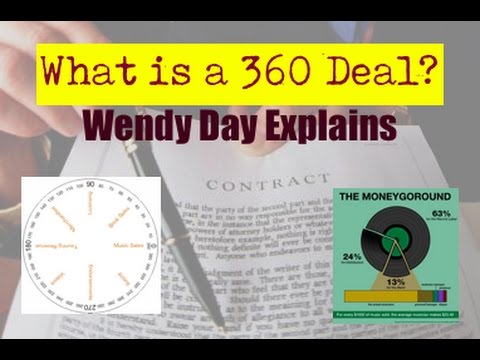
Wendy Day breaks down how 360 deals emerged after Napster killed music sales, letting labels take cuts from touring, publishing, and merch to replace lost revenue. Labels slashed marketing budgets from $2-3 million to $750k while demanding these expanded rights. Artists can negotiate better terms by building leverage through streaming income and touring, like Chance the Rapper did independently.
Chapters
Hi guys, Wendy Day here. How are you today? Um, keep those emails coming because I'm reading everything that you're sending me and I'm covering topics based on the emails that I'm receiving. So those of you that are most outspoken are the order in which I'm making these videos, if that makes any sense. Um, we're going to talk about 360 deals right now. Um, a lot of you have been asking what they are and what came before them. Um, back when I started in this industry— when I rode my dinosaur to work— um, when I started in this industry The deals at record labels were normally between 12 to 15 points for an artist, and a point means a percentage point, right? It's a slang term that we use in the industry. So the deals were 12 to 15% or points of the retail selling price of a full-length album, because that's how the music industry sold music mostly. Um, there were singles, but the deals were based on full-length albums. So that, that really meant that you were getting 12 to 15% of whatever the album was selling for in stores, and that could have been anywhere from $15.99 to $17.99 depending on how much demand there was for the album. The albums that had a lot of demand, um, like the Master P albums, were selling for $17.99. The albums that were in stores like Best Buy would be a little bit cheaper. They would be like $15.99, $16.99, because they'd be on sale the first week, and then the price would go up after the first week of sales or the second week of sales, whatever. You know, whatever the label or the store had deemed prudent, right? So for the artist, what that meant was out— after they paid back all of the money that was spent to record the album, to market and promote the album, shoot the videos, go out on tour— after all the money was recouped and paid back, out of the artist share then they would begin to see their, their income. I don't know many artists that recouped in the '90s and the early 2000s. Um, you had to be a superstar pretty much to recoup and see anything on the back end, um, like a Drake or an Eminem, you know, that, that size of artist. Um, meaning you had to sell over 500,000, you know, CDs, units, whatever you want to call them, in order to see money on the back end. And what artists learned very quickly was to front-load their deals. They would get as large an advance as they possibly could in order to offset the fact that they probably would never see any royalties on the back end. And then that money kind of had to tide them over until until the show money started to come in, which is where they made the bulk of their income. Well, along came Napster, and the music industry, um, took a big short. And the thing about record labels is they never take the short. So, um, along came these wonderful things called 360 deals. Um, Lior Cohen is kind of credited for bringing them into vogue. I don't know that he really did, but I do know that he, he kind of gets— at first he was taking credit for it because it was seen as such a brilliant move, but it hasn't been so great for artists. So now he kind of gets lambasted for it. Shout out to Lior at YouTube. So what a 360 deal did was it offset the loss that the labels felt they were taking by the reduced sales in music. And they decided that since they were building the fame for the artist and the popularity of the artist, which is what enabled the artist to make money in other ways, they felt that they would now take a percentage of that as well. Um, so they started to take a percentage of show money, they started to take a percentage of, um, if an artist wrote a book, they would take a percentage of the book income. Um, if the artist went into television or film, they took a percentage of that money. So basically, they decided to share in all of the revenue streams for the artist. The thing is that the artist wasn't making a whole lot of money to begin with. The reason the artist was seeking film and TV deals and book deals was because they weren't recouping from their recording contracts. It was, it was getting harder and harder and harder to do so, so they were hiring people onto their teams that had expertise in getting them into commercials and getting them into television shows and, you know, getting them onto bigger tours faster so that they could make more money. So today, when an artist signs a deal, almost all artists have to sign a 360 deal. You have to have super leverage in order to not have to sign a 360 deal. And what that means is that the label is going to take half of almost everything except for your show money. They might do like a 70/30 split, uh, 70% to the artist, 30% to the label. Um, in ancillary income, they might do a 70/30 split or a 60/40 split. Some labels do 50/50 splits. I'm not a fan of 360 deals. I have never been a fan of 360 deals. Hell, I wasn't a fan of the way record deals were structured for artists before 360 deals. Like, I thought they were oppressive then, you know, and then they got worse. So, you know, I'm really not happy with 360 deals. But again, it's really difficult to— it's really difficult to sign to a label or or even to an investor and not do a 360 deal where you share in all the revenue streams. I think I wouldn't have such a problem with 360 deals if the labels were better suited to help artists make money in all areas. And I do have to admit that in, in 2016 and 2017, the labels are better at that than they were in 2005 when 360 deals, you know, really first started coming into vogue. If the labels were to help you secure a book deal, or if the labels were able to go to a corporation like Samsung and do a deal for you, then it makes more sense to me that they would take a larger piece piece of the pie because they brought it to the table. But when 360 deals first started, the labels really didn't bring anything else to the table. They really just, um, took a split and did the same work that they always did. Um, in fact, even less work than they always did because the budgets got smaller to work artists, um, when the money was not so great. On the receiving end for the label, for the income from an artist, they immediately slashed budgets. So where an artist would have received a marketing and promotion budget before of $2 to $3 million, now the labels were slashing the budgets to like $750,000. So it was harder to succeed in the industry, and the labels were taking a bigger share. Um, so 360 deals started out as, as really an oppressive thing. Um, the thing that I, that I accept, the only area where I really accept 360 deals is if you're going to secure an investor and bring an investor on board, and you're going to get to call the shots and you're going to get to make your own decisions. I could see why you would put up a larger share of the return in order to help that investor get a return on his investment more quickly, but that investor is also enabling you to go out and secure your own tours and, you know, basically hire your own team so that you can secure your own tours, you can secure your own book deals, etc. I look at Chance the Rapper and, you know, he's done such an amazing job independently that I can't imagine him signing to a label and having to take some sort of a 360 deal. It just wouldn't make logical or financial sense, you know. Not to say that he would— he certainly wouldn't— but I'm sure that the labels, in their hubris, when they offered him deals to begin with, I'm sure they offered him 360 deals. And when he looked at them, he would, you know, he was like, why would I do this? Like, what the hell is this? This is crazy. Building leverage is the way that you get around having to do a 360 deal. The more income that you have as an artist, the more leverage you're going to have in negotiating a deal with anyone. Um, and, and that leverage is going to come from show money first. That seems to be the area where most artists get paid for the work that they do, even though they're putting in endless hours marketing and promoting themselves, the money first comes back into you through, um, through show money, through performances, um, and then streaming income. And, um, for hip-hop, streaming income is larger right now. I guess it depends on the, on the type of, of, of rap music that you make, but For the artists that I work with, we see streaming income come in first. Well, the show money comes first, but we see streaming income come in in terms of the sales income. Streaming comes first, digital downloads and CDs are last, if you're still pressing CDs. We don't press CDs for our artists to sell. We still press promotional CDs that we give away for free on the streets. And I'm based in the Southeast, so every area is different. For example, I don't give out as many CDs on college campuses as I do download cards. And a download card is like a business card. Some people put QR codes on it that take people directly to a website so that they can stream or download your music to get to know who you are. I don't use QR codes. I just don't think that they're popular. Enough. I don't think they really gained the proper traction where when somebody looks at it that they get excited about it. My problem with QR codes is also that it takes people only to one place, either your website or your iTunes page or your SoundCloud page, or if you're putting out mixtapes, your DatPiff page, you know, wherever you're driving them to. I much prefer on the card to list the artist's website, all their social media, their SoundCloud page, their AudioMac page, their Apple, their Google Play, Spotify, Apple Music. I prefer to list all of the different places where the artist's music is obtainable, and I do that because people like to use whatever source they use to listen to music. They want to incorporate you into whatever it is that they're doing. They don't want to have to go to another source in order to check out your music, you know, unless it's free. Um, so somebody who does not subscribe to Apple Music is not necessarily going to want to check you out as a new artist that they don't really know on Apple Music. They're certainly not going to buy a subscription just to check out your music. They may go to SoundCloud, they may go to YouTube, but you want to reach people in the area that's their comfort zone. I listen to music on Spotify, so if I'm going to check somebody out, first I want to hear their buzz. It's very rare that I'll listen to an artist just to listen to an artist. I just— I'm too busy for that, and I get way too much music in order to listen to everybody, so I choose not to listen to anybody, right? But if a friend of mine is putting out music, or if somebody that I have a relationship with asked me to check out their artist, I'm gonna want to do it on Spotify. On Spotify, I'll go to SoundCloud to check out music, I'll go to YouTube to check out music, but in a perfect world, I would rather put them into one of my playlists on Spotify and listen to them, sandwich their artist, listen to that artist sandwiched in between two other artists rather than just go and listen to all of their music like it's, it's like it's a demo, right? That's not how I consume music. And I don't necessarily want to break out of my comfort zone or my mold when I'm listening to music just to listen to something new that's unproven. If something has a great buzz or if people are talking about an artist whether I think it's something that I'll like or not, I'll check it out because I want to know what they're talking about. I want to be part of the conversation. That's how I know who Lil Yachty is, or Uzi Vert, or Kodak Black, 21 Savage. These are artists that came to my attention— Day Day. These are artists that came to my attention because they had a buzz already happening on the streets and and I wanted to know who they were. I wanted to be part of the conversation, so I chose to find them and listen to them. Um, some of them I was able to find on Spotify, some of them I was able to find on DatPiff, some of them I was able to find on SoundCloud. Um, I don't think I went to YouTube to discover any of them. Um, I've seen their videos, but I think I went to YouTube after I had checked out the music because I was on to them pretty early because I work in the music industry. Like, the circle of people around me that talk about music talk about music when it's first coming out, not when the artist is on their third or fourth release, right? By that point, it's already old to me and to those of us in the music industry, um, but it's not old to the fans. It's all new to the fans. So having said that, um, I just believe that since you're asking people to check you out and they don't really know who you are yet, you want to make it as convenient and as easy for them as possible. So you want to put your music in as many places as possible. Um, I do give out a lot of free music. I don't like it, um, but I feel like that's what I have to do in today's environment in order to build fans and gain fans. And then, um, our, our business model is that we monetize pretty quickly. If I'm giving out free music, I still sell it. It's still up on Apple Music and Google Play for people to purchase. And I do that because people that really appreciate you as an artist, when they fall in love with your music, they will support you. And it may not be a lot at first, but you will make some money in terms of financial sales. And I just think it's important for an artist to know that they're getting support from their fans. So I offer everything for sale, um, and it may only be a couple hundred dollars, but hey, it's something, right? Um, so, you know, show some love to the fans who want to support you. They're your true rabid fans. Okay guys, this was all about 360 deals. I hope it was helpful, um, and we'll just keep keeping on. Email me at thisiswendyday@gmail.com and, um, I will answer your questions live on Wednesday night at 7 PM Eastern Standard Time. And then I drop videos like this one on Monday, Wednesday, and Friday at 11 AM. And your email questions are what prompt me to talk about different topics. So the more you ask me questions and talk about what your needs are, the more I can help you and fill them. Okay guys, thanks for tuning in. Wendy Day, peace.
More from Wendy







How Much Is Your Music REALLY Worth? | Jeff Ponchick x Wendy Day | No Standing Zone Ep. 19

Managing expectations is a major key to making it in this business... easier said than done!

I had a great conversation with @SamuelRiddle on the most recent episode of No Standing Zone..

Building Empires: How Sam Riddle Navigated from College Radio to Managing Megan Thee Stallion
