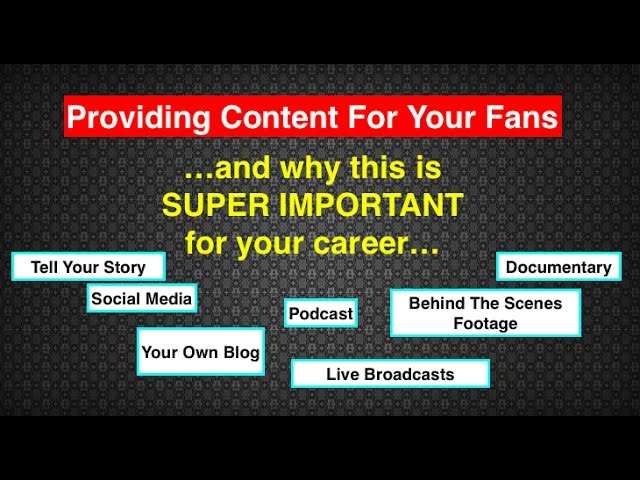
In this instructional monologue, the speaker emphasizes that content is essential for an artist’s success beyond just making music. First, creators must define their brand and ensure all posted material reflects that authentic identity, using behind‑the‑scenes footage that aligns with the artist’s values. During promotional tours, a dedicated videographer should capture daily activities—concerts, community engagements, visits to local spots—to build a library of compelling moments. This archive serves two purposes: immediate fan‑facing posts and, later, a documentary of the artist’s early career. The speaker advises that a music‑industry team should include not only a manager, attorney, accountant, booking agent, social‑media specialist, and publicist, but also a content provider who can film, edit, and distribute material. Posting strategy is highlighted: tailor content length and timing to each platform, use scheduling tools like Buffer, cross‑post between Instagram, Twitter, and Facebook, and avoid overwhelming followers with excessive posts. Additional tactics such as contests, researching successful peers, and continuous engagement are recommended. Overall, authenticity, strategic documentation, and disciplined distribution are presented as key to building and maintaining a fan base.
Chapters
Hi guys, content providers! I want to talk about content providers today. Um, as you know, the, um, internet world has allowed us to see a lot of the behind the scenes in different artists and different movements, and the content that you post is really important. So once you figure out what your brand is and what you stand for, then you need to start filming different aspects of your life, like behind the scenes, to show your followers and potential fans and fans what you're about as a human being. So, and again, you need to keep that within your brand. So if your brand is of a very conscious artist who gives back to his community, you're going to want to film yourself maybe feeding the homeless or, um, speaking at a Boys and Girls Club in your area, or doing things that somebody who is conscious would do, right? If that's your image, you wouldn't necessarily want to film yourself, uh, selling heroin on the street, or pull on a face mask and go rob a bank. So make sure— and I'm being very extreme to make my point, right? That you need to think about how people see you, and you need to deliver them the content that shows who you are within that brand. Um, I don't think you should ever be something that you're not, because I believe that authenticity is extremely important, not only in the music industry but to your fans. I think that If you're going to pretend to be something you're not, it's going to be really hard for you to draw fans to you. I think a lot of the, a lot of the reason that younger, newer artists don't experience success is because they try to chase success instead of being who they are and making music that they're passionate about. Fans can tell when you're passionate, and they can tell when you're not. I believe that comes through whether you want it to or not. So, um, in terms of content, just make sure that your content reflects who you really are and that it's interesting. Um, when we put artists out on promotional tour, one of the people that we always send with the artist is a videographer, somebody that can film everything that the artist is doing. So for two reasons, really. One, for content so that at the end of each night when the artist comes back to the hotel room, the footage can be uploaded to the website, to social media, so that fans that were with the artist during the day can go and find pictures of themselves with the artist, whether it's, um, still footage, you know, still photos, or whether it is, um moving footage, you know, film, video. We always make sure that we try to capture the most interesting part of the day. And the cool thing about being out on promo tour is that interesting stuff always happens. We try to go by different historical sites if we're in a place that has historical sites. We interact with the retailers in the area, you know, the hip-hop gear shops, the flea markets, the smoke shops. Um, we're always on campus at universities. We go to high schools. So we have a variety of different things that we do when we're inside of an area. We go to the mall, we go to the, to the theater. So that, um, we go to, uh, clubs, you know, where the artist performs. If it's a street festival, we film at the street festival. We really try to show a slice in the day of the life of an artist that's building a career. The second reason that we do that is so that when the artist has, um, blown up and is successful, we can put together a documentary that has the early stages. So we're kind of planning ahead whenever we're working with an artist to that moment when it becomes time to tell their story and put out a documentary. A lot of artists, once they experience success, they have to scramble for footage to find, you know, oh God, you know, 10 years ago I competed in this battle, or I got to meet my idol, you know, whoever, Too Short, and I didn't get any footage of that. So we try to collect all the footage so that When you get to that point, all you have to do is go back through your archive, and that's usually stored on a hard drive or in the cloud. But we always back it up so that there's multiple copies, that way nothing ever gets lost. But content is really how your fans are going to get to know you. It— you have to be more than just music today. It's not enough. Even if you're making hit records, people want to know who is that behind the music. And you can do a ton of interviews with media, but the thing is that media is in charge of editing it, and they're going to edit it the way that they feel will bring most viewers, whether it's sensationalist or whether it's covering the key topics that you discuss that are topical. But when you film yourself and you put it out to the world through your social media and your website, You're 100% in control of the image that people see and how they perceive you. And it's very important. Perception is everything in this business. So I recommend as part of your team, um, that you have somebody on board that can record, um, everything that you're doing, edit properly, and then distribute it to your website, to social media. Um, somebody that really kind of gets what your, what your goal is and what you're trying to do. When you put together a team in the music industry, um, it usually consists of a manager, an entertainment attorney, an accountant, a booking agent, um, somebody that handles social media— I call them an internet guru— and then of course a publicist that's going to be the megaphone to let the world know what you're doing and what you're working on. But I also add to the list of teams a content provider, somebody that can share photos and footage with the world of what it is that you're doing and what you're trying to accomplish. And you want to add new content as often as possible, in some cases every day. You just want your, your fans to— and this is in addition to to like what you normally post on social media, right? This is in addition to your Facebook, your Snapchat, your Instagram. Um, from the footage that your videographer or your content provider is, is grabbing on you, they can— um, was that grammatically correct, grabbing on you? Probably not, right? Um, but as they're acclimating— accumulating— I'm tired today, can you tell? As they're accumulating this footage, they're going to have a great understanding of, you know, what time of day should they post the footage on Instagram. You know, what amount of time is best for your followers? Is it 15 seconds, 30 seconds, a minute? Ditto with Snapchat, ditto with still footage on Twitter. You know, are you going to go live on Facebook? If you are, how often are you going to go live on Facebook? What are you going to talk about? These are all things that have to be part of your plan that you— and you can do stuff sporadically, it's not like you can't add to it, but put together a plan of what content you're going to release and when. A great service for releasing stuff for Twitter is Buffer. You know, I use a lot— I use Buffer a lot for my Twitter feed so that If I'm busy at the time of day that's best for me to post, there's always something coming out. And then if I'm posting, I'm doing it in addition to what is coming out through Buffer. But there's a lot of different programs and apps that you can use to help you in posting to your Instagram feed, to your Twitter feed. And then you want to make sure that, you know, with your Facebook feed that your Instagram is feeding to Facebook, that your Twitter is feeding to Facebook, so that, um, for the folks that are on Facebook, which is the, the most popular social media that's out there, um, that your content is continually, continually populating. That doesn't mean you should overpost. That doesn't mean you should drive people nuts. Um, there's a lot of promotion guys that I'm friendly with, and sometimes I have to turn off their feed. I have to unfollow them when they're in the midst of a launch or on the road or working a big project because they just light up my Instagram and my Twitter. It's like bing, bing, bing, bing, and it drives me crazy. So don't drive your followers crazy to the point where they unfollow you, but make sure that you're showing just a nice slice of your life and who you are and sharing that with your potential fans. You can also run contests. There's a, a ton of things that you can do in order to be a little bit different than everybody else. And, um, you can certainly do a Google search to find out what works for others, what works for corporations, and see if you can apply it to your career. You know, follow artists that are more popular than you are and see what they're doing to increase their followers. It's a continually ongoing process. You don't, you don't arrive someplace and then forget about your social media and stop posting. It's an ongoing process, and it probably will be for the rest of our lives. So, um, content provider— get somebody on your team that can film and edit, somebody with a great eye that can take some phenomenal photographs of you. And, um, we'll be back here in a couple of days to give you some more hints of how to succeed in the music business. Okay, y'all, thanks for tuning in. Bye.