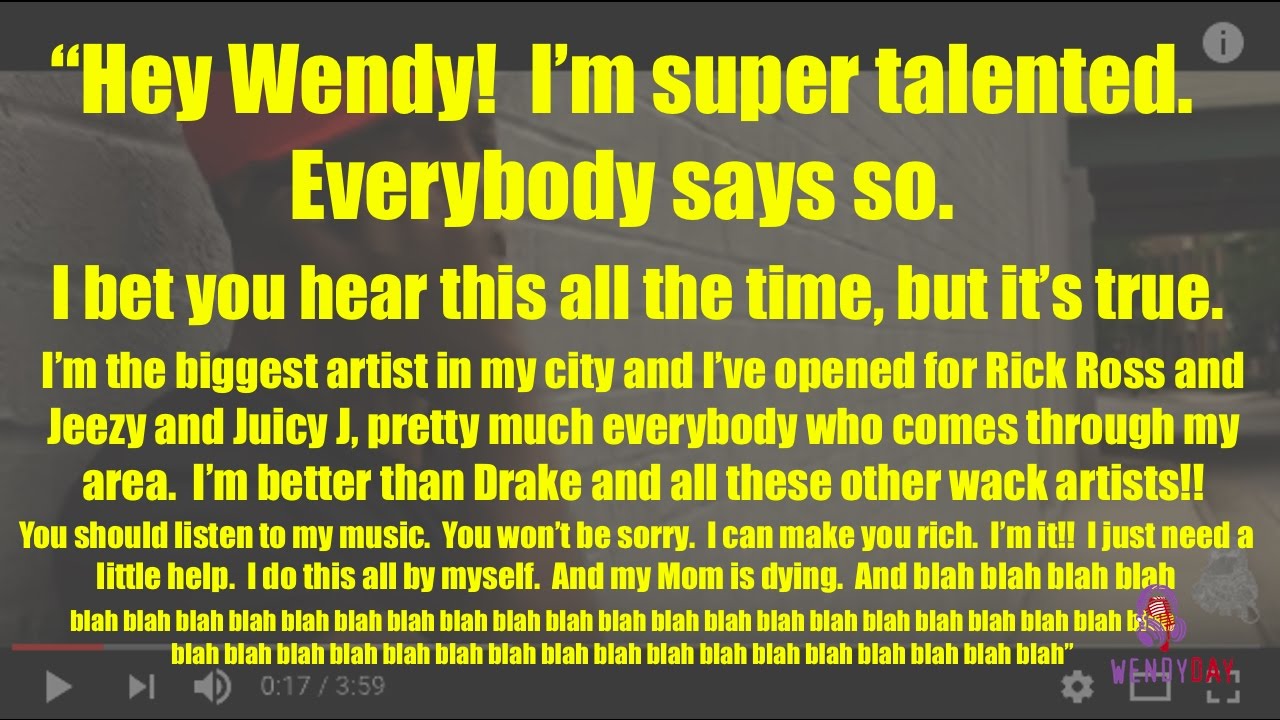
In this monologue, Wendy Day explains that raw talent or great music alone will not launch a career in the music industry. She emphasizes that artists must create their own opportunities by testing music with strangers, engaging local DJs, and building a grassroots fanbase both offline and online. She outlines a step‑by‑step process: (1) test songs with target‑age listeners (13‑26) in public spaces, (2) collect honest feedback, (3) use that feedback to select tracks that resonate, (4) distribute music via SoundCloud, CDs, download cards, and social media, (5) nurture fan relationships through direct interaction and consistent local presence, (6) expand to neighboring towns after establishing a solid local buzz, and (7) leverage DJs and clubs to amplify reach. Day stresses that industry professionals, including herself, only take notice when an artist already has a measurable fan buzz, because they care about revenue potential. She warns against the common habit of emailing industry gatekeepers and instead advocates for targeted fan outreach, personalized social media messages, and building word‑of‑mouth momentum. The ultimate goal is not fame for fame’s sake but sustainable income that can support the artist’s family and future. Throughout, she balances candid criticism of misconceptions with encouraging, actionable advice.
Chapters
Hi guys, how are you? Well, today I have some good news for you and some bad news for you. I thought today's topic, I thought we had covered it enough, but I'm still getting a ton of emails, um, which tells me that most people don't know this yet. So again, I have some good news for you and some bad news for you. Okay, the bad— let me give you the bad news first. The bad news is that just having talent alone or just having great music by itself is not enough to seed in the music business. It's not. I'm sorry, I know that sucks. The good news is many of you think that somebody puts you on, and the reality is you put yourself on. So this is good news, right? Because this puts the control back in your hands. You don't just send music to somebody like me, for example, and say, I'm really talented here's proof, here's my music. Because if I had the time to listen to it, which I don't, but let's just say that I did and it's great music, okay, now what? I can't put you on. I can't help you build your career. That's not what I do. So you could have the best music in the world, and believe me, I've heard the best music in the world, and there isn't much that I can do. The great part about this is there's a lot that you can do. You hold the power to this. You hold the key to this. And with the internet and with a little bit of grind— okay, a lot of bit of grind. I'm saying a little bit, but I really mean a shit ton of grind. You're going to be able to be successful in the music industry. So what that means is You can continue sending your music around, and you can continue sending emails and pleas for help and all different kinds of stuff to different people and hope that somebody sees some value in you. But just understand that the value they're going to see in you is how to make themselves money and how to pimp you out instead of you just doing what it takes to succeed. And here's what it takes. Are you ready? Lean in, lean in, lean in. Work. It takes work. Okay, here's what you do. Take your best music and test it. Test it with other people, not people that are in your circle. Test it with strangers. Even if you need to go into a mall and walk up to people that are in your target market, the age of fans for the type of music you make. And, and just so you know, that's like 13 to 26. So walk up to teenagers. Teenagers are a great, a great, uh, target market for you to test. Walk up to them, ask them to listen to your music. Maybe, maybe bring it on your phone with some headphones plugged in. Ask them to listen to your music. Ask them for 30 seconds. And to give you feedback. If you can get them to stand there long enough, ask them to listen to 2 or 3 songs. Don't make them listen to the whole song, just let them, you know, skim through. Let them listen to pieces of the song, maybe 30 seconds, 45 seconds, a minute of the song, long enough to get the first verse and the chorus, or the chorus and the first verse, depending on how you record. And ask for feedback, you know. Hopefully they'll be real with you. And don't just ask 2 people, ask a lot of people. Get a lot of feedback. Also ask DJs in your area. Get to know who the DJs are, the club DJs, the radio DJs. Start interacting with them. Ask them what they think of your music and get some feedback from them in terms of how they feel you compare to the other artists in your area. And then once you get that feedback and you know that you've got songs that fans will embrace, put them out there. Start passing out music, put them up on SoundCloud, get them out into the marketplace online and in the real world, and start moving around your area. Start, start spreading your music amongst your fan base. Not the music industry, not people that are doing this for a living, but fans, because what attracts people like myself, or more importantly, people that can actually help you with your career— those people want to see how people are reacting to you. They don't care that you have great music. Great music is easy to find. I can find great music as easily as I can find a great t-shirt. And I don't mean to belittle your art form because you guys know I'm an advocate for you. Who else is sitting here making free videos when they could be working and making money, right? So get your music out there, build a fan buzz. When you start building your fan buzz, you're going to notice that naturally your Instagram numbers grow and your Twitter numbers grow, and the views and comments on your YouTube videos is going to grow. You're going to have to put in a little work to get people to come and listen to your music in person. You're going to need to give out— if you live in an area where people still listen to CDs, give out CDs of your music. If you live in an area where they don't, give out cards with download information on it. Send people to your website, send people to your SoundCloud page, send people to wherever you have your music and, and start building fans one by one. Talk to them on social media, engage them on social media. Then once you've done this in your own area— and I don't mean like a week or 2 weeks, I mean when you've done this for months upon months in your area and you feel like you're bubbling a little bit in your area— go to the next town over, go to the next city over, go start doing this elsewhere. And again, don't do it there for 1 week, don't do it there for 1 day. Really start building your, your following and your fan base. Your goal is to— is to target fans. The fans are the most important key to what you're doing. Another way to reach a large amount of fans is to go through the DJs. If you can find DJs that are willing to spin your music on the streets and in the clubs, then you're going to be able to reach more fans faster. Because if a DJ's in a club and there's 500 people in that club or 1,000 people in that club and he starts playing your regularly and they start hearing it over and over and over, then you're just reaching a larger amount of people at one time than you can do on your own. Putting out projects is important. Getting on blogs will be helpful, although it's not crucial. Fans are crucial, and however you choose to reach fans is crucial. So whether you reach them through social media, whether you hand them your music, whether they learn about you on a blog, whether they see your video, or on YouTube when they're just, you know, um, searching for different stuff to look at. However they bump into you is great. The point is, once they bump into you, they have to like what they hear. Not only do they have to like what they hear, but hopefully they'll seek out more information about you. So all that to say, sending around your music to people in the industry, people like me, and asking for feedback is not helping you. I'm not your market. I don't know if your music is good or not. I don't really care if your music is good or not. You could be the most talented person in the world and I'm not gonna know because you don't have a following. I look for artists that have fans. I look for artists that when I go into an area or I call somebody in that area that I've got a relationship with They say to me, oh, so-and-so is really popping, so-and-so is really bubbling. Once you're bubbling, I can help you get to the next level. But if you're not bubbling, I can't take an artist from scratch. I can't even take an artist with a little bit of bubble and help them get bigger. You need to have a decent-sized fan base before somebody like myself can help you. Now, there are people out there that can help you from scratch. There are people that can take you from, from having absolutely nothing to having something. But understand that there's a very large price to be paid to have somebody help you when you've got absolutely nothing. It is so much better for you to do it yourself and build a little bit of a buzz and a little bit of fan base, because you're going to attract somebody that can help you so much easier than attract somebody that, eh, maybe or maybe can't help you. You don't really know. And then you, you blow your entire career putting your faith in one person that said they could help you but really couldn't, because you hadn't grown enough, you hadn't put in enough work, you didn't do enough work. You know, that's the whole point of my YouTube channel. That's the whole point of my, of my blog. I'm not writing articles because I want attention. I'm not making these videos because I want attention. I'm doing this because I want you guys to learn how to do this properly so that you can succeed. There's so, so, so many artists that are successful today that I'll see backstage, or I'll see it at an industry event, or they'll see me on social media and they'll hit me up and say, hey Wendy, you know, thanks for those panel discussions that you did back in the '90s at ASCAP. Thank you for the panel discussions that you did at the New Daisy Theater. In Memphis every month for a year because I learned so much. There's so many people that have taken this information and used it and gotten really successful, and that is my goal. My goal is for you to be successful rather than you sitting at home and listening to Drake's music or hearing on the news how Drake is the number one streamed artist on Spotify. I want that to be you. I I want you to be the person that hits the news and is the number 1 person on Spotify, or number 2, or number 10, or number 100, or even number 1,000, because it means you're doing something. It means you're moving forward in this business. It means you're finally making money in the music business. Fame is wonderful. It is great if you go to McDonald's and people recognize you. You go to the mall and people recognize you. That is so awesome. But what's even more awesome is being able to feed your family and being able to buy your mom a house and your dad a car and put your little brother through, through college or help your sister get her first job. That's what's awesome, and that is what you can do with the music industry if you do it right. So all this to say, it's obvious that you guys aren't getting this yet because you're still sending me emails asking me to listen to your music. You're still sending me emails asking me for advice on how you can reach out to somebody at a record label because you want a deal. If you build a buzz in your area, if you build word of mouth in your area, if people in your region are talking about you, you won't need anything other than that. One of two things will happen: people will start paying you because they want to see you perform, or they will start paying you for your music, or they will start buying t-shirts with your name on it, or record labels will call you and want to sign you. And I don't mean bullshit record labels that you've never heard of. I mean the big ones, the Sonys, the Warner Brothers, the Universal, the Atlantics, the Def Jams. They will see what you are doing and they will want in on that. So all this to say Stop spending time emailing people and asking if they'll listen to your music. Start engaging fans on social media. Go to the pages of artists who have music similar to yours and go through their fans, the people that follow them, and reach out to them. Hi, I'm so-and-so. I have some music. I was wondering if you'd be interested in hearing it. Hi, I'm so-and-so. I read in your bio that you like video games. I like video games too. Hi, I see in your bio that you play basketball. You know what, I'm pretty good at basketball myself. Tell me your favorite memory from basketball. What's your favorite shot? What are you best at? Engage them, start a conversation. Once you build a little bit of rapport and they find out you're an artist, they're going to be happy to hear what you have going on. And then once they listen to your music, they can spread it to their circle and their friends. Maybe they'll even repost something that you have. Maybe they like your music enough to share it with their inner circle. That is the goal. You want to do that online and you want to do that in person. Okay guys, did you get it this time? Okay, talk to you soon. Bye guys.