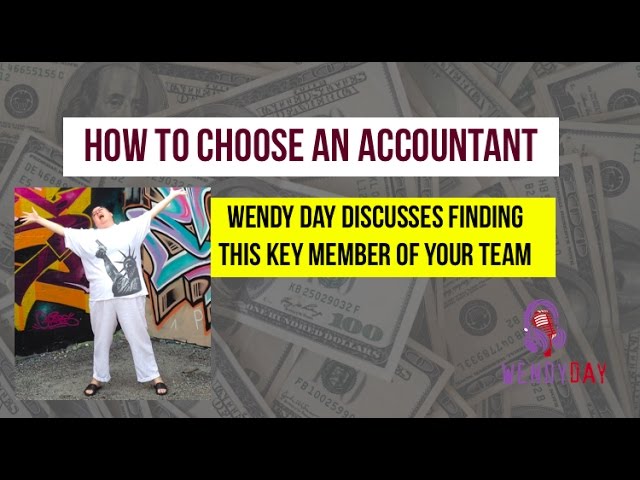
Wendy Day explains why musicians need an accountant who understands royalty streams, publishing splits, and performance-rights payments. She covers corporate structures like LLCs, compensation models, and how to find someone through entertainment attorneys and other artists. An accountant helps you read statements, manage cash flow, and plan for trusts or real estate.
Chapters
Hi guys, good to see you again. So today let's talk about the money part of the music industry. Um, one of the key members of your team is your accountant. And they're also called business managers. Now, that's not to be confused with your manager, the person that helps you plan your career and brings on the other members of your team to help catapult you to success. A business manager is the accountant. It's the financial side of what you do, and the business manager is very unique to the music business because in the music business we have royalties, we have publishing, we have all sorts of unique things that, um, attribute to an artist's income and to your money. So you want to make sure that you've got somebody on your team that has a background in the entertainment industry. If you're signed to a record label, that person is going to make sure that you're receiving what is contractually due to you. For example, if you've got a recording contract with a record label that says that they have to pay you 15% of sales, there's all sorts of mathematical figures that, that go into that. There are cross-collateralization for recouping, there is, um, breakage fees, which is crazy because music doesn't break anymore, but there's sorts of things that play into, um, how you get paid. There's your statutory rate, which tells you how many songs you get paid for, um, on, on a full-length release, on an album. So you need to have an accountant or a business manager that actually understands how you get paid. Another thing that's unique to the music business is a lot of the payments that artists receive occur twice a year. For example, ASCAP, BMI, SESAC— those payments are made twice a year. So for example, for the time period from January till the end of June, the artist is cut a check that usually arrives sometime in September. For July 1st through December 31st, that check usually arrives sometime in March. So you need to have an accountant that's aware of the time periods that your music is— that your checks are coming in, so that if your money doesn't arrive, they can actually chase it. You also want to have an accountant or, or business manager that understands how publishing works and the splits. There's a lot of different facets to how we get paid in the music industry. Streaming income is paid differently than sales royalties from selling CDs. So you need to have somebody that can kind of figure out exactly how much you should be paid, when that payment should come in, and, um, in what form it should come in. A lot of artists, um, including my clients, we set up corporations for them, and we do that for a lot of different reasons. Um, we set up touring corporations in case somebody's hurt at a show so that if they get sued, they don't lose everything that they own. Um, we set up corporations for the music because we're a little worried that if a sample doesn't get cleared that the artist could get sued and lose everything. And an accountant is the person, along with the attorney, that helps determine the best types of corporations. When you're making the decision whether you want to start a corporation that's like a Subchapter S corporation, or whether you want to start an LLC, for example, the reason that you choose one, one over the other is for tax reasons, and it really depends on your income, what you're projecting that you're going to make over the next couple of years. You need to start a corporation that makes fiscal sense, that makes tax sense, and that is something that your accountant will do for you. Another thing that a business manager does is they put you onto a budget. If you're at a point in your career where you're making good money, for example, if you're making $10,000 a show and you're doing 10 shows a month, you're making $100,000 a month. And that is a very realistic sum for a relatively new artist to start making. Once their fan base starts to support shows, their price increases pretty quickly as their, you know, as their buzz increases. So it's not unheard of for an artist to be making over a million dollars a year just in show money. Well, that's probably not going to last forever. So you want to have somebody on your team that can, when that money comes in, pay the taxes on that money as well as put you onto some sort of a budget to help you achieve your goals. Maybe your goal is to buy your mom a house, for example, or maybe you want to set up a trust for your children so that if something were to happen to you, they'd always be taken care of. Maybe your goal is to set up an educational fund for your children. Maybe you want your kids to go to private school, or maybe you want to ensure that they're going to go to college. There's a lot of different planning that goes into, um, securing your future, and the accountant plays a very large role in that. And then the last thing that I want to say about an accountant is they can be paid by the hour or they can be paid by a percentage of your income. Um, a lot of business managers will take 5% of all of your earned income, and for that price they will handle all of your accounting needs. If you're not at a point where you have enough money coming in to pay for them Or if you have a lot of money coming in and you don't want to give up 5% of all that income, then you would work out an hourly rate situation with the accountant. The way that you find an accountant or business manager is, um, mostly through referral. Your entertainment attorney will refer you to somebody that they trust. Other artists can refer you to the folks that they use. Um, the one thing you want to do is you want to choose an accountant that is going to help educate you along with the process. So when you receive royalty statements, you want somebody that's going to take the time to explain to you how to read that statement, because if you don't understand how to read the statements coming in, how will you know if the accountant is jerking you or not, right? So you don't need to have a degree in accounting, but you need to have some basic understanding of what income comes in, how it comes in, when it comes in. Um, and you definitely want to be able to read your royalty statements, whether you're signed to an independent label, a distributor if you have a distributor, or if you're signed to a major label. Um, I found my accountant through referral. I work with a lot of different artists, so I have access to a lot of different people. I met with a lot of different people before I chose the one that was right for me. My guy is in New York, and I chose him because, honestly, because he was sort of like a father figure. He was somebody who was very stern with me financially. I'm somebody who likes to go shopping, I like to spend money, so I found an accountant who really calls me to task on that kind of behavior, and there's many times where I won't make a purchase because I don't want to deal with the bullshit that comes along in telling him that I want to make a large purchase. So he put, he put me onto a budget very early in my career because for what I do, the money kind of does this, just like it does for artists. You know, the money comes in a lot all at once, or I'll go for many months with no income at all. And I wanted to make sure that my bills got paid in the downtimes as well as the uptimes. So he was able to structure my income so that it was more of a steady line instead of, um, ebbs and valleys. And that was just by me setting up savings accounts that were able to pay me my own salary. So that is accountants. They are part of your, um, team. Of course, your team consists of your manager, your accountant, your entertainment attorney, your publicist, your booking agent, and then I also include um, somebody from social media on the social media side and a content creator, because I think it's really important to have that in today's marketplace. So thanks for tuning in. I drop these videos every Monday, Wednesday, and Friday at 11:00 AM, and then I go live to answer your questions on Wednesday nights at 7:00 PM, and it's all Eastern Standard Time. Thanks for tuning in, guys. Bye.