Will Richardson explains why regulators in the EU, UK, and US are cracking down on sustainability claims like "carbon neutral." He breaks down four common mistakes: relying on offsets, incomplete life-cycle data, vague buzzwords, and misleading omissions. He walks through how to rewrite claims with specific, verifiable metrics instead.
Chapters
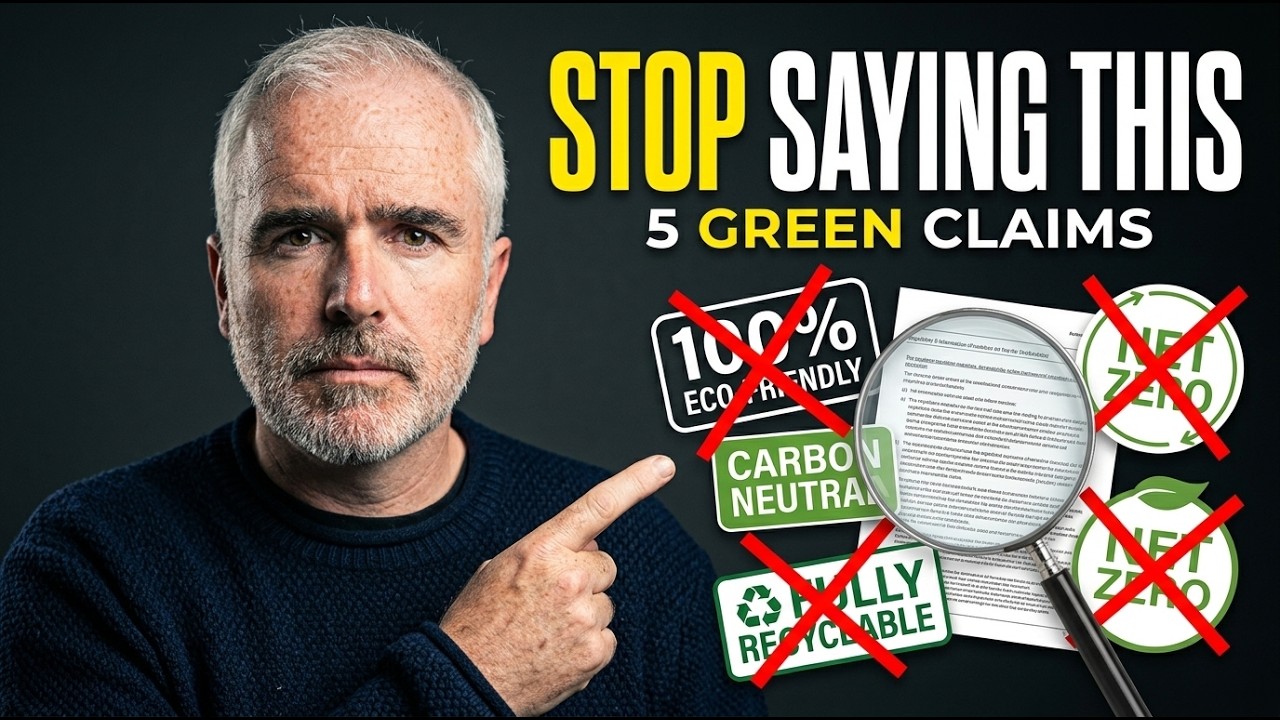
If your marketing has ever said carbon neutral, this affects you. Regulators across the world are no longer just watching sustainability claims, they're actively auditing them. The EU, under its Empowering Consumers for the Green Transition Directive, the UK's Competition and Markets Authority and Advertising Standards Authority, and the US Federal Trade Commission have all shifted from passive guidelines to active enforcement. What was standard marketing language 2 years ago is now a primary compliance Compliance trigger. Here's what they're actually checking. First, reliance on offsets. If a product is labeled carbon neutral or climate compensated purely because a company bought some external carbon credits, regulators are flagging it. Under EU rules, that kind of offset-based product claim is prohibited outright. Second, full life cycle substantiation. Regulators want to know whether a neutrality claim covers the whole picture: sourcing, manufacturing, shipping, usage, and disposal. Claim neutrality on one stage of the supply chain and present it as the whole product, and that's treated as misleading. Third, vague terminology. Standalone buzzwords like eco-friendly, green, sustainable, or CO2-neutral are now treated as absolute claims, which means they need rigorous third-party verified proof sitting behind them. And fourth, omission. Disclosing one green initiative while your core operations stay carbon-intensive isn't neutral marketing. It's misleading by omission. And Regulators are starting to penalize it as exactly that. None of this means panicking or scrubbing your sustainability work off the website. It means translating vague marketing claims into precise factual accounting. That's the whole fix. And it's both a compliance risk and a positioning opportunity. The businesses that tighten their language first look more credible than the ones scrambling to catch up once enforcement lands. Take a claim like, our running shoes are 100% Carbon neutral. Swap it for something you can actually stand behind. We reduced shoe manufacturing emissions by 18% in 2025 using recycled knit uppers. Or buy a ticket and enjoy a carbon-neutral flight via our carbon credits. Replace it with, we invest in certified forestry projects to compensate for flight emissions, which separates the offset from the emissions themselves rather than pretending they cancel out. Even a future commitment. We aim to be net-zero company soon needs the same treatment, targeting a 40% reduction in Scope 1 and 2 emissions by 2030 against our 2022 baseline. Specific beats soon every time. So here's the action plan for this week. Inventory every touchpoint: packaging, website footers, ad copy, B2B pitch decks, social media bios, all of it. Scrap the unqualified buzzwords. No standalone carbon neutral or climate positive unless it's backed by a full verified lifecycle analysis. Pivot to factual metrics: reduction percentages, energy figures, supply requirements— numbers you can defend under scrutiny. And disclose your offsets separately. Frame them as financial contributions to environmental projects, not as an erasure of your product's emissions. This is a data problem wearing a marketing costume, and it's one we can solve together. If you want a second pair of eyes on your claims before a regulator gives you one, get in touch.