NEC4: Contractor's Value Engineering Proposals

This webinar, presented by Glenn Hyde (GMH Planning) with Ben Walker (GABA) and David Allen (SECA Southern), provides a detailed practitioner‑focused examination of how NEC4 enables contractors to submit value‑engineering proposals. It explains the two primary mechanisms – Clause 16 contractor proposals that alter the client‑defined scope and secondary option X21 for whole‑life‑cost improvements – and walks through the procedural flow (proposal submission, project‑manager review, quotation, acceptance, compensation event notification). The discussion covers how the contract’s main options (A, B, C, D) affect the treatment of savings: options A/B apply a value‑engineering percentage (default 50 %) under Clause 63.12, while options C/D use gain‑share mechanisms under Clause 63.13 without a percentage. The presenters highlight the importance of pre‑contract data (value‑engineering percentage, contractor‑share ranges), design liability considerations (X15), and the need for clear written communication (Clause 13.1). Practical pitfalls are flagged, such as misusing Clause 21 design submissions, failing to document proposals, or setting percentages that discourage contractor participation. Audience questions explore why Clause 16 proposals are treated as compensation events while X21 proposals are commercial deals, ownership of ideas, and the impact of X15. The session concludes with a reminder to engage via LinkedIn and a preview of the next webinar on Clause 13 communication rules.
Chapters
Good afternoon everyone, welcome to this afternoon's webinar with myself, Glenn Hyde from GMH Planning, and you'll very shortly meet Ben Walker from GABA and David Allen from Seeker. This is our 10th webinar, we've made it to double figures guys, so we've not been taken off air yet, we must be doing something right. So yeah, our 10th webinar in our series, and obviously that means there's 9 other webinars you can catch up on in case you've missed them.
Where have you been?
But today we're focusing on something a little bit more detailed. So we're diving into contractors' value engineering proposals. So how potentially ideas can be offered up and how they may or may not change prices and things like that. That's what we're going to explore. So what's, what's the reason that a contractor might be proposing some of these things? What's in it for both parties? That's what we're going to explore. How does NEC, particularly NEC4, allow for these mechanisms? And there are some improvements, some enhancements we're going to find out today in NEC4 that we didn't see in NEC3. NEC does a lot of this, just every time that the contracts are evolving and they are there obviously correcting certain things but also adding improvements and enhancements. And today's features are some of those improvements that have been added into NEC4. David, come and chat to us about SECA.
Thank you, Glen. Thank you. Yeah, hi, I'm David Allen, the Executive Director for SECA Southern, and I look forward to hearing more about what is probably an underutilised part of the NEC4, which is slightly counterintuitive in the world where we— where the parties are looking to deliver more efficient and ultimately improved outcomes for all. So This is going to be quite interesting to get through this one. Ben and Glen are obviously going to put a bit more meat on the bone as we go forward so we hear a bit more about the topic, and there's going to be an opportunity for you to ask questions during the discussion that will be hopefully picked out at the end for us to have a look at. However, just a quick reminder about who CICA are, and using their proper title, we are the Civil Engineering Contractors Association. We're now in our 30th year. It is a not-for-profit trade body representing contractors that deliver and maintain a significant part of the mainland UK infrastructure. SECA Southern is just one part of this member-led association that provides mainland UK coverage across England, the devolved nations of Scotland and Wales, and with a policy office in Westminster. We engage with governments and those bodies that impact on our industry at both a national and regional level and deliver activity against our member-led SECA core pillar initiatives. You can find out more about that on our SECA website, um, where there'll be more detail. This series of the NEC4 webinars is aligned to our SECA upskilling and training core pillar ambitions, providing an additional layer of awareness to the suite of seminars and bulletins that we already deliver around the NEC4. We're really looking to increase both SECA member and the wider NEC4 user awareness, promoting the appropriate and equitable use of it. That is, that will hopefully deliver more short outcomes for all of us. I'll now hand you over to Ben at Gather. Thank you, Ben.
Thank you very much, David. Thank you, Glenn. Good afternoon all. Welcome then to our 10th episode, and today we're going to look at value engineering. And as always, had a little look at the origins of value. It's from the Latin valere, which means strong, worthy, and it's actually given rise to quite a lot of words in our vocabulary. So interesting origin. It's all about what it can do, not just what it costs. So again, I think we quite often say this in general conversation, don't we? Where's the the value in that, not just a measure of its expense. So we'll look at what value engineering is, and in particular for NEC, it's kind of two main directions. So we'll have a look at those two. We're going to focus on each of those then. So we'll look at the contractor's proposals under Clause 16, and these are ones where we are proposing to change scope the client has provided. We're going to have a look at the implications under each of the main options as to how value is unlocked for both parties. And then we're going to look at the second type that we're going to tackle today, which is if you have selected secondary option X21 for whole life cost. We're going to spend a few minutes looking at how not to do it, and sometimes it might feel possible to go down a completely different route, and we'll point out the sort of folly in that. I have a few final thoughts and hopefully plenty of time for questions and answers. We tend not to have plenty of time, so I'm going to say it again, Glen, perhaps on this occasion this is a, you know, a fairly brief set of slides, we should get through them. We never do. Okay, so firstly then, what is value engineering? So this is where specifically the contractor has a good idea that requires a change to the scope. So the scope document being that all-important document setting out the requirements for what we want, so typically drawings and specifications, but as we know, it's also constraints. And I think I'm going to take every opportunity I get to say this: please use Volume 2 of the User Guides, Chapter 3, How to Write Scope. If you're not using that, I would strongly suggest— these webinars are not legal advice, but I think I'm fairly safe saying it's a good idea to go and get Volume 2, How to Prepare whichever contract you're using, how to prepare the ECC, and then go and have a look at Chapter 3, How to Write Scope. Enormously useful document. So this good idea to change that scope— well, the first question a contractor is going to ask themselves is, is it worth my effort? And what would bring me to not bothering? Well, there's some pre-contract decisions the client makes and, and states them in Contract Data Part 1, which might change your appetite on this. So one of them is, if you're under Options A and B, is the value engineering percentage, which defaults to 50%, can be different. And the second one is if you're on Option C and D, it's the contractor share ranges and percentages. If these are too complex, too biased in one direction or the other, could be perfectly good procurement rationale for having certain caps and what have you, but well worth just understanding their impact on the incentive and overall motivation behind coming up with value engineering. And finally, if we're going to use Option X21, it has to actually be part of our contract. Now I guess, Glen, you could do that Clause 12.3 agreement to bring it in after contract, but probably easier to just make it one of your selections before we start. So moving our way sideways from is it worth the Contractor's effort, let's assume it is, yes. The next question is, is it a reduction to the payment to the Contractor? If it is going to reduce the amount the Contractor gets paid, then it's— we go, we go and have a look at Clause 16.1, which should be that form of value engineering we're going to have a look at in a moment. And that's unique to changes to the client scope. If it's not got really anything to do with necessarily to do or exclusively to do with changing the amount the Contractor gets paid or reducing the payments to Contractor, then it might be the case that it's going to reduce the asset's whole life cost, the operation maintenance of it. And if that's the case, that might be more likely to be an X21 proposal, which can be a change to any scope. So one is about the build cost, the cost the contractor is paid for providing those works, and it's about the client scope. And then X21 is about any kind of change to scope, and that's about reducing the operational costs. So picking up on that top right-hand box which is circled there, let's have a look at the workflow for a Clause 16 one in particular. So here we go, we're picking up on the left-hand side here and over to Glen. Oh, I forgot to explain why I've got this smiley— well, not smiley face with the question marks. I guess this question is going to run for a couple of slides, which is why would the Contractor promote an idea, make a proposal for an idea that reduces the payment to them? Surely that's just going to reduce turnover. Let's have a think. Over to you, Glenn.
Okay, so this is new Clause 16. Now you might remember NEC3, I'm sure they had Clause 16. Well, actually it was early warnings in NEC3. NEC4, it's now Clause 15, which frees up 16 to be contractor's proposal. So this is the main element within contractor's proposals. The only other element that drops into here is, which we don't cover today but I might as well say it, 16.3 is where the contractor can propose a change to the working area. That's the only other bit that drops into the contractor's proposals. And obviously contractors get paid for people within the working areas. There might be a reason why they would want to add to the working areas. They've got a new satellite office they've had to set up that's outside the boundaries of the site, for example. But that's just on site, not really part of today's topic, but it's the only other bit that drops in to contract proposals. There's not a whole litany of things that— oh yeah, there's loads of stuff in Section 16. There's two fundamental elements: proposals to change the working area, which we won't cover today, and this one, which is basically what amounts to a value engineering proposal. So if we work through our little flowchart here, so the contractor makes a Clause 16.1 proposal proposal to the project manager. And obviously, like any communication, in writing, in accordance with the contract, hopefully through your cloud-based system that you've agreed that you are using on that project. So the contractor puts forward the proposal to the project manager. The project manager, by their very nature, wouldn't make a decision themselves. They go and discuss with the client and with the, with the sort of contractor to understand. And then the project manager will then decide if they're ready to accept the proposal. So the contractor will put forward the idea, the potential saving, and within 4 weeks the project manager will decide whether or not they are ready to accept the proposal. It might be so clear and such a no-brainer they say, 'Yes, we want to do this,' and they will then instruct it. Or if they're not quite ready to accept proposal, then the project manager at that point can instruct a quotation, which would then be a potentially revised quotation to the proposal they've already put forward. Which again, they're not then committing, they're definitely going to go ahead, or the project manager could decide that they're not going to go ahead with it. So they're the 3 options. Once the contractor puts forward the proposal, initial proposal, they can either accept the proposal and instruct a quote or a revised quote, or state the reasons they don't want to go ahead. They may give the reasons, but obviously at the end of the day The project manager is under no obligation to have to accept this, so it's offer and acceptance. And the— whatever, however good the idea is, the client might have other reasons. They just don't want to do this particular proposal. So you can't force these through. It is kind of offer and acceptance, and the project manager will be the one who is managing, managing this process. So the contractor can propose it and then the client, obviously in discussions with the client, they will decide whether or not they want to go ahead. And you saw that same guy with the question marks again and the slightly puzzled face. Why would I do this? What's in it for the contractor to want to do this? Well, hopefully we're going to change that guy's look on his face eventually. He's still back again, still at this slide, still not sure why. Hopefully Ben will have a smiley face eventually. Further on. So the point we wanted to make here was just a note on design liability, because if this is an instruction that's changing the scope, then we just need to consider, okay, would, would this change the design liability? So, Project Manager, any change to the client scope would be— obviously, any instruction change in the scope would be a compensation event. But there won't be a transfer of liability. So if it is the client's design and the contractor's come up with the idea, the client's got to make sure they're obviously happy and do their own checks that this proposal will sort of follow through. There's no instant obvious change to the, the liability unless, as we said here, for example, the proposal is to delete the client's design and replace with something the contractor is proposing. Well, that may or may not change the liability we'd have to question then, is X15 included? X15 being the contractor's design liability being limited to the equivalent of reasonable skill and care. Then X15 might come into place whether or not that has or hasn't been included. So in simple terms, we broadly say that the design liability would remain with whoever it was originally. This proposal is not looking to change that. So whoever's party has the design responsibility we need to make sure that by accepting the proposal, they're still happy with that design liability. Anything to add there, Ben? Are you on mute there, Ben?
No, I think that covers it, Glen. That'd be an expensive round, wouldn't it? No, I think, I think that covers it. So what we want to do now is we spend a bit of time thinking about, is this an X21 or is this a Clause 16? It's clearly Clause 16 because I'm just looking at a couple of questions in the chat as well. Because we are changing the client scope, it's a proposal to change a client scope and results in the contractor being paid less to provide the works. So this is what this particular clause covers. It's not as broad as the whole life cost of an asset, it's just focusing on the construction capital expenditure, that kind of thing. So what we're going to do now is we're going to solve that confusion, the question marks next to our mind there. Why are we doing this? We dealt with that express bit right at the front of the contract in Clause 16 that sort of sets out how we go about triggering this procedure. And I want to pick up on that top right-hand corner now where we're assuming we're going ahead. PM has accepted a quotation, instructs to change the scope. So let's pick up from that, and we land in the top left now: PM accepts quotation and instructs change of scope. So that's where we left off on the previous slide. So because we're doing that, we also have to notify a compensation event. It's one of the event types under 60.1 that the project manager would be responsible for notifying, so there's no time bar on this. So we, we would be responsible for notifying that. And you can see across the top there I've highlighted options A and B. That's because I'm going to talk about A and B, and in a moment Glenn's going to talk to you about C and D. And you can see, Glenn, you're happy to see there that the, the person there without the question marks, because this is the answer to that question: where is the value unlocked for both parties? So this is how it works for options A and B. We leave Clause 16 behind, and much further on in the contract, now that we know it's going to give rise to a compensation event. We, we come to that next blue box: assessment follows or complies with Clause 63.12. So in the case of Options A and B, 63.12 becomes relevant. And this is only relevant for this type of event where the change has arisen through a proposal from the Contractor. And in this case, what might been a really big idea of maybe a £400,000 saving. What we do here is we capture that value of the compensation event and we don't reduce it to its full extent, £400,000. We're going to multiply it by the value engineering percentage, which as we said by default is 50% unless you change it. And that's going to give us a result in this case of a sort of tempered reduction to the prices of £200K. So for a £400,000 compensation event reduction to the prices, we're actually going to end up with a £200,000 reduction. And you can see in the little chart below, uh, we've got the value of the assessed CE at £400,000, but the implemented value of the CE is only to reduce the prices by £200,000. So you've got total prices before the compensation event and total prices with the compensation event, and you can see that a fair bit's left in. Now, just for comparison, just remember, if this had been an idea purely of the project manager, purely come from the client and project manager, then they would have just given a Clause 14.3 instruction changing the scope, and the Contractor would have seen the prices reduced by the full £400,000. So the fact that they've had this idea, while the costs, all things being equal, the costs should reduce by £400,000 because that's what we— the true and full assessment under the CE has been, we're actually keeping half of that in the prices. So obviously that's a massive chunk of profit there that I can't do the maths on the top of my head, but you know, for margins where we might be making 200%, that's a 50th, isn't it? So £200,000 times 50, that's a lot. I can't do the maths. £10 million, is it? So it's equivalent to winning £10 million worth of work and successfully delivering that work and making the the typical profit on it. So yeah, massive. If you've got client-designed projects where you are coming with good ideas, Clause 16 is definitely an area you want to be aware of. Everyone's happy, right? So that's, that's what happens under A and B. We make the calculation as we go. It's per compensation event. And we've just got to remember that that value engineering percentage is stated in contract data. So if pre-contract the client wants something other than 50%, then they need to state a different percentage in Contract Data Part 1. However, well worth just thinking this through because you can trip yourself up with this. Remember, we're dealing with a price reduction. So for a particular event— and I hope I've got this around the right way, Glenn, because I still have to think about it— The higher the percentage, that actually favours the client. The lower the percentage favours the contractor. So the lower the percentage, the less that price reduction is reduced, and therefore the more of the money stays in the total of the prices. So make the percentage too high and it's actually going to discourage that innovation. Remember that first slide where we had the "Why should a contractor bother?" question? And it's a genuine one. If we strip out all the benefit and all the incentive, then why would we bother? So quick recap on that again: we assess the compensation event exactly how we would otherwise, but before we implement it, we are applying the assessed value to the value engineering percentage to reduce the amount of the overall reduction, thus leaving some of the price in there. All things being equal, the cost should come in as per the quote. Much lower than otherwise, and therefore the Contractor shares the amount of the value engineering percentage of that saving. Whereas if it had been the Project Manager's idea or come from the client directly, or clients' designers perhaps, it would just be processed as a change which would have permitted the prices to drop by the full amount. So really, if you're not using this, not— never heard of it before, definitely go and have a read-up on it. It's a really good mechanism. Now, just— sorry, go ahead, Glenn.
I was going to say on that slide there, Ben, so just— you said it— no, sorry, the next one. So just on your— the final words on A&B, you've already said it, but I think it's just worth repeating. So higher percentage favors the client, but as Ben has said, on the surface, a higher percentage favors the client, but then if the contractor is not going to get much out of this, then they're not going to likely to put this forward and neither party gets any benefit. So it's really important. I saw very recently, Ben, I saw two clients who both set the fee percentage at 10%. Now, do you think they really wanted the contractor to get 90% of the saving, or do you think they just got that completely wrong?
I think they might have looked at it and thought, oh, value engineering, we'll let them have 10% of any good idea. And at that point, you would have inadvertently given 90%. Yeah, I think we'll bring in a question at this point. Is there a risk— so thank you for your question, Peter— is there Is there a risk that the PM client sees this saving and perhaps views the CE in a less favorable light? Well, I guess we've all been— the proposal, the initial proposal meant that they are actually obligated to discuss this with the client, which presumably means they're designers as well. We've gone through the loop of understanding the design liability and all that kind of thing. So I think probably the idea has been well considered and probed and prodded, and if we make our decision to go ahead, don't forget all compensation events by default are assessed 63.1, so you'd be doing a full cost, defined cost assessment without the CE and a full defined cost assessment with the CE, and it's the difference between the two. So any kind of consideration along the lines of your question would have to depart from one of those fairly, you know, fairly transparent bits of the process. So I think there'll be plenty of opportunity to push back, as if it was any kind of event. Glenn?
Yeah, yeah, I'd agree. So it shouldn't skew that. And it's— yeah, this is a compensation event, and the contractor Also, some people, contractors have asked me all, if they can, they just reject the proposal and then offer it as an idea themselves further down the road. But this has been well documented as the contractor has come up with the idea in the first place. So again, with a good cloud-based system, it's very clear on who's come up with that idea and importantly first.
Yeah, and 63% let me remember the clause number, 63.12 and 63.13 in the bin, in the bit that Glen's about to show you, is related to Clause 16. You can't let some time pass and then have another go. It's there. So that was A and B. Glen, talk us through C and D because it's slightly different, isn't it?
Yes, so we don't have a value engineering percentage in C and D, so it's very unique for A and B again, and new feature into NEC 4, whereas C and D, it's a slightly different mechanism. And unlike options A and B, this same mechanism did kind of work in NEC 3 already. It was with options A and B in particular that was missing, but here, broadly speaking, 4 is still what it used to be in 3. So I used it—
I remember using it in NEC 2.
Right, okay, yeah, all the way back, brilliant. And so it was in 2 as well. You're showing your age now, Ben. So here we've got Clause 63.13 that says the prices are not reduced. So we don't need a value engineering percentage because the target before the compensation event remains the target after the compensation event. The contractor's forecast cost comes down and the difference then goes into the same sort of commonly known as gain share pot, assuming you're under the target. It will be shared whatever the percentages are within your contract data. Now again, those percentages could be a straight 50/50, 60/40. Sometimes they're bandings, so it might be that certain amounts for the first, you know, 10% under the target, the contractor gets 50% share. Maybe for the next 7.5%, the contractor gets 30% share, and below that they only get a lesser share. So it might be that this value engineering brings you into another band, so it might be you get slightly less of a saving, but whatever that saving is, is still going to be more than your fee percentage inevitably. So it's always going to be worth your while in terms of coming down. I guess the only time it wouldn't be worth your while is if there's a cutoff and your good idea takes you into a band where you no longer get any gain share. I guess that's the only time where you would actually lose out altogether on what otherwise is a good idea.
So that can happen, there can be a fairly rational reason for doing that. Sometimes, I mean, you and I debate this a fair bit, it's not always wise just to choose a target contract because we're not sure what we want. It does have the mechanism for sharing the risk, but I don't know about you, I'd still favour going off and improving the knowledge about what we want, doing a few more studies. But if you do do that, then one of the things that people feel a little bit safer doing perhaps is to to cap the amount of gain share that's available to the contractor in case it was just a poor design from the beginning. And actually, we kind of don't want that feeling of an artificial saving. So maybe we say, well, what's the maximum sensible saving? Maybe it's 10 or 15%. Beyond that, we're a bit nervous. So you can get these situations where the gain share is capped quite early. And actually, if you are making those savings and you're getting near that limit, and then you've got something genuinely innovative, then I guess that is where it could work against you if you've been a little bit too restrictive. I don't know whether that supports what you were saying.
Yeah, it could, couldn't it? But it's a good problem to have at that stage. And look, the client will be very happy for at least 15 minutes and think you're the best contractor in the world. So yeah, easier mechanism, inasmuch as the saving that results just goes into the global pot, which obviously I'm sure you're very familiar— I think we've done a webinar on Option C already— where that pay and gain calculation is done at the end. It's done once. So kind of Ben already said that with Options A and B, you know the saving you're going to get along the way, whereas the only downside— is it a downside? Maybe. But you don't get the visualisation or the reality as to exactly what you're going to get, because that calculation is done once at the end. There's a preliminary assessment done at completion of the whole works, and then the final assessment, obviously, with the very final application. The share ranges, percentages, will alter the real-life cost the contractor will get from that benefit. So the more these configured to favour the client, the weaker the motivation of the contractor to propose that value engineering. So it's like anything we've talked in these sessions before, that either party's got to be— particularly the contractor— it's got to be motivated. There's got to be something in it for them to want to do these things. So things like KPIs, you know, project KPIs. How often, Ben, have we seen KPIs that actually do the opposite of what they're trying to do? They try and sort of— but they try and add a benefit but actually encourage behaviors that don't anywhere near construe the original behaviors that were originally put in place. So wrong percentages, whether it's the share percentages or the wrong value engineering percentage, will then kind of detract or devalue potentially the benefit it was trying to bring in the first place.
Absolutely. And I should have said that at the start, please do engage in the in the chat there, do send your questions through. We'll try and get through as many as possible. Particularly interested on X21 as well. So I can see another couple in the chat. We'll bring you in shortly. And yeah, you and I haven't had a huge amount of experience of X21, I don't think, Glen. I've seen a few Clause 16s, but interesting to see what everyone else is thinking about these and and share the kinds of examples that you've got, if you're happy, without perhaps naming too many real projects, if you're happy to put them on and we can flash them on the screen here. Because it's not all about the works themselves, is it? I think I've seen ones around some constraints that perhaps have been lifted. So it might be that you were assuming you were going to allow a certain amount of settlement on an earthwork embankment, and then you come up with a a slightly cleverer design so the piles can resist lateral forces from uneven settlement, and suddenly you can advance the work. So there's a few things like that. It's not always necessarily about the materials used or anything like that. It could be more broadly about the scope. So yeah, worth having a think about reminding yourselves what scope is. It's more than just drawings and specifications and thinking a bit broader around around how that client scope might be tweaked or changed for benefit. Good stuff. Okay, let's go back to that slide that we looked at before. So this is the one we, we started the webinar on. Is it worth the contractor's effort? Yes, but this time it's not about the client scope exclusively and not about reducing the capital build cost. Now we're thinking about, well, any scope that might bring about an operational benefit. So perhaps we're talking about, you know, alternative local sources of power, perhaps a wind turbine or a set of solar panels or something, maybe a different kind of plant or machinery that's been spec'd that you think could bring back some kind of benefit in operating costs. So We're thinking a little bit broader. Should we put the computers in the basement rather than the roof? I don't know, I'm not a building engineer, but all these sorts of things that might bring about an X21 proposal. So we have to have this in the contract for it to work. So if secondary option X21 is in the contract, then we can go ahead and make one of these. So the Contractor may propose a change to the scope in order to reduce the cost of operating and maintaining an asset. Now interestingly, there's no express requirement to consult with the Client. I don't know, it might just be one of those things that on close inspection, we, you know, if we were drafting it at the time, we might have made made that consistent with Clause 16. I see no reason why you wouldn't be obliged to take it to the client and discuss it with them as the PM. It feels very similar to me in, in terms of, you know, contractor proposing it. Perhaps someone out there knows why there is a difference between the two there, but I think in practice, obviously, you're going to be discussing this with your client. The quotation then includes— it's a little bit broader, so the quotation that you go in with, if the project manager is prepared to consider the change The contractor will put in a quotation detailing the idea, a forecast whole life cost reduction, so perhaps you're forecasting over 20, 50 years, whatever it might be, an analysis of the resulting risks to the client, so a bit of a SWOT on the idea, proposed change to prices, and any revised program showing proposed changes to the completion date and key dates. So those last two bits kind of mirror what quotations for compensation events require: proposed change to prices, proposed change to the timings. But very importantly, this is not a compensation event, so we are not within the framework of the NEC Compensation Event rules of assessing and the defined cost and all that kind of thing. And the, the other thing before I hand over to Glen and we just explore the last part of this process is just to say that, and this comes up a second time in a minute, if the project manager's not prepared to consider the change, they are then— their ability to subsequently give that as a change is prevented. So that, you know, if you decline an idea, you can't— you cannot then separately go ahead and progress with it. So I guess you can't take an idea proposed to you earlier and then kind of attempt to remove the Contractor from having some benefit to it. But let's have a little look at this a little bit closer because the story progresses a little bit further, Glen.
Sure, just on that last one, I'd just probably say that in my experience, it's less likely to lead to a change to the completion date, actually less likely but not impossible, certainly not earlier. Yeah, it's normally in the most part, I'd say these are in summary, spend money now to save money in the long run is typically what these might be. Not strictly true in every case, but you know, whereas the sort of value engineering is generally to save money, these are save money in the long run, but in the likelihood is that there's going to be an increased cost. Now if it's cheaper and going to save money, well happy days, but very often these will be to have a long-term saving but maybe a short-term increase in cost, which as Ben said, why would you not liaise with the client? I think a client would be pretty miffed if their project manager has accepted a proposal that's going to cost them money and they may or may not agree that it's going to have that long-term benefit. The client's got to be pretty confident it will give that long-term benefit. If there is, I don't know, if you were to install this more expensive material it won't need as much maintenance, it's going to save you £10,000 a year of maintenance, but going to cost you £50,000 now, but it should last 15 years. So the client and the project manager initially, but on the client's behalf, has got to be pretty sure it will reach that benefit. What the project manager or the client can't do is knock on the contractor's door in 15 years' time and say, we didn't get that saving, we want our money back. So they're obviously going to have to be confident that it will give the proposal or give the long-term benefits the proposal is being put in place. So here the contractors, you know, obviously made the proposal, project manager deciding would they be willing to consider the change. We've had a chat about this offline, myself and Ben, and myself and I said to Ben, Ben, could you see a reason why a client shouldn't include X21? And Ben's immediate answer was, not really. Well, why not? And that, that's my view. We did put a similar poll in the LinkedIn group, our NEC People LinkedIn group, and it wasn't as conclusive as I thought it was going to be. I think like 55% thought yes, they should always include it, but 45% of a fairly low poll— it was about 69, 70 people— still some people were saying no. I don't know what you think here, but I can't— once we finish this, look at X21— I can't really think why a client wouldn't want to be including it. So you might as well put it forward because the project manager could say no on every occasion. So given that they are not forced into this and the project manager will make a decision based on the GATRAPS proposal, myself and Ben see no reason why you shouldn't include X21. You might as well rather than not. So project manager, if they don't accept, then that's it, it goes no further. If they do accept, then the project manager instructs to change the scope, but this will be an exception to being a compensation event. So it won't be a compensation event, and then the project manager would change the prices, the completion date, and any key date accordingly if that is the case. But typically, in our experience, in most cases, it will probably be an increase to the cost initially to save money in the long run for the clients. That's what these are here mainly to encourage and introduce.
Absolutely. Um, got an interesting question here from Sian. Thank you for the question. What is the reason that Clause 16.1 and 16.2 is treated under the CE process, therefore time cannot be reduced, but X21 is treated as a commercial deal instead of a CE? I think that's a good question. I think off the top of my head, I would say that you affect the change to the scope as it relates to the cost the contractor is being paid for the works. All of that fits neatly within the existing tools of NEC. But where we are considering costs beyond just the provision of the works and into things like whole life costing, there might be a bigger conversation to have, I guess. And there are potentially other things at play like design liability and other considerations, maybe planning, all sorts of things like that, I guess. Health and safety, perhaps. I quite often wonder why health and safety— we could maybe bring that in as well. It's not just a benefit perhaps to the whole life cost, Is there an argument to health and safety in operation of something? I remember switching from internalised jacks on a bridge to boxing them so they were on the outside and boxing them out and thinking, well, that's more than just a saving for maintenance, that's actually a safety point as well. So I think where it's broader, and again, if you think of the other places that NEC does this, so acceleration, again, that's more of a commercial consideration, and a defect acceptance as well. It's more than just, you know, a design decision. It's broader than that. It could be aesthetics, it could be that time is of the essence and we just want to move on, and therefore we're willing to compromise a little bit. So we're kind of going outside of those standard contract mechanisms, and it becomes more of a commercial conversation, which has my understanding of why design defect acceptance moves from the supervisor back to the project manager, so we can make that more balanced technical and commercial judgment. Anything to add on that question, Glenn? But thanks for the question.
No, I'd agree. I think that, yeah, for that reason, that the three elements—X21, default, sorry, defect acceptance, or a quote for not correcting a defect, and then acceleration—they're treated as a view of, well, here is the offer,, and the project manager can't make their own assessments of those elements. If you take acceleration, you know, the big part of acceleration will be the contractor's view on risk, on having to finish earlier. If the project manager can make their own view of that, that will be wildly subjective, and now the contractor's forced into doing something for a lot lower risk, and they'd have to challenge that through dispute process. So yeah, I think it's viewed in the same way. There's a lot wider ramifications here, so it's one of the rare offer and acceptance, take it or leave it, rather than through the CE process where the project manager can make their own assessment.
I don't know though, the more I think about your question, I do like the challenge. I wonder whether an alternative route to do this would have been to assess the change to the scope that triggers this as being a compensation event under the normal rules. And as Glen said, it's quite likely you're going to spend a bit more money, maybe take a bit more time, in order to deliver a longer-term benefit. And then maybe a second part of it, which might be the commercial negotiation to cover the share of the value. So I can see, you know, I could see why you might make an argument for both. I guess NEC in its approach towards keeping things simple as they can be, and it says, well, you know, if we're minded to do it, then why not wrap the whole thing into a single quote? But yeah, it's It's a good challenge. Thanks for that question. I've got another question here from Peter Turner again, thank you very much. What's to stop a client taking an idea, dressing it up as a scope change and keeping all the benefit? Who actually owns the idea and where does the contract protect the contractor's position? Let me cycle back to this slide, Peter, because that It's a good question. And again, remember Clause 13.1 of the contract is that all communications must be in a form that can be read, copied, and recorded. So a proposal needs to be in that form. And I guess we want to be a little bit cautious having too many conversations if it's a— we should be putting in writing straight away. And then 16.1 is that formal documentation. It's the bit that was missing in NEC2 and NEC3, that express provision for how to start this process and make a formal proposal. That kind of, I think, is the answer to your question, because as long as you do that— and I guess there's a little bit of overlap with things like early warning meetings where you're obliged to come up with proposals and solutions, and actually, well, it's still potentially a change to scope. So there's a little bit of thinking there, you know, how am I fulfilling my obligations properly by cooperating and collaborating in an early warning meeting versus maybe banking an idea more formally through the Contractor's Proposal logic. And then as we move on, we can see that this then triggers, and the test in Clause 63.12 and Clause 63.13, regardless of which of those, which of those four main options you're under, that test is: did it come from a Contractor's Proposal? Which should be in a form that can be read, copied, and recorded. So we all— and again, like Glen said, if you're using contract management system, you know, hopefully we can find it quickly, associate the two together, and off we go. Hope that answers the question. Anything to add to that one, Glen?
No, that's it. So it's about documenting, documenting it and getting the idea on the table, whoever's come up with it. Because as we've seen, you know, if the client comes up with the idea on a— and it's, it's not value engineering, it's a change of the scope to get the full benefit. So yeah, yeah, contract needs to document it first.
Do you think— I mean, you asked the question in your, in your poll, um, on LinkedIn about, you know, is there any downside to taking X21? Is there any downside to taking X15? Because some of these, um, some of these, um— I'm going to bring David back in— some of these, uh, proposals or ideas may well see the scope change to remove the client's provision altogether and simply replace it with a requirement that the contractor designs something. Do you think X21 perhaps— sorry, X15 is perhaps something that just ought to be in there anyway?
Well, just in case. Yeah, if they don't have a design responsibility, but we'll put X15 just in case something comes up that they do.
I know it sounds a little bit tenuous, but I'm thinking here if we've got an idea and then we're debating, okay, we're minded to do it, but as a client, we'd rather you take the liability for that slightly different design. And then if X15 isn't there, then it's very difficult for the contractor to actually progress that proposal because they couldn't take the design liability without the liability being capped to reasonable skill and care. And if X15 is not there, then that's not the case. So I guess when you're looking at your project from a procurement point of view, you're just thinking to yourself, I mean, I'm thinking quite a bit about value engineering. There's plenty of scope for that. Is there a chance that we might want to make sure the liabilities on the contractor there, in which case X15 might be— it's one of those questions, when would you not take it? We have a similar debate about X2, don't we? When would you not take X2 as a sensible allocation of risk for changes in the law?
Yeah, yeah, it wouldn't do any— well, it would do no harm if X15 is there and the contractor's not initially got any design. It's just there just in case you wouldn't do any harm.
It'd just be benign, wouldn't it? Yeah, yeah. David, did you want to come in before we jump to the next bit? Oh, you're on mute, sir. Let me see if I can unmute you. Go ahead, David.
Sorry, yeah, um, two aspects. So obviously you're talking about X-15, but going back to X-21 It all depends, you know, if the project manager is not selecting X21 or the client's not selecting X21, I suppose it really depends, the importance of that depends on the route that they're taking for procurement. And if you're sort of going down the route where it's a competitive bid situation, then the contractor is going to put forward the best option they've got to get over the threshold, as it were, and to pick up the project. And if you don't have X21 in there, any sort of benefits that they may be able to add at a later date or any improvements in technology or awareness will not be entered into the fray, as it were. You won't be able to take advantage of that if you haven't included X21. So in a way, you're shooting yourself in the foot. As a client by not allowing that opportunity because often through the development of a project opportunities do arise. In terms of X15 then you've got to consider the risk perspective that the change may be imposing on the contractor above and beyond and I know that obviously X15 sort of tailors that to a degree but the whole process is that the change is been done on the basis of the client need, and the client is still liable for that. So if you are then going to change that circumstance, then that needs to be fully considered by the Contractor and the parties as to how it sits.
Absolutely, completely agree. I've got a quick question. I'm going to actually come to you, Terence, just after we've done this next slide because I just want to briefly talk about how not to do it. And this is a genuine mistake that some people make, so worth just flagging up here. Don't make the mistake of thinking that Clause 21, Contractor Design Submissions and Project Manager's Acceptance, is a way through presenting a good idea. It's not the right place. A project manager's acceptance to a contractor's design is not a kind of secondary route to changing the scope. The only way the scope changes is by the project manager giving a Clause 14.3 instruction. And you'll notice that the language of Clause 21, for example, is about submits for acceptance. It's not for approval or for agreement. So any project managers listening out there, make sure you are disciplined in the use of your verbs. So don't approve or agree things, where acceptance is the verb. Clause 14.1 specifically carves out acceptance. It says the project manager's acceptance of a submission from the contractor does not change the contractor's responsibility to provide the works or liability for their design, or words to that effect. So we, we need to be very careful. And in action, you might completely innocently be thinking to yourself, well, look, I can see in the bottom left-hand side there, I can see the scope document is wanting me to do something in green maybe I purely for my own reasons want to— could do it in blue a lot cheaper. And if I can get that put into my contractor's design as blue and then I get the project manager's acceptance, maybe it'll be okay. It's not, it's really not okay. And if you put blue on the finished works, you'll find the supervisor's going to be writing you a defect. So design Submission and acceptance is not a shortcut. If you've got a good idea, or more generally you just want to change something, maybe blue is— green is much more expensive than blue, that might be an early warning, something that could impact your total costs. It's the sentence underneath the, the 4 bullet points in Clause 15.1. Alternatively, it might be, as we've just discussed, a Clause 16.1 idea if it benefits both parties. Don't think that the right way to do it is through a design submission. It's not. Anything to add to that, gents?
I think we covered that one. No, just emphasizing, so acceptance doesn't transfer liability away for the good chap to providing the works or liability for their designs. So yeah, a lot of good chaps think, well, what's the point of accepting then? It's meaningless. Well, it's not meaningless, it just doesn't mean as much as they wanted it to. To me.
So yeah, yeah, it's another pair of eyes, isn't it? And it's an opportunity, it's a gateway for another opportunity, because you can't, uh, you're not, you're not able to proceed with the works until you've got that acceptance under Clause 21. But it's, it is nonetheless an opportunity for somebody to spot something. But it's not, if you don't spot something, it doesn't relieve you of the, of the obligation that the scope puts you under, is, is the sort of main point there. Um, is, as a contractor, thank you Terence for your question, as a contractor, which option "Is better out of A, B, C, D and Y?" Well, I think you'd probably want to spend an hour or so. We haven't done a webinar on this yet, but an hour or so looking at the strategy behind the main options. I think there's several things you want to think about there. There is no easy answer to this. It depends on the context of your project, the knowledge you have of the ground, the quality of your scope, and, and all of that before we get into questions like what's the client's genuine risk appetite. And lots of people fixate on budget certainty, and actually there's two, two dynamics to that. It's the certainty but also value, and very difficult to get both. So option A will give you more certainty, option B might give you better value depending on the ground and nature of the project. So it's a big question Oh, keep watching this space because we'll definitely do a webinar on this that unpacks that. Obviously, the, the various training courses out there certainly typically spend an hour or 40 minutes or so looking at this point in a bit of detail. In terms of what we're looking at today, value engineering, I think A and B gives you a little more upfront certainty, but C and D contributes to, in aggregate, to, you know, contributes to a gain situation. So I would say that they're equally as important. Anything to add there, Chance?
I would have just answered a bit quicker, Ben.
I'd have just said it depends. Yeah, yeah. I thought you were going to say attend one of my courses.
I think with C&D though, you have probably more opportunity to have an influence on the outcomes?
Well, I think, well, I think what's interesting, isn't it, is in, in C and D, all these main options, we are required to cooperate in a spirit of mutual trust and cooperation. We're required to cooperate, and if we follow the NEC procedures in that spirit, we'll also be collaborating and And I think what, what Option C and D do is it takes it a step further again and says, well, we're going to share in the risk and reward of that collaboration, which in my mind makes it partnering. And value engineering allows for a little bit of partnering even in A and B contracts where we're sharing the risk and reward. So yeah, but it is a big topic actually that, and it also depends on what you'd have done as an alternative. Well, were you thinking of doing a price-to-contract as an alternative? Because there's some thinking to move you towards targets. And equally, if you are thinking of doing cost reimbursable, then there's some thinking that might move you towards or further from targets. It's a big topic and, yeah, well worth the time to— maybe we'll do a webinar on that in the future. It'd be a good idea. Yeah, uh, right. Okay, I think that brings us to a few final thoughts. David, do you want to sum up for us?
Yeah, thank you for that, Ben, and Glenn, for that. I mean, I suppose starting in the right place before you even think about submitting some value engineering as a proposal, you just need to make sure that the scope is already— the existing scope is already clearly defined and agreed. So that there aren't any ambiguities if you then do proceed to submit a value engineering proposal. And that in itself makes it easier for the project manager to actually assess and accept any proposal that you put forward. The other thing to consider, particularly from a contractor's perspective, is that you're often constrained by the practical considerations around time, resource, and also the risk considerations. When you're developing any proposals during a live project. So you really need to make that assessment as to whether this really brings a benefit to yourselves and to the wider project. And really, at the bottom of this is, will it actually be balancing the commercial risk about that sort of potential shared benefit for everyone? So that, that, that that's the starting point. Once you've got past that, as was picked up by Ben on a few occasions, is that you need to make sure that you're getting your proposal put down in writing and submitted in the right way, mainly so that it remains your own idea. So you're actually putting down the groundwork, you're actually sort of, you're owning the proposal as it were from as early a point as you can. You're obviously going to be using Clause 16 and X21 where it is included, And we have had some sort of discussion about whether we need to include X15 as well, and that's probably needs further debate on that one. But certainly ensure that the design level perspective is adequately considered in any proposal because it's the contractor that's actually proposing a change to the client scope, but the liability should not shift. So that's where the clarity needs to remain on that, and the Contractor doesn't inadvertently want to be adopting any liability. The change needs to stay with the Client. Also, to incentivise within a scheme or a project the right balance of— to incentivise value engineering, you need to have the right level of value engineering percentages included in the contract, and that will help generate that sort of momentum to actually look at actively sort of putting forward opportunities to, to bring about a benefit for everyone. I think Ben touched on it towards the end there— don't use the Contractor Design Submission to suggest changes. As he says, you can only use 14.3 for that. And they can't be accepted by or built into the scope by any misacceptance on behalf of the project manager. And probably most importantly, keep talking. The early engagement and collaboration between the parties can significantly improve both the quality and the uptake of value engineering proposals, and where that is transparent and everyone's taking a fair approach to sharing the financial benefits between the parties, that's going to actually help drive genuine innovation. And that's probably all I was going to add to that, Ben. I'm going to leave it at that.
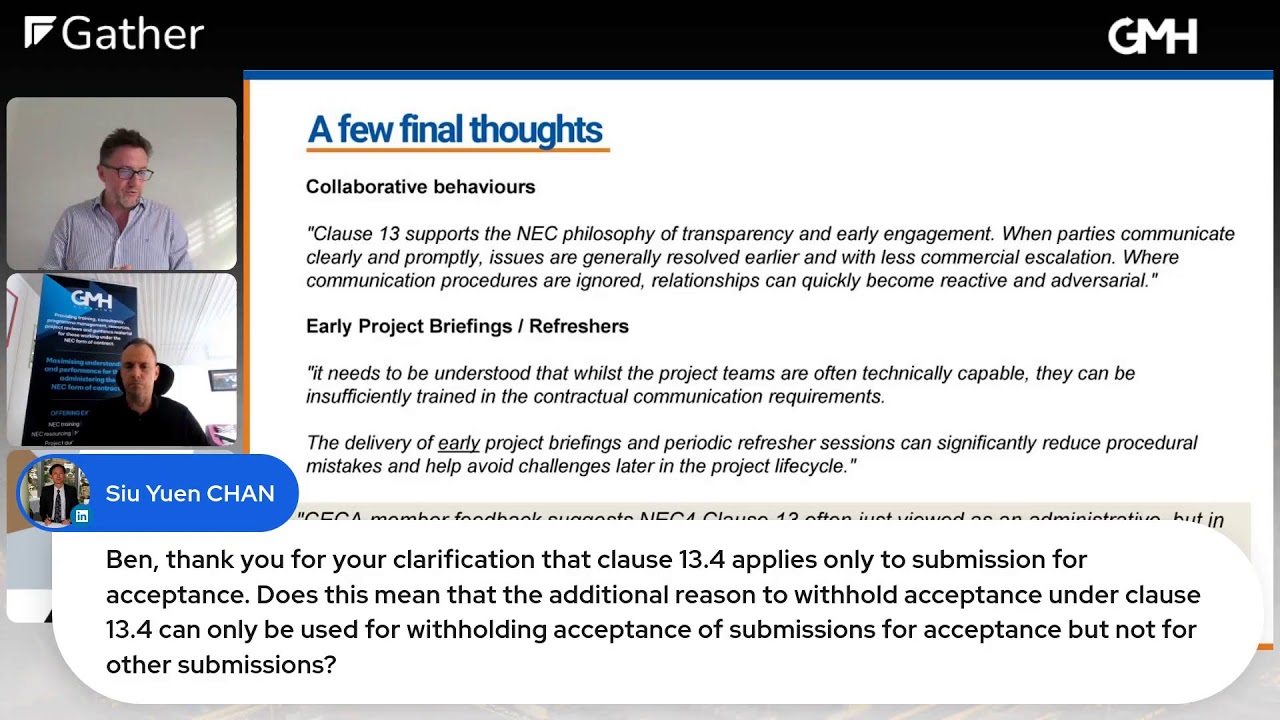
Thanks, David. Yeah, no, good, good summary. Um, we are out of time, so I— but I think we did questions during— it's quite good actually, quite a nice way to do them. I think we, we made sure we got a few more in. Leaves us to advertise episode 11. We're gonna have a little break because this is— there's a lot, a lot goes into these, so, um trying to squeeze them in through the summer was going to be difficult. So we'll have a little break and we're going to come back on the 7th of September with a topic called Communicating Correctly. So we're looking at the 8 simple rules of Clause 13, unpack those a little bit, think about how some of these systems— what are their benefits and making sure we're not inventing extra defined terms and and things like that that might be unnecessary. So it should be quite a good topic, Glen. I think you've originally done something around this, haven't you? So we've got a bit of a head start.
Yeah, we did one of our early Seeker Bulletins, so yeah, we'll be picking up on that thread and more. So yeah, very, very important topic.
Well, we hope you can join us for that, and I think in the meantime, this gets seen by about 3,000, 3,500, so maybe 4,000 people over the course of the next couple of weeks following each of these going live. And it's a shame we can't get the benefit of all their questions and answers as well. So if you're seeing this, please do post it live. So if you're seeing it after the event, please do get in touch on LinkedIn, drop us some questions. Particularly be interested in anyone who's used X21 and what your experiences have been, because I'm very inexperienced in it. It'd be really interesting to see how that's been used in practice. So I think that leaves us to say— bang on time, Glenn and David— so thank you very much, everyone, and we'll see you at the next one. And yeah, please do carry on engaging us in LinkedIn, and we'll see you all shortly. That's bye from me. Thanks, everyone.
Thank you too. Cheers. Bye.