$1.5 Million Business QnA!
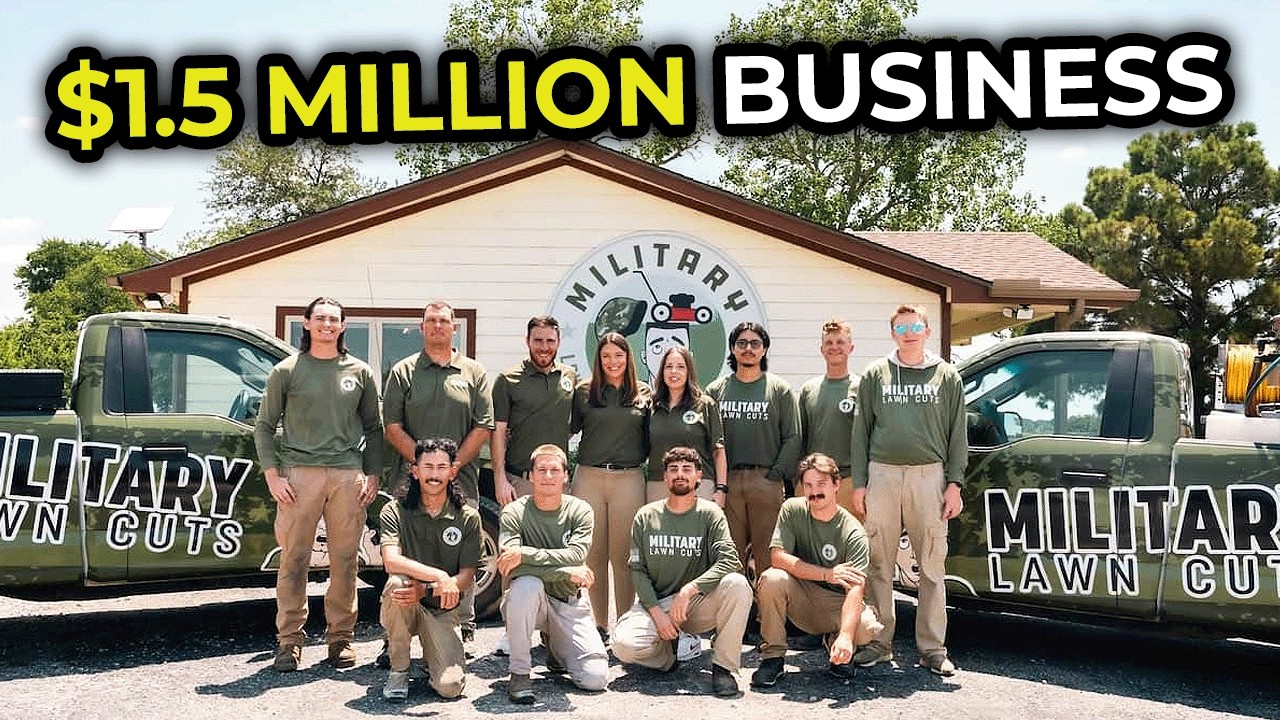
Will and Larissa Kelly built Military Lawn Cuts to $1.5 million across three locations with 22 employees. They keep profit margins around 12% and avoid dirt-cheap pricing that causes burnout. Door hangers outperform Facebook ads, and asking customers how much they value their time helps close price objections.
Chapters
You guys always hear from me, Will Kelly, but today I am pulling back the curtain and showing you behind the scenes of the operational mastermind, of the person who actually helped us build a $1.5 million operation. We're interviewing Larissa Kelly and putting her in the hot seat. Hey everyone, it's Will Kelly and Larissa with Military Lawn Cuts. We're running this back, number 2. If you guys like this Style of content. Let us know in the comments below. This is just pretty much open discussion, Q&A between each other on how we've grown three locations, and I think we peaked this year at 22 team members. So we're just trying to give value and give back to you guys.
Also, if you have like specific questions that you'd like for us to ask each other, either way, put them in the comments below so we can take a look at those and add them to the next video.
All right, I got a question for you, Larissa. So if you guys didn't know, let me give you a little background about Larissa. Okay, so she was a manager at Aldi.
She.
She stepped away from the business and came and started building our business, Military Lawn Cuts, which is ultimately God's business. While she did that, she was out in the field. Not only did she graduate from being in the field, but then she transitioned into the office where she was answering phones, emails, texts, and really doing CRM support. Not only did she crush it in the office, she then became an applicator out in the field where she sprayed for weeds, and did fertilizer and then worked her way up to be an estimator where she actually does estimates. She's not doing the physical work much. And then from there, she became a general manager where she was over 8 to 10 people managing the location. Did that for 2 years, went through the ebbs and flows of the seasonality and all those things, grew the business over and over again. And then she became a regional manager where she was over really like 20 people. In the company.
3 GMs and then their teams, yeah.
Yeah, so 3 locations. She's very operational savvy. There's no way we would be where we're at today without her expertise when it comes to logical thinking and operational things and like getting things done. This is the top-tier operations manager of Military Lawn Cuts that has gotten it to basically $1.5 million. What was the hardest part of that journey?
The hardest part? I cared so much about every single one of those guys, all the team members. And so the hardest part was when you care so much about them and they aren't doing what they need to or aren't following a system or a procedure and having to hold them accountable because I didn't like the confrontation at first, or I didn't want them to be upset and leave. Or be upset with me, but ultimately it was in their hands at that point. Like, we, we gave them what they needed to do and they weren't doing it, and so we have to hold them accountable. But that was my least favorite part.
So how did you handle improving that least favorite part?
Practice. I just, just having to practice it. It's just those conversations that I had to have and how, how I handled it. I had to toughen up my skin on that. By just practicing, by doing it, right? Getting the reps in and then realizing, okay, they don't hate me, they understand. They, they knew that they needed to do that and they, they missed that, uh, they missed that line, right? They didn't meet the requirement. So once I realized that, it wasn't so bad.
What was your favorite part of building the business in the day-to-day ops? By the way, if anybody didn't watch the first series, you can go back and watch that, but We just recently retired Larissa. We were blessed enough to have her step away from the business fully. I am the quote-unquote entrepreneur and the big visionary builder of the business, and she's a marvelous operation person as well. Obviously, co-owner. But so we officially retired her at 35. The good Lord blessed us enough to be able to do that. She's no longer in the Day-to-day operations, she helps out a little bit with like some marketing stuff, but yeah.
Consulting.
Consulting for sure. Yeah, she's now in the consulting business. So, okay, so what was your favorite part?
Your question was what's my fav— what was my favorite part? Uh, so okay, so I was in a bunch of different areas in the business. So my favorite, man, I, I think I reminisce the most going out when I did have a day off from Aldi and going out and mowing lawns.
Mm-hmm.
And being done by noon together and going to the pool. We really were a couple, like, as I stepped away from Aldi, that we did everything together. So we would go to bed together, we'd wake up together, brush our teeth together, get ready for work together, go and mow the lawns together, go do the applications together. We would be working in the office together once we had it like operating out of our house and getting the crews out. I would say that That was my favorite part, was just literally doing all of it together.
Yeah, that's good. Zuko's joining us in here.
If you didn't know, we got 2 dogs and 2 cats.
So, all right, I just wanted to ask you those questions.
I like that. That's a good question. Okay, I got some more questions for you. All right, so part 2. If you guys weren't here for part 1, part 2. But what do you say when somebody tells you the other lawn guy is cheaper?
Man, I gotta put my sales hat on here. Um, the other guy's cheaper. I mean, so then why are you calling me?
I'm just shopping around some prices.
You're shopping around some prices? Okay, so why, why are you leaving the cheap guy?
Uh, he was inconsistent.
So do you think that that's a reason why his price was so cheap?
Yeah, probably.
So with us, we're a professional company, obviously, and then that's when I would go into our spiel, just like military company quality. You know, it may be $5 more per cut, whatever, right? But it's the consistency. I mean, check out all our reviews and But a lot of times with sales, it's like asking the right questions. So you telling me like, hey, the guy's cheaper. Okay. So like, again, part of sales, the whole positioning of sales is like, I'm gonna lean back because I don't need this sale. When people like get needy and they don't know how to sell, they talk too much. They just do.
Mm-hmm.
And the great salesmen are kind of like not— they're not needy. Like, we're not— I'm not needy, okay? You got— you said your guy was cheaper, so why are you calling me? Like, I'm curious, genuinely, not in a disrespectful way, but, you know. And so a lot of times they'll showcase why they're unhappy with the cheap guy, or they stop showing up, and it's like, okay, well, how much do you value your time?
So really you're taking control of the conversation.
Yeah, and asking the right questions, right? Like, how much do you value your time?
Because some people only care about I feel like as soon as you lose control of the conversation, you lose the sale.
Yeah, I would agree with that.
So keep, keep control of the conversation. All right, what's a sales mistake that you see lawn guys make all the time?
They don't know how to price. They just come up with a number out of thin air or from the other company and say, this is what I'm going to charge.
I was going to say, they're going to be like, how much you paying now? Oh, okay, I'll do it for— and then they say like A couple dollars less.
Yeah. And what happens, because like I got a call this year actually from a guy, I forget his name, but he called me and he was like in corporate business. I was just like, yeah, I just started doing this on the side. I'm like, all right. Um, he's like, so I'm like, so why are you getting out of the business? He's like, well, I got like 20 lawns and it's just very, it's like taking a toll on me. It's very physical, which is fair, right? In Texas, the heat, And so I'm like, all right, well, what are you gonna do with them? And he's like, well, I wanted to see if, you know, I wanted to give them to a legitimate company that can service them. And I'm, you know, so then we get into pricing. I'm like, all right, well, how much are you charging them? And things like that. And he was charging them like $10, $15 less than we do, and they were biweekly.
Okay.
And so when you start to do the math and start to add it up, No wonder why he got those customers, right? Like, and he only did it for a spring. He got 20 customers because he was dirt cheap. But what happens is, and this is what happens to most people, the biggest mistake is they dirt— they charge dirt cheap prices, they get all this work, and then they get burned out and they get out of the business because they're working for pennies, literally.
And that is when we get so many customers that call us and say, my lawn guy just stopped showing up. I should have went with you guys the first time I called.
Yeah, or like— I have heard that from the office. The one you just gave me, hey, my other guy was cheaper. It's like, yeah, this is the exact type of person that's— we call these weekend warriors or chucking the trucks, um, that are kind of doing it on the side. And there's nothing wrong, by the way, if you're doing this on the side. There's nothing wrong with that. Just price accordingly to value your time. Right, like minimum, minimum dollar per minute. Like that, like nothing less than that, nothing less than that. And that's even low. Like we, we charge, what is it, $90 an hour at Aubrey?
At our main location.
Yeah, which is $180 for weed control per hour. Like that, that's what it is.
Well, that's also adding in the cost of like, we have a spraying rig, we have multiple spreaders for different granules.
Yeah.
The cost of the material, the fertilizer, that stuff's expensive. Price got jacked up on that. And then we use some pretty expensive chemicals and we treat weeds that other lawn care— not lawn care, other applicating companies don't.
Yeah, and the licensing fees and all that stuff.
Yeah, and the knowledge.
That's probably the biggest mistake, just pulling numbers out of thin air.
So should the business owner still be answering phone calls at a 500 number? Depends on their goals.
What do they want to accomplish? Do they want to be in operations still and in sales still and admin? They could. You could very well build a very profitable business by answering the phones. It's whatever their goals are. If they have goals to get out of the business and out of the day-to-day and build a business that runs without them, I would say at the $500K mark they need to— they probably need to start to hire out the admin. Where do you think they need to be? Whether that be like a part-time person or full-time in the field with seasonal hours in the winter, depending on the area also, because we're in Texas.
So you've made a $1.5 million business.
We.
That started— we— that started with a $100 mower.
Yeah.
So how much of that $1.5 million ends up being profit?
Okay, this is a great question because I remember going to a winery over here Linking up with a couple other lawn care business owners, and I shared with them the profit and loss when we were doing like $700K. I was like, look, we made $700K in the business, this is how much we took home. And they were all like, all their jaws dropped. They were like, that's not true. I said, okay, so your question is, on a $1.5 million business, how much does it cost to run the business? Or like, how much are we keeping?
How much of that $1.5 million It depends.
But if you're referring to our business this year, so let me give you a little bit of context there so it doesn't like— so you guys' jaws don't drop. We have 1 location that's in profit mode and 2 that are in growth mode. So, growth sucks cash.
Mm-hmm.
Generally speaking, when you're hockey stick growing, you're growing your top-line revenue but the profit is getting eaten up by the growth. Because you're buying a lot of trucks, you're hiring a lot of people, you're doing a $100,000 door hanger push, right? Like we're spending all of these marketing dollars. But generally speaking, on a $1.5 million business, I mean, I would need probably my calculator here, but on our business, I would say probably 12% of that, maybe 12%, would be a fair profit. With having 2 locations in growth mode and 1 in profit. I don't know what the numbers are, but maybe like $200K, $225K, $250K, maybe somewhere around there.
Yeah, and we give profit back to our team and everything as well.
Yeah, and for anybody that's watching this that's maybe on our team that's like, wow, you guys make a lot of money. Yeah, we are. We're gonna take that money and we're gonna go launch location 4 and location 5 and location 6. And we also, by the way, grinded for 6 years without paying ourselves. So Like blood, sweat, tears, literally Saturdays, like 6 days a week because we don't work on Sundays. And obviously a lot of the good Lord's blessings. Like hard work pays off, and we've failed so many times and we just got better. So we just figured it out as we go, and it was a lot of stress. Still is sometimes. But yeah, it's a lot of, it's a lot of things.
So speaking of money lost or things that stressed, stressed you out, What is the most money that you've ever lost because of a bad business decision? You can tell I did not let him know any of these questions before because he has to think about them.
The worst business decision that cost us the most money? I don't know. Do you have any ideas or any—
I immediately— my first thought was like flyers at the wrong time, but I don't think that was a bad business decision. I think it was more of a, like, on-hands, like, learning at that time. You know, we tried it, learned from it.
I don't have like this specific one that's like trumps everything, like, oh, this is it. But I definitely have made, we have made probably $8,000 to $15,000, probably like $8,000 to $12,000 mistakes. Whether it's like an EDDM push that flops, I mean, we sent an upsell out recently for mulch at our Aubrey location that just straight flopped. We sent, we sent a text out to 3,500 people and 3 people asked for a quote. 3. And out of those 3, one's gonna book.
And that's where it goes back to timing. And it's the same thing with the flyers, it goes back to timing. A lot of the decisions that we make in the business, it's— the timing is crucial.
Yeah, yeah.
Right? So like, there's times we're in a drought here, so you don't want to send certain upsells out because you're You're in the middle of a drought.
Yeah, and like the thing is, is, you know, because in the manager that pushed that out, like, he did nothing wrong. Like, in fact, he did everything right. We just didn't know what we don't— we didn't know. Like, we didn't know mulch didn't work in the winter— in the summer. I had never sent just a mulch-up cell in July or August in Texas. So it's all— to me, it's only a mistake if you don't learn from it, right? Like, we learned from it. We took that information, we updated our monthly upsell calendar to not have mulch go out in the summer.
Yeah, right, because we always did mulch in the spring, right? Everyone wants it done nice and clean, ready for spring. So spring cleanup. And then also we've pushed it out in the fall before winter because it also acts as a blanket for the plants or the bushes in the bed and it protects them.
Yeah, spring and fall is definitely The time for mulch.
At what revenue number did you finally feel like, okay, this thing might actually work?
What do you mean by actually work? Like we're building a business that can sustain our finances or like we built a business that ran without us?
Like this business is going to be successful. Like this isn't— so you've had a lot of business ideas before Military Long Bets. And you've probably thought that those would work too for them, right? Like you were trying to do multiple different things. This is the one that actually did work. So when did that in your mind click?
So this is the one. Okay, my initial thought was when we put the stickers on the truck.
Okay.
Because there's no turning back, right? From like a pure pride and ego perspective. We just started this business. We put the logo and the phone number and says Military Lawn Cuts on the sides of the truck. how silly would that look 6 months from now? I'll be like, yeah, like everybody sees our truck in our driveway and then it not be there.
Yeah.
It was like, so like at that moment it was like, okay, this is becoming official. We gotta make this thing work. Otherwise I don't wanna look silly like trying to start this thing and it doesn't work. That was like the first glimpse. And then I don't know, when I, when you look at the trajectory of like how fast we've grown. So it was like $18K the first year, I think $108K or $118K the second year. second, and then 365, and then 650. So like at some point in that, probably going from 365 to like 650, was like, whoa, okay, like this is— there's something here that keeps multiplying. And of course, obviously, like we're— I'm just a vessel, you're just a vessel, right?
Yeah, we were growing very quickly in those first few years where we had to like put the brakes on.
Yeah, yeah, otherwise you're just building chaos and A non-system business.
For me, I think one of the biggest parts where it was like, this, this is the, this is the business we're supposed to be pursuing. And I remember this still so vividly. We were sitting in our bedroom and trying, and you were like, we gotta, we gotta come up with a name, right? And I had said, don't use your name, don't use your initials. You're gonna get— it's not memorable, it's gonna get lost in the mix, right? And I was like, We now live in Texas. They're super veteran-friendly and pro-military. And I remember we were sitting there and I'm like, Army? No, we can't leave out the other branches. I'm like, you're a paratrooper, that'd be kind of cool. I'm like, I don't know how to use that. That's sky, this is ground, like completely opposite. And then it was like, okay, military veteran, okay, a little bit military lawn service, military lawn care. Military lawn cut. And then it clicked and I was like, military lawn cuts, like a military buzz cut. And we can make it comical with a guy and a mower going over his head. And I had it drawn on a Post-it note and I don't know where that Post-it note is. I think you kept it somewhere. I just don't know where it is. And then we went on Google immediately and pulled up like the eyes and the kind of comic guy that we would want and what the mower would look like. We sent it to a logo designer And you're like, that's a $100,000 business.
No, I think I said a million-dollar business, or maybe—
No, you know what, I think you're right. I think you did say you're like, that's a million-dollar business.
Yeah, it's a million-dollar business.
And I was like, no, it's not. No, it's not. Like, I, I was doubting because it was me that kind of came up with it, so I didn't think it was that great. But I liked what I did at the same time. But it did, it got us to a million dollars, and then we revamped our logos. Like, that's older one, but we revamped our logo so that way we could make it bigger. And so you could see like why we had to change our logo. We were stuck. We couldn't make it any bigger on the truck. We couldn't read it easily. And so then you were right, that was a million-dollar logo business.
Yeah.
It did get there before we revamped it. I saw that part, you saw the other, the other part, and that's where we balance each other out. But I think that's kind of when it hit for me.
I, I believe it's a $10 million business. I see it as being a $10 million annual business, and that's probably with 12 locations.
I think we could do it with less locations.
Probably. We could probably do it with 10.
I think 10. What's something that you thought would make you more money but it actually didn't?
I mean, some marketing strategies that didn't work.
We did try to veer off from military lawn cuts and try military green lawns.
Yeah, and I, I wrestled with that for a while. And then I realized that we're here to make an impact on people. And I was trying to get theoretically in my brain, like, if you had to build a million-dollar mowing business, you would basically need like 8 trucks, 7 or 8 trucks of just straight mowing. And then you would need 2 people in each of those trucks. That's 14 people if you were building just a mowing business versus if you were building just a weed control fertilization business. To build this same business at a million dollars, you would only need four techs, maybe five. God, this is so much easier, right? Like why don't we just do this? I can pay the four people way better. I can take care of them. I can pour into them. But he had a bigger vision, and he had a bigger impact on our lives to to to not take the easy route, to do the hard work, to put the efforts in. It's going to be a much longer-lasting impact. We can influence people. It's the best ministry that we have, which is our business, which is ultimately his business. And so I wrestled with that for a long time though, but I am convicted that Military Lawns Project is the way. And what we're doing, what we're building, is, is the, is the engine to reach more people.
And we can't say we didn't try it, right? So like, we, we got uniforms that had said Military Green Lawns with Different, a different guy, different logo. We had gotten our weed control truck logoed with a different, you know, with Military Green Lawns, the same thing, right? So we did try it, but we reverted back to Military Lawn Beds. So that was the vehicle.
It is the vehicle.
All right, let's do a little more of a rapid-fire section.
All right, rapid-fire time.
Solo or employees?
For what? Like, okay, let me ask you, if you're gonna rapid fire, is this like my preference? Is this like what I wanna do? Yes. Okay, so team members all day. I don't, by the way, I don't call them employees. They're not members, they're team members.
They are team members.
I never will, even when I'm talking to the team, I never say the word employee. It's very, very, very, very rare unless I'm really trying to drive a point, but 99.9% of the time, they're team members.
They are. We do call them team members.
So I pick team members all day.
I would agree, right? We're all, we're all better as a team. More minds together, we're able to help more people and reach more people, more customers as well. Facebook ads or door hangers?
Door hangers all day. You could build them, you could build a— we could probably build a $10 million business on door hangers in this market without even touching Facebook ads. And that's how confident I am in them.
Residential or commercial?
Residential.
100%. We've done both. Weekly or biweekly?
Weekly.
Buying equipment cash or financing it?
Cash.
Cheap mower and more marketing or expensive mower and less marketing?
Cheap mower and expensive marketing in the beginning, uh, which I— expensive marketing sounds bad because that sounds like it has a higher customer acquisition cost. Okay, more marketing all day in the beginning, all I would trade that off for like, honestly, the first like 5, maybe like first like 2, 3 years, 2 or 3 seasons. You're just cheap equipment, pouring it all into sales, sales, sales. That's how you hockey stick growth. And then once you get up to where you have like 4, 6, 8 team members, you can't afford to have cheap broken down equipment because labor is the highest, most expensive line item on a P&L.
Mm-hmm.
That's when you have to switch over and be like, okay, I actually have to buy new equipment to keep the labor productive. And that's when you make the switch.
Raise prices or add customers?
See, I'm doing it, I'm doing both. I'm explaining both. Is that okay or do I just have to pick one?
I guess explain your why.
Okay, so in the beginning you always wanna grow to capacity. So if you have one truck and you can do 50 customers for one guy, you put 2 guys in the truck, that can get you to 100 customers with one truck, right? Once you get to like 80, 90, raise prices for sure. Or even when you get close to 100, which actually we have— we did raise price one time when we were at capacity, but it was only just because we wanted to take care of the guys because we pay based on performance. Generally speaking though, I would, I would lean— if I had to pick one, I would raise prices. Okay, if I had to pick one.
And if you had to pick one, fire a difficult customer or deal with them?
Oh, I would fire a difficult There's so many residential clients here.
And you don't want to have every single customer, right? Like, there's going to be some that are not the right fit for you. For example, that needed more of a personal gardener for what they were wanting. It's just something that we don't offer. They're just not the right fit for us.
Yeah.
And we're not the right fit for them.
Yeah, said very well.
$100,000 solo or $500,000 with team members?
$500,000 with team members, all day. It takes a while though. Like when you get there, if you haven't managed people before, that's a skill set you're gonna have to learn. But once you figure it out, all day.
All right, so one team member or one new truck?
Okay, that one I don't really get. Let's elaborate on that. Right now, 'cause we have 9 trucks, 22 team members. So you asked me if I want one more team member right now or one truck?
So I think this is going more into like, do you want to get a new truck because you have too many team— too many team members, or would you rather have like less team members and not have to buy another truck?
Well, it depends on what the goal is, because if we're not going to buy another truck and we're not going to add another team member, then you're in profit mode, so you're probably raising prices.
Yeah, so I think it depends on like the location. So like We have a location we're not going to add any more trucks.
Correct, but the other 2 are probably going to buy 2 trucks, 1 truck each.
So it does kind of depend on scenario-based. Yeah. 1 great salesperson or 2 great technicians?
1 great salesperson. Sales cures everything in the business, and if you could just sell, it'll get you out of most problems.
And it's such a good skill set to have in life.
Yeah, and plus like the technicians I mean, our guys make like $35 an hour mowing lawns. So some of them are making $40 an hour mowing lawns. So I'm sure we could find a couple technicians that want to make $35 to $40 an hour very smoothly, versus it's harder to find a really good salesperson that knows how to sell.
Yeah, that's all I got.
All right guys, if you have any questions or want us to review topics, put it in the comments below. Do you have any words for the people?
Thank you guys for watching. I hope this helps someone, at least one person, if not multiple.
Thank you guys so much for watching. Click the subscribe button so you can grow a more successful lawn and landscape business.








