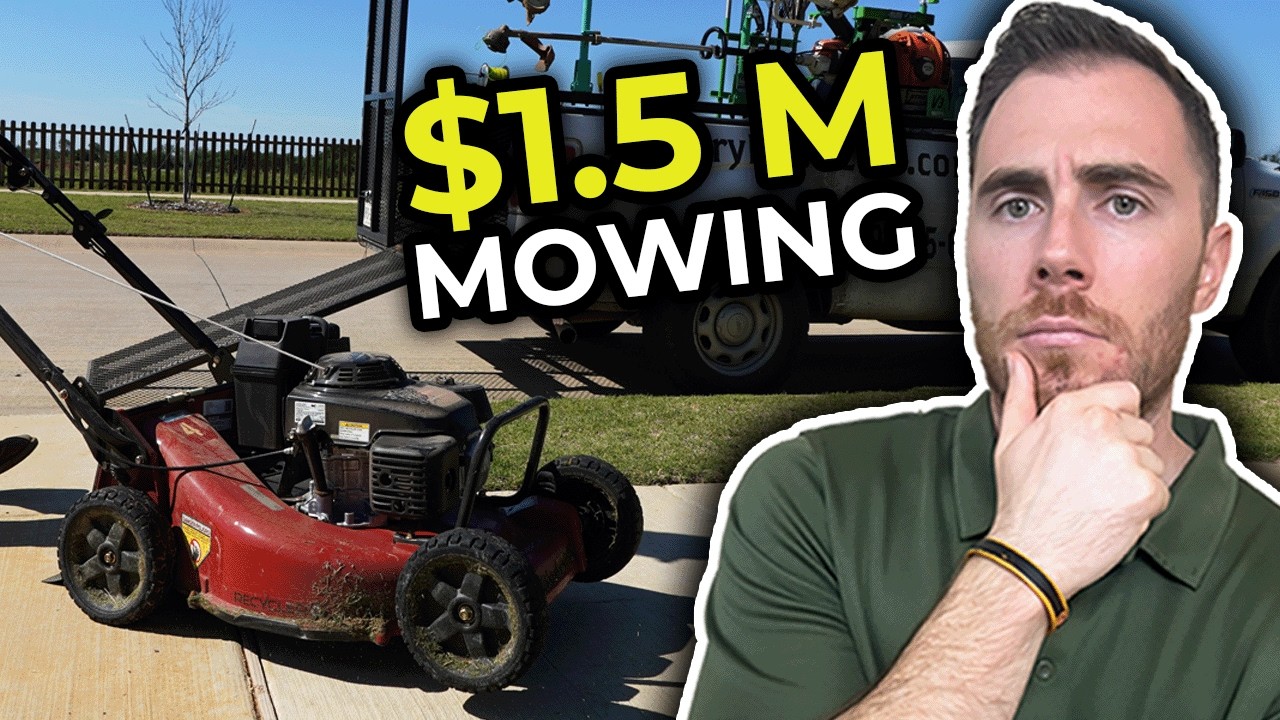
Will Kelly grew a lawncare business to $1.5 million a year starting with a $100 mower and a Pontiac, no debt. He built it by reinvesting revenue and choosing slow growth over borrowing to expand faster.
Chapters
We grew this business to roughly $1.5 million a year without taking on business debt. Our trucks are paid for, our equipment is paid for, and there were definitely times borrowing money could have helped us grow faster. But knowing what I know now, I still wouldn't change how we did it. And it's not because I think debt is evil or that every business owner needs to do exactly what I did. It's because growing without it forced us to learn something I think a lot of businesses skip. We had to make the business actually work before we could afford to make it look successful. You see, when we started, I had basically nothing. I bought a used residential mower for $100 off Facebook Marketplace. I didn't have a truck. I had a Pontiac Grand Prix. Eventually we bought an inexpensive pickup truck for $4,000. We used cheap equipment. We made stuff work. And obviously that was partly because we didn't have a bunch of money. But looking back, that constraint was probably one of the best things that could have happened to us. Because imagine if somebody had handed me $50,000 or $100,000 when I started. I probably would have gone and bought a nice brand new truck and a new trailer and all these commercial mowers and a bunch of brand new equipment, maybe gotten a shop, and I would have felt like I had a real business. But there's one massive problem: none of those things give you customers. A customer gives you business. So from very early on, our focus became generating revenue and then using that revenue to buy what we needed next. Get customers, do the work, make money, reinvest the money, add capacity, then do it all again. And that sounds slow, and sometimes it was, but there's something really powerful about making your business earn the right to grow. Because instead of saying, I think we're going to need another mower, and going and borrowing money for one, you start asking better questions. Do we actually need this? Is the equipment we have being fully utilized? Is there another way to solve this? Will this purchase actually make us more money? Can we delay this and wait another month? Can we buy used? Can we do more with less? That's resourcefulness. And I think resourcefulness is one of the most valuable things you can develop if you are just getting started. Money can hide bad decisions. When you don't have unlimited cash available, bad decisions hurt immediately. So you learn. Now, I also don't want to make debt-free growth sound perfect because there is absolutely a cost. Sometimes you wait. Sometimes another company is able to expand faster than you. Sometimes you have equipment you would love to replace, but it still works, so you keep running it. Sometimes an opportunity shows up. You have to say not yet. And if your only goal is maximum growth at maximum speed, our way may not be the fastest possible way to do it. But the fastest and strongest are not always the same thing. I care a lot about financial peace. I care about being able to sleep well at night. And I care about the business being able to absorb a punch or two because business is unpredictable. Equipment breaks. Customers leave. The economy changes. You make a bad hire. You make a bad decision. A location underperforms. Stuff happens. And when every truck, every mower, every piece of equipment has another payment attached to it, those problems don't stop the payments from coming. That is what I don't like today. When I look at the trucks and equipment we've accumulated. I don't just see assets. I see breathing room and clarity and peace of mind because they're paid for. If we have a rough month, the bank isn't asking me for a truck payment on every truck sitting outside. That matters to me. And here's another thing that's really important. Being debt-free does not mean being cheap. Those are completely different things. We've spent plenty of money. Trust me, we've bought equipment, we've invested in marketing. In fact, shoot, this year alone I think we spent probably $65,000 in our spring push. We've built systems, we've invested in infrastructure in the business, we've grown into multiple locations. I'm willing to spend a lot of money when I believe it's a good investment. The difference is I want to be a good steward of the money we've actually produced. I don't want being debt-free to become an excuse to be scared, because fear can hold your business back just as much as reckless spending can destroy it. So there is a balance. One owner buys everything because he thinks buying stuff equals growth, whereas another owner refuses to invest in anything because he's terrified of spending a dollar. Spending money is a muscle. It's a muscle that you need to expand. I don't want either one. I want to ask, what is the best use of the resources we have right now? That's the question. Sometimes the answer is keep the old mower. Sometimes the answer is buy 3 new ones. Sometimes the answer is spend a bunch of money like we did on marketing for spring. Sometimes the answer is hold cash. But the decision should come from stewardship and math, not ego. And ego is a massive part of this, especially when you're starting. You want The nice truck. You want your company to look legitimate for the neighbor to see that you're successful, or your friends on Facebook. You pull up next to another business owner who's got a brand new diesel truck and a giant trailer, and suddenly your old stuff doesn't feel good enough anymore. I understand that, but I've learned to care a whole lot less about looking successful and a whole lot more about actually building something healthy because nobody looking at that $100 mower inside of my Pontiac Grand Prix would have thought there's a million-dollar company. It looks stupid, but it worked. It made money. And then that money bought the next thing and the next thing that helped us make more money. We just kept repeating that process and reinvesting into the business. That's really my philosophy. You don't have to own the final version of your company from day one. Let the version one help pay for version 2. Let version 2 help pay for version 3. Keep reinvesting, keep improving, keep building. And if it takes you a little longer, that's okay, because the goal isn't just to grow. The goal is to build something strong enough that you actually get to keep it. If you're trying to build a real business, steward your money well, and eventually build something that doesn't completely depend on you. Subscribe. That's what I'm all about, guys. We'll see you in the next video.