Blind Norwegian Wedding Photographer Powerful Story with Inese Kungurova
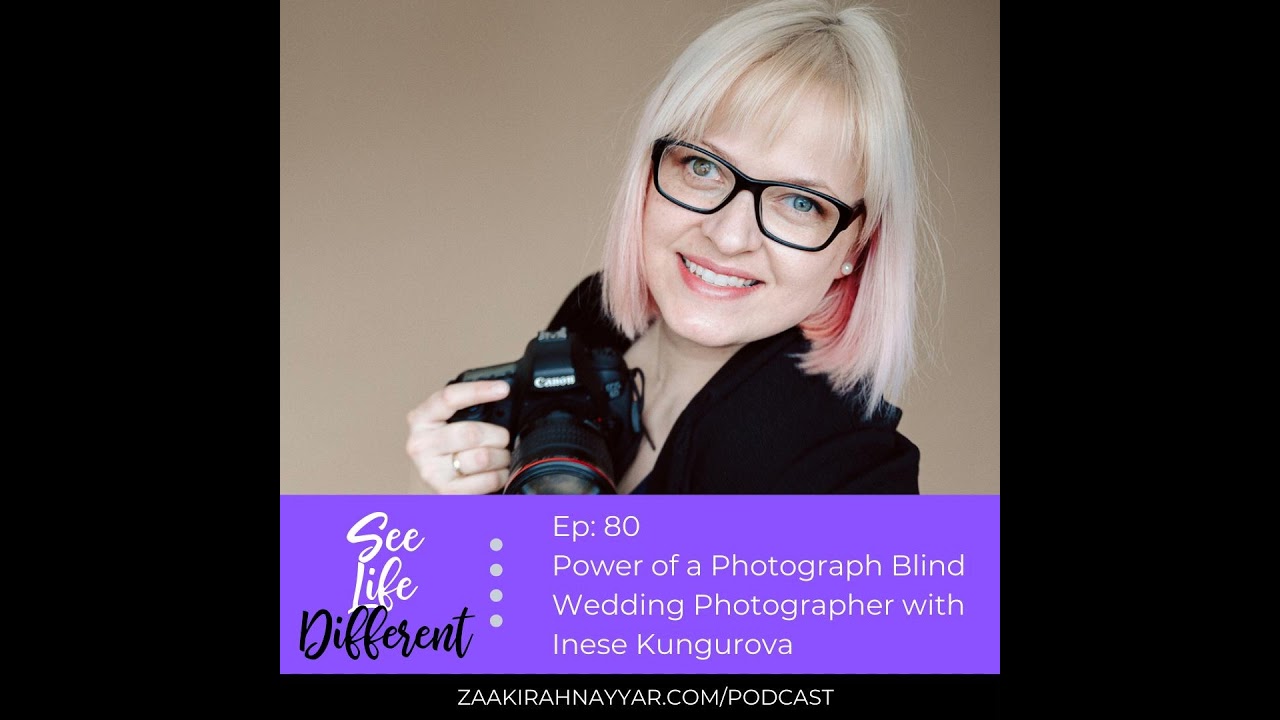
In this episode of the See Life Different podcast, host Zaakirah Muhammad interviews Latvian‑born wedding and portrait photographer Inese (IneseFoto) who lives in Norway. The conversation weaves through Inese’s childhood, early fascination with cameras, a traumatic eye injury at age four that left her with a blind, crooked eye, and how that shaped her identity and confidence. She recounts her informal start in photography, a two‑year part‑time photography school, and why she advises against formal schooling in favor of mentorship and hands‑on experience. The pandemic of 2020 forced a business pivot; with the help of a local mentor, Inese re‑examined her strengths, embraced her uniqueness, and rebuilt her client base, leading to a surge in bookings. She discusses cultural pressures in Norway to “blend in,” the concept of the "jenta‑loven," and how being an outsider became a market advantage. The interview also covers practical challenges of living with monocular vision—driving, peripheral perception, and using the camera viewfinder—along with her coping strategies. Inese shares personal struggles with infertility, multiple miscarriages, a large uterine myoma, and finally the birth of her daughter, whom she calls her "rainbow baby," reflecting on guilt, gratitude, and the impact on her business. The conversation ends with her travel plans to visit family in Latvia, her online presence (primarily Instagram under the handle Inesefoto), and a brief plug for Zaakirah’s own creative community. Throughout, the dialogue is candid, reflective, and motivational, offering insights into resilience, identity, and building a photography business as a visually impaired immigrant woman in Norway.
Chapters
So this is what happened to me in 2020. I was at my lowest thinking nobody's gonna book me, rewriting everything, putting on table everything what I want to be, where I want to be, what I want to do, who I want to attract. And then all of those Hugh Bryce's sayings actually clicked, you know, like all of that. Because you have to still understand, she's American, or no, she's Australian, and I'm some girl from Europe. Like, there's lots of things that fit, but there's still lots of things that doesn't. When she said, no matter how big or small your city is and you can sell, she was so right.
Today we have Inessa. She is a Latvian wedding and portrait photographer living and working in Norway. So she's a cat lover. You'll probably see the cat roaming around in the background if you're watching the YouTube version of this video. She's multilingual, outdoorsy. She speaks 4 languages and has been happily married to her husband of 14 years. So she photographed her first wedding in 2014 and decided to go full-time in 2019. But what's going to be really interesting about this conversation is that if you're watching on a YouTube version, you'll see that she had 2 different eye colors. So we're going to talk about that and why it's so unique and how it allows her to have such a unique perspective as a photographer. Her journey didn't start with photography, so we're going to break it all the way down and start with childhood. Inessa, how old were How you when you started are you? Thank you for being here on the See Life Different podcast. I'm glad that we were able to connect because we met unofficially. I was on a podcast, one of your favorite podcasts, and you reached out to me. I was on the Shoot Bright podcast and you reached out to me to say, I've never really known many other photographers that were also blind in one eye.
You're the first person I know, not just photographer, but the first person. So I was like, ding, ding, ding, all checkmarks.
Absolutely. Perfect. And so far, just what I've learned And just from like reading your bio that you submitted for your first ever podcast, it's been— it's definitely an interesting story. Maybe let's start with that because that, that's a huge part of who you are. Let's start with what makes Inessa Inessa.
Like which part? There's a lot of things. Like when I look back through the history of when I was a kid, a teen, young grown-up, starting, you know, life with my husband, all of that, making family, now being here doing what I am. Like, all of it is part of me. Like, all of the struggles at school, like, it all just builds to the woman that you're today. And I feel like this is not it. Like, sometimes you listen to podcasts and you think like, oh, they're there, they're there. No, I don't feel like I'm there. I feel like I'm going there. Like I have a goal. I see it. I feel it, but I don't feel like I'm there there. So it's a, it's a journey. It's fun. And it's interesting to finally kind of grow into the Ines, you know, um, that I kind of envisioned for myself. Like I'd never envisioned for myself. I want to say envisioned. I never imagined this for myself.
So when you say this, I know that, um, Let's start in 2014, um, when you were photographing your first wedding, because I'm sure there were lots of thoughts going on, because photographing weddings itself are like, woo!
Yeah, it was actually so exciting. I had a camera since I lived— like, it's a mix. I have been on and off living outside of Latvia. Latvia is my home country, so I have lived in Norway, and I got the money, I got the really cool camera. It was actually a Canon 550D. I think you I think you call it 3Ti or something in America. That's the difference. I was looking into cameras and just capture my boyfriend, my travel, and everything. And then when I came back, I was invited to this really low-budget wedding, but nevertheless, I loved it, all the energy and to be behind the camera. And I felt kind of safe. Special even though I was not the bride, and I made her feel special. And I was like, I want to be a wedding photographer. And I remember the next day there was an after-party beside, you know, like we had fun and drunk a little bit, a little bit so much. That was like still taking my camera, it was all the time in my hand. I remember giving this girl like 5,000 JPEGs after this, like 5,000 JPEGs because I gave everything, you know, and I didn't ask for money. It was just, you know, I did for myself, but it clicked and I wanted. So I went to a photography school and when I went to photography school, if you ever have been with old white dudes that, you know, stuff and they love photography and they all about like art and, and this and that, they were like, really, you know, nose up.
Weddings?
Really? You want to do weddings? Like, really? But I finished the school. Um, I did it. So that was like from 22, from 22 people that we started, only half of us finished the school. And it's pretty common. They said half of you only gonna last here. So I was like, okay, I had to go through, like, I had to be the one that finishes it. So when I finished, I was like, so what now? When I remember, like, oh, now I'm going to be this professional. Oh no, you're so far from being professional when you come out to the school. You're like just the hobbies, like nothing changes. But you know, it gives you some kind of perspective of what you want to do, what you like, what you don't. But to say anyone, like people sometimes ask me, probably you get this question a lot. Like, should you recommend going to photography school? I would say no, don't waste your money. Take the— buy the camera for that money and find the mentor and work for free. It's gonna be cheaper and faster, right?
Now tell me, what, um, how long was school for you though?
For me, it was 2 years actually, but it was, uh, I think A few times a week in the evenings, so it wasn't like full-time school. So I had a job and on the evenings I took the classes, but it was fun. I found some people and I think from all of us, like 2, 3 does photography and maybe one, I think, does it as a job. And that's— I don't know any of them that are doing this as a job now. So yeah, that part.
So I think I asked because I ended up picking— well, for me, I had been studying photography at 2 different schools. So one, I was still in high school, and we have what they call a technical school where you get your high school diploma, you get a certification, entry-level certification. And so I chose photography.
Of course, that is the one that I have. That is the one that I have, only I took just the photography without the high school. Like, I have the high school, so it's just the photo. That's the one that I have.
And then I continued that education. I wasn't sure if I wanted to, but I did, like, 6 months later, continue that education into a 9-month program. But I was full-time, so it was literally like Monday through Friday in school, Saturday and Sunday practicing. So yeah, I did a lot of trade for TFP photo shoots. But I think also now, I mean, we have an advantage because we got that education. Because a lot of people now, at the time that we were going to school, were studying YouTube University, which is fine. But yeah, I mean, that's actually where I am now. Like, I'm a mentor to photographers that are literally just picking up cameras. They remember they loved it as a child and they're picking up a camera again. Now they're asking me, how do I, you know, make money from it? So yeah.
Let me turn off my sound. I'm sorry for that. This is how unprepared I am. But yeah, it's right. Like you kind of are a step forward to everyone else. But in reality, you know that of course I didn't have the full time, but I think, I think I added myself a lot of like YouTube university. And I now saw just today that this was actually 7 years ago. So this is like almost a decade ago that I was in a photography school. So things might have changed, but YouTube I think is now even more fuller with information. Even even the big stars like Sue and and my first actually mentor was not mentor, but like like a star I followed was Susan Stripling. If you know her, she is all about weddings and she's in New York. I don't agree to 100% what she says, but she's super smart and she knows exactly how to explain. So I use everything she teaches into building this business here in Norway. Like, I started with her, and that is how I implemented, like, all of this. So having some sort of education that you can easily, like, scoop information from, like, no matter is it paid, it's free, it's YouTube, it's your mentor, whatever, always recommend it. Just, you know, pick a source.
I definitely agree, because actually my favorites were— actually, I knew about one called Jasmine Starr. For me, there's a different perspective of like, I like to find ones that have similar nationalities as me, but there were no women. There were no women at that time. The guys that I would follow, there's one called Matthew Jordan Smith, and I came across his books at the library. My mom worked at the library at that time, so I came across his books at the library. Seeing, okay, you can publish your work. You can work for a decade. I remember holding onto that part of his introduction of his photo book. You can do this for a decade and have timeless work, timeless work. Because for me also, I actually started off with travel photography. My parents gave me a camera, I was 5 years old, but we were always on road trips and going to see family. And so I had my camera that way. And then it wasn't until, Well, I was always the little historian in the family anyway, so I was the one taking the photos everywhere. But really, I didn't really know that you could make money from it until school. So yeah, I started off with travel photography and then it was shifted over to portrait photography, lifestyle photography. The name changes all the time. And so now it's also brand photography. But how have you been kind of making that pivot also, especially— let's talk about 2020 for a little bit. How were you able to make that pivot when there weren't that many weddings?
I have to say, 2020 was a blessing in disguise. I have never been so poor and happy at the same time. I was unhappy, but happy. I found another mentor. I have always this glitch in my head. Whenever I feel stuck, I'm like, okay, you need education, find it, and then something comes along. So I found another educator. She's here local in Norway, Ingvild Kolnes. She's all about finding kind of you, because all of these big education programs, they don't really focus on you as a person. But she really zoomed in, like, you know, take all the shit away, and this is why you rock as what you do. So that is when I kind of blossomed. I saw what I wanted. I knew exactly what is my client. I knew exactly why I'm awesome. Like, that was the hard— like, the hardest part was sitting down, looking at yourself and saying, okay, this is where you suck. And this is where you're awesome. And this is why you should get paid equally or more. Because I remember when I moved, I had this mentality of, Blend in, fit in, shut the fuck up. Sorry, I hope I'm allowed to say that. Bleep that out. But like, blend in. And I had this mentality all my life because, you know, of the eye surgery that I had as a kid. And we didn't even touch this, but I actually have a crooked eye, and that is from because I can't see. So it is something on my face. People can see it. And I hated the idea that I stood out. All my childhood, my grown-up life, like, I hated that I stood out. So that is why I started wearing glasses, because nobody looks at your eyes so much, I would say. And I lied to my first eye doctor that I can't see a line, and she actually prescribed me some glasses, but I later on started to need them. So sorry about that. This is just a little bit of the background of how shitty my headspace was. Like, I was blend in, don't stood out, be blah. Like, don't have a take, like, don't have an opinion, um, shut up and just be as normal as possible. And Ingrid actually was the one that brought Ines out, and she was like, you rock, why do you want to hide that? Like, You are awesome at this. Why do you want to hide that? And then I remember, like, I knew some Norwegians, so it was easy, if I would say, quote marks, easy to blend in. But then I remember I was complaining to somebody. I'm a complainer, so I was complaining to somebody like, well, nobody's going to hire me because I'm not a Norwegian. And she's like, shut up. That is why you're going to be hired, because you are not a Norwegian. And then I'm like, yes, this is my— what is that saying? Like the horse to ride on. Like, take it and go. So I was— I have been sitting on this horse riding in bad. Like, if you look at the standard Norwegian, like if you live here, they like to not stand out. They like to be with little— like don't show too much opinion. There is even a name for it. It's called jenta-loven, and it's pretty much we all are as one. You don't matter as a person. We matter as a group. And there's a lot of, like, people that are, like, trying to obey this, but also there's a lot of people that are trying to get out of this unwritten law of not blending in, like, being different and being unique and And actually not being afraid of standing out. So this is what happened to me in 2020. I was at my lowest thinking nobody's going to book me, rewriting everything, putting on table everything, what I want to be, where I want to be, what I want to do, who I want to attract. And then all of those Zubrises sayings actually clicked, you know, like all of that, because you have to still understand she's American or no, she's Australian. And I'm some girl from Europe. Like, there's lots of things that fit, but there's still lots of things that doesn't. When she said, no matter how big or small your city is, and you can sell, she was so right. And then when I came here, I see other Norwegians struggle selling, and I'm like, there's no richer country to sell. Go and sell. They have money. Go and sell. You just have to provide service, You have to love what you do. You see how enthusiastic I am about this? Like, I'm like, you can do this. If I can do this, it's like everyone can do this. So I found my horse. That is what happened to me in 2020. I found my horse, and I've been riding it, and I'm like super happy. And in August, I actually did almost as much in like invoices as I did in 2020. This August, I wrote in invoices only as— oh, I can't talk. Let me do it one more time. This August, I wrote in invoices almost as much as I wrote in whole 2020.
And I'm so glad you mentioned that because a lot of people either had to or still are trying to break down the root of who they are. And even, I think even for me, I think it's something about the new shift, the new retrograde of getting you to that point mentally of like, okay, there's a new millennium happening. What are you going to do about it? Right. Especially with the new digital entrepreneurship space. Of course, you know, old school word of mouth marketing works, but you now have Facebook ads. You now have, like we said, online courses, all these podcasts. And so it's easy for people to get overwhelmed and forget who they are at the core. I've been through it too. It's like, okay, I have to remember, like, I was doing marketing for so long, other nonprofits and small businesses and startups. But photography is at my core. I mean, it's in my name, like literally, Nayyirah means bright light. I was saved by the bright light of a photograph with a camera. And I was given a camera at the age of 5. So photography is a part of who I am. And so, of course, you know, when I get away from that, I don't light up. I don't light up and I'm not like happy and I'm not making money. So it's like, okay, who are you and what do you really want, right? So you definitely got to boil it down to that. And I think that's what a lot of photographers have to really realize. Don't do it just because your family said, hey, can you take pictures? If you prefer to take pictures of landscapes, do that. If you prefer to take pictures of babies, do that. And so I think, you know, that's what a lot of people had to really rethink. reflect on. Use a mentor or whatever you need to do to reflect on and remember, hey, I like capturing people and I need that one-on-one opportunity to capture people. So, you know, that was it for me. So I'm definitely glad you mentioned that.
Great question. Always ask, why do you love it? Why do you love it? Like, what the— why do you love it? There is a you question in there. Like, it can be selfish, it can be stupid, it can be not stupid, it can be smart. But like, why? And that why, I was answering that one, I kind of know it, I have answered it, but then I again lost it. I'm like, my why is still there, but if I ask you, why do you love what you do? Like, why? Can you—
Yeah, I'll give you an example for those. Yeah, for me, why do I do what I do? I love capturing the essence of people. I love allowing women especially to be able to step outside of their comfort zone and into a new level of confidence that actually allows them to tell their story.
Yeah, that— do you find that that has to do something with you? Like, you maybe want to do things like, you know, for the— make others feel the way you want to be feeling?
Sometimes, yeah. I think that that's what it is. You find your why through what you did not get growing up.
I've been in the online space for over 10 years, and I've seen it all, and I Finally found a community that is easy to use. Beginning in 2022, I'm opening the doors for Focus Creatives, a membership community and directory where Focus Media Group, my creative marketing agency, will work with 200 creative women of color who want to build their personal brand, become more knowledgeable in the digital space, and build your business the right way. I've been an entrepreneur for over 10 years. I'm a second-generation entrepreneur, whether it's going to be through podcasts or photography or branding or just getting your website and your business systems up and going so that you can run your side hustle with ease. Even if you have an e-commerce business, it's so important that you understand just how the digital space works, especially with the ever-changing algorithm and how fast things are changing. Joining the Focused Creatives community, You get the equivalent of a service with Focus Media Group, except we're just giving you the basics to get started. The rest of it is on you to network in the community of over 200 women. We'll help you with the basics to get started with whether it's content for your website, your book, your podcast, or even a graphic that you need for your YouTube channel or your social media. The rest of it is on you to find the woman, the tribe of women that you need to help you Stay on track on your goals. In 2022, we are not letting our goals, our New Year's resolutions go to waste. 2, to become a paid Focused Creatives community member, you get monthly office hours that are the first Tuesday of every month. All of the team at Focused Media Group is basically going to be your guiding light or your coach. We all combined have over 20 years of experience in the digital online world. You become a paid member, there's a free trial for 7 days. Sign up today at bit.ly/focusedcreatives. That's bit.ly/focusedcreatives. That's P-H-O-C-U-S-E-D creatives.
I have to say, I don't have baby photos of me.
Hmm.
My mom had 4 children, and she was busy, busy, busy, and nobody had a camera. And when they did, I was not, you know, the one that got that attention. I was the one that grabbed the film— not the film, but, you know, the camera that was loaded with film. And then my mom was angry that I was using all the film. But I don't have baby photos of me. And the only photo I have of me, the first one with my face, is from first grade, actually, first grade at school. And I cherish that photo so much, like so much. And I'm there with my brothers and everything. And the only other photo of me is of my backside. So I don't— I have a kid now. She's 4, and I hate it that I can't see the similarities between her and me. Agree? Give me a second. Agree? Somebody is on the toilet. This is the reality of making—
Yeah.
Like, being a mom. But all of that saying, I remember never liking— like, when the teenage years hit, I remember never liking myself in photos. I hated how I looked. I hated how, like, how I was photographed. And always thought that it's my problem. It's a me problem, right? Because I look shitty in photos. And then I understood that that is nothing to do with me. It's just a shitty photographer. So my why is actually I want to make others feel how I wanted to be treated. Like, I want to give others the photos where they're going to love themselves, like I would want for myself. And you know, it's so hard to get good photos of us. Usually the photographers, we don't get so much, you know, On the other side of the camera. Can I ask if you have children? I didn't see any. Not yet, not yet. Because I saw— I, I was listening to a lot of your podcasts about a lot of stuff, and the one that resonated with me was Don't Ask Me How. What was her name? But she talked about infertility and finding The motherly issues and all of that. It sounded really similar to me. So this is a topic for another time, I'm just saying.
No, it's actually for here. We'll talk about it. But first, I want to go backwards. We— I'm sure we have a lot of listeners like, okay, I still want to know what happened to her eyes. So you want to tell us what happened?
So I was, I think, 4. I was 4. And, uh, me and my cousin was playing around, and we lived on this big farm. There's a lot of garbage around. My dad always likes to, you know, throw stuff around, and he fixes stuff, and some things, you know, never put away. And me and my cousin was playing and jumping off of the rope onto the table and from the table to the ground, and we did it once. And then we flew again with a little plastic bag, and then we run after it. But the long story short, in one of those jumping down times, I jump on the wire that was coiled like this and up. So I remember starting to have like I couldn't open my eyes. I closed my eyes, and and I went to the low like I I knew where my home was, so I. I just went back home and a little bit opened my eyes, and there was just bright, like too much light. I couldn't open. Then I sat down crying with my mom, and she's— she told me the other part. I don't remember that, but she told me other part that she wiped one tear, the second tear, and the next tear was a tear with the blood in it. So, and she said it's like a God gift because she She just— not that it happened, but a God gift was that a week ago before that, she read in this small little calendar, you know, with the notes where you can take it away, like in the corner. Like, it's a small calendar, really small, and then you can take away the paper for that day.
Oh, put it in the corner.
And you are on the next day, and there's tips. And on one of those pages, there was a tip about what to do when an eye injury happens. And that paper said don't like push, put pressure on it. So I'm happy they could make my eye still look like my eye. I don't see with it. I can't see. It's not fixable. Like there's nothing that any doctor can do, but at least I have like, you know, the iris.
Mm-hmm.
Because a lot of kids, when I was at hospital, Lost even that part, and they were with white eye, left with one white eye. I don't know if you're so like, if you remember any of this part, like if you had any kind of, you know, being in an eye hospital or something when you was a kid, but probably something like that has been around you. Anyway, if you have not, now you know it.
Yeah, I know. Yeah, I know.
It's, it's, I'm happy that I have an iris and it kind of looks like my eye. My only issue is that the eye wants to wander away because I physically don't see anything from it. And I hope to get it fixed finally this year, you know, to get them looking straight both, because that is my last and only insecurity I have. I have to say, I have always had— find it hard to look people in the eye because of it. And, you know, I don't wanna— I don't want to confuse people. It's just, I don't want to talk about it like with, with strangers and all of that. Like, I'm okay talking about it when it's one-on-one, especially with somebody like you that understands. But when it's like, I don't know you, don't ask me the questions about it. And especially small kids, what's going on with your eye?
And you're—
I have these million ways to push them off of the topic, get them off the topic. Because it's, you know, you like, I don't want attention about it. Like anything else, just don't give me attention about it.
Yeah, no, I get what you're saying. Even though my eye is completely prosthetic, it was actually, you know, taken out from surgery. I was 9 months old. On my many hospital visits, I meet others, a few others who have the same cancer that I have, and some of them still have their eye. Their cancer was detected in advanced technology. So they still have their eye, but they too cannot see in it. But also, I know what you're talking about because it was a full circle moment of my— I don't remember the word, but it was like my dissertation for high school. I had to, you know, do something similar just to get my certification in high school. And my mom and I chose medical photography. So I went to shadow the photographer, shadow the Medical photographer that worked with the doctor that saved my life, so I learned even more about eyes. So I know what you're talking about, and I also know what you're talking about with the insecurity, especially of little children, curious little children. They mean no harm, but they ask in the most honest way, what happened to your eye? So yeah, I mean, of course you can't control when your eye wants to move and when it doesn't. Even with my eye, it still connects to the muscle, but sometimes I would just freak people out and just kind of wave it in like a, hello! Sometimes it moves, sometimes it doesn't. So for those of you who are listening, definitely watch the YouTube video. This is going to be fun. But yeah, so I completely understand what you're saying, especially with the insecurity and especially with— how was that for you getting a driver's license? How old were you when you started driving?
16.
And how was that for you getting a driver's license?
Back home, you can start learning when you are 17, and you can get your driver's license when you're 18. But I always thought that there's gonna be some issues, but we have like a medical certificate that you have to go through doctors where they ask you— where you meet a bunch of doctors and they ask you questions and they like examine if you're Like, you can't be on the road. I don't know if you have something like that in America, but that's something that we had back home. I don't know if even Norwegian has it, but I had a big, like, let's see what's going on. So I went to the eye doctor. That's one of the doctors that you have to go through. And she examined me and she's like, yeah, totally fine. There's no issues. The only difference that I don't know if you have driver's license is that we do a lot of this, a lot of— head bending back and like blind, like the blind area that other people have, we have it more. So we do a lot of like old ladies on the street, like we look, I look a lot around and thank God I have never been in a car accident because of my like not seeing something. But I have been multiple ways like almost crashing or something or almost drove onto somebody or somebody almost crashed into me because I didn't see that. But other than that, have to be honest, I would be as good. I think I'm better driver than most of people here on the street. So plus I like to drive really good. Like I like to drive some, you know, a little bit aggressively. I'm a Latvian though. If you would know how Latvians drive, we are a little bit more like in India, in India, how you see in movies, how people drive. We are between those and Americans. Like we are a little bit chaotic, a little bit of not listening to the law, a little bit aggressive. So I'm more on that side of the spectrum of how I act on the street, but I'm a little bit better after living multiple years here in Norway.
I think I'm with you on we're kind of better drivers because we naturally have to look out for everything else. But actually, yes, that's actually what they teach us, you know, at least in my driving classes, to not depend on the mirrors because mirrors are for closer than this. should be. So you look, yes, look to your left, look to your right, but also again technology, I ended up getting blind spot mirrors on my car. So I now I'm kind of lazy of like, I'm just, I'm literally just, you know, looking at the mirrors. So I have blind spot mirrors.
I need those. I need those.
Yeah, it's like a little mirror that goes on the bottom corner of your mirror, but actually most cars, well, At least my dad's SUV has it, um, of a smaller mirror, not the mirror.
Yeah, yeah, I've seen that. I have seen that. Yeah.
So, um, even those, you know, helpful. But yeah.
Okay, Amazon, here we go.
I know, I know, right? But it's crazy, a lot of people get anything from Europe and London anyways, so nothing is original in America. But, um, but also for a while on my driver's license it said to always have like extra mirrors and never really drive at night. So of course, you know, there were certain restrictions, but I think that, you know, like we say, I've never, thank goodness, never been in an accident. The only thing has been is I've been too close to another car or another car was too close to me, but never an accident. So yeah, thank goodness for that.
My question is also, did you experience as a person that doesn't see with one eye and You know, like, I think we have the same side. Do you remember as a kid going into walls? Do you? And also, do you still find that you pick up your glass with your fingers, like, a little bit, like, touching where is the point instead of just grabbing it? And sometimes you hit it because you can't measure the distance perfectly with your eyes. So you kind of trust your gut feeling. And also, if you move, if you move or you're in a strange location you have never been in before, like hitting your legs a lot just because, you know, you're in strange and you don't— yeah, like you haven't echolocated yourself around the stuff yet.
Exactly. Yes, yes, yes, yes. Because what happens is, well, one, I've always tested myself in that way. I knew that it's called peripheral vision where you can't see out the corner of your eye. So I've already tested myself in that way. So if I'm working on a computer, and my glasses over here, I think I know where it is, but I'm— I look and I'm like, oh, it's not even there. But the other thing is, I've always had to tell my family— well, luckily my parents know this, but, you know, any friends and family that I'm around, like, okay, I need either a nightlight if we're going to a different location, or I need a few minutes myself. Let me go check out the place myself so I can see what wall I may or may not be bumping into. So yeah, I experience this.
Yeah.
Especially at night. If there's, you know, most people— that's why I used to hate sleepovers growing up because everybody operates so differently and wouldn't fully understand. Like, I need the light off, why do you need the light on? Or, you know, stuff like that. So yeah, I get it.
Yeah, yeah. And driving in darkness, like when it's dark outside, when you don't have any lights on the street, oh, that's the worst. I have stopped multiple times. I have My husband, let's just like take over. I'm not driving because I can't. Because every time a car comes to front to me, like it comes. What's the name for like to me? All I see, I think, is that they're deer legs. We have a lot of deer here, so I'm like always too afraid that I'm gonna hit a deer or something. So I'm like, "No, no, I'm not driving. You drive." Because I feel I don't see as well, and I see the same with my husband. Like he. has almost the same prescription as I do for my one eye and his both. And he sees better with his both eyes than I see with my one eye. Like, he can see better on the street. He feels he doesn't need them during daytime. I can't go out without like my glasses and I'm -1. So I'm not that blind with my other eye.
Yeah.
But like in reality, I have to have my glasses on. Otherwise, I I don't feel like I have to walk in the, in the, into the shops like I'm an old lady and look at every single price.
Now, how do you feel this affects or impacts or changes when you're looking through the viewfinders of cameras when you're taking photos?
This probably is this English dark humor. But, you know, close one eye to take a photo. And I remember in school they teach you that you should close one eye because then you see more two-dimensional. But in reality, I don't remember myself without, like, with two eyes. So there's no like, oh, something is different. I have no idea what is not different. Like, this is my normal. Like, there's no other way. And I saw— I forgot, like, I don't keep like a regular account. Like, I don't regularly say to myself, oh, by the way, you just see with one eye. It's just something that's out of your head, out of your mind, and then you sometimes remember about it, and then somebody asks you about it. In reality, you feel normal. This is your normal. There is no other level of like, oh, this is so much different than it would be otherwise. I have no idea. The only, the only thing that I find really confusing is like 3D glasses. I'm like, what the hell are you talking about? What is 3D glasses? How can that work? I am super confused about that, and I have asked multiple people to explain it to me, but the explanation sounds stupid to me. I'm like, what are you— like, it's eyes, how can it work like that? But you know, I understand it physically, but I'm like, no. That's like, that is too much astronomy for me. You probably— it's the same, right? You don't get the concept. It's like being, I don't know, blind and somebody trying to explain to you about red color. And you're like, what is red color? That's the color of your lips. What color are lips? Like, what is color? So it's just, they don't get the 3D glasses thing. And I'm so jealous. I want to get that. That's the only thing I'm like, I really want to do that. If I would have 2 eyes, that would be the first thing I would do, go to the movie theater and have my 3D glasses on.
And so, well, also, I think then someone told me this, but I feel like it's relevant to this conversation, is that we have the photographer's eye.
Probably, probably. I think so, because I have this, like, I don't know if you remember your childhood, but just clips, but I have these like clips of me laying in the grass and looking how the grass moves. And I now, I still remember those clips in my head, and I remember like I want to remember this moment and capturing with like, you know, with your memory. And since you have one eye, this is your like movie. So I have these moments of me running or me being in the— like having like small clips of my childhood that I really wish I would have a camera for. Really wish.
Mm-hmm. Mm-hmm. Love that. Now we're coming to the end. This has been an amazing conversation. They kind of like a two-part question, but it has to do with travel. I know that you are a world traveler before the pandemic, obviously. But where?
Let's say world. We would stick to Europe though. World is too big of a button for me, but I hope I will be.
But tell me more about that. Tell me where. you want to travel to next?
I actually have bought my first tickets. I have not seen my family for 2 years. My kid is 4. She has not seen her grandparents, her cousins, her aunts, her uncles for 2 years. She has no idea who they are as a people. She doesn't understand the concept of grandparents. She doesn't— like, this is Like, this was the sad part. Like, I still try to like contact them and keep them updated and, and keep those calls going on, but it's not the same. Like, so I have bought a ticket to my homeland. I'm gonna go, I'm gonna hug the shit out of my mom. I wanna, I wanna hug my dad. I wanna hug my brothers. I wanna hug my brother's children. So that is my number one thing that I wanna do. And That is the one place I want to go.
Okay, I love that. And, um, now you did briefly talk about it. Would you talk about it briefly, of what a blessing your baby girl is? Because of infertility.
Oh, the infertility part. I have not talked about this on my social media because I, I never knew this is like a Like I have said, the rainbow baby about my kid and all of that, but it is a really hard— like, this is when you talk hard stuff in your life, that has been the hardest part. Like getting over infertility, being then a parent.
You don't really get over it.
You don't.
You never really—
you don't. It sticks to you. And, um, I— we tried for a— like, I— we felt with my then-boyfriend We fell pregnant when we were really young. I think I was like 25 or 24 and he was 25, 26. We got pregnant and we're like, oh shit, so what do we do now? And they were like thinking like, we're young, we're too young for a kid. And then the unexpected happened, uh, 3 months later on the ultrasound, there was no baby. There was not even a heartbeat. There was no— like, it doesn't look like it. There was just a Black hole, and then I was like, you know, sent over to cleaning and all of that. And it's an operation, and it's very like I never like it. Just you can't get over that when you had to go over like spontaneous. What's the name? Spontaneous abortion. That's the name here. It's called it's yeah similar yeah when you have to go through that, it's like it's. It's part of you. You can't take it off. It doesn't go away. You can't wash it off. It's there. So then we thought, okay, so this didn't happen. We live forward. Everything's fine. We got married. We were like, okay, let's try to have kids. And of course nothing happens. And you just have fun and nothing happens again. And nothing happens for a half year, a year, 2 years. And you start, you know, educate yourself, you get into doctors and everything. And then I, I actually had huge myomas. I don't know if you know what it is. It's a cancerous growth that isn't like— it doesn't like— it's not bad. You, you don't get the, the aggressive cancer, but you have to cut it out. And at least that's how it's called here. It's probably the— I'm I'm mispronouncing stuff, but anyways, and they cut, um, like the biggest myoma I had was the size of American football on my uterus. And we actually were scheduled for, how do you call it?
IVF?
IVF, yeah. Government-paid IVF. And when that was finally about to happen, I actually got pregnant naturally. I, and, and Reality was, I quit my day job. I quit my day job. That was a lot of stress, a lot of like constant nerves, constant like you, you are in work 24/7. Even though you go home, your body still has the stress from the work when you go home. And then I quit my job and I was pregnant 2 weeks later. No insurance, no help. nothing. You're like— and I was like, oh, I'm gonna be this photographer, I'm gonna do my business, and shoot, you're pregnant again. And like, the happiest thing that could happen happened at the worst time that it could have happened. But all these 4 years has only made— you know, we say what doesn't kill you makes you stronger, and it is so true. When you're in it, you hate it, you have to go through it. And being like building all this business while having small children, like having a toddler, having a small kid, it has been hard. It has been super hard. And like breastfeeding and having your laptop there and trying to build your website and also, you know, looking over your kid and all of that, it was really hard. Now, we have not been like, you know, safe for 4 years. Nothing has happened again. But this time I'm like, I'm okay, I'm fine. Like, just to be honest, the, the kid deleted the pain. Like, there is no more pain from the first until, like, that infertile— in those years, there's no pain from those years. The kid has cleaned it up. And, and there is a lot of like, you see the kid and you really want to be grateful for it, and, and you feel guilty for having the kid, and, and guilty for a lot of things, and guilty for not having multiple kids. Like, now she's at the age she asks for brothers and sisters, and I'm like, I'm doing what I can. Like, what do you, what do you say? Like, what do you say to that when you can't? Like, you, you can't. when that doesn't happen. And now I'm just like leaving up to him. If he decides— the up, the one, the, the Almighty— if he decides that, or the universe or whatever, if they decide that this is gonna happen to me, it's gonna happen. Fingers crossed. But not like really— I'm not dying. I'm not dying crying. And I do understand the pain. Like, it's— the body understands the pain, but it Gets like— it deletes everything. The moment you get pregnant, it's like there's no pain. But the mindset that I had is, I'm gonna be pregnant one day. It wasn't the mindset of, I'm never gonna be pregnant. It was a mindset, I'm gonna be a mom one day. It doesn't matter how, it doesn't matter what, one day I'm gonna be a mom. And then she came, and now she's troubling us during our podcast. This is the reality. I was even considering doing this during the night just so I wouldn't, you know, she wouldn't be bothered by me sitting at the computer.
Well, I'm so glad that you are here to share your story. I'm so glad that you shared your story, and this has been an amazing conversation. And to wrap things up, where can people find you and learn more about your story? And especially for those who travel to Norway and want to work with you, where can they find you online?
I am everywhere as Inesefoto. Uh, don't ask me to say those, to spell it out.
I'll put it in the show notes.
Please check the notes. It's just E-N-E— no, no, see, I, I already fucking it up. No, I can't.
Alphabet.
Okay, it's an American thing. I can't spell it out, but, uh, Inesefoto everywhere. And I'm— the only place I'm really active is Instagram and If you want to see my work, look at my Instagram. That's the most recent work, and there's like a lot of information there, but you know, I don't share so much of my personal story there.
Thank you, Anasa, for this amazing conversation. Thank you for listening to the podcast. Be sure to subscribe, follow, and download so you don't miss the next episode. If you want to learn more, you can visit zaakirahmayar.com. That's Z-A-A-K-I-R-A-H-M-A-Y-A-R.com. Ahnayyar.com.
More from Zaakirah

Wealth, Discovery And Alignment through Human Design and Gene Keys with Danielle Eyman



ADHD, AI, Artistry: Amber Andrews on Building a Brand that's Honest, Creative and Converting



Sensory Reset: Soft Stories of Joy, Belonging, and Healing Inner Child Live from Essence Fest


