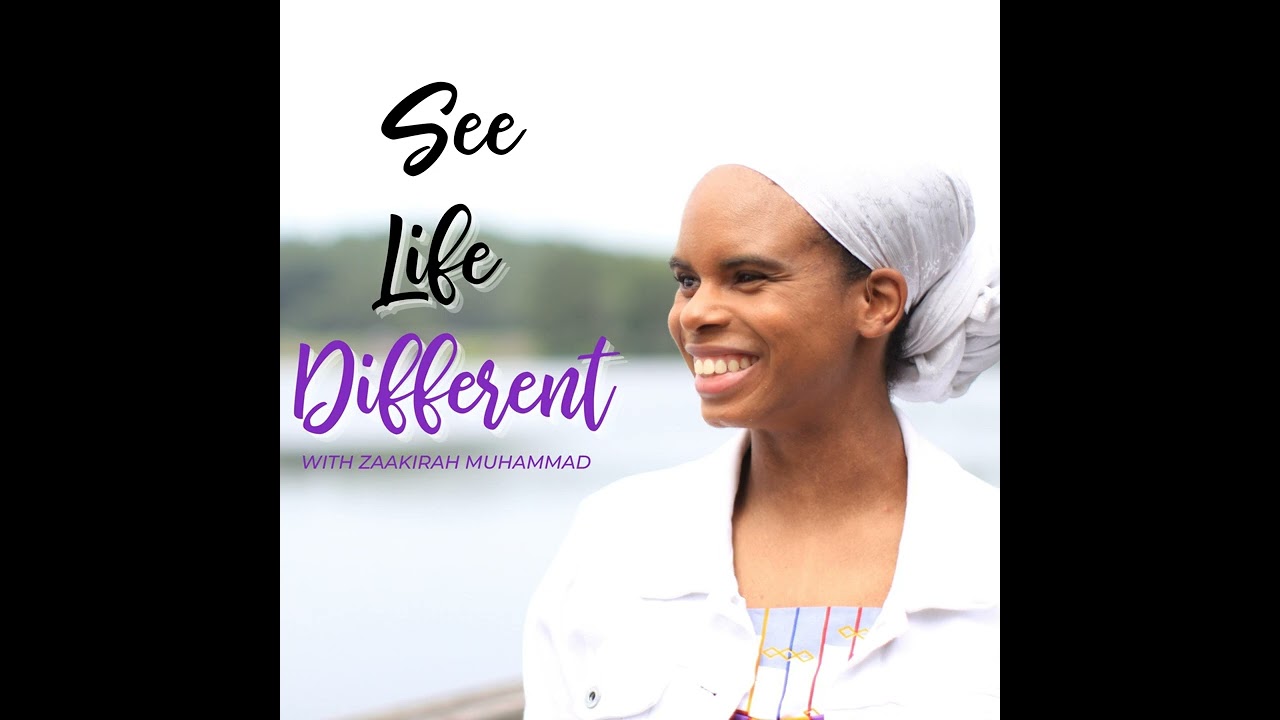
In this solo episode of the See Life Different podcast, host Zaakirah Nayyar—a Black, Indigenous, woman of color, cancer survivor, brand strategist, author, and world traveler—explores how grief reshapes identity, love, faith, and purpose. Recorded during the New Year while reflecting on the recent deaths of Anthony Joshua’s Muslim friends, she shares a series of personal loss narratives: survivor’s guilt from childhood retinoblastoma, the death of a close friend in middle school, multiple later childhood friend deaths, and the impact of celebrity tragedies. Zaakirah frames grief as a process of recalibration rather than repair, using metaphors of chiropractic alignment, slingshots, and boomerangs to illustrate intentional slowing, boundary setting, and renewed strength. She introduces the concept of “interdimensional love,” rooted in Islamic teachings, describing love that transcends linear time and expectations. Her intersectional identity as a disabled African American Muslim woman informs her perspective on faith, hijab symbolism, and navigating multiple cultural expectations. Embracing a new calling as a death doula, she connects her personal survivorship, family lineage to Frederick Douglass, and storytelling tradition to end‑of‑life care. The episode concludes with three reflective questions for listeners and multiple calls to engage via reviews, comments, and her website.
Chapters
Hi, I'm Zaakirah, and I am the host of the See Life Different podcast. This podcast is perfect for you if you are a Black, Indigenous, woman of color ready to step outside of your comfort zone. This podcast will inspire you, empower you, and educate you on how to see life differently, whether it's in your business or in your personal life. I am a cancer survivor, brand cultivating strategist, author, and world traveler. Let's get into it. Grief rearranges us. It doesn't ask. It doesn't wait. It just happens. And when it does, we're left standing in a new territory, unfamiliar. Because our world feels different. That strange disorientation in the aftermath of loss where we question, is this real? Are they really gone? Am I really still here? This episode is being recorded during the New Year while the world is still reflecting on the passing of British-Nigerian boxer Anthony Joshua's Muslim friend and teammates Abdul Latif Ayodele and Sinegami. Today's episode is going to talk about grief, love, and how they reshape us. If you feel that topic might be too heavy for you, just know that this episode isn't just about grief. It's about the clarity that comes after. It's about recalibrating, redefining legacy, and finding strength in that space in between. Grief has been in my life several times. First, I had survivor's guilt when some of my age didn't survive the cancer of retinoblastoma, a rare childhood eye cancer. When I was in middle school, about 12 years old, my good friend Jackie tragically passed away from the same cancer I had been in remission for. We met as summer camp counselors. She lent me Usher's Confessions album. Over the summer, I had intended to return it to her when we would see each other at school a few weeks later. I'll never forget the day that our principal made the announcement to the lunchroom that she had passed away. I remember zoning out and not being fully present to my circle the remainder of the day because they did not know her or bond with her as much as I had. Her death hit me hard. I was overwhelmed with survivor guilt. for the first time ever. She was one of the kindest and brightest people I knew. That Usher album became pivotal in my life, a soundtrack filled with reflection and growth. My favorite song on there is the one with the lyric that says, it's the simple things in life we forget. They inspire me every day to keep raising awareness and fighting for early detection, and intervention for childhood eye cancer. It also shaped my commitment to honoring those who have faced this now treatable disease. I then experienced the shocking deaths of 2 more childhood friends by the time I was 22, women who were perfectly healthy. By this time, I was so numb to the pain of abruptly losing the physical presence of someone I love that people deemed me as the one who stayed calm When it comes to grief, chaos, and death. Not to mention the fact that I am a millennial, and politically we have all gone through so much since the late '90s. The next type of griefs come through celebrities whose tragic passings shocked and rocked the world, including my own favorites such as Aaliyah, Lisa Left Eye Lopez, Michael Jackson, Luther Vandross, Kobe Bryant, and Chadwick Boseman, to name a few. The most common type of grief comes from our own immediate family members— grandmothers, aunts, uncles, fathers, sisters. In the years 2024 and 2025, I was often traveling, living life, fulfilling my purpose whenever I received the news of the passing of a loved one. I know just how jarring it can be to come back to life after experiencing loss. The pace of life does not soften. The expectations do not slow down. Life goes on for everyone around you, especially if you are the one who has to deal with the legal headaches that come with deaths. And burials and beneficiaries and words of testaments. What I've come to realize is that grief does not just reset, it recalibrates. Think about recalibration in the way a chiropractor thinks about alignment. Not fixing something broken, but adjusting what's been carrying too much weight. Grief is the reason why I see life differently, why I live life differently. It changed my relationship with time. I don't rush through my days or force myself into rhythms that don't fit. I do fewer things with more intention. It redefined my sense of peace— what feels grounding, what feels loud, what feels honest, what brings joy. Nothing launches forward without first going back. Think about a slingshot. It has to slowly be pulled back before it can propel forward. A boomerang has to move away before it can return. This season of stepping back, of moving deliberately, isn't hesitation. It's gathering strength. It's recuperating. It's recalibration before motion. Grief has also changed who I love and what I love. I'm more deliberate now, less scattered in my care. more honest about where my love can truly land. It's shifted how I show kindness, no longer as self-abandonment, but as a practice that includes stronger boundaries. I trust my intuition more. I listen to what my body knows and honor those signals instead of brushing them off. When I think about love, especially after loss, I'm reminded of something that I call interdimensional love. It's connection that exists outside of linear time, roles, and expectations. It's not defined by duration, but by recognition. Being a Muslim woman gave me language for that kind of love long before I ever experienced it. Loving without clinginess, trusting without demanding, honest not because it's forever, but because it's true while it's here on earth. Not every single significant love is meant to last. Certain people come into your life to change who you are. They help you release what was never yours to carry. Some come to remind us who we are and then trust us to carry that forward. Legacy isn't always just about what we leave behind materialistically. It's how we show up in the world while we're still here. It's the small, intentional ways in how we love and how we remember ourselves and treat others. Looking back, I see how my faith, my upbringing, my experiences living between cultures has prepared me for this deeper understanding of love and loss. As a disabled African American Muslim woman who had traveled to over a dozen countries, I learned early on how to hold multiple truths at once. I've navigated feelings of not being quote unquote Muslim enough in one space or not being quote unquote disabled enough in another. I learned to advocate for myself very young. Why I was fasting, why I didn't celebrate certain holidays, why I didn't drink or eat pork, why my prosthetic eye looked that way. That loneliness and repetitiveness triggered me to drift away from the faith I grew up in. Without community, I started to question everything. My mom didn't recognize me. My dad used to jokingly call me a quote-unquote convertible Muslim because sometimes I covered my hair, sometimes I didn't. Sometimes I prayed, sometimes I didn't. I returned to it on my own terms, the same way we return to a different version of ourselves once the cloud of grief has been lifted. Through it all, I've come to see the hijab as more than just a fabric. It's about modesty. Humility, protection, and alignment. It's a way to move through the world grounded, aware, and reflective. Early experiences of living helped me understand that grief, love, faith, and legacy are all interconnected. Grief is love left unsaid. Learning to live with it, sit with it, and move forward with it is a never-ending process. Recently, I felt called to step into the work of a death doula. As a childhood eye cancer survivor, I learned early on what it means to face mortality. I carried the heavy role of receiving the news that children my age with the same eye cancer that I survived were no longer living. I've experienced the loss of multiple immediate family members and friends. I've witnessed my maternal grandmother's Alzheimer's Journey and decline, and carried family stories, both spoken and unspoken. Being a descendant of the Frederick Douglass family lineage, I have learned that storytelling has always been the thread, but I'm embracing a new way of weaving it into my calling as an end-of-life doula/death doula. For me, this work is about legacy, memory, and the sacred transition that deserves care dignity, and voice. My name, Zaakirah, means the hereafter or the afterlife. So it feels like no coincidence that this path is part of my life's purpose. As we move into this new year, I invite you to reflect on 3 things. Ask yourself these 3 questions. How has your life been shifted by unparalleled experiences? What has grief taught you about love? How has it reshaped the way you move through the world while keeping your legacy in the front of your mind? Thank you for listening and allowing me to share my voice with you. May this year bring you clarity, intention, strength, and abundance. If you feel called to connect with me, you can leave a review of this podcast publicly on Apple Podcasts or wherever you are listening to your podcasts. You can leave a comment on YouTube. You can leave a comment or a review on Spotify. You can also contact me on my website, zaakirahnayyar.com. That's Z-A-A-K-I-R-A-H-N-A-Y-Y-A-R.com.