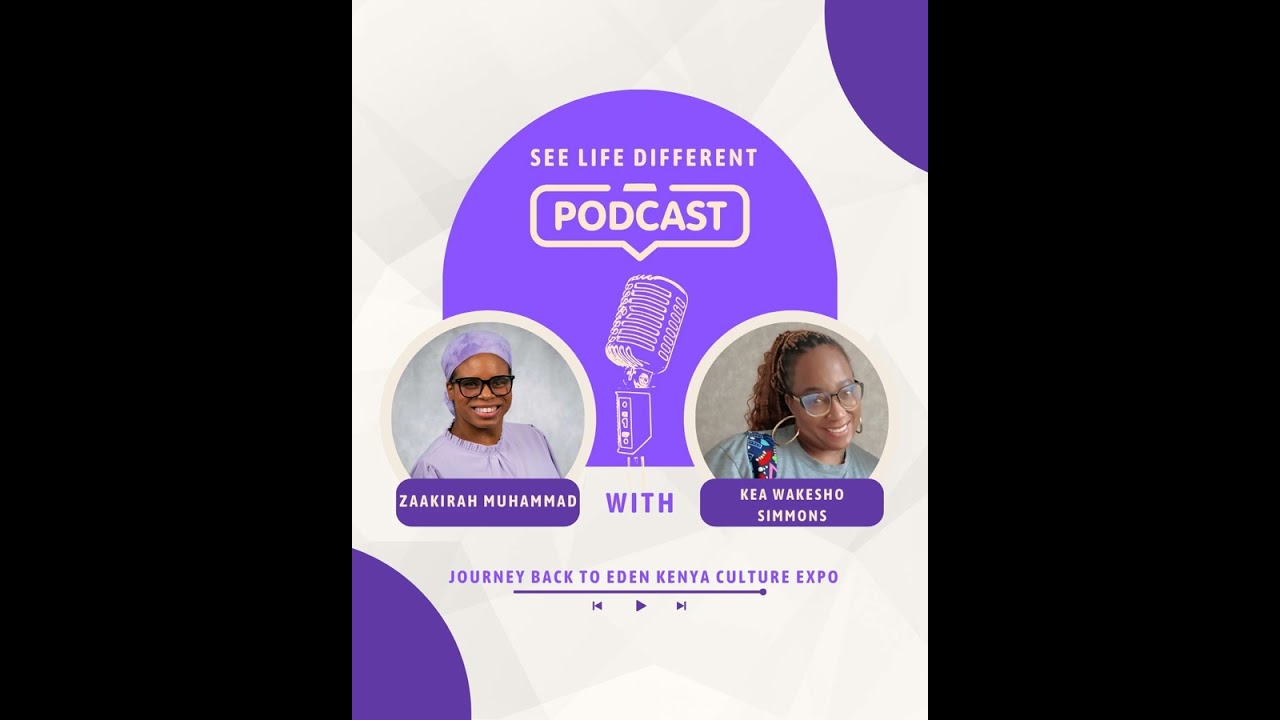
In this episode of the See Life Different podcast, host Zaakirah Muhammad—a cancer survivor, brand‑cultivating strategist, and Journey Back to Eden ambassador—interviews Kia Wakesha Simmons, the visionary behind Traverse Culture (formerly Worldviews) and the Journey Back to Eden Expo in Kenya. The conversation begins with an introduction to the podcast’s mission to empower Black, Indigenous, and women of color to tell their stories in business and life. Kia shares her personal backstory: growing up in Charleston’s Gullah Geechee community, dropping out of high school, serving five years in the U.S. Army, then working as a civilian contractor, and raising a son while traveling the world. She describes how military deployments sparked a love for travel, leading her to explore South Korea, China, Japan, Afghanistan, and eventually Africa. Her Pan‑African spiritual journey took her to Ethiopia and Kenya, where she felt a deep sense of belonging among the diaspora. Kia recounts her first arrival in Mombasa in August 2011, the hospitality of her adoptive Bamburi family, and the vibrant neighborhoods that reminded her of Miami. She explains the evolution of her brand—from Worldviews to Traverse Culture—focused on Afro‑centric regenerative tourism, identifying marginalized cultures, and advocating for tourism policy reform in 63 countries. The Journey Back to Eden Expo is presented as a three‑year, 200‑invite initiative in Nairobi’s Two Rivers Mall, blending cultural exchange, business panels, fashion shows, and inclusive programming for disabled, neurodivergent, and diverse participants. Details on ticketing, partnership with Noir Fashion Week, and contact information (info@tverse.com) are provided. Kia shares future travel goals, aiming to visit 187 countries and explore the Siddi communities in India and Pakistan. She concludes with a vision of leaving an impactful legacy that empowers others, especially those historically excluded, and acknowledges the ancestral call guiding her work.
Chapters
Hi, I'm Zaakirah, and I am the host of the See Life Different podcast. This podcast is perfect for you if you are a Black, Indigenous, woman of color ready to step outside of your comfort zone. This podcast will inspire you, empower you, and educate you on how to see life differently, whether it's in your business or in your personal life.
I am a cancer survivor, brand cultivating strategist, author, and world traveler.
Let's get into it.
Hello and welcome to another episode of the See Life Different podcast, where we empower you to confidently tell your story while also being empowered through your business, through your personal life, and through your lifestyle. And I am Zaakirah. I am your host. I am a disabled brand cultivating strategist and world traveler. And where I also see you in one eye. So that's how the brand See Life Different came about. So today we are talking to Kia LaKesha Simmons. She is the visionary behind Savorish Culture and the Journey Back to Eden Expo, which I am an ambassador for. So we're going to be talking about that. We're going to find out who is Kia, why is she having this event, and how did we even meet? So we've been talking about all the touch points, the social media, you meet people, And as soon as you meet them in person, you never know when you're gonna be at the same place at the same time. Let's talk about that. What's that been like since you've officially been here in Kenya?
Just the experience and like meeting people in person? It's been quite interesting. When I do walk in a room, people be like, oh, hi! I'm like, oh yes, hey, how are you doing? And just being able to see all the wonderful things that the diaspora is doing here in Kenya and to be able to hear the stories like your story and to see the work that everyone is doing is just really inspiring.
So it just keep me going.
Yeah, we got work to do. Let's do it. Let's make it happen.
So go ahead and tell me your backstory. Who are you? How did your name come about?
Yeah, so my name is Kia Wakesha Simmons. I've taken on my Kenyan name, but I am not Kenyan at all. This is how Kenyans say it. I'm not Kenyan at all. I'm originally from Charleston, South Carolina, the Gullah Geechee culture. I am a little girl from Charleston, South Carolina that dropped out of high school in the 10th grade and was able to take my life and the trauma that I went through as a child and reverse it and be able to travel the world. I'm ex-military. I did 7 and a half years of civilian government contracting, and I'm a mom. Shout out to my son. So yeah, that's a little bit about me.
So which branch of the military?
I was in the US Army.
So how many terms?
So I did 5 years in the US Army, and then I did 7 and a half years of civilian contracting, which has nothing to do with the Army, but we support the military, and that afforded me to make enough money to travel the world.
I have mentioned in previous episodes of my podcast, I had a whole episode I got to interview my dad before he passed, and he talked about what it was like being a Vietnam veteran. And most people don't know that not only are you really afforded the opportunity to travel while you're on duty, but also you get some benefits that can keep you alive and well and healthy and still living after that. And so how were you able to utilize that and make traveling your school of life?
Ooh, yeah. So that's a great question because my first duty station was South Korea, and I've Fell in love with South Korea, fell in love with travel. Then I was 23 years old, first time out of the country, mom of a 13-month-old son at the time, and it just changed my whole perspective. Again, like I said, I'm a small girl from freaking Charleston. Now my second home is Virginia, and I was born in Atlanta. However, I had never left the country, and so to see the world in a different way was quite inspiring. And I ended up going to China and Japan while I was there, and I'm just like, okay, Yeah, this is it for me. It was definitely teaching me about myself and how we can embrace different cultures and learn. It became my university. Once I got out of the military and I started doing contract in Afghanistan, that's when I really started blossoming. I was around 28, 29 years old. Yeah, the world became my canvas for sure. It just really taught me a lot about myself, spirituality, and then I got into Black empowerment and Pan-Africanism.
So let's talk about the Pan-Africanism, because you talked about a pivotal age of— you're in your late 20s, most people are still trying to get a sense of their identity. And so when you go to other African countries, I like to say that they're your real-life genealogists. They will tell you where they think you are from. So tell us more about that experience. What has that experience been like?
When I started my enlightenment journey, still watching Sarnetta TV and Dr. Umar and even young Pharaoh, I see he's Trending now on TikTok, and Sarnetta and Sarah Sutansedi, all those guys reading the books of our great philosophers, Dr. Francis C. Welsh, and so on and so forth. I started to go down this rabbit hole of, okay, then who am I as I'm learning all of this doctrine about Black empowerment and Pan-Africanism? Who am I actually in the world? What is my DNA? Or where do I fit in spiritually as well? Because it takes you down that rabbit hole of even questioning your spirituality and what you've been raised to think to be true. And so when I actually decided to go ahead and travel to the continent, because I had been to other countries around the world but not to the continent, I went to Ethiopia first and I got to go to the Rastafarian compound and all these great things and seeing ancient history in terms of our spirituality, where Christianity actually started and so on and so forth. It just really opened my mind up. And people— now people there didn't think I was Ethiopian, right? Unless you go deep down in the village, they you see Ethiopians who look like me. But then when I got here to Kenya, to Mombasa, people automatically thought I was Rwandan or Kenyan or even Nigerian, of course, when I got here. But for the most part, no one actually thinks that you're American even when you speak because they have such a large diaspora. And so for me, that made me feel like, oh wow, I found a sense of belonging even though I have a very rich Culture in Charleston. I'm very proud of it. It was just a different type of belonging, and that started that journey of let me investigate a little more.
What made you decide on Kenya? Tell us when you first arrived in Kenya, and then what made you decide to say, "Okay, this is where I want my base to be." Yeah, so it was August 2011.
I arrived here in Mombasa at Moi International at 1:53 a.m. on Ethiopian airline. And this is when I always say this to make my Kenyans, my Wakenyans laugh. But I've been coming here since Kibaki was president. And Naku Mat was a thing, and the Bob's place was popping in Nyali. So everybody, y'all know 3 of those reference points. And actually the City Mall was being built when I got here, finished being built when I got here.
So City Mall, for people who don't know, it's in Mombasa, but you have to cross a little bit of a bridge just to get there. So it's like the beach town, but yeah.
Correct. You go from mainland to the island. Mombasa is actually the island off the coast of Kenya. When we landed here, I was like, oh my God, we've been bamboozled, hoodwinked, and lied to. I say this all the time, the people is what make this country absolutely amazing. And that for me, shout out to my adoptive family, James Mloasi and his family. They're from Bamburi. We stayed the night at his aunt's house for the first night in Kenya. And we were like, okay, this look like our auntie house. You got a flat screen TV. I know it's going to sound crazy. Surround sound, microwave. I know it sounds crazy, but— While I didn't think they lived in the bush, I didn't think they was living that, you know what I mean? Like that, that first day was just eye-opening, especially in certain neighborhoods of Bamburi. It looks like Miami and you look like you're in Florida or somewhere like that. And so for me, once I was able to engage with the people, that was it for me. It was my dream to always move here eventually and do business and so on and so forth.
Hi, my name is Zaakirah Muhammad. I am a brand cultivating strategist. And an eye cancer survivor and the Journey Back to Eden ambassador, officially the ambassador for those who are disabled, physically disabled, visibly disabled, or neurodivergent. Journey Back to Eden, think of your Afrofuture, your Year of Return, your Essence Music Festival all in one, but in the cradle of humanity over here in Eden, magical Kenya. So join us for New Year's Eve. You get to explore Nairobi, you get to meet other cultures, you get to possibly go to Mombasa with the optional 12-day trip. And You get to network with other people and immerse yourself into the local culture. So join me New Year's Eve. Visit my link at bit.ly/jbezaakirah. That's J-B-E-Z-A-A-K-I-R-A-H. And learn more. And I can't wait to see you there. I'm glad you mentioned that because we live in a day and age where media is easily getting misconstrued. And unfortunately, artificial intelligence is not quite intelligent yet. Off topic slightly, I saw on a LinkedIn post that someone asked AI to make a map of Africa, and they had Senegal on the northeast, they had Rwanda more above Kenya. It was just completely misconstrued. And so how do you think that your purpose falls in line with making sure that there's no more of that?
Oh yeah, that was the whole point when I started the first brand, Worldviews. Worldviews, the way that we see the world see us as people of color. That was the whole mission, is to be able to show people who look like me, because we often do not see ourselves internationally, especially us Black Americans, to say, hey, you have options. You can tell your story as well, as well as immersing in other cultures so you can connect the dots. I think me starting Worldviews and then progressing to have to rebrand to Traverse Culture is a part of that entire vision, and it works on both sides. Traverse Culture and Worldviews' mission was to showcase the marginalized cultures, which I hope to be in 63 countries through tourism policy reform. Because when you go into countries like when I went into Panama and I wanted to do just Afro tourism, it did not exist. I had to put it together and then go to the Panamanian government and say, hey, I actually offer Afrocentric regenerative travel that doesn't exist. Regenerative travel exists, but Afrocentric regenerative travel doesn't exist. And simply what that means is we go into a country, we identify these marginalized cultures that are not being showcased through tourism. We're not able to engage with them and connect the dots and advocate for them to look at policy reforms while implementing Afrocentric regenerative travel to give them a voice. So that's that piece of the mission. For Traverse Coaching.
So how are you able to merge that with the Journey Back to Eden? Because this is not the first one.
No, no, this is the second one. We had the Call to Action 2023-2024. We had over 100 participants. We also brought in Noir Fashion Week from New York, a successful fashion show as well. And so yeah, that was the pilot tour. So we were like, okay, it makes sense. This is needed. And so the Journey Back to Eden for us, essentially we got it from the Year of Return, right? And shout out to Ghana for paving the way and showing that this is possible, that we could do this in numerous African countries. In fact, numerous countries around the world, because we're not limited to the continent. We are global people everywhere. But The Journey Back to Eden essentially is a call to action for relationship building. That is super important to me because I did see a gap in the year return in where I believe it started that way, but somehow we got lost. And so what we want to do is be able to tell our stories too. We do come with culture. There's this insane argument online that Black folks in America do not come with our culture. But if we are indeed from the continent, we indeed cultivated the culture from our roots. And wherever we landed anywhere in the world— Fiji, Australia, New Zealand, India— wherever we landed, we cultivated that culture and it still remains with us. And thousands of years later. And so what we are doing with the Journey Back to Eden is making sure that we're inviting ourselves, by the way. This is not an invitation from Kenya. This is a private sector initiative where we are inviting ourselves to these people's country, but we want to be intentional so that we're not just saying, hey, we're coming here and we're just trying to take over. But no, we are coming here and we're making concerted effort to not only know who you are in your country, But come and get to know who we are so that as we're moving through trade, what I like to call conscious trade and commerce, we have a healthier relationship so that we're not bumping heads based off of our differences, but leveraging those differences.
Absolutely. And so we had this conversation both with onboarding me as the media ambassador, and then when we had our Instagram Live conversation, my first time being in the motherland was to Ghana. And I was with an organization called Crossroads Africa, and it was like the Peace Corps before the Peace Corps, but a summer version of it. And that was the mission. During our training, they said, do not go in there acting like a savior. You're there to help them with whatever they need and the skills that they don't already have yet. So when I finally understood what this journey back to Eden is about, because social media is only a small fraction of it.
Yeah.
Then I said to you, I'm like, I've been to the Essence Festival that was in South Africa before the pandemic. And I'm like, that's exactly what they were doing in South Africa. This is brilliant. This is amazing. So how else can people find out about it? And it's not just for the Kenyans and it's not just for the diaspora, right?
No, it's for anybody, all Africans of the diaspora and lovers of Africa. The agenda will remain the same. And so we're not going to exclude people who may or may not look like us because there are genuine lovers of Africa and African people and the empowerment of African people. So it's an allyship that we definitely want to create a coalition. that we want to create. So everyone is invited to it. It is only 200 invites, only 200 invites. So if you don't make this year, you do have 2 more years to join us because it is a 3-year initiative right here in Nairobi, Kenya. We will be having it at Two Rivers Mall. Shout out to Two Rivers and Holiday Inn for always being great partners with us. It is built into a 7-day and 12-day tour. So not only are we going to give you some great information through the business panel and the culture exchange expo, the New Year celebration, and now we have the town hall meeting with Dr. Umar, but we're going to be able to show you a lot of what we're going to be talking about in real time through the itinerary. And so if you are interested, you can go to her link that's in the bio. Click her link in the bio. She is an official JBE ambassador. If you have any information, you can email us at info@tverse.com. You can also call us at our 1-800 number on the website. But if you need any information or you want to link Up and come to the JBE clicker link.
So say the email again one more time because it's shortened version of the actual website. So what's the email again?
It's info at T V E R Z E dot com. Info at Tverse dot com.
I like to add and most of my conversations with popular questions, and one question is: What is the next place that you want to go to?
India. I'm going to India and Pakistan.
Okay. Yeah.
Yeah. My goal is to visit 187 countries before I pass. I'm at 46 countries. I'm 42, so I got some time to go. And so yeah, India has always been one of those places, but I specifically am going to see the Siddi people. The African people love India. And Pakistan has always been somewhere— I love their food better than Indian food. Don't come for me, my Indian people.
Wow.
And then I wanted to— yeah, it's very ancient land, very ancient land. So I also To see the Siddiq people are actually in Pakistan as well.
And then what do you want your legacy to be?
I want my legacy to, to be that I made an impactful legacy. So it's not just about me. I was able to help as many other people who look like me or may not look like me be able to do the same thing or have the same access to what I've been able to have access in my lifetime.
And thank you for giving access also to those who are disabled, those who are of different religions, those who are of even different political standpoints. Being able to have those tough conversations and be okay with having those tough conversations and understand that at the end of the day, by the time both of your opinions get out, you understand that we are one people. So thank you for doing the work.
Thank you for having me. Thank you for being a part of the work. This is not for Traverse Culture, but this is for all of us collectively. We'll all benefit from it. And I honestly believe that the ancestors— now I accept it because before I wasn't an ancestor. I'm not trying to be nobody leader. I ain't trying to be no activist and all of that other stuff. But I do believe that the ancestors have placed this on me to do. And I'm Standing on the shoulders of them, and I may not be able to finish this, but I'll be able to leave enough for it to carry on.
Tupac, I think it's a quote; he probably said it. But it's something on the lines of I'm gonna I'm the one that can spark the change. I may not be the change, but I'm gonna be the one to spark.
Correct, correct. And that's what I believe wholeheartedly. Absolutely. Yeah. Thank you for having me. Thank you. Yes.