Let Go and Let God with Asiya Nasir Shaheed of Jessica Cares
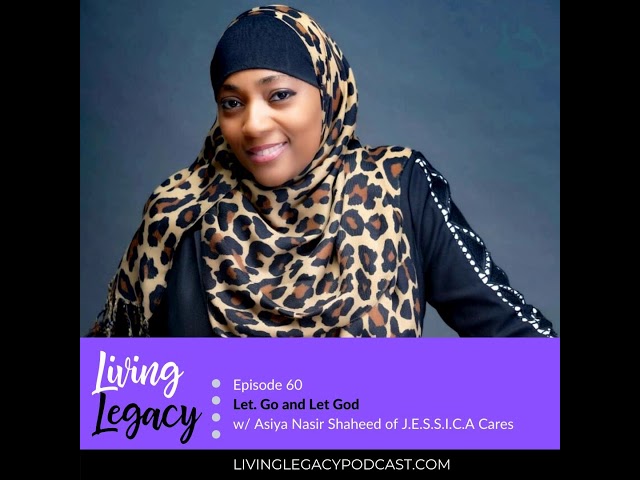
In this episode of the Living Legacy Podcast, host Zaakirah Muhammad interviews Asiya Nasir Shaheed, the Chief Empowerment Officer and founder of the nonprofit Jessica Cares. The conversation traces Asiya’s personal journey from a childhood in a Jehovah’s Witness family to embracing Islam in 2014, detailing the pivotal moments that led to her conversion, including early exposure to a hijab‑wearing classmate, a supportive personal trainer, and a sister’s class that culminated in taking the shahada at a conference. Asiya reflects on how the COVID‑19 pandemic reshaped her Ramadan and Eid experiences, prompting deeper personal reflection and virtual community building. She explains the origin and mission of Jessica Cares—an acronym for “Journey to Becoming an Extraordinarily Strong, Successful Individual with Courageous Aspirations”—and how the organization supports young girls through retreats, workshops, and virtual programs. The interview also covers challenges she faced after adopting the hijab, such as workplace discrimination, family estrangement, and the emotional toll of letting go of unsupportive relationships. Asiya discusses her self‑published book, Mirror Mirror on the Wall: Who Am I After All?, designed as a transformational guide with exercises, and how proceeds fund her Hajj pilgrimage. Throughout, she emphasizes resilience, faith‑driven purpose, and the desire to leave a legacy that inspires others, especially Black Muslim women, to pursue empowerment and spiritual growth.
Chapters
You are listening to the Living Legacy Podcast. This weekly podcast inspires you to step outside of your comfort zone. My name is Zaakirah Muhammad, and I'm your host of the Living Legacy Podcast. I am a cancer survivor, brand cultivating strategist, author, and world traveler. This Living Legacy Podcast features women of purpose sharing stories of resilience. They are single and married. They are artists and entrepreneurs who run businesses and juggle parenthood. If you are ready to hear interviews about professionalism, entrepreneurship, travel, life, and love, you are in the right place. They will share stories of how they overcame adversity while seeing life through a different lens. Let's get into it.
Welcome back to another episode of the Living Legacy Podcast. In this season, we have been splitting the season up to do a little bit of a different theme in season 4. There's a different theme. So half of it, you've heard a few episodes already where I've interviewed a few Muslim entrepreneurs. So these are African American Muslim women who are doing the dang thing. So they also share their stories of overcoming adversity with resilience. And so today we have another Muslimah. We have Asiya Nasir, who is the CEO, more like Chief Empowerment Officer, of Jessica Cares. She has extensive experience in the corporate and financial industry, 25+ years, and now she takes that experience to working with, mentoring, and empowering young girls. And she's a great speaker, transformational speaker at that. And she developed this unique format which has an acronym for her name. She actually converted to Islam, so we'll talk about that, talk about her experience of converting to Islam and what it's like to be a Black American Muslim. She's based in the New Jersey area, and she'll talk about why it's her passion and why it's her purpose to inspire other young girls to pursue their life goals. So without further ado, welcome Sister Asiya. How are you?
Assalamu alaikum. I am wonderful, wonderful, wonderful. I'm just so happy to be on the show with you.
Thank you. Thank you for being here. 2020 is definitely the year for change. I wanted to do something different of talking more about, um, Islam, talking more about, um, the power of entrepreneurship also, because it's not something that's looked down upon, um, at all in the religion of Islam. And so maybe we can start with that. Maybe we can start with, uh, your Islamic story.
So how I became Muslim?
Yes.
Okay. Wow. So my, um, Islam— my introduction to Islam started when I was actually very, very young. Um, I was actually raised, um, uh, Jehovah's Witness. Both my parents— my father has since passed away, but growing up, both my parents— my mother's still alive and a devout Jehovah's Witness. So I was raised, um, very structured in that, uh, religion, which, um, will— you'll find amazingly helped me transition into Islam much easier, you know, much more easily. Um, so when I was about— I think I was like in the 3rd grade 3rd or 4th grade, there was a young girl came mid-year. You know, it had to be, you know, December, you know, January, something like that. It was mid-year. She walked in and this Muslimah walked in the classroom. And I remember I had never seen a Muslimah before, never knew anything about Islam. And this one, you know, this young girl came in with hijab and everything. And I remember I was just like in awe, like, oh my God, what is this? What is that? It just, I didn't understand it, but I knew it just did something. Triggers something in me. And I remember watching her be teased a lot, um, through, you know, wearing her hijab and, you know, people not being familiar with it. But it was something that she— you know, later on she left, um, the school after we graduated, and I never saw her again, never was exposed to Islam after that again. But it was something that just stuck with me, and every time I saw something on, you know, Islam or anything like that, I, I just was drawn to watching it. Fast forward into my 40s now, I was really not in a good space. I had just— I was in a very toxic relationship of someone who was struggling with self-esteem herself. I was in a very toxic relationship and was really looking, as you just mentioned, I was looking for change, but I didn't know exactly what change that was gonna look like or how it was gonna look. So I just remembered I was— I had put on a lot of weight, and I was like, you know what, this is my year. I'm gonna lose weight. I'm gonna get a personal trainer. And it just so happened that my personal trainer was Muslim. In talking with him and, you know, hearing certain things, I remember I just said, "Are you Muslim?" And he said, "Yes, he actually was." And me and him developed a relationship that I later on found out in the religion of Islam was not necessarily the correct one, but it was my gateway into Islam, and I learned a lot about Islam. That was my first introduction to going to Jumu'ah on Friday and listening to a khutbah. That was that person taught me how to. Make salat, you know, and all of those different things. It was a 3-year period, and I remember I had fasted with this person in Ramadan even though I wasn't Muslim for 2 years. And that second year that I, I fasted, I was just like, look, are you gonna do this or you're not? My personality is I'm either all or nothing. I'm not an in-between person. I don't even know how to be like that. So I was like, okay, this is 2 years now you're fasting. You're obviously— you're listening to lectures, you're going to Jumu'ah. I'm like, what are you doing with this Islam? You know, obviously it captures your attention, but I still hadn't known enough about it to make that decision. So without even talking to that other person, it's just between me and Allah at the time, I made the decision that I was going to actually learn really what was Islam all about. Was it some of the stereotypes and, you know, inhibitions that I had within myself? Like, is this what this religion is about? And I looked up and I remember I asked Allah, I said, guide me to where I can learn this religion and really make a decision if I'm going to be Muslim. And he guided me to a sister's class on Saturday. I live in Jersey, and this sister's class was in Long Island, and I drove every Saturday.
The other side of New York.
Yes, the other side of New York, totally the other side of New York. And for 4 months, I drove every Saturday to this sister's class, and alhamdulillah, I learned so much. I was able to ask questions. I was able to see where Although my introduction to Islam was what it was, I, I had to make a decision to be a Muslim. And after 4 months of really learning the religion and being afraid, also overcoming my fears of telling my family and colleagues and friends that this was the direction I was going to take with my life, I went to a sisters conference. It was a 1-day conference in Brooklyn, and I don't know if anyone, any, anyone who's listening knows Sister Aisha Prime. She was the keynote speaker, and I remember I prayed. I was praying like, if this is what I'm supposed to do, let me know. Let me take away my my insecurities and my fear. And she gave a keynote address that I'm telling you, after that, it was no doubt in my mind. I was like, I'm gonna take my shahada. And right there at that sisters conference, as soon as she was done, I told someone in the back that I wanted to take my shahada, and Sister Aisha Prime gave me my shahada.
That's beautiful. That's beautiful, Masalah. I love that.
And that was in 2014.
Okay, okay, perfect.
And here we are, 2020, and I feel like our religious faith is definitely being tested of how much do you really know, especially with the difference of being able to pray, being and kind of needing to pray on your own, especially with the 2 E's that we had, our 2 only holiday celebrations. So I guess what would that What was that experience like for you? I know because some people, um, would have been reverts, as we call them, instead of converts, they're reverts, reverting back. Um, but what was that experience like for you? Because there's a lot of people who literally had to depend on Google, depend on YouTube, find a master that, you know, could lead the prayer or could teach them. You know, some people really wanted to understand the surah, the most powerful surah that normally is recited during the Eid prayer. So what was the Eid prayer like for you? Because it's different from any other year that we've ever experienced.
Yeah, it was different. For me, it was the most connected I felt to Allah than from my first one. My first Eid was very special to me because it was like, although I had fasted 2 years prior, I wasn't Muslim. So that very first time that I fasted, it was very special for me because I was like, now I'm Muslim and I get it. I understand the importance of it. This particular Ramadan really forced you because you were isolated from, you know, sisters, and you really got to look at yourself and where am I spiritually? Mm-hmm. Where am I in relation to reading the Quran? Am I familiar with the Quran? Do I know surahs that I can recite on my own when I'm making taraweeh prayer at home? It really forced you to look within yourself. And I don't think that that was by coincidence. I think that's exactly what Allah decreed. And he wanted us who say that we're Muslim and believers to really look at ourselves and where we are. And are we distracted with this world? Are we distracted with everything in it? Or do you realize from where your blessings and your foundation come from? And so even though it was different, it really caused you to really look within yourself spiritually. It made you look— for those who have family members and children, where are my children at in Islam? Because now we're all together. Now I'm forced to see, does my— is my child even interested in Islam? So for me, it was really, um, it was the best Ramadan, the best Eid, because it really allowed me to just really connect with, with Allah, and it gave me the time that I really needed and wanted to read the Quran, to do deeper reading, listen to more lectures. Um, and, and we all say that if I had time, I would do this, if I had time, I would— well, Allah was like, yeah, okay, well, I made time for you, now what you gonna do?
Absolutely.
So yeah, so it really tested us, like, okay, so now that you have the time Are you really going to put that time and make it useful for you spiritually? And so for me, it was beautiful. And I was able to participate in with another organization called Women of Wellness. And we put together a sisters Ramadan series. So every Friday, I was facilitating a Ramadan series that really captured bringing home the Sahabas and the Sahabiyyat into our everyday life and what we were going through right at that moment and just taking the jewels from their life and the test that they were going through and seeing how with Allah's help they were able to overcome in the same way, inshallah, we were able to overcome and get past Ramadan. And it was beautiful. We really got to bond even though we couldn't see each other physically.
Exactly, exactly. And so I feel like this is a great segue into now talking about how you came up with Jessica Cares.
So I came up— actually, I founded Jessica Cares, um, almost 10 years ago. This November will be 10 years. So I actually started running Jessica Cares prior to even becoming a Muslim. And it was through my, you know, being in the corporate world. I was a branch manager. I had to do a lot of business development. I got to meet a lot of founders and executive directors of nonprofit organizations. And part of my job was to be involved in the community. So I got to work at the battered women's shelter. I got certified and I was doing, you know, working at homeless shelters and I was feeding the hungry and doing all that. And I really, um, was, was touched. I was always really touched. I got my kids involved and they would come with me. And it was— I was working for a bank called Investors Bank and they had us go through a leadership, uh, class. And I thought this leadership class was going to be more about— it was a 10-week leadership class. I thought it was going to be more about how do you manage better to make better teams and, you know, better sales and all that stuff. So that was what my concept was when I went into it. When we actually took the class, it was more of a life coaching experience. It was really like, if you want to be a good leader, you have to be whole within. You have to be OK within. So it was very, very self-reflective. I actually cried a lot in that whole leadership series. And it was that moment that I was just like, wow. I had learned a lot about where I was. And as I mentioned earlier, I was in a very toxic relationship, um, and it really allowed me to see myself, um, and where I was. And I really wasn't happy with where I was, even though I had accumulated so many accolades as far as work. In my personal life and in my spiritual life, I was definitely not where I wanted to be. And so I started the organization, my nonprofit called Jessica Cares, um, and that was with the concept of if I could give these girls Jessica Cares, something that I didn't have growing up with the things that I went through as a child. I was like, maybe they can overcome and not make the same decisions that I made because of the place that I was in, you know, mentally and emotionally. So, um, I started Jessica Cares, and that obviously my name, my birth name is Jessica, so that's where the Jessica comes from in Jessica Cares. But it's in acronyms, and I wanted the acronyms to embody everything that I wanted each young girl Um, or woman that interacted with our programs, um, interacted with our annual retreats, what I wanted them to walk away with, which was being better than when they came. And the acronym stands for Journey to Becoming an Extraordinarily Strong, Successful Individual with Courageous Aspirations.
Say that again one more time. People are probably going to rewind that.
It stands for Journey to Becoming an Extraordinarily Strong, Successful Individual I love that.
I love that. Perfect. And I think that's a brilliant idea. And I love how so far your life has literally been full circle of, uh, you definitely were definitely self-aware. And I feel like maybe that's a December baby thing. Hey, December baby.
I'm a November baby, so I'm at the top of the list.
November, Sagittarius thing. But yeah, I think it's a Sagittarius thing. This Living Legacy Podcast episode is sponsored by Libsyn. It is a hosting platform, and this is your chance to start your own podcast and share your own story. Get this month and the next month free of hosting. Visit signup.libsyn.com and use promo code Legacy. That's signup.libsyn.com and use promo code Legacy to get this month and the next month free to host your own podcast. That's been, um, you know, a great way of just realizing how full circle life is. And I understand that all of this was really healing for you. Now I do want to jump into, since you have talked about coming from a dark and toxic place to now being in a bit of a brighter place, you want to talk about how, um, life has been now?
Life has been great now, you know. I mean, I'm not gonna say it's been perfect, I think, you know. And I think that's the whole, um, message that I send to even the, the women and the girls that participate In Jessica Cares, and that's why the J stands for journey. It's not something that happens overnight. It's not something that just because you make up in your mind, I want to live better, that everything just comes full circle like that, or that everybody, you know, is aligned with what you want. And sometimes it can be a very lonely place when you're in growth or in evolution. It could be a very lonely place because some people that you used to, as I say, rock with and, you know, hang with some of those people are not coming with you in your next chapter. And having to let go of certain people in your life that you think is going to be with you for the long haul, you, you realize that you no longer have a lot in common. And that happened in several— in, in 2 particular stages. In that stage of my life when I decided that I wanted to change and I didn't want to be in, in the toxicity that I was in, that was one phase of my evolution and starting Jessica Cares. The other is when I became Muslim. It took my, my self-esteem, and it really took me to really have to look at myself because I wasn't looking at it from the lens of the world. I was looking at it from the lens of Allah, you know. How was he— what did he want from me as a woman, as a Muslimah, as a mother, as a daughter? And it, it really made me look at myself and say, oh, you still got work to do, a lot of work to do. So it was that journey again, and once again it was the chipping and the chiseling away from people that were not good for me and wasn't going to be good for my, um, my growth spiritually. So I had to let go again of certain things and certain people, um, and that included, um, I wouldn't say letting go, but having to realize that I have to love some people from a distance. So I have some family members that when I became Muslim, they no longer, um, talk to me, and one of those people is including my own mom. And my sister. So that's been a very— probably, I think, one of the hardest things that I've had to deal with, um, is, you know, uh, oh gosh, um, you know, just not having my mom in my life the way, uh, I would like it to be. Um, being that I'm a different person now, I would love to have that experience with my mom. She's 80 years old, so I'm always very conscious of the fact that I don't know how much time we have left. So I'm sorry that I'm getting— I don't— I didn't think I was gonna get emotional talking about it. But, you know, so that's even though I'm in a good space, that's— it's still— it's something that in being in a space where you're comfortable with the decisions that you're making, it doesn't come— it doesn't mean that it doesn't come with hurt sometimes, or having to deal with that other people don't align with the decisions that you make, although it's good for you. I let— I fired my boss because when I became Muslim and I started wearing hijab to work, I was, I was treated very differently from my supervisor. And it got to the point where I would physically get sick going to work. And so I made the decision, being that I already had Jessica Cares, and I remember when I took my shahada, The very first dua that I made, Zakira, was that I asked Allah to use me. I said, Allah, I don't know in what way, but just I want to be used by you. I wanted to—I wanted my life to have purpose at that point, and Allah was guiding me the whole time. You know, with Jessica Cares, that Jessica Cares was going to be a platform that I could use even in Islam, and so I was, you know. I was able to then fire my boss and start working Jessica Cares full-time. And I was able to expand in a way that, you know, Allah tells us that he opens up provisions in ways that— in places that we never could have imagined. And I was just in Jersey, and then I was able to expand to Philly and New York and California and Texas and all of these other places. Allah just opened up a window of different things. And, you know, that's why when we tell Allah That we want to be used by Him, and we ask Him for something. We got to be prepared that Allah is going to definitely answer that dua, and we got to be ready for the work. And so, alhamdulillah, I was ready for it. I really wanted it, and I'm just, I'm just, I feel privileged and honored to to be used by Allah each and every day. That when I wake up, I'm doing something that I'm hoping and praying is going to be something that's going to be a testimony for me on the Day of Judgment.
Absolutely, absolutely, and. That is definitely what this conversation is all about. That's definitely what this podcast is all about, of, uh, overcoming adversity, which is you sharing how you did it, and also living your legacy while you are here. Yeah, that's great, that's great. And so this is also, um, was also a great healing process when it came for, um, writing and releasing your book Mirror Mirror on the Wall, right?
Yeah, absolutely. Um, you know, when I started doing the work and I really started to put out, you know, Jessica Cares and what we're all about and, you know, really marketing that if you're, you're at a place of wanting to heal and if you're at a place that you're wanting transformation, really change, you know. Um, and that's why I don't call myself a motivational speaker, because motivation comes and it's in spurts. I feel motivated for the moment and then I go back. I wanted to be more transformational, and that's what I always make dua and ask Allah, that my words is transformational. So when I started really, you know, delving into the work that I wanted people, you know, sisters and girls were contacting me on Instagram, email, saying, you know, I wish I could participate in your programs. Because a lot before the whole COVID-19, the majority of my programs were always face-to-face. So—
In Jersey only.
Well, even, even outside of Jersey, like we had a retreat in Cali, we had a retreat in North Carolina, we went to Texas and we did a whole youth summit, you know, with the organization in, um, in Texas. So we were expanding, but it was always face-to-face. So the women and the girls that were contacting me were from like out of the country, you know, from Australia, from Africa, from England. And I was just like, what? You know, that's the power of social media. And so I was like, what way can I give to the sisters that can't be with us face to face? And one of the things that I thought of was write a book, write a book. And so each chapter in the book Um, it, it has an exercise for them to work on, so they're actually like in a workshop, you know, doing the same thing that we would be doing in a workshop face-to-face and engaging. It was really forcing them to look within themselves. And I took that concept from the Sahabas, you know, when they taught— when we learned about how they read the Quran, they would read it in pieces, and then not before they moved on to the next series of ayats that they would memorize and learn, They implemented it and made it part of their lifestyle. So it was—they had to do the work. So it wasn't just reading; it was actually how do I change and transform my life? And so I wanted that each each person who read the book, whether they were at a workshop or they were somewhere where I could never reach them, touch them, or see them, that they would still be able to have the same experience. And so that was the purpose and intention for the book. And alhamdulillah, I've gotten such positive feedback by Allah's permission. And I dedicated that book to making Hajj. So all of the proceeds for every person who have purchased a book, I have my little Hajj fund that I have put the money towards. And inshallah, I'll be able to, to make Hajj when they open up this whole COVID thing again and, um, we'll be able to travel. I'm halfway there. I'm halfway there with my savings. So I'm, I'm excited for me only having my book out for like a year and a half. Allah has truly placed barakah and blessings in, you know, In, in that, that project. So absolutely.
And it's definitely a pilgrimage. It's definitely a pilgrimage in itself of, uh, I would say writing a book, you know, writing a book, getting it out, especially the self-publishing route. So that's definitely great, and I do hope that you did to make the pilgrimage.
And I think with the book, I share a lot of what I went through, you know, the, the fact that I'm not writing from a place of, you know, I'm writing to you. But this is— I've gone through this too. I've had limited beliefs. I've bullied myself with negative thoughts. I've valued outer beauty versus inner beauty. I have not forgiven myself for certain things. And I actually, when I wrote the book, I shared a trauma that happened to me when I was younger. And for some of my family members, it was the first time that they had even heard about it. And it happened to me when I was 8. So I was very transparent in that book, which can be sometimes scary. But I knew that it was necessary because my target audience was that young girl or that woman who feels broken or damaged. And it was like, don't wear someone else's shame. That's not your shame. We just have to heal from it, you know. And that book was really, really— that was really something from the heart. I wrote from the heart. And so, you know, it was important.
And just like any artist, when you write from the heart, when you show your love from the heart, it definitely— excuse me— it definitely uh, shows and it heals, and more people literally gravitate toward that and see you in a different, more positive light as well. So that's always a good thing.
Yeah, and they can see how Allah helped me because I do talk about that, even though the book was written from a universal standpoint where anybody from any religion— because some of the ills that we all suffer from is not a Muslim thing, it's not a Christian thing, it is a universal thing. However, there is one God, and that is where your healing comes from. So I do talk about how when I you know, that transition in my life and how it impacted me and my thought process and how it changed every aspect of my life since then.
Wonderful, wonderful. Now here's a fun question I'd love to end, um, the podcast with. Um, well, there are 2 questions. I feel like I'm gonna ask you 2 questions because this has been a good conversation. So the first one is, what is your legacy, or what do you want your legacy to be?
That no matter how broken that you might feel, um, Allah doesn't see you as broken.
Yeah.
You know, it's just part of his decree for what you had to go through to get to where he wants you to be, to be closer to him. Um, and some of us have to go through more than others because of our personalities and how we choose to accept, you know, reprimand or structure or discipline or whatever. Some of us have to go through more than others, but it's all in his decree to get us where he wants us to be. And what I learned through that process is that I'd rather go through what I got to go through in this life than stand before Allah in the most deficient way. Allah's goal and Allah's mission with each and every one of us is to refine us, you know, to chisel away at all of the deficiencies. That although we will never stand before him perfect, that what we go through in this life, if we submit to it Then we get to make the transformation here in this life and submitting to his way of doing things, so that when we stand before him on the day of judgment, we are in the best version of ourselves. So when I talk about being the best version of ourselves, it's not just in this life, but it's also that when we stand before our Lord, this is the best version that I could be. I've chipped away. I've worked hard. I've done all of the work, all of the tests that you put me through. With your help, I've endured all of that, and I've changed. who I am, hoping and praying for your mercy, that you see the transition and that, you know, um, I'm standing before you the best person that I can be, the best version I can be, even in my imperfect state.
I love that, I love that. And though the next, um, uh, fun question is, when this is all over, where's the next place you want to travel to?
Oh, uh, Saudi Arabia. I want to make Hajj. I want to make Hajj. I do. It's so sad when I look at the Kaaba and I look at Saudi Arabia right now, and it's like you could count how many people. And it's like, oh my God, it's— I can't believe this is happening. But I definitely— that's one of the things, that's one of the places that I def— I want to make that. And I've actually, uh, made it a point not to travel like I was before. Um, because I was like, when I— we have to honor, you know, our prayers to Allah. And it's like, if I can save up money to make this trip, that's money that I can save to put towards Hajj. That is one of the 5 pillars, and it's only obligatory if you're financially able. So I'm like, if I have the money to travel somewhere else, I want to travel, and I want to knock that off my bucket list. I want to be able to say I did that, and then now I can travel the world. And I mean, I've traveled and I've been places But I would— I want to be able to say I, I have fulfilled that contract with my Lord as part of my shahada. I've— I have fulfilled that. Everything else I've done, the other 4 pillars, I got that, you know, by Allah's permission. Hajj is the last 5 pillar— is the last pillar that I have not fulfilled yet. And I, I do feel that he's putting things in place for me to be able to do that. So we've able to launch our apparel line, the book Um, as well as the, the mug so you can drink your coffee, your tea, or whatever. So all of that is going towards the Hajj fund, and they can find that— oh, on our website too, jessicacares.org. You can go visit our website and see what classes we have coming up and the different programs that we have. But Hajj is definitely where I want my next trip to be.
I love that, I love that. And I do want to end this with, um, a comment that came through on the live video. Um, probably someone you know. Um, so Masha'Allah says your journey had truly inspired others to start their own journey in life. Alhamdulillah for your transparency and your energy. May Allah, uh, God, subhanahu wa ta'ala, continue to strengthen you to be able to continue the life-changing work you did. Love you for the sake of Allah.
I mean, oh no, yes, I do know who she is. Masha'Allah, yes. And that's— and, you know, to be honest with you, it always feels good to hear like those type of comments, um, and, and how you've impacted others. And I just, I just thank Allah for it because I know I can't do— when I say any of it, I can't— I could not do this work without Allah's guidance, his direction. I'm asking Allah to always keep me humble, to always keep my intentions pure. Um, it's, it's all through Allah. Because Shaytan will always, you know, the devil will always come and try to, you know, throw something in it to make it impure. And, um, you know, so when I hear stuff like that, I just, I'm just thankful to Allah that he's helping me to stay true to my intention and what, what I wanted this whole time. And I, I just, I want that, you know, through the mistakes that I've made in life, that whatever good that I do in this life, that it will earn his mercy, that he will give me Jannah. You know, and then I can, you know, be able to to fulfill all the dreams that I have for the next life. You know, in meeting this, you know, I want to meet Asia, who I took her attribute. You know, I want to be able to meet her. I want to be able to meet the Prophet, sallallahu alayhi wasallam. So I'm just hoping that my deeds in this life, no matter how short it may be, I'm praying that it will be impactful. So when I hear stuff like that, I'm just like, Allah, I hope you, you know, I hope that's that. I hope you put that in my, you know, that's in my deeds. I hope that. I love it, I love it.
So we are coming to the end of the episode, and I want to definitely give you a huge thank you for living your legacy out loud.
Thank you so much. And I want to thank you for creating this platform because I don't think we, you know, in mass media, we don't get the, the, um, the recognition. I wouldn't say recognition, but we don't have the platform to really show what Islam is about. And to show Muslims for who we really are. I think a lot of people have the stereotype that we are oppressed and we have no mind of our own, um, that we, we are not entrepreneurs, that we are not movers and shakers in the Islamic community. We are. And just like the Sahabiyats from before, women are the backbone of this ummah, you know. And I— this platform allows both the women, the young girls growing up that we're raising, and even the, the men to be able to see the value of the Muslimah in this whole process. So I thank you for Allah giving you this platform and that you sharing this platform with women like myself and so many other women who are, you know, really striving to do good in this life.
Now where can people find the book, find Jessica Cares, find you on social media?
Um, they could— you can definitely find the book Mirror Mirror on the Wall: Who Am I After You can find that on Amazon. You can purchase it right on Amazon. And again, the name of the book is Mirror, Mirror on the Wall, Who Am I After All? That's the name of the book. And it's really a self-reflective book. That's why it's Who Am I After All? And so you can find it on Amazon. You can definitely find me on Facebook under Asiya Nasir Shahid. That's my name. You can find me— my Jessica Cares page. where it has all of our upcoming events, workshops, webinars— well, more webinars now because everything is virtual. So you can find all of our upcoming webinars on our Jessica Cares page. You can find me on Instagram under Jessica Cares 1, and on Twitter it's the same thing, Jessica Cares 1. And you can find us on LinkedIn too. You can find me on LinkedIn under Asiya Nasir-Shahi.
If you are new to the Living Legacy Pocket, we have had a few more episodes of highlighting and featuring other Muslim women. One, in episode 11, I interviewed Nimat Vibhavi. She is a South African author, so we actually recorded it during the holy month of Ramadan in the year 2019. So we talk a lot about that as well as what it's like to publish a book. And then we also talked to my childhood best friend Asia, and we talked about all— everything, because we have, you know, 2 decades of friendship, which is rare for most people.
Yes, I know exactly what that feels like.
And then also we talked to my mom, so this was actually right after, um, our book Seeing Life Through a Different Lens came out, and so we had a 2-part episode in episode 36 and 37 where of course we talked about the power of religion and power of spirituality, um, impacting our lives. And then the previous, uh, guest in our series for the Black Muslims who see life through a different lens. Uh, we've had Khadijah Abdulaziz of Makeup for Yourself Beauty. We've had Sabria Mills of the Dope Muslim Woman podcast. I definitely encourage you to listen to that podcast if you want to learn more about the Muslim and Muslim men perspective, as well as Imani Bashir, who, uh, who is a world traveler and has previous experience at sports broadcasting and is now a journalist currently living, currently living in Mexico.
So wow, wow, you have it. You really— and you know, may Allah reward you. May Allah reward you immensely for, you know, putting the— you know, I wouldn't say— well, yeah, spotlight on all of the great work that so many different Muslims and Muslimas are doing. So masha'Allah.
Thank you, thank you. It was definitely something that, you know, Allah, God gave to me, um, you know, at the, at the start of everything. Um, I feel like when, when things opened up it was like, okay, well, what can I do? I mean, my activism is not going to be out there on the streets, so what can I do? And so, um, there's this quote that I've been seeing around the web, and I'm sure you can relate to it too, of my business, my Black-owned business, is my form of activism. So that's, that's what I'll be doing.
Right, girlfriend. That's right, that's right. And I've always said that protest is not just one form, you know. Um, protest and, and being seen and being visible and being heard, it's so many different, um, aspects of that. And all of us You know, we contribute to that in the different forms that we do it in. So yeah, I love it. I love it. I love it.
Well, I appreciate you. Thank you so much for being here on the Living Legacy Podcast.
Thank you so much. And, and, you know, just continue to keep doing the work, and I will be making dua for you that Allah continues to place barakah in everything that you're doing, um, with this podcast and, and your other, other, you know, uh, projects, your book and, and your media company and everything. I will definitely make dua.
Thank you for listening to the Living Legacy Podcast. Be sure to subscribe, follow, and download so you don't miss the next episode. If you want to learn more, you can visit zaakirahnayyar.com. That's Z-A-A-K-I-R-A-H-N-A-Y-Y-A-R dot com. Do you have any suggestions on a topic you want to be talked about? Send me an email or leave them in a review. If you love this episode, be sure to share it with your friends.
More from Zaakirah

Wealth, Discovery And Alignment through Human Design and Gene Keys with Danielle Eyman



ADHD, AI, Artistry: Amber Andrews on Building a Brand that's Honest, Creative and Converting



Sensory Reset: Soft Stories of Joy, Belonging, and Healing Inner Child Live from Essence Fest


