Plus Size Fashion Entrepreneur turned Dyslexic Performance Coach | Remi Ray of Diverse Creative UK
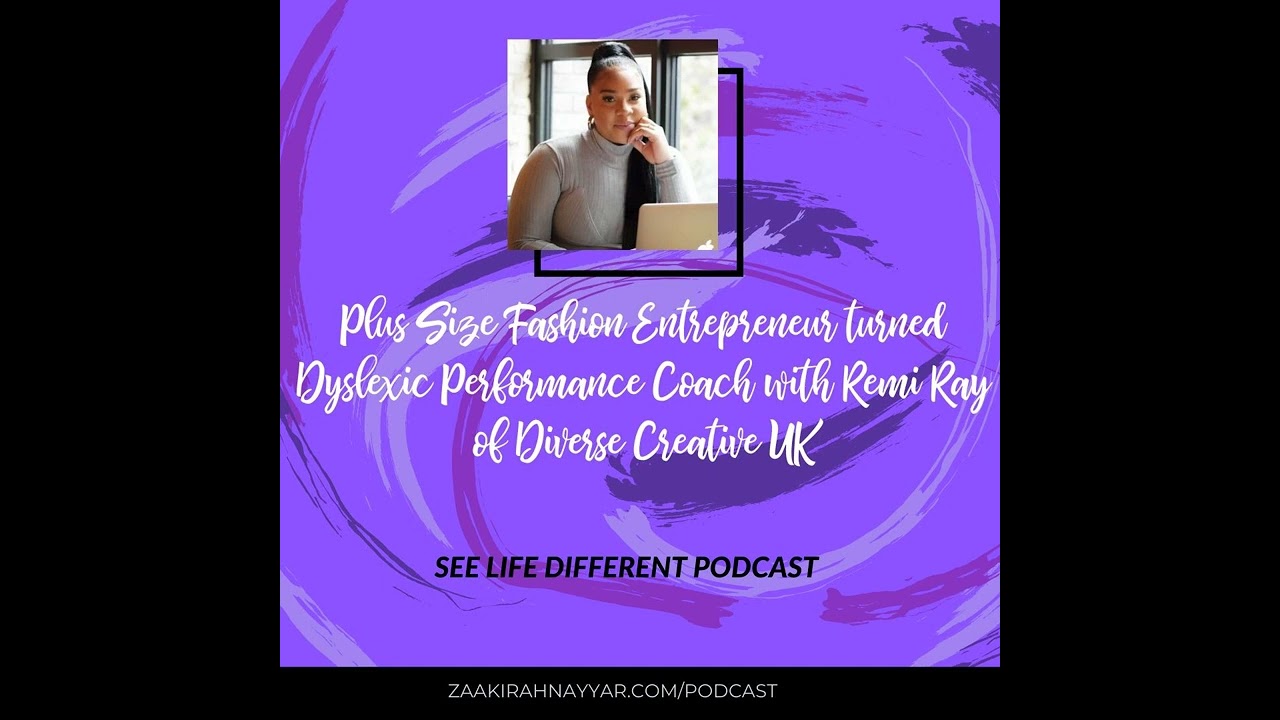
In this episode of the See Life Different podcast, host (Speaker A) interviews Remi Ray, a former plus‑size fashion entrepreneur who now works as a high‑performance coach for neurodivergent women. Remi recounts her early career launching a plus‑size fashion brand, the challenges of being ahead of market trends, and the eventual pivot to coaching after securing major contracts and pausing her fashion work. She shares her personal dyslexia diagnosis at age 19, describing the university assessment process, how dyslexia affects her short‑term memory and information processing, and the broader spectrum of neurodivergent differences. Remi offers concrete advice for listeners: researching neurodivergent conditions, self‑reflection lists, seeking support networks, and using tools like Grammarly. She highlights community resources such as hybrid events, Facebook groups, Twitter hashtags, and social media support. The conversation closes with personal travel aspirations (Dubai, Africa) and a legacy vision centered on self‑acceptance and creating generational wealth for Black and brown children, aiming to fund travel experiences for future generations. Throughout, themes of entrepreneurship, resilience, self‑acceptance, and community empowerment emerge.
Chapters
So today on the See Life Different podcast, we have my good friend, my British friend from Impact Weekend, Remy Ray. She is a high-performance coach for neurodiversity women. So she helps them to accept their individuality and increase their income. So she has been an entrepreneur for over 11 years, and she's one of the 50 most influential neurodivergent women— diverse women too, that's what I was trying to roll off my tongue. And we're here to talk about all things neurodiversity. So for those of you who are new listeners to the podcast, welcome. If you are a returning listener to the podcast, you may know that I am also a cancer survivor. So I've also been wondering all throughout my life, am I neurodivergent? You know, because it's been interesting when I— when I'm an entrepreneur for 11 years as well, of like, you see what to see, what to look for, and what to look for even if you are not neurodivergent and how to support the neurodivergent community. So welcome, Remy. I can't wait to have the conversation today. How are you?
I'm very well. Thank you for having me. I appreciate the opportunity.
Yes, and we met, um, we haven't met met yet. I mean, I mean, you're all the way in London, London, right?
Yeah, I'm in London. Where are you now?
I'm, I'm all over the place. Currently in Oklahoma, the state of Oklahoma.
Last time I think you were in Atlanta, the last time we touched base.
Yeah, and since then it was Dallas, Texas, and then traveling a little bit, and now Oklahoma. Yeah. And so what we're talking about, if when you're listening, we actually connected at a, um, uh, virtual event, professional development, business development, Impact Weekend, and they had a hybrid event. And so the fact that they had hybrid, you and a few other ladies from London, um, and Europe were able to attend. And it was just, what, 10 of us that just kind of like stayed connected, yeah, uh, for the whole year after, right?
Yeah, yeah, yeah. So that was what, 2020, right? February 2020.
Well, yeah, because we get to have that Facebook group, um, leading up to the 2021 conference. Yeah, yeah.
And then now we're in the other group. So yeah, that was 2020. Time has flown.
Yes, yes, yes. So what have you been up to since then? I know we have some, uh, have bun in the oven.
Yes, I have a bun in the oven. I really do. Um, apart from the bun in the oven, um, so after Impact Weekend, I was already working. So it was my plan to launch my offering, which was a program called The Shift, which I did. I got customers and clients and stuff, and then my work kind of pivoted because I have a non-for-profit, what you guys would call a non-for-profit as well, um, and some major contracts for my business came in. So I had to pause with coaching. I had clients, I continued to work with them, but I couldn't do any more advertising in the way that I had wanted to. So I had to focus on the business stuff because the contracts had come and I had no choice. So it's been a bit of a mixed bag since Impact Weekend, but you know, we give grace because that's what we asked for and it is what we received.
Exactly, exactly. I love that. Now I think, um, for those of you who don't know your story, maybe you can talk about what that transition was like from fashion into just knowing that you wanted to be a high-performing neurodivergent coach.
Yeah, so it wasn't, um, I think like many of us that are coaches now, like, it kind of happened organically. And the more people I speak to, it seems that way. You may have been teaching people or mentoring people throughout your whole entire journey, right? And I think it's the same for me. Um, my journey in plus-size fashion actually started in 2009, and I basically— that's when the internet was doing its thing, you know, it was starting to become the thing that everybody needed to like lean into. Um, and I was at the uni at the time. I did my dissertation on like the plus-size fashion and andrology, and like I tried to get in the fashion world and I kept finding that I had a lot of barriers. And I was like, well, what's the barriers here? Like, okay, I'm not skinny, I'm Black, um, you know, Jamaican heritage. I'm not blonde, I'm not skinny, I'm not red-lipping, do you know what I mean? Like, I have a different kind of swag. I come from what would be considered as the hood here in the UK. And so— What is the problem? Why am I not able to penetrate this space even though I've got a lot to contribute? And I just kept getting really rubbish roles, PR, bits and pieces that I just had no interest in. It's not that they're rubbish, but they just weren't what I was looking for. And I'm a non-technical fashion person, right? So I have the ideas, I give them to somebody else and they help me create them. And so after so much rejection, I had little skints here and there. I did some styling with a major stylist and stuff. I was like, I need to do something for myself. So I traveled to New York over the summer and I came back and I said, I'm going to boss a move. I'm going to boss a move. And I put up on Facebook that I was hosting a plus-size fashion show. And at that time I started to build out like my own brand, which was called Trapped in a Skinny World. And all I was doing was flipping vintage clothing, but specifically for plus-size women. So this was still new. Plus size wasn't a thing here yet. People weren't, you know, on the gram with like bikinis and stuff. People still had a lot of self-confidence issues and stuff like that. So I was ahead of the market, which meant that the business failed because there wasn't coaches like how we have them now, or all these gurus and stuff to tell me how to pivot. So I closed the business. But I wasn't defeated. I knew that there was something there. I just didn't know how to cultivate it. And then Fashion Week was coming along, and just because I was really abreast with what was going on, I said, you know what, I'm going to try again, and I'll put together the equivalent to London Fashion Week but for plus-size women. And once I posted that on Facebook, it was nuts. So now I say, uh, you know, I contributed to the billion-dollar industry as we know it, which is the plus-size fashion market. Um, we had major sponsors from out the gate. From the Topshop group, so that's called the Arcadia Group in the UK, and the JD Williams group, even Hanes from the States was involved in some of the work. We had clients from Hong Kong, we had people from all over the globe that traveled to showcase their collections in the UK, and we did that twice before me and my business partner had very different ways of operating and I decided to leave the business and part ways. But yeah, in a nutshell, that's my plus-size fashion story. story journey thing. I also launched 2 collections as well, actually. So they, uh, one showed in Nigeria and one showed in Australia.
Very cool, very cool. And so what I hear though is being ahead of the curve had its pluses and its minuses.
Absolutely, absolutely, absolutely. And I don't think people talk about that enough. The truth of the matter is sometimes when you're ahead of the curve, if you don't have the money to rectify the journey you know, you get lost in the sauce. But if you do have the money to get steered in the right way, then you could be good. But yeah, you need money.
Yes, yes. And then, um, I guess speaking of money, like, that's, that's another thing that's also kind of, um, in the words of self-confidence that you're referring to, you know, those money mindsets around knowing what— just like you said, being able to do something for yourself, right? Then you still got spouses, you still got children, you still got, you know, bills. So Um, how did you know, and when did you know that— what was that moment for you that you knew that, okay, I gotta, I gotta do something else, I gotta do something different?
I'm always hustled, right? My first job was basically— we lived on like an estate which we call like a council estate. You might call it like the projects or something, um, in the States, right? But I would babysit all the kids, I would create posters so people knew they could drop their kids off with me. I was older than some of the younger kids, right? So that meant I had a bit more trust with the parents. So I would babysit kids. I would— I was always onto making some money somehow, some way. You send me to the shop, you have to pay me. I was just— I've just always had that drive in me. And at the age of 13, I started working at a local market selling sportswear with my auntie. One day she was sick. I went to the wholesalers by myself when I was 15. I built my own rapport with them and they started selling to me and I took the clothes back to the hood. and sold to everybody else on the block. So I just think it's innate. It's just one of those things that I have. I have the ability to connect, see what can penetrate, see what can move, and then just do my thing like that. I don't know, I've just always been able to do it.
I mean, it makes sense. You said you're Jamaican, so why not, man? You know, do what you gotta do.
We do, we do indeed, we do.
And so also a little-known fact about you is you are dyslexic.
Yes, I'm dyslexic, dyslexic, dyslexic.
Like all the way dyslexic.
Okay, okay, tell us more about that. I was diagnosed at 19, but, um, and that was when I was at university, but I always struggled. I knew that there was something wrong from like nursery. I, I could tell that articulate myself in a specific way, or like my mobility was just different, but I just couldn't figure out what that was and dyslexia at that time. I'm gonna be 35 this year. It wasn't a buzzword. Now, you know, we see neurodiversity, you know, everywhere now, and people talking about disabilities, but then nobody was really talking about it. And so it took me 19 years to understand what was going on with me and how I processed information. And it was tough. You know, you'll be afraid to be in school and your teacher call you out to the front of the class and tell you to spell something, and you're like— Oh my God. I cannot spell even barely my name. And so, yeah, very, very tough.
So tell us about the diagnosis process. Like, what was it that— just like you say, with the conversations now, most people are taking multiple tests and multiple symptoms before they realize. So what was that for you?
So obviously, when you're at university, you are submitting loads of assignments and things like that. So the workload is increased tenfold than you know, school and stuff. So I think basically my assignments just weren't up to scratch. And so my lecturer, especially when you're in a creative space, they often pick up on these things a lot earlier than they would if you're in like a mainstream school that doesn't really understand like creative processes. And then I handed in an assignment and my lecturer was like, you need to go and get tested to see if you're dyslexic or something. Dyslexic people can barely spell dyslexic, you know, it's a tough word to spell in itself. So I was like, dyslexic, what does that even mean? And then, yeah, they ended up putting me through a process, you know, pairing me with a mentor, and then they assessed me in all these little tasks. It was a variation of tasks, so it tests your memory and all of those kind of things, processing of the brain. And within weeks, yeah, they was like, you have dyslexia. And, you know, all it did for me at uni was give me more time. There was more empathy around my work. But ultimately, after living with this for 19 years, there's a lot of work that now needs to be unpacked and unlearned in terms of habits and processes and stuff like that, which I think I've really, really struggled with over the years because you survive, right? And so you survive any way you know how. Um, so it was— it's been tough.
And I can imagine. And I think what I think I want to rewind a little bit is, uh, of course anyone could just simply Google it if they know how to spell it right, but maybe tell us more about that because you've already mentioned it's hard Or to spell, spell, you know, name correctly. Like, what is it really for those who are completely unaware?
It can be a variation of things, and I think that's one of the interesting things about being dyslexic is that it can affect people in a multitude of ways. Me specifically, it's to do with my short-term memory and how I process information. Another person may not have trouble with those things at all. It could be the way they read, it could be the way they spell. It's to do with the way your brain processes information. And so there isn't like your dyslexia and my dyslexia may very well not be the same, and I think there's like a misconception around that that needs to be unpacked. Also, you may be dyslexic, you could be ADHD, you could be dyspraxic as well, and those are all other components as well which can work together or can work against one another, you know. So there's a variation of things, but I think if you've ever felt that you struggled in any way to read or write, I would suggest maybe getting a screening because those are like the easy telltale signs. You're not going to know looking at me that I couldn't read, I don't read at a fast rate, or, you know, maybe words get jumbled up for me. You're not going to know that by looking at me, but actually sitting down and really thinking about some of the times that you struggled when you were trying to like, you know, write an essay or whatever, then maybe you'll be like, Oh yeah, that, that sounds like me. So I urge anyone, and to be honest, even if you're not dyslexic, having a test, a screening is what usually the first part of the process to find out how your brain processes information. I mean, it's a gift in itself, right? You— that can help you throughout life. You don't have to be dyslexic to want to know how your brain processes information.
Absolutely, yeah, the brain is a powerful thing. Absolutely. I have a cousin who's on the autism spectrum, and then, so that's been a wonderful learning experience to see how he operates now that he's a young adult on his own.
And yeah. And there's a lot of grace that needs to be extended as well. People just assume, so the fact that I can articulate myself in a verbal way, people just assume nothing else could possibly be wrong. And probably your cousin's experienced it too, right? People just have an assumption because maybe they can do certain things very well and other things not so well. So people just need to take time when you're dealing with people who— I don't like to say like disabilities and things like that, I just call them differences because it's just a different way of operating.
That's exactly right, there is different abilities. Yeah, I love that. Now, um, do you continue to give us maybe 4 more things that those who don't don't think they have any, you know, neurodivergency, of what they could do to educate themselves?
Yeah, so the first thing I would do is just Google dyslexia, dyspraxia, ADHD, just to understand what they actually are. Step 1, right? Just so that you know what you're dealing with. Step 2, I would sit down and maybe write a list. So this is more for you if you've ever thought that you had a something or wasn't sure. To write out a few things of where you may have struggled, um, so that you can understand if this is something you need to look a little bit more deeper into. 3, I wouldn't be ashamed to ask for help as well. I think that's important. So if you have ever struggled or you're just interested to find out if people are struggling, maybe you're in a leadership position or maybe you're somebody who actually may think they have a difference of some sort, look for some support. So if you're in an organization, is there like a network, or is there a support group or something on like, um, social media that you can lean into just to kind of get a better understanding? And you can feel comfortable and confident knowing that there's some additional support there as you start to navigate this journey of, you know, exploration. And the fourth thing I think is, um, understanding that this is like— the stats say about 1 in 10 people suffer with something, you know, like dyslexia, and it could be as high as 1 in 5, right? So that's a lot of people who are in a very similar position to you, so you're really not alone. And I think those couple of things can help just increase your confidence, because a lot of people with differences— dyslexia, dyspraxia, a visual impairment, um, you know, and all of the things, right? A lot of the time it's to do with the fact that society has told us that this is not the way to operate, and so we assume that we're not So we assume, we internalize it, right? We assume that we're not capable, and most of the time it's not true. Some of us are the smartest people in the room, but we haven't been given the opportunity to, you know, say what we want to say or do what we want to do. And I think those 4 things can help just enhance your confidence, at least for you to begin your journey.
I love those tips. Yeah, this is about, uh, just really understand you, right? So you don't take things personally because nothing wrong at all.
Nothing, nothing. It's just a different way of operating.
Exactly, exactly. I think I want to add another resource, um, one that kind of been helping me learn a little bit more too, is Twitter. If someone is not already an active Twitter user, it's, it's like a faster Reddit if you're one of those Reddit users. So I would highly recommend looking at Twitter too as well, because people who actually going through it are opening up and sharing.
Yeah, on social media, a lot of people are vocal, you know, just search the hashtags around the variation of things. And like Grammarly is something that I use all the time, like I don't type without Grammarly, you know what I mean? Like it's in my emails, it's on my phone, and if I'm writing anything of length, I paste it in. I've got the premium one, and that in itself just enhances confidence. And I find that that's not even just because I'm dyslexic, but like my friends who are not dyslexic also use tools like Grammarly just to polish up on their writing and things too.
Oh yeah, I love Grammarly because sometimes I'd be moving too fast, so we gotta slow it down, double-check that word.
Yeah, yeah, absolutely.
I love that. All right, so we're coming to the end of the conversation, and I have 2, maybe 3 fun little questions that I love to ask every guest. Are you ready?
Yes, let's do it.
All right, the first question is, um, when we kind of get a little bit— well, for you, let me tweak it a little bit. Normally I ask when there's toward the end of the pandemic. But for you, let's say when baby is old enough, where's the first place you want to travel to?
Um, probably Dubai because it's like a getaway for— like, it's probably like going to Miami in a way for you guys. So for us, we probably will go to like Dubai to like woosah and chill out. Um, and it's not as expensive from this side to go to Dubai. So yeah, probably Dubai for like like luxury relaxation. Um, yeah, and Africa is— my partner's African, so—
Which country?
He's from Ivory Coast, part Ivorian and also Nigerian. So we'll definitely be touching Africa very soon.
Very cool, very cool. Okay, and then the next question, uh, is if no one else got anything else from this conversation, what is one thing you want them to remember?
Self-acceptance. I think you've got to, you've got to take the rough with the smooth, but the first thing you have to do is accept yourself. And I think, um, there's a lot of messaging out there around being strong and, you know, just going, going, going, going, going, but none of that works unless you accept yourself in the way you operate. So self-acceptance.
Love it. And the last question, what do you want your legacy to be?
My legacy is connected to generational wealth, because I believe that not enough Black and brown children get the opportunity to dream. And the fact that you said travelling, right, travelling is a luxury to many. I want to leave strands of wealth in a way that, you know, Black and brown children have the opportunity to dream and not have pressures of being an adult before their time. And that could be, you know, God willing, maybe 100 children get a ticket around the world by the time I pass, just so that they can experience different cultures or something of that nature, because it's important. Traveling has really opened up my mind. This allowed me to meet you, even though I traveled virtually here, but I've been to the States loads of times, you know, and, um, across the globe. I've been to Argentina and Ethiopia and places like that, and they've expanded my horizons. So yeah, generational wealth.
I love that. Yes, travel is definitely up there because I am all about the school of life, and that's the best school there is.
Yeah, yeah, absolutely, absolutely.
I love it. Well, thank you, Remy, for being a guest on the See Life Different podcast.
Thank you very much.
More from Zaakirah

Wealth, Discovery And Alignment through Human Design and Gene Keys with Danielle Eyman



ADHD, AI, Artistry: Amber Andrews on Building a Brand that's Honest, Creative and Converting



Sensory Reset: Soft Stories of Joy, Belonging, and Healing Inner Child Live from Essence Fest


