Retinoblastoma Survivorship: Stories of Resilience and Advocacy with Leia Hunt, Grace and Genevieve
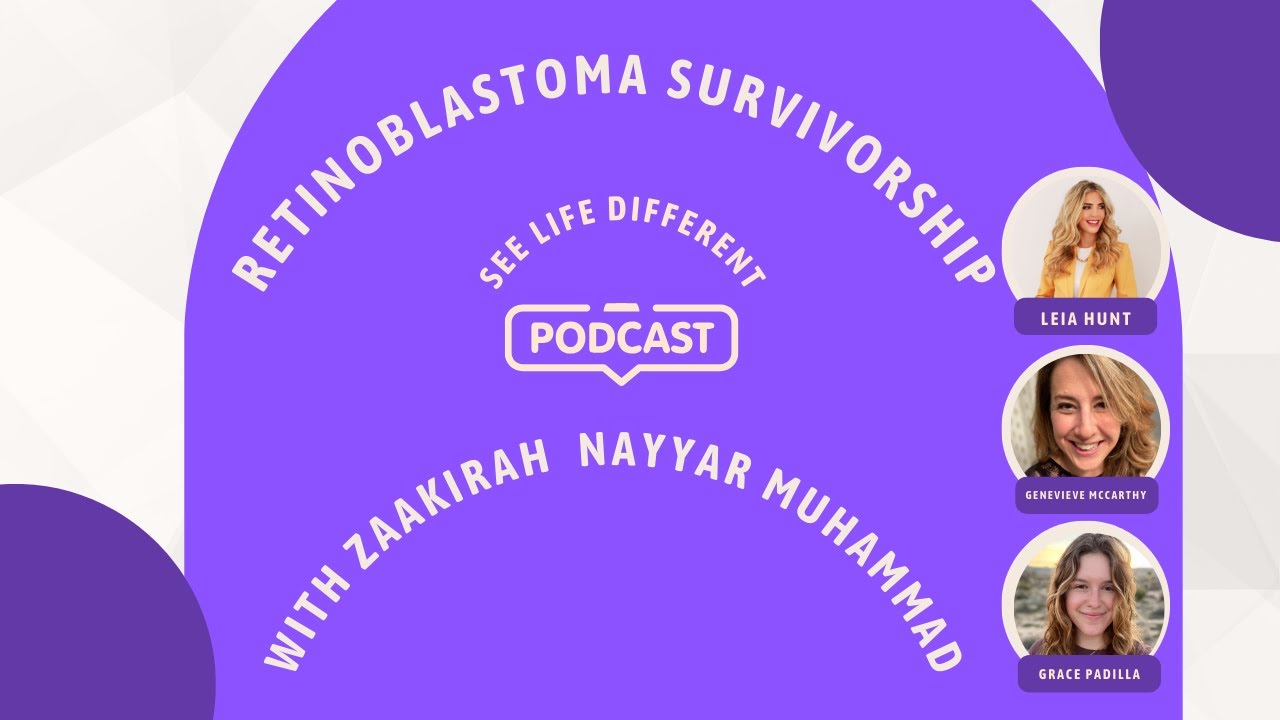
In this episode of the See Life Different podcast, host Zaakirah introduces the global burden of retinoblastoma and then interviews three survivors and advocates: Leah Hunt, founder of Leah's Kids; Grace Fredillo, a unilateral retinoblastoma survivor now a neuroscience PhD candidate; and Genevieve McCarthy, a Canadian Retinoblastoma Society president and survivor. Leah recounts her early 2000s diagnosis, multiple rounds of chemotherapy, radiation, a radioactive isotope that saved her eye but caused total vision loss in the left eye, and her decision to keep the natural eye rather than enucleation. She describes how that experience led her to create Leah's Kids, a nonprofit that provides financial aid, emotional support, retreats, and advocacy at state and federal levels. Grace shares how growing up around doctors sparked her interest in science, her academic path into neuroscience, and her research on neural plasticity. She explains her genetic mosaicism for RB1, the extra health surveillance it requires, and frustrating encounters with clinicians unfamiliar with retinoblastoma. Genevieve tells the story of her 1980s diagnosis, nucleation of her eye, and subsequent genetic counseling for her children. She outlines the evolution of the Canadian Retinoblastoma Society from a family‑run phone‑tree to a formal charity, and her current leadership role. The conversation expands to discuss global resources (We See Hope, Know the Glow, ECHOPE, CRAB, etc.), mental‑health support (Silence the Shame, recreation therapy), and concrete advocacy actions listeners can take (local proclamations, contacting mayors, community events). Throughout, the guests emphasize the shift from merely surviving to thriving, the importance of peer support, and the personal purpose each finds in helping other families.
Chapters
Hi, I'm Zaakirah, and I am the host of the See Life Different podcast.
This podcast is perfect for you if you are ready to step outside of your comfort zone. This podcast will inspire you, empower you, and educate you on how to see life differently, whether it's in your business or in your personal life. I am a cancer survivor, brand cultivating strategist, author, and world traveler.
Let's get into it.
Retinoblastoma claims over 7,000 children annually and leads to blindness in many more. In developing countries such as the U.S., the survival rate exceeds 96%. However, most children still suffer from varying degrees of vision impairment, hearing impairment, and other secondary conditions. The global impact of retinoblastoma extends beyond the affected children and extends to their families and their loved ones, as well as the survivors. It results in emotional trauma, PTSD, survivor's remorse, you name it. Today, we talk to Leah Hunt, who is a 2-time unilateral retinoblastoma survivor and the founder of Leah's Kids, helping families. battling all kinds of childhood cancer. Despite undergoing 26 surgeries and losing vision in one eye, Leah's resilience has propelled her to advocate tirelessly for pediatric cancer awareness. Through her nonprofit, she offers financial assistance, emotional support, and joyful experiences, transforming her personal story from a book to a TEDx talk to anything else happening. She also worked on a state and federal advocacy level, contributing to significant policy changes and raising awareness for pediatric Not many people know about it. Not many people may have seen the video, but we met in person in Hawaii, of all places, at the One Retinoblastoma World Conference Adult Survivors Panel.
And now Leah shares her cancer story.
So I was diagnosed in the early 2000s with retinoblastoma unilateral. And so from them diagnosing me with retinoblastoma and seeing the tumor in my left eye, I immediately started chemotherapy. So we did about 5 to 6 rounds of chemotherapy. to chemotherapy and that wasn't working. And then through that time, we were having surgeries to see what was happening behind the eye and to really get in there and get a better look. And then I also did radiation. Then the cancer went away, but I had a quick relapse within 6 to 12 months. I relapsed again after about a year and a half of treatment, and we continued the fight. And at one point, they put a radioactive isotope on my left eye. And I was in isolation for about 7 days. And that isotope sat on there and it did 2 things. It did a good and a bad. It took the cells, so the cancer cells started dying out. It took the complete vision in my left eye from that treatment plan. And that came slowly after the isotope was removed week after week. I kept telling my mom I could see a little bit less and a little bit less. And then one day I woke up and I just couldn't see anything out of my left eye. But since then, I started the journey of remission, and after 5 years, I claimed survivorship. And ever since then, I am cancer-free, but I don't see out of my left eye. And something that's so unique about my journey is that I did not have enucleation, so I did not have a removal of my left eye. So a lot of times when RB kids get diagnosed, they'll take the eye. However, I was working with Dr. Carol Shields at Wills Eye Hospital in Philadelphia, Pennsylvania, and really my dad went to her and was like, hey, Let's keep Leah's eye for as long as we can. Let's keep Leah as normal as you could say that we can. And at that point, that was not very common in an RBC child doing chemo and everything. Normally you just remove it, remove the bad cells and get a prosthetic and you keep going. But for me, I did the chemo, I did the radiation, I did the surgeries, and I got to keep the eye. And so to this day, I do not have a prosthetic. I have my real eye. And I was one of the first few handful of kids, especially under Dr. Shields' care, that did not have removed So it was definitely opening the doors to a whole new medical journey for her and for other kids and families on this journey.
We are talking to one of those survivors named Grace Fredillo. She is a unilateral retinoblastoma survivor and a neuroscience PhD candidate at the University of California, San Diego. Her academic pursuits reflect her drive to understand the brain and inspire others through her story. So she has a dual perspective as a scientist and a survivor and talks about the importance of advocacy, the importance of research, and the power of resilience.
I think just being surrounded by doctors a lot as a kid, I thought that they were amazing and they saved lives. And I thought that was really cool. And as I was in high school, I started getting more interested in science. So I took an anatomy and physiology course and I thought I was just so excited about it. Oh, like I think I wanna be a medical doctor. And then I took this really cool summer opportunity. It was a week-long camp called Summer Scrubs. It's hosted through the University of Arizona's medical Phoenix Medical Campus. But you basically, high schoolers get to go and learn a bunch about being a doctor. And I thought it was really cool and I met a lot of really cool people there, but I think I left it being, I don't know if this is For me, but I was still really passionate about science and the body and understanding that. And I wasn't totally sure, but I kept the option open as I like went to college and my major was in neuroscience. And then I started doing research basically there. And when I was learning about the brain in my introductory neuroscience course, it's plastic, meaning that it can change a lot and it's really malleable and it'll, it'll learn to adapt so that it's using the brain in better ways. So for example, example, like if you're blind, you don't have as much areas in the brain dedicated to visual processing, but those areas will be commandeered by other processing, or different parts of the brain will use those neurons for different things and change it. And I was learning about that in this intro neuroscience course until I raised my hand and I'm blind on one side, and what do you think that would cause these changes? And she was really great about just chatting with me about it and relating it to my own experience. And then I think from having this, oh, like my brain's maybe a little bit different just because it's, I don't have vision in both eyes. I went to this really, uh, program which basically helps underrepresented minorities or first-gen low-income college students get into graduate school. So I applied for that and got in and was doing research at the time. And then during my senior year of college, then applied for PhD programs. And I was excited about applying to PhD programs. I was really excited to keep on asking questions about the brain. I was like, I don't know what's going on here. There's so much to know. And so yeah, after that whole process, I ended up going to the University of California, San Diego. I'm in their neurosciences graduate program now. And so that's where I've been for the last 5 years. And my work isn't super related to retinoblastoma. Now, I think so much just served as a jumping off point for being interested in the body and medicine, and then transitioning that into research and understanding how we work and why we work the way we do. But now my work more so involves understanding how the nervous system generates these persistent responses to brief stimuli. So I found out a few years ago that I have a genetic mosaicism for retinoblastoma, which means that a certain percentage of the cells in my body carry the RB1 mutation that was from the tumor that was in my eye. And that it just leads to uncertainty with passing it on to my kids if I decide to have children, and then also secondary cancers. And so that's something that's been interesting, like learning to talk to people about secondary cancers. And I've had some really great experiences, but also some not super great experiences. with doctors. So once we found out that I had the mutation, I decided to start seeing a dermatologist yearly to just get skin cancer checks because I'm at higher risk for melanoma. And I remember going to a dermatologist at one point, and this is the first one I went to, and she wrote in the form like why I was there. I'm here for just like screening. I'm at a higher risk for melanoma due to the retinoblastoma thing. And the doctor comes in and she's like, I've never heard of retinoblastoma, like in relation to skin cancer. I don't know what you're talking about. I know this is what I was told to do. I was 19 or 20 at this point. And she was like, I just Googled it and I don't see anything and I don't know why you're here. And she made me feel really small for being there, for trying to take care of my health. And my mom went to the appointment with me, but I was in the room alone. And then I came back out and I told her what happened and she was like, we're never coming here again. And so I think it's— and I've had experiences with doctors who have not been that. They've been really understanding or just been like, yeah, totally, that's why you're here. But being told that you don't know about your like medical like history and stuff, I think that can be really frustrating within the medical field. And I think we can see this in a lot of aspects of the medical field, but especially when it's retinoblastoma, where it's a smaller subset of people who know what's going on. And so it was really frustrating, and that was really learning to like continue to advocate for myself within the doctor's room, which was something I felt I hadn't had to do for a minute. But being able to advocate for yourself, having the resources and knowing how to advocate for yourself, and the best way to navigate these really complicated Systems. I think that Oma especially can really feel the difficulties of that, and I think even that's I guess that's more going on towards the doctor side, but more going towards the community side. Being able to have like a community and and people that you can than others has been something you have to learn how to do, and I'm really someone who's always been really open about it. So I've never thought too much about being oh like I might need a little extra time or something this. But yeah, just being able to have the spaces where you can. Advocate for yourself, have people advocate for you, even in just the like day-to-day. I remember when I was first starting research, I was working under a microscope a lot and the person who I was working with was, oh, I don't know if you're going to be able to do any of these surgeries under the microscope. Oh, like why? As a monocular vision person, I never knew this, but I guess stereoscopes have some depth in them. So with each eye, and it just had never been something I'd ever considered or knew about. And so you use that depth to understand the 3-dimensional of working under a microscope to work on these small things. And it can end up being a little bit harder for me, but having to be— sit there and be like, I don't know if I'm going to be able to do this, but I need to sit here and push through it and figure out where exactly my limitations are compared to what someone else is telling me my limitations might be. That's been Definitely a steep learning curve.
Every day, more than 10 children die from curable eye cancer. For all of these children's lives, in economically less developed countries, access to timely and appropriate medical care is limited. It is highly curable. However, 98% of children have one eye surgically removed, or they end up losing both of their eyes and going blind. Florida Cancer Hope, also known as ECHOPE, Its mission is to educate the public and primary health workers about retinoblastoma, to achieve early diagnosis and refer rapidly to specialist care, empower the medical community to deliver sustainable, high-quality, evidence-based care that gives each child and adult survivor the best possible opportunities, and to enable family support programs that reduce practical, emotional, and financial and social burdens to improve access I loved how we got to meet back in Hawaii.
I think that was a very special conference, and hearing your story and your testimony, it's definitely a beautiful experience.
My mom and I went to the We See Hope conference in October in Hawaii, and my mom and I have been like pretty involved with retinoblastoma since it became something for me as a kid.
Genevieve McCarthy is the president of the Canadian Retinoblastoma Society. And as a mom of unilateral retinoblastoma, she will be sharing her perspective on what it's like also being inspired by her parents' efforts, and now that she's a parent, what it's been like to use her personal story to advocate and connect with others.
My mom recognized something wasn't right. The eye wandered. It had a little bit of a glow in it. She couldn't get me to focus, and when she was holding me, the one eye would fall outward and it didn't look at her. And so I was about 6 months when she first sought out support and they told her, your baby's fine. I'm a June baby. So it was my Christmas photos when I was about 6 months that she really started to recognize the glow. And her one girlfriend posed me in all these different ways to catch the glow that day. And that's when she really knew she needed to go back and get another opinion. So I was about 8 months old when she got into an ophthalmologist and that person recognized it, had not seen it before, but recognized it and sent us immediately to SickKids Hospital. My mom says that she didn't hear the word cancer for a couple of weeks because she was in such a blur. She didn't even know where SickKids was at the time, north of the city, and the doctor had to draw her a map because we didn't have technology in the '80s. We were lucky enough to live in close proximity to Toronto. And so, Dr. Ghali and her entire team there really were the captains of our ship. We went through treatment and, actually, I should say nucleation, 'cause I did not have any chemo or radiation treatment. They diagnosed me right away with a grade 4 size tumor, Group D, and they nucleated my left eye without any other forms of treatment. And I had EUAs for many years, examination under anesthetic, as well as my younger brother. But they did not find any other additional tumors. It was a big part of my parenting journey to learn all the accurate information when I wanted to become a mom. I educated my partner as well on what the risks were of passing on retinoblastoma, and we felt very supported when we visited our genetic counselor and spoke with our team at SickKids Hospital in Toronto about what the risks were and what they would do to help support us in the journey. I'm a unilateral survivor and my risk was very low because I'm a non-heritable gene carrier that we decided to just go ahead with a typical pregnancy. And we had both of my kids examined and tested when they were about 2 or 3 weeks old. So we went down to SickKids and had a blood test and they did ultrasounds of their eyes and we just did a really thorough exam and both of them were clear.
It's obvious that not everybody has a supportive partner Had supportive parents, had supportive community. So I asked Jenna to even leave.
And how is your relationship now and the level of advocacy?
My current boyfriend partner is one of my strongest supports, one of the cheerleaders behind me, as well as understands the needs of mental health challenges. ADHD is what we are dealing with and facing. We have pretty much all of us in our house. struggle with ADHD to some degree. So we empathize with each other, we support, and he was very instrumental in helping me to build confidence in wearing the gold eye. It took me 40 years to get the gold eye or get a fun eye in general, but he was very instrumental in helping me to build that confidence and change the narrative is the way that I describe it.
There's a very unique thing when you've grown up in the cancer world But then you have a foundation of cancer world in your entire life is eat, sleeping, and breathing cancer in some form to then have someone step into that world with you. And I think it takes a very strong man or a woman to really walk in and say, hey, I'm going to openly walk through this cancer journey with you and with other families. One of our real conversations was to be like, hey, these are my side effects. Hey, I don't know if my kids are going to have cancer. Just want you to know that's a reality. I don't know what fertility looks like, but that's a reality too. He has really stepped in and now is a huge advocate for pediatric cancer alongside me and the Foundation. So it's definitely been a very special journey to now have a best friend advocating and working alongside of you.
Grace and Genevieve share how their mothers became advocates and how they followed in their footsteps. Meanwhile, Leah offers insights on how anyone can step into the role of an advocate.
May is Mental Health Awareness Month, and Silence the Shame is on a mission to empower and educate communities on mental health and wellness. To learn more about the organization, visit their website, silencetheshame.com. Subscribe to the Silence the Shame podcast. Also check out and subscribe to Silence the Shame TV on YouTube to see past community conversations, webinars, and more. To show your support, please consider donating by texting SILENCE to 707070 or at SilenceTheShame.com.
Know the Glow is a global initiative dedicated to eliminating preventable childhood blindness. Their mission focuses on raising awareness about the glow, a potential indicator for over 20 eye diseases, and promoting early detection to prevent blindness. They achieve this through digital campaigns, resources, storytelling, ambassadors, and Support programs. The organization also connects families to local care and engages volunteers. The Canadian Retinoblastoma Society is a charity dedicated to supporting Canadians affected by retinoblastoma. Founded in the early 2000s, it provides education, advocacy, and peer support to individuals and families impacted by the condition, guided by the values of We Act, Relevance, empowerment, accessibility, community orientation, and trust. It makes sure that everyone who is affected by retinoblastoma in Canada is supported.
I've been involved in the Retinoblastoma Society pretty much since I was a kid. My mom recognized when I was diagnosed that she was seeking support and that there really was a lack of specific support for pediatric cancers. When she reached out to the Canadian Cancer Society, they pretty much told her, kids don't get cancer, we don't work with the children. And this was in '85, so you have to keep in context that things were very different. She reached out to the CNIB for support. However, I wasn't blind. I had lost one eye, but I was still very Visual. And so they really didn't have resources for her. So anywhere she tried to go, they told her, you don't fit in our box. So she created her own box. And so when we were at SickKids, and she would look around the waiting room and ask other families, did your child have RBE? Can we connect? And so she started exchanging phone numbers with a lot of people and started what she called the Retinoblastoma Family Association. And so for many years in the '80s and '90s, we did fundraising events. She did newsletters. They had a telephone tree where they would call each other and support each other. And the whole premise was really around peer support for families to connect with each other and know that they weren't alone in this RB journey. We were lucky enough to have Dr. Brenda's support as well. So she used to come to a lot of events. She would be up at the head table during fundraisers. She would put her name and her face out there for us to use to encourage people to be involved. And she would attend a lot of our family picnics and fundraisers to be a part of those events. So it was really an important draw for us. And I think it establishes that real strong feeling of family when your primary caregiver comes. And you can sit and break bread or have a coffee or a glass of wine with that person and feel more comfortable and more supported when you see them back in the hospital. I think it creates a real important piece around us connecting as a community. So we did many of those activities and events for many years. I became a public speaker for the Terry Fox Foundation. We did a lot. So it was natural for me in my teenage years and when I went to university to push away from the community. I didn't want to identify as different. I didn't want to focus on my RB. So I moved on and focused on being a young adult, and I wasn't as involved at that time. When I finished university and I had my own family, RB became relevant in my life again. Becoming a parent. And it was then that our current president at the time, Catherine Ramsey, passed away, unfortunately. And so it was about early 2000s, I had slowed down and it was a little bit quieter in the society. And another board member came to me and asked if I would be interested in contributing again. And so in 2020, just after the chaos of COVID had started, I took over the presidency and led from ground zero group. We didn't have a very robust board at the time, and we've refilled us up. And 5 years later, we have currently 6 members on our board.
I was a Make-A-Wish kid, and so I was able to get a playset, which was awesome. And my mom got really involved in helping kids through Make-A-Wish. And then that was in California. And then when we moved to Arizona, when I was about 7, there was this organization called Retinoblastoma of Arizona started by Colleen Crowley. And my mom, I think they got in contact and then we started going to those events. And then all of a sudden, 10 years later, my mom was the president of the Retinoblastoma of Arizona. And so we stayed really involved from a really young age and it's been really cool.
If you want to join in on advocacy, start in your town. Start with your friends, your family, your community. Go from there. Start with a proclamation in September for Childhood Cancer Awareness Month. Just email your mayor. It's very simple. And go from there. And you'll see. You'll see the next step will be on the horizon. And from there, you'll continue to grow.
I was remembering there was one time my doctor was at Bascom Palmer in Miami, at the University of Miami. So for pretty much 16 years of my life, I think before my doctor, my doctor went into private practice, I think he was about to retire. So I got the opportunity to basically shadow him. And so for him, he just knew how I was just always inquisitive, always sharp, asking all the questions. So he knew that, he understood that I was going to shadow him and become the next him, the next ophthalmologist, the next ocul oncologist. And so I get there, and the place that I want to hang out the most is the medical photography section. So in the program, you go to a doctor appointment, and they take a picture of how's the eye doing right now. And my life has always been shaped by photography, by storytelling, so knowing that you can ask those kind of questions and then see the results of how's your eye doing now. And now it's like the doctor appointments are so quick because the machine, that particular machine, is kept improving. The technology kept improving so much, but medical photography was the part that gravitated towards me. Same thing, because I asked the question, I'm like, what is that machine?
So, so my people always butcher my name, and so my name is Zakirah. It's named after the holy book in the, uh, Quran, which is the, the Muslim holy book. And so it's actually, if you remove the Z, Or the Z, depending on what part of the world you're in, it's just Akira, which means hereafter or afterlife. And so growing up, when also when I discovered my purpose of, okay, the minute I tell people that I am a survivor, it's a good thing and people want to gravitate towards me. I don't have to isolate myself. But I say all that to say that at that time, Shakira's song Hips Don't Lie was coming out. In the part in the beginning and the ending and any part of the song, it's Shakira, Shakira. Yeah.
That's what I used to let people know how to pronounce my name to make sure that And that also reminded me of my history, if you will, is southeastern United States. So Tennessee, Georgia, and Florida. And so at one point we were living in the state of Tennessee, even though my diagnosis was in South Florida, we were living in the state of Tennessee.
Okay.
And there was a pretty major hospital It's by the name of Emory University. It's a university that also opened up one of the most major and trusted hospitals.
Okay.
And all I remember, it was my first time meeting other one-eyed human beings, other people with retinoblastoma. Just the doctors there, their assistants are there, other family members are just there, and you, for the first time, you do not feel alone. So it's in real life connections are still very important.
Found out that I wanted to be the storyteller. I wanted to tell the story of those who were willing to tell their story. But then I realized my superpower is actually that listening. Like, I hear what you're not saying. I think that that's how I end up still getting pulled in because it's storytelling, it's branding, it's picture taking. So all of it is how it's still kind of part of my name.
So What do you want your legacy to be?
If you think about the legacy that you're gonna leave behind when, you know, you're not there necessarily, be that just physically you're in a different location or years later, I want to be known for someone who was really kind and empathetic and was able to listen to others and either provide the sounding board or just be a resource in some way. There's so many ways to help people, and you be a helper or a mentor in so many different fields. But I think, yeah, if anything, I just want people to know that I'm a safe space. Like if people going back in the future and, oh, like I was having a really rough day and was able to talk to Grace and she didn't maybe fix everything, but she brought a smile or just helped. It's nice knowing that you have a positive impact in someone's day.
Professionally, I am a recreation therapist, so I use a lot of play and humor. To impact people who are going through challenging times. It is my goal to have an impact, a positive impact on a grand scale. I've been working in supportive services for over 20 years in various populations, and the same goes for my work in retinoblastoma, is I want to be able to provide a positive impact for those who are affected by whatever population I'm working with, whether it's retinoblastoma, whether it's seniors, whether it's mental health, I want people to know Leah for service, for hope, for being in the trenches with somebody.
I think awards and accolades and big events and all that is fun, and there's a purpose behind it, but I think at the end of the day, it goes back to that human-to-human connection. And it is, you know what, I know my life's purpose is not to be the surgeon or the researcher and to find the cure or to take the tumor or whatever that may be. I know that's not my life's purpose.
I think that's a great way to calling, put it.
but I know my life calling is to be one-on-one with a mom, to be one-on-one with a kid as they just are starting to understand what is cancer and they're starting to understand what's retinoblastoma and what do you mean I have to get a different eye. That's what I want to be known for, to be sitting in the trenches. And if I'm not known for anything, I think that's just as fine. But I think counting the smiles on kids' faces and being one-on-one with them is the most important to me because I know that's what I needed.
What ways are you going to continue to see life through a different lens when it comes to all childhood cancers?
My journey is to be with the families that we serve, but then also advocating on the state and federal and really showing kids that they are amazing, even if they don't feel good, even if they look a little bit different. And I think that's my mission and that's my purpose. And that's how I see life through a different lens. And I think that's so powerful. different lens. And for me, that's what I'm called to do right now. And until I'm pointed in another direction and somewhere else to serve, I'm going to keep on keeping on. And so really seeing life through the lens of a little kid and then helping that little kid in the midst of it.
We're pushing ahead right now in research. So I think there are more and more opportunities for kids not to be losing eyes, and there's more and more sight being saved. So the future of retinoblastoma, I think, is very bright. But I don't want to downplay the need for that peer support still, that need for connection and sharing stories, even though we might not be as impacted physically. It's a lifetime journey. So even though it was pediatric or childhood cancer for me in the past and I'm over it now, it's every day. It's every moment. It's always at the back of your mind. Forefront of my mind that I'm thinking, especially because I do have a prosthetic that doesn't move. So I'm always mindful of my posture. And so some of those things are ingrained in me to be mindful of. And I think it's important that we support our kids and be there to create community so that they know that they're not alone in some of those feelings.
What are some other resources you have for those who are not affected by retinoblastoma but want to learn and further understand and make those dots And then they've made the connection, they've seen the glow, and now they just want to know what next.
I started the Leah's Kids Foundation, and we're a 501 nonprofit, and we serve families all over the U.S. with any type of cancer health retreats, financial grants, family dream parties, resources, advocating, books, whatever that may be. But I would never have founded Leah's Kids if it wasn't for my own journey, my own cross. And if it wasn't for that hardship that I went through, then something beautiful like the foundation could not have been born. We do our mental health retreats for our teens and our young adults ages 16 to 26, and we take them on retreats and we talk about fertility, we talk about hair loss, we talk about maybe having an amputee, we talk about going from a minor's insurance with your parents to your own insurance. You can find the foundation and myself on all social media platforms from Instagram to LinkedIn, Facebook. We have a website. You can follow me personally at Leah Hunt. It's L-E-I-A, just like Princess Leia from Star Wars, but it's said— and then you can find the foundation at leias_kids. And happy to chat. Feel free to email me. Go on our website, leiaskids.org.
There are a ton of great organizations. Know the Glow, they're wonderful. They're doing a lot in terms of advocacy around the world, and they have some very valid information on eye glow diseases, not just retinoblastoma. Of course, I might be slightly biased, but I do feel that the Canadian Retinoblastoma Research Advisory Board, their acronym is CRAB, they do also have some extremely valid blogs and content on their website as well. And they're most special because the patients lead the direction of research within that organization. So, We have a say of where we see research going, and we, as a Canadian organization, have directed and piloted the priorities within retinoblastoma research. I would highlight We See Hope because they also do an amazing job. They have an American chapter, and they have a Canadian chapter, and I believe that they have a European chapter as well. And Marissa does a great job of spreading valid and trusted information, as well as her personal stories and personal stories of other people. She highlights excellent doctors and people doing good work within this space. So I think there are a lot of good resources out there, but it's important to be careful because Dr. Google is not always correct. And it can be very frightening to go down those rabbit holes of what other people have experienced, as well as social media can be a difficult place to turn to for support because we're a very rare and small group, and not everyone understands, and not everyone's story is the same. And so you may find some negativity or some opinions within social media that don't come from medical doctors, that don't come from valid sources. So be mindful if you turn to social media or to Google searches It's extremely important to involve the child life department within your hospital or as an external service. I wish that there was a child life specialist in my life in the '80s and '90s because I came away with some self-esteem challenges, as many kids do, that I definitely could have used some good conversations and some coping strategies and tools that I see now. There's no harm in reaching out to some external services and making sure that you take care of yourself as a parent because this is a tough journey and it's not a short-term journey.
And I love the quote by Mother Teresa. She says, do great things with small deeds. And, and it's just those tiny little things that can build and build. So take that first step, whether that's writing a post on Facebook, maybe that's buying a childhood cancer t-shirt. Maybe that's just saying a kid's name or doing something in honor of a kid.
It's really important for people to know that it's very possible to live an extremely fulfilling life despite the challenges that retinoblastoma can have, like in the immediacy of the diagnosis, but also in the prolonged survivorship that is retinoblastoma and surviving retinoblastoma. I think like we talked about this like at the conference, if you're not surviving, you're thriving. And I just really resonated with those words Because I think you can feel you're surviving at times, but then at a certain point you can look and you're reflecting on all the good that you've been able to do in your life, not necessarily in spite, but just of retinoblastoma, but and retinoblastoma. Like you're still able to do what you want. Like the biggest limitations are the limitations that you can put on yourself. And granted, there's always a big asterisk there, but if there's something that you want to do and it's like a goal of yours, like it might take a little bit longer, it might take a little bit of a roundabout way. But go for it and just get it done.
And I appreciate you taking the initiative to bring us together again, because those of us who have been have a lot to share and a lot to offer. And I think it's really important that we lean on each other, have these types of chats, and share stories, because as much as they're different, they're also similar. A little tidbit that they can relate to. And I really appreciate you taking the time to create this because if you don't do it, if someone doesn't take the initiative, then this information doesn't get out there. And so I really appreciate you doing this.
I am so thankful for you and your amazing story and your courageous and boldness. So you're amazing.
Thank you so much for organizing this. I'm glad we were able to make it work. I think it's awesome how involved you are. You're so close and on the nose with everything. Related to retinoblastoma, what's happening now.
Thank you for listening to the See Life Different podcast. To view this episode's show notes and links mentioned, and to listen to previous episodes, please visit zaakirahnaayar.com/podcast. That's zaakirahnaayar.com/podcast. Be sure to also leave a review so others can discover it too. I'll talk to you next time.
More from Zaakirah

Wealth, Discovery And Alignment through Human Design and Gene Keys with Danielle Eyman



ADHD, AI, Artistry: Amber Andrews on Building a Brand that's Honest, Creative and Converting



Sensory Reset: Soft Stories of Joy, Belonging, and Healing Inner Child Live from Essence Fest


