How to Optimize Your Funnel and 10x Sales
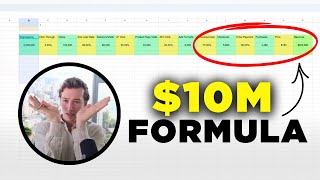
In this instructional video, the speaker walks through a systematic framework for growing an e‑commerce business by modeling the sales funnel as a series of measurable steps—impressions, click‑through rate, site‑load rate, product‑page visits, add‑to‑cart, checkout, and purchase. Using a concrete numerical example (2 M impressions → $672 K revenue), he shows how each step has a lever that can be pulled either by improving the conversion rate at that stage or by increasing the volume of traffic entering the funnel. He demonstrates the impact of incremental improvements (e.g., raising CTR from 5 % to 10 % doubles revenue) and discusses practical tactics for each lever: ad creative testing, site‑speed optimization, removing unnecessary landing‑page steps, strengthening offers, and adjusting price points. The speaker also emphasizes reverse‑engineering the most profitable customer journeys to pinpoint where revenue is generated, and he advises that when all internal levers have been exhausted, the final growth driver is to acquire more impressions through ads, content, affiliates, or outreach. Throughout, he encourages continuous testing, data‑driven analysis, and iteration, promising future deep‑dive videos on each funnel component.
Chapters
Okay, so in this video, I'm going to show you how you can get your e-commerce business to $1 million a year in revenue, $5 million a year in revenue, $10 million a year in revenue. Whatever your goal is with your e-commerce business, I'm going to show you from a revenue standpoint exactly how to get there. And the answer is truthfully, it's pretty simple. It's not necessarily easy with all of the work that you need to do, but the concept itself is really simple. And I want to dive into what I think is the simplest way to think about growing an e-commerce business and the metrics to focus on, essentially just how to think about increasing your revenue if you run an e-commerce business. So right in front of me, I've got a combination of what I've described as statistics and levers. Now, all of the statistics are in blue and then levers are in this orange color here. So Fundamentally, each of these statistics represents a step in the journey that somebody might take in order to give you money. Now, this can look different. I'll explain the nuances of this in a second, but just at a high level, if we take your typical e-commerce funnel, you've got impressions. And these impressions, let's say, will come from like you posting a video on social media or you running an ad. People see this. An impression is a view. They see this video, they see this ad that you've read. Now, a certain percentage of them will click on that post or on that ad. And that is a click. And let's say in this scenario, we've got 5% of people click. We get 100,000 clicks off of 2 million impressions. When somebody actually clicks to go on your website, that doesn't guarantee that everybody will land on your website because websites still have to load. And when you have bad Wi-Fi, you might have been on websites before, you're trying to load a page and for whatever reason it just doesn't load, it's taking forever. So you leave, you can't be bothered to wait anymore. And that's what happens a decent amount of time. You'll see around 20% of people on average, 10 to 20% of people don't wait to load the page. So in this scenario, we've got 80% of people actually load the page, which results in 80,000 sessions or visits. Essentially, a session is someone spending time on a website, same as a visit. So we've got in this example 80,000 visitors on a website now. Now typically your average funnel, especially if you're selling an e-commerce product, will take you to your landing page where people have a session and a visit, and then people will go to your product page and then they will be able to go to their cart and they'll add to cart. Some funnels will remove this step. They'll just straight up delete this step entirely. And that's something that you can do. You can literally do this. Oops, I'm messing up my entire spreadsheet now, but you can quite literally just delete a step and you'll see what happens in this scenario when I delete that step. So we're gonna get into optimizing this in a second. But typically, again, people visit your landing page and then 50% of them in this example will visit the product page itself, the place where they can actually add to cart. They can swipe, swipe through your product images. They can get more information about the product that you're selling. Out of those people, if 20% of them actually click add to cart, then we have 8,000 add to carts. On the cart page, if 70% of people, which is roughly standard, click checkout, then we've got 5,600 checkouts. If 80% of them actually enter their payment information and pay, then we've got 4,480 purchases. And if your average price point is $150, then you've got $672,000 in revenue. So if we're going to grow an e-commerce business, it's really simple. There are these levers and there are essentially levers in every step that somebody takes that you can pull. Um, or you can fill your funnel with more people. So you can think of it as a funnel. You could think of it as levers. But if I were to draw this visually, it would look like a really wide funnel up at the top here, 2 million people down to 100,000 people. And then it would just start getting smaller and smaller and smaller until the very bottom of the funnel is spitting out these 4,000 purchases here. And yeah, you can either make your funnel wider, So reduce the slope the funnel has, or you can just fill your funnel with more water or more impressions in this scenario. So I'll go through them and I'm going to touch on a couple of things really quickly that you can do to pull the lever and influence each of these steps. But before I do that, you can build a funnel like this for any kind of online e-commerce business, and you might have several different funnels. You might have several different journeys that somebody actually goes through before they land on your website. You might actually find that you've got people that look at an Instagram page and then look at your LinkedIn page, and then they look at your Google search listing, and then they click on your Google search listing, and then they land on your website. So there's a few more steps before this actually happens. Now, what I would recommend doing is looking at the place where you get most of your revenue. So building something along these lines and figuring out where most of your revenue is coming from at the moment. What journey? What if I reverse engineer this process and with 4,480 purchases, how are people ending up at the point of purchase and just reverse engineer every single step, build it out like this. And what you'll likely find is you've got 3 to 5 of these people find your website organically. So there's organic impressions and there's a slightly different process they follow. People find your website through an ad and your ad has a specific page that you're sending traffic to that is custom specifically to that ad. And people see it go through 10 or 6 steps instead of 10, whatever it may be. If you build these out, then it becomes really, really easy to optimize each of these steps. And this is something that I learned way, way, way too late in business. And I like properly understood way too late in business. I did this as a service for all of these e-commerce brands that I work with. We look at their entire funnel, we optimize each step of it as much as we possibly can, and then we grow them. We just fill them with more impressions. But I didn't do this in my own business, not nearly enough. And this was a big lesson for me and something that really hindered my ability to grow. We're still a decent-sized company, but we could be, we could be a $10, $20, $30 million a year company right now if I had learned this and actually applied this to my own business a little sooner. So I'd really recommend going through this and understanding each of your weaknesses, but also each of the metrics in your funnel. So if we look at this, if we've got 2 million impressions and let's say these 2 million impressions, just for the example's sake, are coming from ads right now. And 5% of people click through, then I've got 100,000 clicks. Now what can I do? Theoretically, I can go there and I can figure out how to improve my ads. And this is the part that is simple, but it's not necessarily easy to do. It's not easy to figure out what all of your problems are with your ads. But fortunately for us, through research, through time, through thought, through talking with people and having conversations, through watching YouTube videos, through consulting with ChatGPT, through asking your customers about what they care about, you can start to figure out the things that are important to the people that you are showing ads to, and you can make more ads that focus on this. If we are running ads, we can change our ads. Essentially, if we're getting a 5% click-through rate, we probably, if we want to change a metric, we usually have to change an input as well. The metric is the output. The actions that we're taking and the input. So we'll probably have to change our input in some regard. In this case, it's the ad. So we can change the ad. We can make another ad and we can then test that and we can see if we run both of these ads together, if one of them is going to be higher than, have a higher click-through rate than the other. If it does and it's successful and I get a 6% click-through rate, great. Now let's say that we test a bunch of different ads and I finally find an ad that has 10% click-through rate. Wow. I've got a 10% click-through rate. Now I've got 200,000 clicks. Holy moly, my revenue's gone from $672,000 to $1.3 million. I have doubled my revenue by doubling my click-through rate. Now let's go and apply that to my site load rate. Now why is it loading slowly? And you can literally go down each of these steps in the funnel. You can do tons of research on how to get a website to load faster. And I can figure out how to get it to load faster. I can make my images lighter. I can stop using lots and lots of apps on my Shopify store and I can remove them and get rid of old code that's making a website load really slowly. And as I do that, I might be able to get my site load rate up to 90%. And if I can do that, boom, we just added $150,000 in revenue. Now let's do the same thing. I've got sessions and visits and 50% of people actually click on the product page. That is on my landing page, that is on my homepage, that I'm sending traffic to, and I get 90,000 people on my product page. Well, what could I do? I could just remove this step, and instead of sending people to a homepage and then a product page, I could just send them to a landing page or a product page that, that where they can actually buy something straight away and where I can actually have something to sell them straight away as well. So if we do that, Wow. We double revenue again. Now let's pretend, let's pretend that because I'm sending way more people to the product page, there's a, there's some less of them in this, in this scenario, less people are actually adding to cart and it, that number goes from 20% down to 15%. That $2.2 million in revenue that I have now is still higher than the $1.5 million in revenue that I had previously. Again, these are very broad examples. And there's no guarantee that any of these things are going to work just because I'm giving this example on a video, but the concept is the same for each of them. So, all right, we've got, and that is a general concept, just so you know, is going to help if you remove steps in a process, then the process becomes more effective and more efficient. And each of these is essentially a percentage of people that actually make it through to the next step. You can also think of this as percentage of people that don't make it to the next step. So you can imagine that 90% of people don't make it to the next step, 10% of people don't make it, 85% of people don't make it, and so on and so forth. So if we know that every time people take— that there's a step in a process that people have to follow, a certain percentage of people will not follow it, then we can remove steps as an attempt to increase our overall goal, our overall output metric that we're looking at. So in this example, add to cart has gotten lower and now I can go and try to figure out how to get more people to add to cart so I can answer more of their questions. I can show them more proof. I can make my offer stronger and more exciting. There's lots of different things. But again, this is something that you have to research and understand and I'll be making plenty of videos on. Do not worry, I'll help you with each of these steps. If 70% of people that add to cart actually click on checkout, then how can I make it more like How can I get this number to 80%? If I can get this number to 80%, I've got 21,000 people checking out, I've got 8— I've got 17,000 people purchasing, I got $2.5 million in revenue. The last thing that I can start looking at, aside from these two, the last lever that I have to pull is my price points. Maybe I can charge more, maybe I can show even better results than what I'm showing right now with my product, and instead I can justify a $250 price point. And if I can do that, then I get my revenue up to $4.3 million. So I hope this is at least somewhat helpful. And there's one last thing for me to talk about, which is if you're in doubt, if you are stuck and you look at— you do this exact process and you look at the drop-offs and you're like, I really have no clue. I've done all of the research I possibly can. I've made changes. I cannot figure out how to improve the stats in my funnel. I don't know what to do here. Then Good news. There's one last thing you can do and that's just get more impressions. And to get more impressions, you can post more content, you can run ads, you can set up affiliates so you can get people to post for you and find ways to get traffic to your website for you. And you can contact people, you can reach out to them and say, hey, go to my website, I've got a sale on, or I've got this excellent product that you should check out and we can improve this impressions number. And if we, if we say, okay, we got 2 million impressions, then I, and I want to grow this, then over the next 12 months, I just have to figure out how to get 4 million impressions on my shit. And if I can do that, and wow, I've got an $8 million per year revenue business. So I hope that is helpful. That really is the simplest, easiest way to think about e-commerce. And if you're ever struggling, if you're ever running into complicated problems, you're looking at your business's profitability and you're saying, this doesn't make sense. You're looking at advertising returns and saying, this doesn't make sense, this is too expensive. You're looking at your business and saying, hang on a second, I've just worked for 12 months and my revenue hasn't grown. My business has not improved in any way, shape, or form. Then you just need to go back down to this formula. You need to look at the different ways that people are coming into your business, and you need to go to each one of the steps that they're taking and figure out how to improve it. And if you really don't know what to do, if you really can't make it any better, then go back to this ultimate step, this first step. The very top of your funnel and figure out how to get more people into that. And that's exactly what I'm doing by filming this YouTube video. So I hope that was helpful. I'll be making specific videos on each of these breakdowns, but I'd love to see some comments from you about what issues you have inside of your business and what you'd like me to address sooner than later. Just