THE NEXT RENAISSANCE BY ZACK KASS | BEYOND EXPO 2025 AI SUMMIT
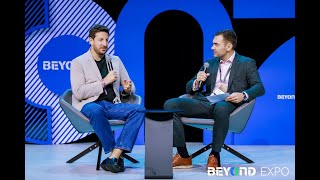
Zack Kass talks with Time magazine's Charlie Campbell about AI's near future: which tasks companies should automate, how open-source models like DeepSeek are disrupting the market, and whether compute and energy will become the real bottleneck. The conversation spans pricing models, geopolitical competition, and the risks of displacement.
Chapters
Hi, good morning, everyone, and welcome to this Beyond Expo fireside chat on the next Renaissance. My name is Charlie Campbell. I'm an editor at large at Time magazine. I'm delighted today to welcome Zach Kass. I prepared my own gushing introduction, but it all pales compared to the. The video we've just seen, so I'll spare it.
I was gonna say. Yeah, Maybe just skip it.
Yeah, yeah, exactly. Well, I don't know where my video is, but, you know, it must be lost in the post or something. But it's great to have you here. How are you enjoying the event so far?
Yeah, it's wonderful to be in Macau. It's my first time in Macau, and I'm actually here with my wife, who is pregnant. So this is our Chinese baby moon.
Congratulations.
Thank you very much. Yeah, we were just talking about it. So, yeah, it's amazing. Macau is funny if you're American, because everything is eerily similar. You wander around and you're like, I know. I've been here before. Especially these convention centers look identical to the Venetian convention. I mean, it is a spinning image of the Venetian in Las Vegas. But, yeah. And obviously this is China, so it's twice as big.
Absolutely. Well, we haven't got too long, so we'll dive straight in. In the age of artificial intelligence, everything is changing from how we work, how we interact, how we play. How do ordinary people, business people, like those in the audience, embrace that technology to improve their careers, their lives?
Well, so obviously there's a. There's a bit of a confirmation bias at play. So if you're here listening to us talk, then by definition, you've already sort of decided that AI is important to you and is going to make a big difference in your life. And then it's less about should you embrace this? And more about how. And for most people in the room, they're probably at the bleeding edge of consumer adoption. I think what is interesting to consider is. And the heuristic that I try to challenge people to use is, what are all the things that they do today that they wouldn't do if they had five personal assistants, a number of assistants. That sort of is so much that you'd outsource everything. And I challenge people to think about that. Not because it's necessarily the exact right way to consider AI, but it does test us to consider what are the things that we shouldn't be doing, or what are the things that I wish someone else would do? And that usually leads you to start exploring AI in a much more Sort of reflexive way. And Toby Lutke, the CEO of Shopify, recently challenged his employees to basically think this way, which is, what if every one of you had a much smarter friend or person sitting next to you to do this for free and instantly, what would you, how would you do it? And he asked all employers to reflexively use AI first, which is, I think, a very interesting and easy way to, for any individual to start to reconsider how AI will, will change their life.
But for many firms, there is this fear that if they don't embrace AI immediately, they're going to be left behind. They're going to end up being behind the curve. And so there is a sort of a drive to integrate AI into many products which perhaps aren't that well tailored for it. I mean, do you feel there's a fear that firms are wanting just to tick the box that they are looking into AI without actually taking pause at the moment and seeing how it can actually improve their processes?
So, yeah, I mean, inevitably, I think a lot of the fear that people have that they are either adopting AI that is, you know, not serving them, either because it's giving, you know, hallucinating and giving the wrong answer, or because it's automating work that shouldn't be automated and is actually doing worse work. That seems very reasonable. I think even more importantly for many companies right now, the concern that they are not adopting fast enough is probably valid. And in fact, if I were a big company, if I were the CEO of a very big company right now, I would be far more concerned than ever before about startup, about ankle biting competitors, because all of the things that have historically helped big companies get bigger heft, economies of scale basically become obsolete in an age where the human computation becomes far less significant. So one of the things that I remind big companies of is that, yes, in fact, it is important that you move quickly now and also identifying what it is you you should automate and what it is you shouldn't automate becomes as important as ever, because there is a bunch of things that you could automate that would actually harm your business or detract from the customer experience or the employee experience that doesn't serve you. And so having a much more deliberate idea of what it is AI should do for you or your business becomes critical. Which is again, why the heuristic what would you do with five brilliant people next to you? Is like a very interesting one for any individual or any collective body to ask.
Throughout history, there's always been innovations which have moved Society forward, moved business forward via the Industrial Revolution antibiotics. And there's always been a little bit of pushback to that. You think of the Luddites and smashing the spinning jetties and this kind of stuff. Is AI just another one of those sort of inflection points which we're going to move past and just accept? Or are there specific dangers and perils attached to the technology which are different or set it apart from the previous leaps which we've experienced?
So the answer is probably yes to both. I think we are obviously approaching the precipice of a technology that stands to change a lot of things in the way that the first and second Industrial Revolution saw radical changes to everything, and then the digital revolution. I also think that there it is harder now to draw comparison to past events because one, the scale of the human experience. The first and second industrial revolution impacted 500 million and a billion people, or, you know, a little less. Relatively speaking, this one's going to impact 8 billion people. Also, the diffusion, the proliferation of technologies, it took a long time for the Industrial Revolutions to actually blanket the earth, right? For the industrialization of most technology, it actually took close to 100 or 150 years. We think AI is going to take about 10, right. At most. So the speed of the diffusion and the scale of the diffusion is unprecedented. And that actually I think is sort of underreported. It's one of the things that people don't fully appreciate is how quickly everyone is going to access this. Now that's good because it actually serves to solving for disparity, right? One of the reasons that Industrial Revolutions historically had really complicated effects on the economy is because it served a lot of people or a few people quite well economically, but a lot of people very slowly. Now everyone on Earth with access to the Internet has access to GPT 4.5 for basically nothing. That's unbelievable. That is amazing. And so we are looking at these competing forces that I think will both complicate our ability to sort of want this, but also it is hard to imagine that we would want this done any other way, because a slow rollout of AI is one where a few companies get all of the advantages or a few countries get all of the advantages. And that creates more disparity and more inequality. And so I think this one is going to be different for sure. And in the long tradition of Industrial Revolutions, it will drive down the price of goods and services and it will increase access. And the two measures of the human experience progress. How free are we and how Cheap is it to live. And we are about to be. We're about to live much less expensive lives.
But you mentioned that, you know, ChatGPT4 is available basically for free on everyone's phones. There's so many companies now which are investing a huge amount of money into services which are basically available for free, burning up a lot of, a lot of cash along the way. I mean, something fundamentally has to change there. I mean, do you foresee a lot of the smaller companies whittling away, consolidating behind the big players, or are they going to have to change their approach to commercialize this technology? Are we going to have to get ads on ChatGPT or like Google sponsored answers to questions to try and monetize this technology?
Yes. So a lot of people rushed out to build foundational models and there are companies here that have built and are building foundational models that's going to turn out to probably be economically unviable for a lot of reasons. One, OpenAI is pushing the frontier so fast that it's going to be hard to compete with. But also actually small models are becoming prolific and starting to commoditize all of the research, which is great. Again, we want this world. It just means that it will be harder to make money in foundational research. Then you have the infrastructure layer. And the infrastructure layer also exists quite a bit around here. And the infrastructure layer is going to have, I think, a very, very good time economically building, you know, building, selling the picks and shovels to people. Building with this technology is going to be really good. And the third is the application layer. And again, most of these companies here are at the application layer, robotics, software, et cetera, that I think is going to have another really good economic time. And then the question is how? And you pointed out a couple models, one is subscription, one is ads, and the other I think we haven't yet discovered, but I think we will soon, which is outcomes. I think there is a decent possibility that as the world starts to realize that the compute is commoditized, that discovering something is actually not sufficient, that there is something else that we want to pay. Someone for Perplexity has just said that they want to sell an ads version of their super product. And what they want to do is actually charge the advertiser and the user for discovering the perfect product. And so what their idea is basically instead of saying, we're going to pay for your attention, we're going to sell your attention, what they want to do is actually broker an outcome. They want to make money when you actually execute, make some purchase decision, which is a pretty interesting way to think about aligning incentives that Google did not bother to do. Which is why the Google experiences feel so corrupted in so many ways. So I think that there's going to be a subscription world. I think the ads world is actually far less likely. I don't think the ads world makes sense. And then there's this outcome based pricing world that I think could be very interesting.
Obviously we're here today in China and one of the most recent developments in these LLMs is the rapid growth of Deep Seq which seem to upend a lot of the pricing models of traditional sort of chatgpt and equivalence. What is your opinion of Deep Seq? Do you think it is revolutionary in the way which has been touted, I mean it roiled the market. Nvidia chips have suffered the biggest loss of of U.S. stock market history and everything. I mean, but since rebounded. I mean do you think that Deepseek is a, an inflection point, something which will change the landscape permanently?
Well, it already has. So I think arguing. It would be silly for me to argue that Deep SEQ has not changed AI, it's changed AI. There are two things that Deep SEQ did that I think are worth sort of bifurcating deep seq R1, the model is by any measure an incredible scientific achievement. Deep Seq built a state of the art model with less computer that also cost less on an inference basis. That's a big deal and something that should be celebrated. And then they went a step further and open sourced it. So it is an open sourced version of a much more efficient model that is state of the art, a big achievement. And then Deep seq also launched DeepSeek the app which is a different version of ChatGPT. Now the reason that we sort of bifurcate these things is because Deep Seq the app is I think just a slightly less expensive version of something that exists and quite honestly not quite as good. Anyways, deep seq R1 is a remarkable, remarkable sort of precedent setting scientific achievement. And we now live in a world where we should expect more and more of these state of the art achievements in places that we didn't expect them. We didn't think that China had the necessary compute and we didn't think that state of the art models could be this inexpensive. And we should now come to expect scientific achievements at the frontier that don't just improve the quality of the model but also reduce the cost of the model. And in that sense What Deepseek did, I think will be remembered as one of these very seminal moments in AI discovery.
Okay. And obviously your former employer, OpenAI has gone through some restructuring recently, moving back to the sort of nonprofit sort of format. Are you concerned about the restructuring and whether it will make it more difficult to maintain the non profit sort of aspect? You think all the for profit things will, eventually the corporate commercial impulses will take over?
I don't think that. I don't think that. I don't think that OpenAI's for profit or nonprofit status actually makes much of a difference. And this is a very hot take that I think is worth sort of acknowledging. There was so much made, so much made about whether or not OpenAI should be or for or not for profit. And none of it has acknowledged the fact that OpenAI has raised money very early because it costs a lot to build AI systems. And if you raise a bunch of money, that you are expected to return money to an investor. And I think the most of the for profit versus nonprofit news cycle has been sort of manifested by Elon for reasons that should be obvious to most people at this point.
Okay, obviously, like in order to sort of build all these, these AI models, you need massive amounts of data centers, a lot of power and everything. I mean, do you feel that this is going to be a constant, the power need that everyone's going to be looking for, you know, new nuclear power plants, new fossil fuel power plants that fund these data centers? Or is this just a push at the moment while you're training these models so that the power needs will sort of roll back a little bit after?
Yeah, so. So. We are, we're basically short on three things right now that we know we are short on compute. That's obvious.
Yeah.
China feels that, frankly the whole world feels that.
Right.
You don't even need artificial sanctions to feel like you don't have access to the resource du jour, so to speak. Korea recently said they wanted to buy $570 billion of compute. Japan said they wanted to spend a billion dollars on compute. Saudi has contributed to or, sorry, 570 billion. Japan said a trillion. I think The Saudis said 1.5 trillion is what I heard on compute. It's going to take a lot to actually spend that money. Right. It's easy to say you want to spend that money. Spending it is quite hard. Then you have another problem, which is energy. We are short energy because even if you buy all this computer, you still have to cool it and you have to power it, given that something has to give and one of three things is going to give. This is a guarantee, I think. One, our understanding of what the model requires is going to change quite a bit. So the compression of the model, which is already happening, is going to continue to happen at a rate that we aren't expecting. And the actual energy requirements on any given model is going to come way down in part because I think we're going to see models start to run on the CPU themselves. Okay, so the, the, the edge compute and the diffusion of the AI is actually going to bring energy costs down. Two, I think that we are going to probably see a massive improvement in our understanding of the AI architecture. So today we, everything is a transformer. As you know, the transformer has a lot of juice left to squeeze on performance. So we are going to make the transformer much better at doing AI. And also we are probably going to figure out how to make the transformer much more efficient. Okay, the architecture itself is going to get better and then eventually we are going to have a new architecture. This has to be assumed. The transformer is not the last architecture and the next architecture may require a lot less compute and energy. And the third is that I think we are going to have massive scientific breakthroughs still in both compute and energy. Right. We are still operating and I remind everyone this Nvidia is still basing their GPU on an original graphics processor. I mean, we are, we are still just improving, but albeit quite a bit, something that was built to play video games.
Right.
We have a long ways to go in actually improving the underlying sciences of compute and also energy. I think we are still discounting how quickly fusion is coming, both in small reactors and also large reactors. And the likelihood that these three events happen, sort of, there is a convergence is very good. Models compress, architecture improves or changes. And we see massive improvements in both the chip efficiency and the energy efficiency, such that in 10 years we are consuming, you know, a thousand or even 100,000 gigawatts of energy globally. And we're not actually thinking about how much it's breaking everything because we just see this logarithmic improvement in all these things.
But then it doesn't make it hard for policymakers to plan their energy needs. I mean, should there be, you know, a power plant takes 10 years of planning. So I mean, do they plan for the infrastructure now to boost the energy or do they better bet on the energy consumption is coming down and technology being okay?
This is why it's so hard, right? Because today everyone's like oh, we need a bunch of renewable energy. And I agree solar is, solar is continuing to blanket the earth and is doing quite a good job producing better energy. I think my bold prediction, my hot take is that most of our energy, most of our renewable energy today will look like shopping malls in the future, right? Okay, so there's going to be a bunch of infrastructure that we build that looks very, very obsolete. Very quickly someone's going to finish building a massive solar field just as the first nuclear reactor comes online and they're going, or fusion reactor comes online and they're going to go, wait a second, why did we do this? Well, job creation, a bunch of other things. But the reality is some shopping malls are still very important. There are centers of retail that are still very critical. It just turns out most are obsolete. And I think that figuring out how the grid is going to be taxed, I mean the major problem with energy is that we don't know how to move it or store it. So you just need to, you have to localize all energy. And I think one of the major breakthroughs is also going to come from our ability to actually move and store energy on the grid so that power doesn't have to be perfectly localized. But in a world where power has to be localized, I actually think it's fairly easy for countries like Saudi and UAE to just start investing aggressively in chip fabrication facilities, in data centers and in energy because not much is going to change for the next 30 years on that basis.
We saw from President Trump recent trip to the Gulf that there is a massive investment in AI there and future technology. I mean, how do you gauge that? Do you think this is a genuine push to be competitive in the global market or is this following the trends of the day?
Well, okay, so in the rich tradition of these sort of more western Gulf states, there is an incredible new incentive to sort of invest in the latest thing, football clubs. But the truth is if you have, if you're sitting on an exceptionally valuable but soon expiring resource, oil, and you are trying to plan a forward compatible economy, it's probably, there's probably not much better that you could do than to invest everything you had into chip fabrication, data centers and fusion energy, new energy sources, I don't think it's performative. With that said, I've spent time in uae, I've spent time in Saudi Arabia. These are places that are very, very aware of the stockpile of currently valuable but soon less valuable resource and the need to distribute and diversify their wealth and they have proven in building the cities that they've built and building the infrastructure they've already built a very real ability to redistribute their investment. And frankly, I'm rooting for it. I really hope that this happens because it seems to me that it presents the best opportunity to create a more stable Gulf region.
We've only got a couple of minutes left. I was just wondering whether there's any final takeaway, which you wanted to end on, about what you're seeing here today and the future of AI in China.
First of all, this is amazing. And I told Jason yesterday that. So I came to China in 2023, end of 2023, for the first time to talk about AI. And I spoke at a conference in Shanghai. And the mayor of Shanghai, after a contingency of us, met with the mayor of Shanghai after, and he had one question for me. He said, are we going to be left behind? Which expressed a tremendous amount of vulnerability at the time with respect to AI. And I said, you know, it's very thoughtful. I don't think so, and here's why. And I basically described a world where I thought the research commoditized largely because of open source. What I couldn't have predicted at the time was what Deepseek would do. Fast forward to May 2024, when DeepSeek wrote their first paper and I started paying attention to this Chinese company that I thought was going to radically improve AI access in China. I started talking about it more and more and then fast forward to this year, January, when I was at UBS's Greater China Summit. The sentiment was changing. It was becoming more. Could we versus will we be left behind? Could we keep up now what we see here, standing in front of Nvidia's inception startups, walking around one of the largest conference centers in the world, surrounded by all this. All this technology that is quickly adopting and taking advantage of this technology. It is such remarkable evidence that the diffusion of AI is going to be. Is going to feel almost ubiquitous. And the net winners is everyone. Like all of this competition, all of this innovation benefits the average person faster than any industrial revolution we could have ever imagined. And the average improvement to the average person's life is, I think, something that none of us are fully appreciating yet. And I'm not saying it doesn't come with a bunch of unintended consequences. You know, dehumanization, identity, displacement, there are a bunch of things that we have to be concerned about. But in a world where we all spend so much time saying, how can we make this thing better? All of this technology, which is going to diffuse and sort of distribute very quickly, stands to dramatically improve the world in ways I don't think we fully appreciate, even if we thought about it very hard.
That's a very upbeat note to finish off, so thank you so much, Zach. And please, everyone, special appreciation for Zach Cass.
Thanks, Charlie.
More from Zack


Anchor Your Mission, Adapt Your Methods: Thriving in an AI-Driven World (w/ Zack Kass)

AI Will Change Your Life Faster Than You Think, According to Former OpenAI Exec Zack Kass