Why Turning Off "Bad" Google Ads Campaigns Kills Your Revenue
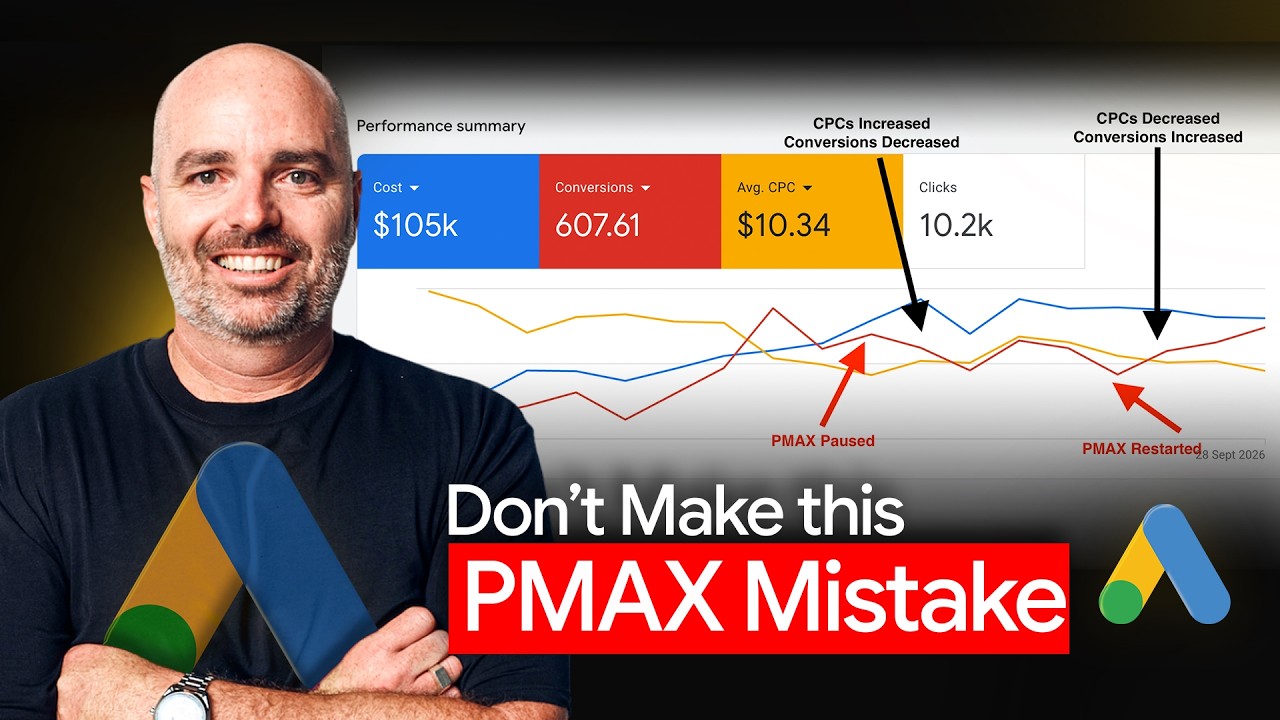
In this video Aaron Young challenges the common practice of pausing high‑cost, low‑conversion Google Ads campaigns. He argues that for accounts spending $5,000+ per month, campaigns are interdependent and treating them as isolated entities can backfire. The video explains how search behavior is shifting away from traditional keyword‑sniping toward AI‑driven tools (ChatGPT, Gemini, Claude) and platforms like Meta, making a broader, team‑sport approach essential. Using a real U.S. lead‑generation business that spent up to $100k/month, Young shows that turning off a Performance Max campaign caused CPCs to rise and cost‑per‑conversion to blow out, while reinstating it immediately lowered CPCs and improved conversion costs. He emphasizes diagnosing issues via change‑history analysis, considering offline conversion data, and scaling responsibly. The video concludes with a call to action for viewers to seek one‑on‑one help from Define Digital Academy and links to a full case study.
Chapters
So you've been taught to go through and review each campaign inside of your Google Ads account and turn off the ones that have a high cost and are giving you no conversions. And while it seems like a really good optimization action, and many cases can be a really smart play, but in this video I'm going to show you that sometimes turning off a low-performing campaign could be one of the worst things that you could do for the performance of your Google Ads account. Now I know this sounds really counterintuitive to what you should be doing because it makes sense. I can see the campaign spending and I can see the campaign results. If I'm not getting those results, why would I continue to invest in a campaign that is not giving us any money? Or should I say any return on your money? Well, in this video I'm going to show you a very real example of a business owner who did that exact thing. They turned off what looked like a poor performing campaign, and what ended up happening was that its top performing campaign actually started rapidly losing results. Now, the reason for why this discussion is so important, because not only in 2026 has Google already been making changes inside of how the Google Ads platform works, the biggest change here is the way that people are completing searches. For many, many decades, well, 2 in fact, is that from when Google was first launched through to a mere matter of 3 to 5 years ago, the main source that people would go to would be Google Search. So if you're looking for a product or service, you go straight away to a Google Search. Now, that is still a very, very popular option, and I would argue the majority of the market still use Google as their core resource. But the behavior is changing really, really rapidly, and pretty much every week as we go on and every month as we go on, more and more people are using tools like ChatGPT, Gemini, or even Claude. And as well, people are also using platforms like Meta in order to find some different products. And this is why it becomes so important inside of Google Ads. Because in 2026, you can't just rely on what I call keyword sniping. And keyword sniping is essentially a practice that has worked really, really well for Google Ads since it started, in that you find those high-intent searches and then you just target those bottom-of-the-funnel, high-intent searches. And then when you get your ad copy and your landing page and your offer dialed in, you can just continue to increase that spend. Now I'm not saying that you shouldn't do that inside of Google Ads, but what I'm saying is now you need to reach beyond that pure activity. Now a slight word of warning here, if you are just starting inside of Google Ads and you're spending under $5,000 a month, you can continue down that path. This video is very much aimed at business owners who are spending more than 5, 10, 20, 30, in some cases 6 figures inside of Google Ads or more a month. And if that is you and your business, you do need to start to really think about— you can't just focus focus purely on those keyword sniping tactics of hitting your bottom of the funnel traffic with high-intent keywords. If you only get one thing from this video, this is the core concept I want you to understand. Google Ads is a team sport. What I mean by that is that you can't judge the success of any campaign inside of your Google Ads account just by the individual campaign line. You need to really look through the data and really try to find out how do those campaigns interact with each other. And if we can use a sporting analogy, I want you to think of it like this. Now, if we take football, for example, and just for clarity, when I say football, I mean soccer. And that's just because obviously it's been a World Cup year. Now, quite rightly, much of the focus goes on the top-scoring players. So think about your Messis, your Ronaldos, or even your Haalands. I'm not going to get into an argument as to which one is better, but quite rightly, because they get that final glory shot and they're really skilled at that, they get a lot of attention. But you need to remember for any goal that is scored in soccer or football, whichever way you want to call it, that it is a team effort. And even if they were the only one who ran the ball, and even if they ran the whole field, it's the other members on the field which are running lead runs, which are taking defenders out of the way so they can continue their clear path. With the core concept being take away those players, and then that star player can't be a star player anymore. And that's the same example of how Google Ads operates. Especially when you start increasing how much you're spending inside of Google Ads, you may look at it and judge your account and go, oh, it's these high-intent search or shopping campaigns which are really bringing in all the money. But if you stop some of your other partnering campaigns, and this could be anything from your Demand Gen campaigns through to your Performance Max campaigns, even through to some dynamic keywords, whether it's— whether it used to be Dynamic Search Ads, but it could even be AO Max if you're going down that path already. Those campaigns, especially when you review them at the campaign level, won't be pretty reading. So, and this is where the real skilled business owners who are running Google Ads or the skilled marketers can really tell the difference of what is wasted spend, so you need to turn it off, versus what we call supporting spend. In that, yes, that campaign line may not be giving us a profitable result, but if we turn that off, it would affect in a negative way other campaigns. And that's where you really need to start looking, like I said, Google Ads or your Google Ads account being a team sport. Yes, there are star campaigns which give you that top-level performance, But those campaigns quite often will not operate to the same level if you didn't have your full structure really thought out in the best way for your business. So right from the start, I want you to understand this in this video. If you are aggressively scaling or you're wanting to scale your business with Google Ads, the big thing that you need to stop doing is looking at each campaign as its own entity. Yes, there are campaign guidelines. Some campaigns, those ads will appear on different networks. Some will appear on the search network. Some on the Shopping Network, some will appear out on YouTube or the Display Network, whichever types of campaigns you're running. Some will also have a different intent and a different purpose. Some may be a branded campaign. You may have some competitor ads in there. You may have some bottom, bottom of the funnel ads. You may have some more top of the funnel sort of keyword search ads. And you really, really need to make sure when you've got a more complex account structure like that, that you are not making the mistake of just judging a campaign's performance the individual campaign line. Now to make this really, really clear, what I'm going to do is we're going to jump into a screen share so I can walk you through a real-life example of what happened when a business made this decision and they turned off one of their underperforming campaigns, and it had some really, really real and quick rapid results to their best-performing campaign. Let's go and have a look. Alright, so I'm going to take you through the real-life account data, but what I want to do here first is I do want to walk you through— we've actually brought out some of this data on a week-by-week basis so you can actually see clearly what's happening. So we'll reference Google Ads dashboard and then we'll also come back to here. Now let me give you a little bit of a breakdown of what this business was. This was a lead generation business based in the United States. They were spending up to about $100,000, but we have actually been able to bring their spend down to below $60,000 while actually seeing better results. Now at the end of this video, I'm going to show you if you do want to watch a full case study on how we did that, but this is a separate section of what one of the lessons and learnings we learned from working with that business owner. And like I said before, if you are a business owner, and you would like some extra help with your Google Ads, especially if you'd like one-on-one support, just follow that link in the description below, you can find out more about how Define Digital Academy can help you and your business grow with Google Ads. What I do want to show you in from here, and we'll come back and reference this soon, is that they've got 4 core campaigns, they were running 4 core, 4 campaigns, they turned off Performance Max and went back to 3. They're now back at 4 campaigns. They've got 2 search campaigns. It's important to note they don't run any brand spend. These 2 search campaigns run 2 different services that they're trying to attract. They've got Product Service A, which is much more valuable for them, and that's why they're spending more money on that one. They've got another service which is still valuable for them. The traffic is a little bit cheaper. That's why we keep the spend in the market there. But this is their core service. They've then got a Performance Max campaign, and then we are also doing what I call an uplift test. We've chosen 2 core states in America, and we're running Demand Gen there to go through and see what effect that has not only on the total account but also things like branded searches and also just total leads and total revenue generated in those individual states. I'll probably do a video on that later because I think that's a good video to touch on. But let's just look at this account now. It's important to note that this is their core search campaign, so This screen we're looking at is just looking at one search campaign only. And as you can see, we pretty aggressively increased their spend, $2,500 a week, and it peaked up to $8,360 a week. Obviously the conversions was growing at the same level. And then what we did do in through here, I will note that we did start to adjust some of their conversion metrics as we got more offline conversions data coming in, we're able to slightly adjust. That's why there was that little drop there. But the big thing I really want to hit on through here is look at their click cost per click. So obviously through other optimizations, their cost per click started at $17. As I said, it's the legal space, super, super expensive. But we were able to get that down to below $10. Even as we were scaling more, they were able to see that continue to drop down with conversions trending in the right way. But what I want to show you through here is this increase back up in CPC. And if we just jump in through here, let's go to the clicks as well. Is that this then started to also affect their spend. We didn't make any budget changes here. So let me bring out these 2 graphs for you here. And I'm not as concerned about the conversions. And the reason being is because at this date they have offline conversions. It takes about 30 days for all of that conversion data to come back. But what was my big interest here is that when we stopped Performance Max, the CPCs started to increase. Now those CPCs, we'll go through the table data so I can really show you how much they did move because it was quite significant. But also what I want to show you through here is that when we restarted a Performance Max campaign, the CPCs started to go down again. So if we put these 2 graphs together, this was the first one. So back here, the CPCs started to jump back up again. And then when we restarted Performance Max, the CPCs started to go down. Now let's go back and look at this graph that we spoke about at the start. So what I wanna show you in through here is this is where we were really starting to scale up the spend. And CPCs, obviously, as we expected, did start to go up a little bit, but then they started to tail off. But what happened through here is that once we turned off the Performance Max campaign, there was a bit of a halo effect. And that's where we saw some performance continuing to go on for the next 14 days. But then it really started to kick. CPCs started to go up. And then what happened from here, you can start to see their cost per conversion really started to blow out. Now, This will drop down a little bit, but it's not going to get below $200. So they really did. It'll probably, probably end up somewhere. I mean, this one's already at $234, but they started to see a decrease. So they started seeing an increase in their CPCs and a decrease in their conversions. Now look what happened when we restarted a Performance Max campaign. It's reversed pretty much immediately. Now, this was only half the week, so it started on the 11th of September. So this is only 3 days of this week. We saw an immediate reduction in CPCs. So CPCs went back down to below that $10 mark. And you can already see the second week in, the cost per conversion is already trending well to go below that $200 mark. So what's the core message here? What I really, really want you to think about is that especially when you are spending Google Ads at scale, this business was spending up to about $60,000 a month. You need to remember here is that all of your campaigns are interconnected. And by turning off something like a Performance Max campaign, you may have that unintended result of actually seeing really bad results or diminishing results in your other campaigns. And this is why we always say if you do see a drop in performance or a drop in campaigns, and if you don't really know what the issue is, one of the best ways of going through and really diagnosing what the issue is, is to go back and look at your change history. Look at the total account change history and start marking those dates. What changes did you make? Did you make changes to bidding? Did you pause a campaign? Did you increase a budget on another campaign? And because sometimes the changes that you made in other campaigns can have a detrimental effect to your core or your top-performing campaigns. Now, as always, this was very, very specific for this business. You need to go through and judge and look at your own business and your own account to really get the full effect of what are going to be the best decisions for you and your business. But remember, the core of this video is to remind you that when you are optimizing your Google Ads account— and I use the keyword of account and not campaigns— don't just look at the campaign level. Look at your account data in whole. And if you want to take it that extra step further, as you know what we teach here at Define Digital Academy, it's also about taking that extra step further and looking at what's actually happening in the business— the real leads, the real sales conversions that are coming into your business as a result of what you're doing inside of your Google Ads account. Hey, thank you so much for joining me. My name is Aaron Young from Define Digital Academy. And remember, if you would like some extra assistance with your Google Ads, if you're a business owner and you know that you need some extra strategic help to grow your business with Google Ads, that's the one reason why Define Digital Academy exists. And it would be an absolute pleasure to have a discussion with you. To find out more, just follow that link in the description below. And if you'd like to see an actual case study on how we structured this account, how we scaled it so quickly, and how we actually got better results with about 40% less in ad spend, go through and watch this video right here. Hey, thanks for joining me. See you next time.