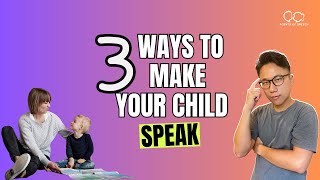
YouTube video by Ming (Agents of Speech) giving three practical strategies to encourage communication and early speech in children with speech/language delays: (1) create a strong routine with a motivating activity/toy (example: bubbles) and use predictable back-and-forth to teach turn-taking and requests; (2) use baby steps toward speech—signing/gestures, imitation, and rewarding any vocal approximations—to shape spoken words; (3) keep modeling target language at the child’s current level (one-word labels or sounds, sound play) rather than expecting full verbal responses. Ends with invitation to download a checklist from agentsofspeech.com.
Chapters
Hey, this is ming here from agentsofspeech.com today we will be talking about three ways to get your child to start speaking. And this is applicable for anyone who is speech and language delayed for a child. Right? And we'll dig right into it. So first way is to create a very strong routine. And if you've been to speech therapy or any type of early intervention, you will realize that they use a lot of bubbles. And why? Because it's fun. Okay, so I've got some bubbles here. I want to show it to you. It's very hard for them to handle it. It's very heavy. They can't open it, so they must play with me. All right? Sometimes I see when I use the small ones, especially when I was a junior therapist, I used a lot. It spills. It's hard to manage when the child's trying to grab it and so on, and it's a mess. But this one, I give it to them. They're like, they can't even hold it right. Okay, so what you need to do is to give them something for free first. Okay. Whenever you're trying to communicate or make a child to start talking to you, you need to give them something for free. In this instance, it's bubbles. So what I would do usually is to open it first, blow a few bubbles to show it to them. Right? Blow a few, let them pop it. Let them have fun. And then later on when they know, oh, okay, so I'm here to pop some bubbles. It's fun. It's cool. This guy is blowing me bubbles. That's very nice. Right? So then when he wants more, I am in the position to ask for more from him. Okay? So I would start off with getting him to start giving me this bubble thing back to me, right? I would give the whole thing to him. And then he will try to open. Or she's going to try open. She cannot. And then I put my hand out as a helping hand, and he'll give it back to me, and then I will open it and I'll blow again, Right? So I do this a few times. He quickly knows that he needs to give this to me. That's already communication, right? So that's what we're teaching. We're not teaching a child to speak, per se. We're teaching a child to communicate. Slowly, we will upgrade the communication. All right? So from just giving us the thing, we want him to start other gestures and so on. And this is the second way of getting your child to talk to you. All Right. Getting your child to engage with you is step one. The second way is to have baby steps to teach towards speech. And if you're new here to agents of speech, then this might be new. Okay. We teach children to use a lot of signing, a lot of gestures, imitation of actions and so on to build towards speech. And then slowly we want the child to start saying some word approximates. We don't even care if the words right or wrong. Even if a child says ah like that, I will still say yes, good boy. And I sing ah. And I will instantly blow some bubbles so the whole thing looks like this. Okay. I will show them this bubble and then I'll give it to the child. The child will be like, h, I don't know, I can't open it, it's too heavy. Tries to give it back to me. I hold it, I wait here because there's already a routine of him knowing that he, he knows that I need to open it in order to blow. Right? So I'll wait here and I'll say something or do an action or tell him to do something. Like for instance, open. That's the one we use a lot here. Or maybe it's just ah or open, right? If he's, if he even makes a tiny squeak of noise like, like that. I was like, yes, open. I'll open it, pull it out again. And right before I blow, I will try one more thing. Okay. It might be blow. It might be, or whatever. And usually children will pretend to blow like, like that. And I will acknowledge and say, yes, nice, yes, blow, and I'll blow. Okay, so that are the two ways that use together. Number one, have a strong routine. It could be bubbles, it could be whatever your child likes. I might be using the swing, the slide, anything that you can stop right before something happens. And then you can teach baby steps towards words. But two ways that I really like to use together, right? Number three way is to keep modeling what you want to hear. Okay. So I see that a lot of parents will keep on asking and prompting the child to speak whilst that is not might work with typically developing children, Right. The problem with it is that speech delayed or language delayed children, to be more exact, they do not have the prowess, the ability to talk. Right? So if you keep on repeating something without helping them to do something easier or, you know, giving more hints or making it more achievable for him, it's going to be frustrating and they're just going to ignore you. Okay? So that's why you need to keep on modeling what kind of language you want to hear from them. And that doesn't mean that you speak in whole sentences or ask questions or so on or give commands. What you should do is to describe in, like, one or two words at the level that your child is operating at right now. Maybe your child isn't speaking, therefore you. The best way to give them the correct language input on modeling is one word. Okay? And if that one word is too difficult, just try sounds, right? Do some sound play if you don't know what it is. Sound play is just adding weird sounds and babbling to things that we're doing around the house or playing together. All right, so that's it. That's the three ways I want to share with you. And if you're interested, you should go to agents of Speech.com checklist to get a checklist of all the tools and toys that we recommend you when you're starting home therapy yourself. Okay, so that's the end of this video. I'll see you in the next one real soon. Bye. Bye.