5 Tips to Get Autistic Children Talking to You
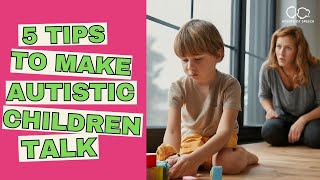
Ming shares five strategies for getting autistic children to talk: be direct with clear commands, combine verbal and written cues instead of relying on gestures alone, ask questions instead of giving long explanations, join their interests by playing alongside them, and manage sensory environments while gradually building skills.
Chapters
Want to get autistic children talking to you? Here are five tips as fact about research that I can try right now at home. It's been working for us, and I want to share it with you. The first thing is being direct. Direct meaning there shouldn't be a lot of jokes, not a lot of sarcasm. If you want a child to do something, you tell them exactly what you want them to do, all right? And this means not catering to other people's feelings. What I mean by that is, if something is not yummy, you got to say it. Or else when your child, autistic children, when they try it, they're like, what are you talking about? This is disgusting. So when you do that, you lose trust. And something else that I see a lot, and I do when I just start off as a therapist, was that I would praise about everything. And that's like the golden rule book, a golden ruler inside the therapy books, right? That we have to try and find everything to praise about. But the thing is, when we don't praise praise specifically, we're not direct about our praises. What happens is that children get desensitized. They don't understand why we're praising about something. They think that we're fake. We're not being direct about what we truly think about. And those praises become later on thorns in the relationship. Meaning, I don't even know if this praise is correct or not. I don't know if we're saying it just to please me or to get them to do something that they may not want to do. So be direct about things and also extends to being direct about your commands. So if you want a child to follow your lead, want them to listen to you, the best thing that you can do is to say the command and then directly guide them physically to do the thing. All right? If you're not direct with these commands, these instructions that you give children, what happens is that autistic individuals will learn that I can ignore these commands. And therefore, there's no power in your commands and trials, not under instructional command. And a lot of people will say, no, Ming. Nowadays, we don't do that anymore. We may follow children like child's lead, but that doesn't take away the fact that you need your child under instructional command when there are dangerous situations, right? Or when you just cannot allow your child not to respond in a certain situation. For instance, you might be in a mall. It might be traffic. You might be in between a crossing in traffic. There's a lot of situations where you want to have that control. All right. Secondly is to use less nonverbal communication. All right. So we use a lot of nonverbal cues to communicate facial expressions, gestures. Right. And to rely on things that are other than words to. To try and tell you something that's a little harder, like a complex message that's going to be a little bit confusing to a lot of autistic children. All right. And I've heard this first time, like firsthand when we neurotypical people. I'm guessing I'm neurotypical here. I don't know. Nowadays, using a lot of body language and facial expressions and also like eye contact to talk about, to tell a message when no one is speaking is going to be difficult to autistic individuals. So it doesn't matter if the children, they're teenagers, they're adults, as long as you're using non verbal communication stuff that is not supplemented by speech. And we call this total communication. We want a hundred percent that the message is conveyed both in verbal and gesture, in body language, whatever, in written, and whatever means to get the message across. Okay. So if we're using a lot of non verbal communication. Deal. Complex messages, it's going to be difficult. And you might be thinking ming. But you've been talking about how we use gestures a lot to supplement. Right? So we don't want to use nonverbal communication only. Right? We don't want to use gestures only because it leaves a lot of interpretation in the child's hands or brain, so to speak. And it creates a lot of incorrect assumptions that children. Children have. And then there will be a communication breakdown. And therefore children don't want to communicate with us because it's too difficult. I don't want to try anymore. All right. The third thing is monologues. There's this thing going on in this therapy space that we have to describe, explain everything that we see, everything that child touches, everything that they do. But the problem with autistic individuals or our children is that they cannot really take perspectives too well. We call this theory of mind, meaning they cannot see the world through my lens to think about. And in my perspective, what would I be thinking? So if we monologue and we talk a lot, we talk about this called self talk, Right. If you learn this from it takes two to talk. The hand program is called self talk or parallel talk, so to speak. These things may not be your best bet when you want children to start talking to you, because what happens is it's more like info dumping. We're trying to talk a lot and throw everything on the wall and see what sticks. Whilst this is a good method during language facilitation activities, that has specific goals in terms of play, speech and language. It's largely difficult when you're having a back and forth conversation. Like a lot of parents who say, I want to have back and forth conversation, but if you go on a monologue when you talk about and describing everything, then there isn't really any back and forth here, right? So it's not really enjoyable. And it's not even about like just autistic individuals. It's like every day, everyone. If you start talking about yourself and talk about this and that and you ask a lot of questions that are not probing questions, that are like closed questions and quizzing questions, then what's going to happen is that children will think that you have an agenda behind it. And that's the worst thing. Because once you sense the agenda, doesn't matter if you're on the spectrum or not, you're going to shut off, right? Once someone's trying to get you meet a friend that you haven't seen for a long time and they start taking it out an iPad, and then they start selling you insurance, then you shut off, you're like, oh, I guess we weren't out here to get a coffee. I guess we were out here for you to sell me an insurance plan. This is what happens. There's no back and forth and there's not enough social cues for a person on the spectrum to chime in because it's all about you. All right? So anyways, the next thing I want to talk about is sharing specific interests. I went to China recently and then this lady asked me, oh, I have this really close friend. The son is 17 years old. The only thing he does is play with water. He doesn't talk with other people about any other topic. Right? He is verbal, he does talk, he does know a bunch of math, he's academically fine, but he just plays with water. And she was like, so what do I do in this situation? What can I share to my friend? So the first thing is to start playing water with that autistic individual. Ask them a bunch of questions about how they would like to play that thing if they're verbal, if they're non verbal, just enjoy the whole process with them, all right? I think it's a huge misconception that children on the spectrum, they don't develop play or language. They do, but just in specific ways. So this feels more of that you're trying to understand Trying to let them lead you into playing the way that they want to. And this is very different from the very generic explanations that you see online. I was like, oh, follow Charles League. See the interest. Let them like, show you how to whatever. No, it's like you see them playing it already, right? You go into it and then you look at you observe them play, right? And once they're comfortable with the distance that you're there and they can't feel, they feel that you're genuinely interested, which is very difficult to do, by the way. There's a whole book about it for, you know, just for us. It's called how to Win Friends and influence People. Also works on autistic individuals, right? You know, like, you got to be like a puppy, right? A puppy is universally loved across all cultures, right? So what does a puppy do? Like, they have no agenda. They just come over and want to be a friend. They go pounce all over you. They wait next to you, right? Depending on your body language and how you are, if you're in a bad mood, they're not going to pounce on you that much. They're going to be next to you and try to get your attention slowly. So it's the same as when we're trying to deal with or not, not deal, but we're trying to establish a relationship with anyone in the world, let alone autistic individuals, right? So we want to make, make them feel like we love what they love, right? I'm just sitting there and watching them and going, wow, that's awesome, right? And slowly you'll get there, right? And I have examples of us teaching parents of how to do this. There was a parent, she's from Indonesia, her daughter loves turtles. So what we did was we got a bunch of turtles. We started feeding lettuce to turtles. The whole thing, it went on for a long time and just sitting next to the child, watching him feed lettuce, and we were like, wow, that's awesome. Wow, look at that going on. Like, just talk over it and think about what words would trigger something funny, right? And this goes back to not using a lot of nonverbal cues, a lot of non verbal communication. We want to use language in the way that children on the spectrum use language, which is for entertainment purposes, right? So a lot of times when we do a facial expression or like a nonverbal gesture, we want to make it funny, right? Once it's funny, they want to repeat it. That's why we get echoladia a lot of times, because they Find it funny, and they repeat after it. There may be a meaning associated with it in the background. Nowadays it's called the stall, right? It's like a whole chunk of a phrase or an action that represents a certain feeling, right? So you want to add these into when you're sharing these specific interests, right? So back to this girl with the turtles. Feeding different things, cleaning the tank, giving them water, washing the turtles. All these activities you can do alongside with them and make sure that you're really having fun. Because if you're not having fun, then you have to learn to have fun first before the communication happens, right? Because a lot of times when we're trying to small talk with children, it doesn't work. How do we even. Like, how do you even think that having a small talk with the autistic individual is going to work better? The best way is to start with interests, right? If you want to make a good, great, huge business deal and that particular person only likes playing golf, then you better start learning golf. It's the same as teaching anyone, right? You want to start with their interests. Because autistic individuals aren't putting the hand on saying, I want to learn how to talk. They're not doing that if they're putting their hand up and saying, I want to learn to talk. You don't have to go through any of this because you already have your motivation and everything aligned, right? Okay, so the last thing I want to talk about is managing sensory environment, which is common knowledge now to do, and it's taken way ahead, like, way too much. I think sometimes we want to be accommodating and challenging at the same time. The reason is because if we don't challenge these sensory environments, and therapists will say, especially occupational therapists, they'll say, as children get older, their sensory needs may increase and blow up. If children love swings, right, when they're in their adolescence, the swing needs to be a lot more intense to actually help them regulate. So I my own opinion, this is me talking. I don't have any problems with that. I think that it needs to be regulated in a way that they cannot have it anywhere. Because to live in this society, as much as we all have our sensory needs, right, when we need to communicate and work and do our thing, right, we will have to wait for that to happen, wait for when we have time to engage in sensory activities. But when we want to get into the world of autistic individuals, we have to be weary of what's happening. All right, so I'm going to Tell you a story. An autistic woman. When I was talking to her, I realized that something was bothering her and it was something on the floor, it was between the tiles, it's not aligned and even. And she was getting a little bit meh. So this is a little bit different from sensory, but still why it bothered her was because between the tiles the height was a little different. So it started off as that and then the rigidity and the, the feeling of I must get this done my way. That kind of thinking kicked in as well. So what we needed to do was to divert her away from that, go to a different place where she was okay with that. Had like tiles that were even. Right. And not only these are something that these are the things you should look out for. I think the biggest thing is sounds and smell and also light. These are quite important. So if you have a room or a place where it's calm and comforting, it'll be much easier to get children on the spectrum to talk to you. Okay. As long as there's not a lot of distraction going on, then it would work a lot better. There's a reason why there aren't a lot of windows in clinic rooms. And that's because what happens is they see a bus and they start talking about the buses and it's very difficult to get, get back on track on language goals anymore. A lot of times we have a goal for autistic children or like whoever, it's called public maintenance. Right. So what we do is all we need to stay on the topic and the conversation so that we can, the other person can get information from you and you can get information from them. But it stems from the number one issue is interest. So if a child is not interested in the topic, it will be very hard to maintain the topic. Second of all, if there's sensory stuff going on that's distracting, that's also going to affect the topic maintenance. And if the child doesn't really understand what the heck's going on with the conversation because you're using a lot of non verbal communication like through like facial expressions and sarcasm and jokes, it's going to be hard. The whole topic needs to be very direct. And if you talk about yourself a lot through monologues, that's just not going to work. So all this combined, what we should be doing is in the beginning we need to be accommodating. But as we're accommodating to all these specific things that I've talked about, these five tips is that we need to make it challenging for them. It needs to push them towards the next. It's not nowadays therapy is oh, I need a hundred percent accommodating. It's not like that. If we are accommodating, the world's not going to be accommodating of which. Right. Therapy a lot of times is taking out an individual from the real world was a little bit too hard into a safe and comfortable place where we can challenge comfort zones and a lot of therapy and people who are self diagnosed autistic nowadays would challenge this kind of thoughts. But remember where education and therapy came from? It came from the framework from Vygotsky, right zone of proximal development or whatever you call it. So it's just basically means you have to make sure that you're just teaching at the right spot so that you can push them further and further. So we might be accommodating to children, but we want to leave children with the tools and the skill set to talk to people that they may not be comfortable in the future so that they can get what they want. So going back to the woman on the spectrum, she's 30 something years old now. Once she understood, she didn't care about a lot of the jokes, a lot of the sarcasm and she could focus on her work, right. Which was teaching children as well. It made her life a lot easier, right? And a lot of times because she doesn't know what to do, she starts imitating other people's responses to certain stressful situations. Right? So she would start getting angry, start making jokes, but she doesn't really understand the true intention behind it. So therefore the goal after all these is to teach the use of jobs humor and have them understand the reason behind it to cope for a situation to make other people feel better. All these, all right, these are the five tips. Obviously after the five tips, you will have to push autistic children and individuals if they want to. If they don't want to, then there's nothing we can do. We can describe what they want in the world and then they can make it a conscious decision logically about whether they want to continue with this or not. Right. But it's never about forcing autistic children to want to become neurotypical. That's not the point. It's about pushing anyone with any diagnosis into a different, into a, outside of this, of their comfort zone. Okay? So if we don't go out of our comfort zone, it's very hard to learn anything new. And that's why you're watching this video, I'm sure. Is that outside of comfort zone to teach autistic children? That's why you're trying to learn here. All right. So that. That's it. If you learned anything, please subscribe and comment below. And if you want more this kind of teaching and you want to share with other parents all over the world, 14,000 of them, you can go to www.agensofspeech.com. course, we have a vibrant community, asking questions, answering questions from therapists like myself, veteran parents, as I call it. And also we have a bunch of courses about social skills, getting the child to speak first words all the way to sentences and up. Just go there and check it out. All right, that's all for this video. See you in the next one next week. See ya.










