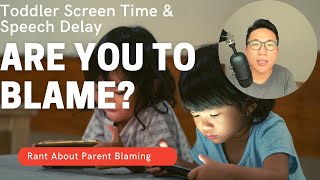
Ming from Agents of Speech pushes back on blaming parents for toddler speech delays from screen time. Studies show each 30 minutes of daily handheld screen time raises expressive language delay risk by 49%, but that's correlation, not cause. She argues for empathy over blame and points to other biological factors that matter too.
Questions this video answers
February 3, 2021.
A 49% increased risk per 30-minute increase in daily handheld screen time.
Chapters
Hey everyone, this is ming here from agentsofspeech.com today I just want to go on a rant and talk about one of the comments of a lot that I get over on Facebook and it reads like this. I'll show it down below as well. It says actually it really is the parents responsibility on kids that is unable to speak. Too much screen time and no conversation at home is the main reason. Shooting other the same professional and said you are better is not very kind. Okay, so as you can see, I also linked the context of, you know, my post on Facebook about an article I was writing a story about my client, how, you know, she went to a therapist and the therapist was like, it's your fault because you're basically letting her control the situation. You're not doing this, you're not doing that, you're spoiling your child, so on, so forth. Right. For more context, go click on the link below to look at the post. Right. First of all, I want to say that there is a correlation between screen time and speech and language delay. Right. In fact, if you look at some articles which are popping up here and there nowadays because there's more and more like iPad gadgets that are available to kids and people are making like children apps and YouTube videos for children, there are more and more studies about this. All right, and let me just share my screen. This is a website called from the Hannon center, which is a very good resource for professionals and also for parents. And here they are saying that, you know, how the screen time impact language development and basically the gist of it. I'll also put this link in the description box. All right. They said that they found that toddlers who were exposed to more handheld screen time were more likely to have to have delayed expressive language skills. Okay. And they go on to say, like they found that every 30 minutes increase in daily handheld time, there was a 49% increased risk of expressive language delay. All right, so what does that mean? This means that it's a risk factor. Okay? It's not a causation. Right. So there are children out there who spend so much time on screens and you must know a kid in this day and age who just glues his eyes to a screen all the time and they speak perfectly fine. It's not a causation, it's a risk factor. Okay. That means your child is subject to a high risk when you let them have screen time. It is the parent's responsibility to have this in control and to have this kind of knowledge, but not Everyone has like, not everyone going into parenthood knows these kind of stuff, right? So it sucks when people go ahead and point fingers and say that, oh, it's the parents to blame. That's why they're unable to speak. That's why they're non verbal, that's why, you know, they're, they're autistic whatnot. Okay? That is totally not the case. In fact, all right, most of the time language and speech delay, okay? For a matter of fact, there isn't really a biological like reason or there's no reason at all that usually we don't know why they have a speech and language delay. Obviously, a language environment is very important because if there's no language around us, we would have not learned the language. Okay, that's not what I'm saying. What I'm saying is a risk factor and people are saying that it's 100% your fault because screen time, therefore language delay. That's not the case. Blaming and telling people parents this and that. You're basically criticizing their parenting, which is not cool. And it's not offering a solution. All you're doing is saying, hey, look, it's your fault. That's what happened. And you got to understand, you got to have some empathy. If the parent, the mother hears this and they start blaming themselves, they are less likely going to like try even harder to do something about it. Came to a professional, came to get assessment to here are some solutions, not an evaluation on their parenting. Okay? So what we should do is to offer solutions, skills and knowledge, transfer them those to parents so that they can actually solve language delay. Okay? And hey, sometimes you know it that you can see these, these kids who are like speech and language delayed. It's obvious. It's not because of screen time. They're drooling, they have problems with their, you know, their oral sense sensitivity, you know, the structure, their, their, their muscle tone. These kind of things is not because of screen time, just because they're able, unable to speak. All right, so you need to know the whole story before anyone says that it's the parent's responsibility as a whole. Obviously there are things that you should not do as a parent, but everyone needs to learn, right? For example, you shouldn't give your child a pacifier because it increases the risk of your child having an open bite. But I wouldn't go ahead and ask and say to everyone who has open bite that hey, it's your fault that you gave him a pacifier. In fact, some children are born with open bites. So what do you say? What would you say about that? You would never point the finger. So the last point I want to make is in the comment that they said, oh, I'm like stepping on other professionals and saying that they're bad and I'm better than them. I'm not saying that. Never did I ever say that I'm better in any case or sense. What I'm saying is that those professionals lack empathy. Okay? And if there are anyone like that, I truly do not endorse that kind of talk to parents, especially if you work in our field where we need to empathize towards parents who do not know enough. Okay? And if you do that all the time, parents don't want to work with these professionals anymore. This video is just a rant about, you know, me feeling unhappy about people saying that I'm putting other professionals down and saying that they're bad. And second of all, I feel that really any parent who has the heart to watch these kind of videos, to be on this channel, to be inside our Facebook group, should be subject to hearing from people who are saying that it's their fault to blame. Okay? Without enough evidence. And that's all I wanted to say today. I'll put all the links, articles, the Facebook post, all in the description below. We also have a great Facebook group, by the way, and you can join if you want to. There's a lot of parents who look out for each other, provide solutions, and that's what we're looking for. You know, solution based, not blaming. And that's all for today. Thank you so much for tuning in. I'll see you very soon. Bye.