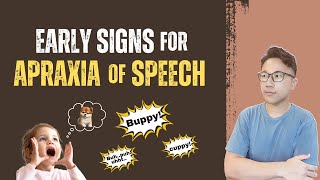
Ming outlines early signs of childhood apraxia of speech: a large gap between what kids understand and say, limited consonant sounds, reduced babbling, and reliance on stops and nasals. CAS is rare among speech-delayed children and usually suspected only after age 3, so early language therapy matters while specialists confirm diagnosis.
Questions this video answers
Three or fewer consonants by 16 months; five or fewer consonants by 24 months.
Diagnosis/suspect window varies; commonly suspected before age 3–4 and often diagnosed around ages 3–6 (sometimes up to 5–6).
Ming @ Agents of Speech; video created/uploaded February 21, 2024.
Chapters
All right, let's talk about apraxia of speech, or some people call it childhood apraxia of speech. And there are some early signs that you can see for apraxia of speech, but most of the time it's going to be suspected. The reason is because before the age of 3 to 4 or maybe sometimes in other countries deem AOS apraxia of speech or CAS in different countries to be only diagnosed at around 5, 6, like from 3 to 6. It varies. Right. So a lot of times when you see speech therapist, they say, oh, I suspect is like, the diagnosis will say s, and then CAs, like suspected childhood asprexia speech. So some early signs that ourselves therapists will look into are the following. Okay. And I'll tell you some things that I think about apraxia later on. So is there a family history of apraxia? Right. It's, you know, most of the time it's genetical. Right. Presence of receptive ability and expressive ability. Language gap. Right. There's a gap, meaning they understand you a lot better than they can speak. There's a huge gap, probably. Okay. A limited phonetic diversity. What does that mean? That means they don't have a lot of consonants. And at 12, they don't have a lot of consonants that they can say. Consonants are stuff like B, P, T, K. Those are not the vowels. The vowels are r, e, oo, a, or those ones. Right. And if you see three or fewer constants by 16 months, or five or fewer constants by 24 months, that's also an indicator and an early sign. And you can also see like over reliance on stops and nasals, meaning like they're talking, and stops meaning the constant stops like P, T, and K. Right. If they rely a lot on that and they don't have a continuous, like those are F and S's, or l, those continuous sounds. Those continuous sounds are harder to produce, especially for apraxic children. So therefore they rely on these stops and they might even rely on nasal sounds, which are these ones. There's a limited variety in terms of these consonants. And we also see reduced or delayed babbling. And the thing about babbling, there's two types. The. The first type is that it's very simple, just the constant, but later on, some people call it like a reduplicated babbling, which is like whatever, and it's like many syllables. Right. If you see that your child doesn't do as much of that, that might also be an early sign. But obviously this can be an early sign for everything. There's also, you can see that they're less loud than most children. In fact, I've seen this with most of the apraxic cases that I've ever had the honor to treat. And they don't really vocalize that often. They also have a restricted syllable and word shape meaning. Like, they only use some sort of, like, syllabic structure, which I cannot go through what a syllabic structure really means. But basically, you know, how if I say hi, right? If you spell it out phonetically and you read it on a dictionary, it's like H A I for hi. If a dictionary phonetic version of hi would be he, right? But if you write H AI AI, that would be phonetical for high, right? So that's H A I. The syllabic structure is cvv. And so if a child has apraxia, most of the times their syllable structures are made simpler. So they would, like, get rid of some of the sounds here and there. All right, so those are the early signs. But I want to tell you, apraxia of speech takes up a very small population of children who are speech and language delayed. It's a subset of a subset of a subset. And you have to be careful because a lot of parents will email me and say, oh, my therapist suspects of which. And it's. The keyword is suspect. We don't know. Okay. And through my, you know, 10 years of doing therapy, I think I've only done, like, five or six cases of apraxia speech. And I'm only making this video just so that you will watch it and think maybe it's something else and I should focus on language therapy instead of doing a lot more research on apraxia. I think you should stop now. And the diagnosis should be left to people like myself or someone who knows what they're doing. Doesn't need to be me, by the way. I now primarily teach parents over the Internet. In fact, we have a child, a girl in the uk, who has a practice speech that we're coaching. But anyways, if you really do want to go into the rabbit hole of this, you have to understand the therapy for apraxia of speech is different from if your child only had a speech delay, so to speak. It's different because then we have to think about, like, two things that they have a problem with. Right. Number one is that they cannot do more syllables. Whether it's in a word or in a sentence, the harder it is to say it correctly. That's number one. Okay. Number two, the flexibility of using those sounds are also toned down. Right. And I'm not here to define what apraxia of speech is. There's loads of videos out there, so those are early signs. If you see that in your child, that, you know, they have a lot of. They're very, very few consonants, right? The syllabic structures are very reduced, made simple, right? They're babbling. You see that they don't do a lot of reduplicating stuff like. Like an ambulance, then maybe that there might be a case. But most of the time, statistically speaking, it's quite unlikely that your child has apraxia of speech. All right, Most of the time, it would be much more worthwhile to think about teaching the language first. And then when the language catches up and then we can see a difference between the receptive and the expressive, we can then do a deep dive when they're like three to four, or maybe even six and get a diagnosis and do the correct thing and then go from there. That's it for today's video. If you want to teach your child to learn more language at home, you can go to www.agentsofspeech.com course. And we have all the free courses there that we use to sell. Anyways, hope to see you in the next video very soon. Bye bye.