Einstein Syndrome vs Late Talker / Speech Delay
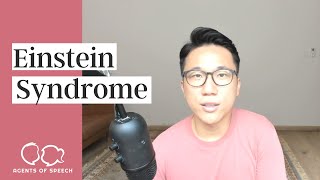
Ming, a speech therapist, explains why "Einstein Syndrome" is not a real diagnosis and why waiting to see if your late-talking child is a genius is risky. Early assessment and targeted therapy work better than hoping they'll catch up on their own.
Chapters
Hey, guys, this is Ming here, speech therapist from agentsofspeech.com today we want to talk about Einstein Syndrome. Okay? And this is coined from a book by Sowell. And I've put the link of the book down in the description box below. And I've received many comments when I post on Facebook or email or whatever. And parents say, I thought that, you know, I heard Albert Einstein start talking at the age of 5. Why are you telling us this? Are you making us scared? Am I supposed to be afraid? Am I supposed to check up now? Why are you fear mongering or whatever parents like to say? Right? And I want to tell you that the term that I actually read a little bit of the book, I haven't read the whole thing, but I think it's enough for me to give you a quick overview of what I think, what my opinion is. Okay? So whatever I say here doesn't represent the book or anyone else. It's just my own opinion. And that's what I, I, I'm about to share with you. All right, so in the book, it says that if children do not have identifiable conditions like autism, cognitive disorder, or other physical conditions such as, like articulation disorder, then it most probably is Einstein syndrome. If you haven't been to physician in the book, it asks you to find a physician. Right? But if that condition is not correctly diagnosed by a speech therapist or occupational therapist or a clinical psychologist for ASD autism, then you're gonna miss out on quite a bit. Okay? I'm not telling you that there aren't Einsteins in the world. There most probably are quite a few, I would say, but the percentage, I don't know how many. Okay? And whereas the prevalence of asd, the prevalence of language disorder, language delay, articulation disorder, all these we know, okay. There's a percentage to it. How about Einstein syndrome? We don't even know what it really means. Is not written by someone who studies disorders or syndromes. It is written by the author, which I am not entirely sure about. I'm not like, discrediting him or anything. Okay. What I mean is you have to understand your chances. Okay? So, yeah, fair enough. If you don't identify these certain conditions, then it most probably is what we label as a late talker. And this is what the, I guess Einstein syndrome is about. It's just a late talker, right? So the problem here is that in the book, it does talk about a little bit how late talking isn't about the how the child won't talk. It's more about how other people, professionals, you know, or teachers, neighbors, point fingers and say, oh, you should get it checked out. And the guilt of that goes into the parent and they are guilt tripped into like seeing more speech therapy and so on. And, and in the book, it actually tells you to encourage you not to go for speech therapy in most cases. And that's where I feel a little bit uncomfortable as a speech therapist myself. And the biggest problem is that, yes, I really hate it when parental guilt is always being stirred up by, you know, other people around you. And not necessarily they want to, it's just their natural response into like problem solving mode. Just because their child is talking more than you, it, it gives them the right to talk, give you advice. Whereas I always think that, hey, it's just a matter of chance. If their child were like that, they wouldn't, they wouldn't have anything to say to you, okay? It's just that they were born like that, right? Most of the time. And at this moment in time, we still do not know the reason for autism. We don't know the reason for our language disorder, delay speech disorder. So on all these things, we don't really know why it happens. And similarly, we don't know why there's this Einstein syndrome, right? I want to ask you, at the end of the day, therapy and getting it checked up, all these things are way of managing risk. You going to speech therapy or seeking professional advice is also managing risk. I've had many, many, many children who come to me and with, you know, just doing a little bit therapy, I will know whether there are just a little bit delayed and considered Einstein syndrome. And maybe like six weeks down the road, they start talking nonstop already and I can discharge them. And what you have to understand, at least for me, speech therapy or any therapy that I'm doing, I'm. My goal is always to discharge the kid, okay? I don't want you guys around at all. In fact, when therapist wants you around for maybe the money or whatever, that's the wrong mindset. I want you to leave and go away and have a life, okay? Don't need to come to me. If you need to come to me, that's not necessarily a good thing. You know what I'm saying? I want you to, to be able to feel comfortable with how much your child is communicating with you. Okay? So the question is, if you want to reduce risk, obviously go seek a professional, right? If you want to reduce risk, you cannot think in a way that you think that, oh, my child might be Like Albert Einstein. That's actually hurts even more if it's the other way around. You know what I'm saying? I'm not saying that. I'm not just discounting your child. I haven't seen your child. It's just, logically speaking, you shouldn't put your hopes up and think that way. Instead, you should always seek for the truth. And sometimes the truth can be very hard to find. I'm not saying that it hurts, but it's hard to find sometimes. Okay. There are loads of opinions all over the Internet, all over the world. Even if you go to professionals, they give you different opinions about the same person, about the same child. Right. So it becomes very dizzy, very confusing for the parent. So that's why I always say, if you don't know, then we only. We will act on the things that we know first. And the. The things that we act on doesn't necessarily mean it will hurt the child in the short run. In speech therapy, I think it's a misconception that we force children to talk. We do not do that. We teach them a way to communicate. We give them a better way. If they don't do it, so be it. But if they do do it, then they get rewarded better. And that reward isn't materialistic. It's the comfort that they can now say something that we understand. Okay. Or that we react in a different way that gives them a sense of achievement, that kind of reward. Okay. When I say that. All right, so don't take me the wrong way. All right, so what is it that you can do right now is that you need to teach a better way to communicate. You need to talk in a way that promotes language. It's not something that will hurt your child necessarily. Actually. All these techniques that we teach in speech therapy helps and works with typically developing children. These are language facilitation skills. We've got a whole video about that in our YouTube channel, so you can check that out. Right. So at the end of the day, how do you even know if your child has the Einstein syndrome? You will never know until they start talking. Right? It's impossible to know. And that is a huge risk. Okay? You just don't know. You cannot just suddenly decide one day when they're two or three and you're like, oh, this child is Einstein syndrome. I'm. They're going to talk at 5, so I'm going to just relax. All right? If I tell you that, you're not going to buy it either. Okay. I've tried to Say that to a lot of parents who are obvious to me. The child is just a little bit delayed. They'll catch up anyways, right? It's impossible to convince. They still ask me, does my child have apraxia of speech? Does my child have like sensory processing disorder? Does he need this? That. Do I feed him dha, fish oil, whatever? No. If you don't know, then it will stay unknown until the time that it can be detected for Einstein syndrome. Most probably this means by their four or five. I don't care if a child is very, very smart and can do a lot of things. The only thing I care about is that can they communicate? If they cannot communicate, then that's the thing we need to work on. It does doesn't mean that we need to work on their math or whatever, help them get better at drawing or whatever. That's none of my business. I'm a speech therapist. I'm here to tell you that if your child isn't speaking now, we should teach them how to speak better. Okay? Okay. And it starts with you and I, we speak in a different way to help them talk. Right. So if you don't know, then just let it unknown for now. Okay? I know it, it hurts. It's. It's hard. And in some countries around the world, you can only know if your child is on the spectrum at around 3. And for other things such as practice speech without your child knowing how to imitate and at the very least have some communication with you, you won't be able to know. And that's also beyond three. Okay. Beyond three years old, we can start to make that diagnosis. Right. So my experience and take on this, there are a lot of children who are bright, smart, and they are just delayed in language. I've seen loads of those and I've seen loads that suddenly if there's an outburst of words and they catch up within a short span of like six weeks or something. Right, that happens. It does happen. But does the other stuff happen as well? Yeah. There are children who used to talk and then at 2 and a 3 they stop talking. And then by 4 they are severely autistic. Right. I'm not telling you to give you fear or everything, but I'm telling you that there's unknown for everything. And we cannot put our trust into the unknown. We need to put the trust into things that we know. And the things that we know is that there are methods to help you be a better communicator at home. There are ways to make you talk better and and to teach communication facilitated better at home, we've got a whole load of videos here. You can watch it as much as you want to. If your child is hand pulling right now, I would suggest you go to agents of speech.com hand pulling. It's a free five minute activity you can do with child to reduce and get rid of hand pulling. Okay? And that's pretty much it, guys. That's all my rant today. I know that this kind of topic will get a lot of, you know, backlash or whatever, but this is what I think, okay? What I think is I do not care whether a child is good or gifted or not gifted, cognitive disordered or whatever. All I care about is that can they communicate with you if they cannot communicate with you, why? And then what can they not do if they, if we identify those stuff that they cannot do and then we teach the things that will help them achieve that? That's good enough already. That's the most we can do. Practically all the stuff, all the diagnosis, whether he is a genius or not a genius or you know, gonna be the next president or something, we don't know. That's the unknown. Let's not put our money there. Let's put that money to into actionable stuff that you can do right now. Okay? So hopefully if you want to have a educated conversation, you can comment below and let me know what your thoughts are. There's a free will, all kinds of like free speech and whatever and just let me know what your thoughts are. All right, so that's it for this week's video. I'll see you in the next week. Bye.










