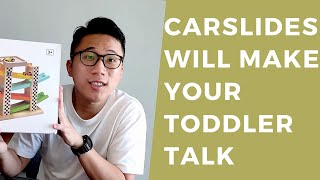
Ming from Agents of Speech shows how a toy car slide builds language in toddlers ages 2-3. Keep cars in a box for surprise reveals, model "1, 2, 3, go," add sound effects, and require your child to say words like "open," "help," or "crash" before each turn. Repeat the same sequence to get more words out.
Chapters
A car slide is one of the best toys that you can use for toddlers from like 2 to 3 years old. And it works wonders, especially if your child loves cars and transportations and stuff. So first off, I want to say that this thing I bought for very cheap in a store called miniso. I don't know if you guys have it in wherever you're living at, but this is really, really cool. First off, I want to say keep the box because it's really, really important that you keep this in a box because the cars, they go missing. As a caution, remember, don't wash these wooden cars inside because it will expand and basically ruin the toy. Okay, so first of all, how to use it to make your child talk. This kind of toy is that if you leave your child with it for a long time, they will go on themselves over and over and over until they're bored of it. So one of the reasons why we keep the box is because we can use it every time, store it well, and when we take it out, we give it to the child. They don't know how to open it. It's another opportunity for us to target some word. First one is to teach them to say open. Or at least make a gesture. Open. Okay. This is what I learned from my first job as a speech therapist from senior therapist that taught me this thing. So basically what we do is we do a gesture like this. Open. Okay, cool. Open one. All right. So sometimes what we do is we open the whole thing once they do it, they say it once. But. But when you're targeting your teaching speech and language, you want them to keep on saying it and increase the repetition. So open, open, open, open. Help them finish it. Open, open. And then you get it. See? Open, open. And you do. Open, open, open. Good boy. One more time. Do open. Nice looking. Open. Last one. You do it. Open. You do Open, open. Good boy. There you go. So once you open it all you can now go like, like that and take it out so that it's. The suspense is there. Okay? And then hopefully you have still this little bag with you. Do not use all of the cards in one time. Only take out one. Okay? So once you have one in your hand, you want to teach your child the whole sequence how to play this toy. As always, you need to let them know how to play this toy. So you want to play it once yourself. Alright? Make sure the slide, this part is facing towards you so that you can catch it. So you can go like 1, 2, 3, go. And then you catch it so once you do that, your child is going to be hooked on this toy. And now you can teach them words and gestures about it. So every time you get it, your child has to use the open palm to ask for it. Good boy. All right, the car comes down from this side, comes towards you, you grab it, you rub your hands together, and then you let them do the guessing game. What do you say? That's right. Open. Good boy. Here you go. That's right. All right. Put. You ask them to choose one. Open. Is there anything here? No. Open the other one. Is there anything here? Yes. Use the car. Hold it like this. Your child has to use the open palm, put it on his hand, and then let him put it here and say, 1, 2, 3, go. Just you say it. They don't need to say it. Okay. Once you're doing that, you want to add some sound effects. You go, whoa, when I come here, boom. And you grab it. So that's the whole sequence. Now we can add more words to it once we have a solid sequence and your child knows what's going to happen next. Ready? One, two, go, Go. Good boy. Ready? Of course, the first word we want to teach is open, right? So open. Is there anything? No. You can teach the word no. Open. Is there anything? Yes. Teach the word yes. And then after that, you hold it up like this and you teach the word car. So you can say car. Good. Here you go. And then you put it here. Very important. You hold your child's hand, don't let them move, and say, one, two, three, go. And once this happens, if you can see it is the car is stuck. So you can teach the word stuck as well. So something cool with these toy car slide things is that the car gets stuck a lot. So you can say stuck. You can teach them to say fix it or help. Something like that. Help. Come down. Boom. Starts all over again. And once you're up to this point, you've done the sequence a few times, you can start using different toys to try and slide it down. So you can use, like, food toys like this. 11 See if it fits, and you can say, no, it doesn't fit. It doesn't fit. No. So once he knows that it gets stuck from the beginning, or maybe he likes it a lot, or she really wants to just push it down like this, then it's still fine. So it's stuck. Help. Oh, stuck. Oh, no, cannot. And then next time, you can let them choose and they can actually think, oh, I would rather go for the car, because that would Actually work. So you can teach stuck. No, too big. With this. Using something else or a different car of a different size. And up to now realize that we've only used one car and we've targeted a bunch of words and taught them how to play this toy by themselves nicely. So we have a still a whole bag of it. So what we can do is actually just zip it up and then tell them to say open again. Obviously open cars one out by a time. All right. And you can give them a choice between, oh, blue or green. Which one? All right, they're gonna choose. Okay, Blue. Cool. And you can also have the green too. So once you put two cars on it, you go one, two, three and a half. Go. Like that. Alright. So you can help them do this to put two cars together. It refreshes the sequence. It makes it fun again. So that's why you want to add the cars one by one so that it's more fun every time. Right. And if you let them do it themselves, you say 1, 2, 3. What happens is it gets stuck instantly. It crashes. So you can teach another word. You say crash. Stuck. Oh, no. Go down here and do it again. Boom. Another boom. Like that. Another question you can ask which color? Which one? Or blue car? Green car. The which question is nice. You can actually ask how many? Once you got to a point where you've introduced four cars, you now you can ask how many do you want? Or how many is there? Four. How many is there? You can take one away. Three, two or one. Let's visit the sequence again with four cars. Now let's say that they already got to this point where you've already taught them to use four. How many do you want? Oh, four. Which one first? Okay, yellow. Yellow car. Here you go. But yellow car. Alright, next one. Which one do you want? Oh, orange car. All right, next one. A blue car. All right, so you hold it for him here. And then last one, green card. Great. Are you. Are you ready? 1, 2, 3. And you stop and you see if they will say go themselves. 1, 2, 3, go, go, go, go, go, go. Like that. So that's the end of our video here. I hope that this is helpful. And we actually have a whole checklist of all the tools and toys that we recommend to parents who want to start@agentsofspeech.com checklist. So go ahead, go there and download it. And if you have any questions about this play sequence with this slide, you can put them in the comments below. Don't forget to like this video. Because more parents like yourself will actually see this and learn how to do this at home yourselves. So thank you so much for watching, and I'll see you in the next video very soon. Bye.