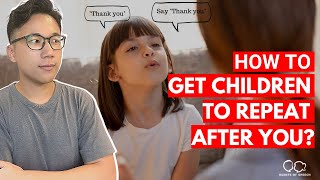
A short instructional video (Ming @ Agents of Speech) advising parents on getting children to imitate and repeat speech by first teaching imitation through gestures. Key points: avoid rote verbal repetition, teach low-level gesture imitation (e.g., open palm) using clear containers to create communication opportunities, prompt then reward with the desired object, and avoid teaching imitation and speech simultaneously.
Chapters
Hey, this is ming here from agentsoftpeach.com today we're talking about how to get your child to repeat after you. So the first thing is stop repeating the same thing over and over and over again. The reason why is because I see a lot of parents saying cookie, say cookie, say cookie. And then the kid doesn't talk. They get in a tantrum, they walk off, right? So if you are doing the same thing over and over and expect the child to do something different, that is the definition of insanity. Because you're doing the same thing and you're hoping for something else, it would never work, okay? So the reason why your child doesn't do it is because they don't understand the concept of imitation. So what you want to do is to teach imitation through gestures first, okay? And the reason why we want to do this is because I always say this. And you can look at all the videos that I've talked about before is that you cannot put your hand inside of your child to move their mouth and talk like a puppet, right? That's impossible. But what you can do instead of is to take their hand and do a gesture, finish an action, an imitation, so to speak. But you prompt and cue your child to do it, and then you give a reward afterwards. So the reward is whatever a child wanted at the time that he or she may have been like pulling your hand, leading your hand, whatever you call it, and asking for that particular thing. So you show the gesture. So let me give you some real quick examples. So the one that we love the most are two, right? Number one is like open palm, like that, so that we want them to like settle down and put their hand out and stuff snatching, right? So once your child is winning nicely like this, instead of trying to actively grab everything, the next step is to teach a gesture. Usually we do open because open is the easiest that you can create a language communication opportunity where you close something and lock something up. And they need your help to get what they want. So therefore they have to communicate and therefore you can do open to do it. So there are loads of suggestions online. Some people make it hard for your child by putting it up top on the shelf, right? You can put it some like a hide it, you can do whatever. But the thing about it is that you putting it up top, the kids are so smart, they will get a chair, they will climb up. It's dangerous, number one. Number two is like if you want to hide it, they won't know it's there and therefore they won't care to ask for your help anyways? Because asking where is something is a higher language function. It's around like three or four years old that they start asking where. Yeah, so we don't want to do that. We want to put it inside of a clear container. And we talk about this a lot. We actually have courses and training for parents that we do the exact thing, right? We put it inside of a clear container that the child can see but cannot get and therefore need our help. Right? So. So we teach the concept of imitation through using gestures. Teach them first because that's a lower skill and it's easier to prompt. Right. Imagine doing two things at the same time. Teaching how to talk and teaching that the concept of imitation. Never teach two things at the same time, okay? Especially for speech delay. Children, you're asking for a very bad experience. Okay? Last thing. Have a meaning or reward after the imitation. We talked about this already a lot of the times. Why I have to say again is because parents will just tell the kids to imitate something, and after. After which they say it, what do you go? You go and. And that's it. So that's not healthy. That's not nice. So what. What do you need to do here is you have to know what your child wants, teach the gesture and provide that outcome. And you don't do it. Just only one time. I see a lot of parents, they love, say, ice cream, and then they give a whole cone to them. And therefore, the kid's gonna take a very long time eating that thing. And they only did training for one time, right? So it's not good. So that's it for this video. It's a real quick video to let you know why and how to get your child to repeat after you. If you wanna learn more, please go to agentsofspeech.com checklist. It's a list of tools and toys we recommend you to get when you start doing therapy at home. All right, so I'll talk to you in the next one. Bye. Bye.