How to Teach Child to Follow Instructions and Commands at Home
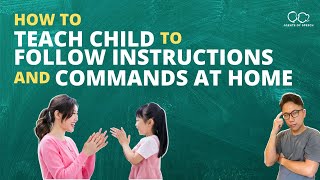
Ming from Agents of Speech teaches how to know if your child actually understands commands or just guesses from context. Test with weird, out-of-place instructions, count how many key words they catch, and use physical prompts you can fade away to link words to actions. Reward compliance right away and have verbal kids repeat instructions back to spot where they get stuck.
Chapters
Hey, this is Ming here from Agents of Speech. Tom. So today we're going to talk about how to teach your child to follow commands and instructions at home. And one of the things that parents tell me when they first come to us is that, hey, my child understands most of the things I say. It's just some question, some commands they might need some help on. I would always challenge them to say, are you sure they understand fully what you're trying to say or are they guessing? So that's why we will always, when we're doing the assessment, we try some unconventionalized commands. What does that mean? So let's say you go on a holiday and you go somewhere that you don't understand. So through the context of something. Let's say I was going through the immigration, I just went to Japan going through the immigration. They asked me to, you know, like to put my fingerprints on top of the machine. I didn't understand Japanese, but given the context, that was a scanner in front of me and that he was doing this gesture, I knew that I was supposed to put my fingers on. Does that mean I understood 100% what the sentence that the immigration officer was telling me? Probably not. Right. And that's happening at home as well. So what I mean by that is like if you give them a piece of tissue, I have a scrumped up piece of tissue here and I give it to your kid, I say throw it in the bin. Most probably they're going to throw in the bin because there's nothing else to do with a piece of rubbish. Right. It's not like they're going to use it to wipe the floor or wipe the table. So I would challenge you if your child understands something like this, you tell him to wipe the table or put it on the sofa. Let's see what happens. I think nine times out of 10, if a child is delayed and they're non verbal or single word level, they probably don't understand what you're trying to say and they would just throw it in the bin. A child who totally understands you would give you a look. It's like, what, what, why? Right. Like if they really understood it, they would question prior to asking them to do something outside of the context. All right, so if your child does understand these type of uncontextualized commands, I'll give you like three examples. For example, if you give him a four and you say put it on the floor, that's really uncommon. Something else would be, instead of putting on his shoes, you might tell him to like Put the shoes on the cabinet, put the shoe on the table. Right. And one more might be if you see a chair and you tell him or her to sit down, like usually it would be sit down. You tell him to, oh, tuck the chair in. Let's see if he or she would understand that. Yeah. So let's talk about how much your child can understand, which is what we call a breakdown level, and how much your child can. Like, it varies. So when you do a speech and language assessment, what we try to find out is that how much can your child truly understand? And the way that we measure it is by how many critical elements. That's. That's the word for it. Okay. Critical elements a child can take. So for example, if you're learning a new language yet again, I'm giving this example because you can relate. There are everyone who's learning a new language or everyone who's learning language in general. We go with a keyword approach. A keyword approach. And this is like some people who will say, oh, gestalt learners. If you're, like, not new to teaching delayed children, you will say, stop people learning a phrase. What do you mean by keyword approach? Keyword approach is when I hear a whole sentence and I pick out the ones that I truly understand. I try to guess what the sentence is about as a keyword approach. And it happens all the time, whether you are analytical or gestalt learner, so to speak. Not going to get into that. We have a few videos about that on our channel, so you can check out. Check that out if you want to. The keyword approach, you need to understand how many keywords can your child take? Okay, so we start off with just one keyword, and then we have two keywords, three keywords. So let me give you an example. If I say there are a few choices on the table, and I say put the apple in the fridge, and there's an apple, a banana, a kiwi, or whatever, and then there's the fridge, there's a cabinet. There's a few different locations that the child can choose from. So if your child can only comprehend one keyword, one critical element, so to speak, then they would probably hold onto the apple and don't know what to do with it and just guess the next thing. They might throw it in the fridge. Because that's the most contextualized guess that a child can do. That's why you need to have different options for different keywords so that it's contrastive. So it doesn't. If there's only a fridge to put something at. Right? They're going to put it inside. And you don't count that as a child who can understand a command or a sentence that has two critical elements. Because then the last part, he just guessed it. He didn't comprehend that part. So we cannot falsify that. We cannot. Like it's very scientific approach, right? Like how much can a child understand? If the latter part of it, he just guessed it, then what's the point? Okay, as we go up the number of contrastive elements, we don't go up to like 4, 5, 6, 7. We don't do that. Why? Because then we're more like treating and testing their short term memory more than testing their language. All right, we start thinking about, oh, so how many keywords can they do? What type of sentences or commands can they do? So there are different sentence structures and this is what we call like a horizontal development, like a generalization kind of goal. So for instance, if they can do like a svo sentence command, they understood that. Can they do a voa, can they do a vocal. Right. I'm not going into linguistics here. I'm just telling you there are different types of structures. I'm not going to give you a bunch of examples either because a lot of parents would love to just like chew on that and say, ah, I can. My child can do this, this and that. That's not the point here. The point is that you have a slight understanding of where your child sits at. Okay, so there are different levels of command comprehension. As we were talking about, the structures are the horizontal. We're going to talk about the vertical. So the vertical, it starts off at contextualized commands that are verbal or nonverbal. If you put a chair in front of your kid and you say sit down or you just point at it, are they going to comply? If they understand that, it means they understand the object is for what purpose? So a chair for sitting, A fork is for poking, a spoon for scooping. Most probably they would understand that if you put a pair of shoes in front of them, they would slip their little feet in. Right. If you say put on your shoes, they're going to do that. Great. That's contextualized commands done after that. One level above that is what we call object comprehension. So let's say if there's a bunch of stuff on the table and I say I want, give me the watch. And if they can give me the watch, great. There's contrastive elements, right? There's different things on a Table. So if they can do that, great. That means they can comprehend objects. Yeah. And then one level up is what we just talked about is where like the uncontextualized commands that can be a sentence and it could be just one thing inside the one keyword that they needed to understand. So if I give them a piece of tissue and say, put on sofa, right, put it on the sofa. The keyword is sofa. So if they run off and put it in the bin, that means they're using the context more than their ears and their brains to understand what you're saying. And after that we'll go into the sentence structures that we were talking about. Okay, so if they can get the uncontextualized ones, can we do stuff that relates to a verb plus object, a verb plus a place, and then we go up to subject, verb, object, kind of commands. At that level we kind of stop. And obviously there are different types of commands that we do. There's like one step command, two step command, three step commands. So step just means there's like a time element which is you do this first and then you do this, and last you do this. And usually we only go up to three step commands. Yet again, if we're doing more steps than that, that's kind of crazy because then we're trying to teach and train their short term memory. So not the best idea because you'll just frustrate yourself because you kind of forgot what you wanted to say. Like if we do first put the cup on the table and then roll on the floor and last turn around or something, you'll forget. Trust me, I've tried that before. The step commands are good only because we want to get a child school ready because it's very functional that we tell inside of a kindergarten. The teachers will say, okay, first wash your hands and then do this and then do that. Or in a PE lesson, the PE teacher would say first go through the hoops and then jump over the whatever and last row on the floor or whatever. Right. So they need to have an understanding of what we call temporal concepts like first, next and last, which are like stepwise. Now you understand there's different levels of a command comprehension. Okay, how do we teach? We finally got to that point. So it depends on what types of which level your child is at. That's why I went through it. So if we're talking about a child who is non verbal and we're trying to teach certain instructions or commands at home, it's better not to point. Why? Because a Child who is learning to comprehend with their ears will start thinking like, we'll be looking around and you can see in the eyes. If they truly want to understand you, they'll be looking at your eyes, where they're looking at how you're faced, what type of gestures you're doing. Pointing is not good because it removes the element where they truly have to listen. So what we want to lean upon is physical prompts which are pushing them towards the way that's correct, getting them to, you know, if, if there's a verb involved, do a verb gesture to help them understand. If you say, drink milk, right? Try not to pop, try not to point, right? Drink milk, okay, Drink milk. Then they drink it, right? Or physical prompts is that you just physically help them, which helps them. Because if you, and you might ask, right, well, what's the difference then? The difference is that when you say the word and you push them and you help their hands to do something, it links up the actions with the words. Whereas after you say something and you are pointing, it becomes prompt dependent because it's very difficult to fade out of point. A lot of speech therapists on the Internet will say, ah, stop prompting. Kids are prompt dependent. Well, that's because you need to use prompts in a way that is fatable, that you can get rid of. Okay, how do you fade out a prop, a point? It's very hard because like you're going to use your pinky or something. That's impossible. What you use instead is a physical prompt. So in the beginning you help them 100% and then maybe you just help 75% and then 50% and then you just push them a little bit so then it's fatable. Okay? So that's what you need to understand when you're trying to teach your child anything. All prompts and cues need to be faded out. Okay, so gestures as well. You can gesture it and then do a small gesture and then ask them, okay, what did you hear? Can you gesture out yourself? So it becomes a self prompt. So always think about how can you fade it out or make it internalize that prompt and cue. So these are very high level understandings about this. If you do get it, do understand this. You can teach your child anything. Okay, so you prompt, you prompt the prompt, you physically prompt and you gesture out. The next thing I want to talk about is after you give an instruction or a command, you need to prompt immediately. Because if you don't, then it just becomes background noise to your child. So many times when A child doesn't understand what the heck you're saying. What they would do is just ignore you. So when they ignore you, then what does that mean? It means whatever you say, mom or dad, I don't need to listen, I don't need to care. Because you say it and then you give up. There's no consequence. That's why after you say something, enforce it. Okay? Enforce it and then reward. If you don't enforce it, it becomes one of those like public announcements that you go on the subway or whatever, like the mcr, mrt, whatever, wherever you are in the world, whatever it's called. And then you hear those announcements that mean nothing to you because at the end of the day it doesn't affect your life. So why should you care? So different from a fire alarm that rings and then you must go or else people will start coming to you and pulling you out. That's the same as giving a command that you want your child to learn. You have to enforce and prompt that immediately. And once they do it, you can reward them by praising or giving them something that does of value. The thing about enforcing it is that a command is easy to enforce because all you got to do is to take your hand and do the action by itself. If you keep on prompting, it'll be easy for them to start liking, trusting and also listening to you. Okay? And there are some people out there who are going to say, oh you, when you do that, when you prompt someone like that, it's invasive. It's not. There's free will. How can you do that to your child? Yada, yada, whatever. Well, the thing is, if you allow the child to ignore you, then you would never really be able to intervene. And it's up to them then to learn this. And you don't want that to be up to them. You want it to be up to you. And it's also about the prompts. So one secret about prompting is that you don't want to pull too hard, push too hard. What you want to do is to be behind them when you're doing a, a receptive task when you're prompting you behind them so that they, they don't see you push. Like if I'm in front of you, I'm going to pull you, you're going to feel it's invasive. But if you're behind them and you push them slowly and then you help the hand like that, they can't see you. All they feel is like they're being helped out. So it's all about the skill and how you prompt and not the prompting itself. Right. There are loads of things that are invasive if done the wrong way. Even like for in adult life, if I ask you about something that is, that is very personal, if I say it in a way that I must know or whatever, if I'm judgy about it, then you're going to find it invasive. But if I listen to you first and I ask you questions and I set a boundary, oh, you don't need to tell me if you don't want to, you know, like all these, then you would feel good about it. And by the way, this is why this has got our feedback about agents of speech. We listen to you. We don't say that, dude, what, what are you doing? You do it, you're doing it wrong. We never say that we're trying to understand where you're coming from and give you some advice and ask you questions. If you don't like it, then so be it. We, we're. We're fine with that. And so the, the method of doing things needs to make your child comfortable. Because if it's not comfortable, then you won't get to where you want to go. All right, so the last thing I want to talk about is rehearsal. If your child is verbal, but then at the same time, there are some times where you not sure if they're totally understanding what you're trying to say as an instruction or a command, the best way is to use rehearsal. So rehearsing just means asking them to say the instruction one more time just so that we understand that the child got all the words and all the keywords and stuff. So if someone can imitate a whole sentence, at the very least they should have some understanding about the language. So for instance, if we're talking about, like other languages, like Spanish, Japanese, whatever, I don't know what your second language is. Right. If you have one. So when someone tells you something, you can repeat it back. Most probably you already know some of the words inside. There are one or two words that you cannot catch. But if once you try to repeat it, you internalize those words as the same for children. And whilst they're repeating those words, rehearsing it, that instruction, you can also give some sort of like, gestures at the correct keywords. So if I say something like a longer sentence that we usually do with like, verbal children who are around two to three words when they speak, what we do is go to the kitchen and get a spoon for me. So I would say, can you say it Back. Like, can you. Can you say it back to me? And then they would say, like, go to the kitchen and get the spoon. Okay, so go to the kitchen and get the spoon. All right, go. So they do it. They come back, and then you tell them one more time as a feedback. That's right. You went to the kitchen and you got a spoon for me. Very good job. So rehearsal is very important for verbal children because then you will know where the hiccups are. If there are some points where there's some parts where they cannot imitate nicely, it means that at that word, they didn't truly understand it and they didn't catch it. So it's better than giving an instruction that. That feels like it goes into a black hole. There's some sort of thing that echoes back and you'll know. Oh, so these are the parts where I need to prompt more, maybe with a gesture or whatever. That's how you do it. There's obviously a lot more nuances to this, and I don't want this video to be longer than it should be. We have, obviously, instructions and commands aren't the main thing that we usually teach children. In terms of receptive. We start with that because it helps with going to school and having schools accept children into mainstream. Because last thing you want a child to be in the classroom is that they are not taking instructions or commands. And so when you eliminate the fact that children cannot understand something and the only thing we're dealing with is behavior or whether they want to deal with, like do the instruction, that will be much easier for the teachers there to at least have a starting point. Okay, so that's it for this video. If you really want to learn more about how to teach children to speak, to follow instructions, to answer questions, you can go to ww.agentsofspeech.com course we have free courses on all the way up to a sentence level and above for children who are speech and language delayed. So that's all for today. I hope to see you next week. Have a good one. Bye. Bye.










