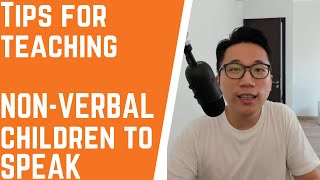
Ming from Agents of Speech explains how to teach nonverbal children to start communicating on their own. Create situations where they need something, wait for their natural protest, then shape it into a simple repeatable act like tapping or looking. The goal is initiation, not prompting.
Chapters
Hey, what's up? This is ming here from agentsofspeech.com I'm a speech therapist, and today we're going to talk about teaching children who are nonverbal. Okay, let's first define what it means by non verbal. It means that your child isn't using words, verbal language to communicate with you. Okay? They might be already speaking words to entertain themselves, to copy things from videos, to recite videos, to sing songs or whatever, but they're not using it to talk to you. Number one is that are you teaching, initiating communication? It sounds terribly hard. It just means are they starting, Are they taking initiative to talk to you? That means, are you prompting communication right now? Is it every time that they want something? Do you go next to a child and do you say like, hey, what do you want? What do you say? What do you do? Something like that that triggers them to do some sort of response. Okay, that's something that you have to be careful about. Are you doing that right now? If you are, then you should stop because you should teach them to communicate with you to begin that communication. Children will become passive if you do not teach initiation. They will come up to you and just stand there and wait for you to ask the question. Right. Yesterday I was doing a consultation online, and then the parents said, yeah, I saw the video, right? The kid would come up to the parent, use their shoulders to scrape on the parent without saying anything. Well, they are initiating, but not in the right correct form. Right? It needs to be the correct context. It needs to be the correct way. The reason why, if your child starts imitating you, whatever you do after you say, what do you do? And then they start imitating you is because they don't understand the context. Therefore, they won't remember the words. Because all they know is that if you imitate, if he imitates you, he will get what he wants. But not by saying that correct word at the correct time, at the correct context. He will get the exact thing that he was asking for. So that's why you have to teach them to initiate, because not in a way. They're not in a state to wait, look, and think about what to say, Right? They're just trying everything. They're just imitating you. Second of all is you have to create this situation. You cannot passively wait. Maybe like in a day there might be like three or four times that they will want something from you. But a lot of the times you have to create those situations for yourself. So one thing I tell our parents to do a Lot is to put stuff in a box, right? I learned that from my ex boss. It's a great tool. You know, if you have something that you cannot open, you must ask someone to help you out, right? And that person is you. So put things that they love inside the boxes so that every time they want something, they have to talk to you, right? It could be something else. You could put something really high up top and they can't get it. It must be a problem that only you can help to solve, all right? Or else it doesn't matter. It really doesn't matter because they can solve it themselves and don't need to talk to you anymore. Okay, let's say that you already like, you know, put stuff away and you know, and out of reach and they need your help. So what do you do now? Well, you do not go up to them and say, oh, what do you want? You want mommy's help or daddy's help? Don't do that, okay? You have to wait. Wait until that point where they cannot take it anymore and they start doing things. See what they do? So some children hit, some people scream. Some children pull your hand, right? They pull their hand. They're already doing it. But you have to teach them. At that moment, break their routine and teach them something more appropriate, like talking, like tapping on you or like, I don't know, like looking at you. I usually start off with tapping because that's the easiest. It has a sound, right? It's visual. You can feel it, right? There's a contact between the person who's asking and who's helping. So it's very, very obvious. And you want to start off with something so easy, even if they can talk, right? Because easy behavior will be 10 times more likely to be repeated, right? Think about it. If it was easy for you to work out and exercise, you would do it more often. It's just human nature. So make it easy for your child. You need to remember that he's already doing it, right? I've already told you, it's already in screams, in crying, in like yelling and like hand pulling or like giving you something and like shoving it into your hands. So you have to remember they're already trying. But teach them the correct way, wait for them, and then teach them to say things when they are looking at you and you have their focus and attention. Okay? So with that said, that's all I wanted to talk about in this video. If you want to know more, you can go to agentsofspeech.com nonverbalguide with dashes and you can see on the screen and there's a link in the description box below as well. This is actually a three step process that I've put down in words. It's easy for therapists to do, for us to do, but for parents I believe that this set of instructions actually help a lot. It's from my coaching clients. This is the easiest way to actually do this. To teach nonverbal children, to teach them to imitate verbally, to teach them to talk to you better for for the parents to interact with the children better. So with that said, go there. Agentsofspeech.com nonverbalguide with dashes in between. Okay, so that's all for this video. If you have any questions, any queries, please put them down in the description box below. And please remember to like this video so that other parents who need this kind of info can find it. Okay? So thank you so much. Stay safe and I'll see you in the next video. Real soon. Bye.