Is Your Child Speech Delayed? | Risk Factors for Speech and Language Delay
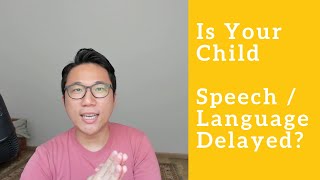
Ming from Agents of Speech explains warning signs of speech delay in children: small vocabulary with few verbs, trouble understanding without gestures, consonant deletion, and limited pretend play. Boys are at higher risk, as are kids with ear infections or family history of language problems. Get a professional assessment if you notice these signs.
Questions this video answers
Approximately a six-month delay of comprehension.
March 31, 2021
Chapters
Hey, guys, this is Meng here from agentsofspeech.com today we're going to talk about the risk factors for speech delay. Like what can you observe your child to have in order to determine whether to go for a speech and language assessment? But at any time, this is another disclaimer, you should really go see a professional to get it all checked up to see what the reasons are behind how much your child is delaying. Or maybe they're absolutely fine, right? And they don't need any type of therapy. So these are some of the things that a parent or a professional can look at and see if they need some sort of intervention in their early education. Right? So first of all, let's talk about expressive, about how much they can talk. And sometimes when we look at children, we will say, oh, he. He knows a lot of words, but what category of words do they know? Okay. And some of them, we will look, okay, do they have a small vocab? Do they have a big vocab? Usually it's a small vocab if you know it's risky towards a speech delay. And in particular, we will see that they have a lot less verbs like action words. And the reason behind it is because verbs are more abstract. You can see the object, you can see the action of it, but it's more abstract to know that the. To label the action itself. Children will actually use some verbs, but they will use it for everything. For instance, like make, go, get, do. They will use it these. These kind of verbs for. For nearly every situation, okay, or gets or wants. These are the verbs that they keep on using that are overgeneralized because they don't know the specific word for that action. So they will use those, what we call transitive verbs, right? To let the parent or the communication partner know what they want to do. Small vocabulary, few verbs. And if, even if they have verbs, they might overgeneralize it. Right. Second, comprehension. So this is something that you have to see a speech therapist to kind of understand more. Because if I tell you, it will be difficult because most of the time, parents, when they talk to their kids, they use a lot of gestures that they. Not. They're not aware of. And kids use a lot of their eyes to understand the context of a situation and guess what's going on. And we do that a lot as well in a foreign country, right? We use our own world knowledge to kind of understand what's going to happen next. For instance, I'll give you an example. For instance, if you're in a Metro or subway or whatever you call it in, in, in different cities, right. When you hear the announcement, you kind of can guess what they're saying, right? When, when the doors are closing, they suddenly say something. Obviously they're saying, oh, please don't. Please let the people out first. Please wait. The, please be careful of the gap and also the door closing and so on. So you can guess according to the context, according to your world knowledge and, and same as your kid. Even if they cannot understand your fully what you're saying, they can probably guess because of the time of the day what you're doing, what smell is going on. Like if you're cooking, right? And what setting it is. Like, are you setting up a table? Are you, like, are you, have you just showered, you're all wet and you're telling her, your son or your daughter to go take a shower as well, right? Or do they hear those noises? These are contextual cues. So it's very difficult to tell you what to look out for comprehension. But usually we would say that anyone who has six months delay of comprehension needs some sort of intervention. So go see a speech therapist to really understand about what, what type of comprehension problems your child has. Okay. Because a lot of times is what we call masked, right? It's masked by their, the, the smartness and looking at things and picking up cues. Right. Next thing we want to talk about is phonology. And what we mean by phonology basically is like articulation. There are speech errors, the pronunciation, okay. So you can tell if a child has a limited number of consonants. So for example, if they delete the first sound in a word, for instance, if they say cat in terms of the at or at or whatever, then you can, you can tell that they have limit number of cons. Consonants are actually deleting and actually saying the wrong syllable structure is what we mean. Right. And other than that, you can also see there's a limited variety in babbling. Okay. And you will also see that babbling is reduced in terms of the frequency because children who are typically developing the babble a lot and they use a lot of sounds to play by themselves and learn and actually practice themselves. Right. The last thing I really want to talk about is if your child has any vowel errors. Let's say that if you tell them to say get, they say yeah, like that totally wrong. Then please go see a speech therapist immediately to check out like how much they can actually imitate and so on. Right. Talking about imitation, this is also something that is very, very important. If there are very few spontaneous imitations, let's say that you tell them to play peekaboo, like, peekaboo like that. And then they don't really imitate, or they cannot really anticipate, or they not really doing it together, then, you know, there might be something to it. But if they rely on you for doing a lot of direct modeling and prompting for imitation, then that means that they cannot really do it themselves. Right. When we talk about, you know, imitation, we will think about gestures. Okay? So gestures are very important. And in language development, if your child uses very few communicative gestures, like pointing, like telling you to come over, or like tapping themselves, tapping you, whatever, and they use less supplementary gestures, which means adding some meaning to a word. Maybe they say water and it's like hot. That means hot water. Okay? So there's some supplementary gestures that a child might use to add to what their limited vocab and try to tell you more about what they're trying to say, then that's a good thing. Okay. If you see they don't really use that, then, you know, it's also a risk factor that, you know, you need to take into account. And these things you can actually tell your speech therapist about so that they have a much bigger and clearer picture. Because how much assessment can you do in one or two hours, right inside the clinic group? Of course, it depends on the skill level of the therapist as well. But all in all, the most important is that you're able to remember these things and tell the speech therapist what's going on. And that's why we're doing this video. You should look at play skills. A lot of parents are like, telling me that, you know, oh, my kid only throw stuff or mouth, like, put something in their mouth and don't play with the toys. That's a risk factor. A child should learn how to play toys properly. If primarily they're manipulating them and putting them together and throwing them around, then that's. That means that they don't have a lot of play skills. And play skills are linked to cognitive ability. Doesn't mean your child is low in iq, Just that in the development and learning about the world and, you know, thinking about, like, words and language. They're not up to par yet. That's all I mean, right? So you need to see if they have more symbolic play, like putting two things that are related together, using the tools in the right way, like using a spoon to a doll, you know, and if there's like a sequence to how they actually play It. This actually goes on to social skills. Okay? So you need to look at how much your child actually talks to you, okay? The rate of it, how many times, how many, like expressions of communication, intention, Right. We were talking about this in another video. So do they talk to you? Do they have a limited use of language? Is it only for requesting from you? Did it comment you? Do they answer your questions? Do they ask questions to you? Do they ask for attention, for clarification when they don't understand something? Right. Did they ask for help? You know, all these things are basically telling you how limited or how good their communication skills are. Another thing that you can look for is that are they better at communicating, interacting with adults rather than peers, because developmentally speaking, or all people, all children, us, when we were kids, we learned to communicate with our parents first and then go out to the, to the world and talk to people of our age, right? So if your child is better at talking to you adults and not good at, you know, interacting with peers and playing with games and like, putting themselves into the situation and participating, then that's also a risk factor, and that's something we might have to work on later on as well. All right, so let's talk about some outside, like external, and might be some reasons or, or things that you can take note of. All right? First of all, boys are much more prone to speech delay than females by a landslide, okay? And that's just a fact. We don't know why at this moment. It's just a statistic. Okay? Second of all, a very prevalent reason for all this is middle ear infection. And the reason for middle ear infection to be more prominent in kids than, than adults like us is because the ear structure, the ear canal structure changes as we get older. The younger children water or whatever liquid gets trapped inside easier, so therefore increases the risk of them getting an infection inside the middle ear, okay? And when they cannot hear a lot of things, that means they're. They don't get a lot of. Get 100% of, you know, the language modeling you're giving them, or, you know, understanding the words that you're saying correctly. And sometimes when they cannot hear you correctly, they won't say it correctly, and it just keeps on going as a bad feedback loop and therefore it will make them speech delayed. That's all. Okay? And third of all, there might be a family history of literacy problems, you know, speech delay problems, language delay problems. These things are also like risk factors towards your kid. So if there might be this kind of history, then you might want to get it checked up earlier just to make sure that your child is on the right path. Right. And the fourth thing is like, really parental interaction. What this really means is that we're not pointing fingers. No one's pointing fingers. No one should point fingers about, oh, this is because of you, the parent. No, I've made a whole video about like, you know, the use of gadgets and why it's not the parents fault and so on. Right. There's no point. But what I mean is parent interaction is very, very important. And it's great that you're watching the video. This means that you're already thinking about educating yourself about how to deal with speech delay. So hallelujah. That's. That's great. You need to upgrade your interaction in order to decrease the risk of your child having a speech delay. Okay? So it doesn't matter if they have it or don't have it. It's better to always upgrade your interaction so that you get a better quality of communication at home. All right, so that's the end of this video. If you haven't, go to agents of Speech.com checklist. It's a list of tools and toys that we recommend parents to use to start home therapy. Okay. And that's it. If you want to, you can put questions down below and I'll see you in the next one real soon. Bye.










