Sensory Meltdowns vs Tantrums for Speech Delayed Children
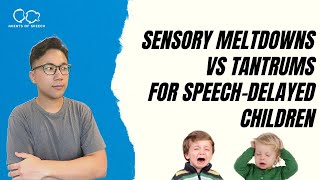
YouTube video by Ming (Agents of Speech) explaining the difference between sensory meltdowns (sensory overload) and tantrums in speech-delayed children. Defines sensory meltdowns, gives sensory examples and personal anecdotes, outlines four common functions of tantrums (wanting something, escaping, attention-seeking, frustration), and offers practical caregiver strategies for identifying causes and de-escalating or teaching alternatives.
Chapters
A sensory meltdown. Or we call sensory overload. That's more official. The name is when there are too much sensory information from certain sources, a stimuli that makes the person depleted in energy. They might feel grumpy, it makes a person anxious, irritable, all these things. Right. And this doesn't need to be a speech delayed child or someone who is on a spectrum. It could be anyone. Okay. So I've experienced this before. I've seen people experience this as well. And this stimuli could be in any shape or form. It could be too much light, too loud. Right. Is this sound that is very annoying to a certain person? Yeah. And then, you know, like there's still screeching sounds that a knife hits the plate. Some people can take it, some people don't. Right. And then there might be. It's. The smell is very different. It's too much for a certain person. You need to think about an all types of sensory input. Okay? So sensory meltdown happens when there's too much and it's too irritating for a person. And for us who are caregivers, who are teaching speech to lay children or people on the spectrum is that sometimes our sensory profiles are very different. Right. I might be less sensitive to certain inputs for myself that would be tactile. Right. Of a higher threshold for, you know, I'm not as ticklish, I would say, than children. Right. So therefore I wouldn't understand when, you know, like I've seen children who, if you by accident brush a certain texture on their hand, the skin just stands up, right. All the hairs just stand up and everything. And you can see that very clearly. All right. The second thing is when you see people who are sensory overloaded, you will see that they will start to give you like a facial grimace. What do you mean by that? So, you know, like I was just saying, when the knife hits the plate, right. Like that a lot of people will just try to, you know, go away from that stimulus. Right. So given that, now you know what a sensory meltdown is. And I want to tell you from my experience, right. How I get sensory overloads. And also I would tell you some examples of children during sensory overloads. Right. So for instance, for me it would be when things are too loud. Okay? When things are too loud, we can adhere too much loud noises, I will get very sleepy and I get quite grumpy as well. All right? And for some people, they don't understand this because inside my eardrum it gets, it rattles inside. Okay? So that's, that's Something for me. And the same is. Let me give you another example. So you know how when we were young, we, as in like millennials, right? When we were younger, we turn on the TV and we can hear the sound that the TV was on. Well, actually some people cannot hear that, all right? And they cannot identify it when they hear the TV gets turned on. The static noise that some people can hear, right. And as we get older as well, the higher pitched noises we cannot really identify as well. So what I'm trying to say here is I've seen some kids who can hear, like if you turn on the ac, they get really irritated. So there were times that I had to turn off the AC to work and of course it was very hot, right? But what I'm trying to say here is if you see somewhat of a tantrum, you start think about what can you reduce to slowly get to the reason for the meltdown, right? There must be something going on. So you have to go one variable by one variable, right? If it might be the smell inside of a room. So maybe you change room to somewhere that smells different. And obviously some people are less sensitive and you must find someone who's a little bit better at this to identify different, like scents of sort of. Right. And sensory profile is such a thing that some children actually are hyposensitive, meaning they're seeking for that sensory input. So on the topic of scent, you've seen a autistic girl who likes the scent of hand sanitizers. So that becomes like a reward for her. And whereas some kids, they hate it, right? They hate the texture, they hate the smell. And let me give you one last example is like one of the. My students before, she hates band aids, the sticky stuff on her hand, whenever it gets stuck on, she instantly runs off. All right, so let's talk about something else. Tantrums, right? So generally speaking for speech delayed children, right, before, like from 1 to 6 year old, before they develop any more emotional things like emotional needs and feelings and such, what happens is that a lot of the time falls into these four buckets. So number one is wanting something, right? In the industry, we call it like we want something tangible, right? Mending for something or activity of sort. So it's wanting something, right? The second is escaping from something. Okay? And here you have to understand sometimes when they had a bad experience with a certain sensory, they will try to escape when they feel like they're going to feel that sensation again. All right? So it's very. It's fair enough that you Know like sometimes if a person has semi drowned in a swimming pool before, had a bad experience, they would try not to swim anymore, right? So I mean you must have a friend who's like that. So that's escaping from something is that when they see it, they want to run away already. Right? And, and you see a lot of kids, actually I, I've taught a bunch of children to reduce their fear about like using scissors and like hair clippers of sort for cutting hair. And that in itself is something else. What is something? What we call tactile defensiveness. And tactile defensiveness is different from a sensory overload, right? A tactile defense is that they, they can see in the future that something might happen to them and they get defensive about that. Okay. So escaping from something is a very, very important like thing that you need to look at it and think about why the child is having a tantrum. You need to see what they're, are they wanting something? Are they trying to escape? And the third thing is attention seeking. So attention seeking is something that within our industry and if you Google and stuff you will see a lot of people like, oh, ignore the tantrum, let's see what happens, right? Whilst ignoring is a good method, and it's only a good method when your child wants attention. The reason why we try to ignore is to single out is to take away that attention from your child first, not meaning if like some people get me wrong when I say I, I remove my attention and ignore the child's tantrum, that's very different from not caring, right? So if I see that they're in danger, I'm going to go safe, right? But I'm not going to encourage and empower that attention seeking behavior. So the only way that you will know is by removing your attention. If you remove your attention and the tantrum escalates, then obviously this might be attention seeking activity like a tantrum. Okay, so why do I say that? Let me give you a quick example that I use a lot and I learned from my supervisors back then is like when you kick every time you put a coin in a vending machine and the drink doesn't come out and you kick it, right? And then it comes out, then you learn that whenever you kick it, the drink comes out. So the kicking is the frustration is the tantrum, right? So when you kick it once, the drink doesn't come out, what do you do? You can't get more times so that, so the level of tantrum increases, right. To get to the purpose that the person wants, which is getting the drink. And here is the same. If you can remove the attention and you see that the tantrum increases, what that tells you is that probably the purpose of this tantrum is for your attention, okay? And the fourth thing is frustration. So all the things that I've said above, no matter if it's a sensory meltdown, as it has been too much wanting something, having got the thing for a very long time, right? Trying to escape, but they can't escape, right? Trying to seek your attention, but they can't get your attention, what happens next is just good old frustration. And then when they're frustrated, it's more of trying to soothe them back into a more calm state, right? So you have these four reasons for tantrums in general, but at the same time, being able to find a reason for tantrums is one of the most important things you can do as a parent and also as a therapist, right? Because if you cannot find the reason why, you cannot solve it, okay? So generally speaking, what you want to do is to provide a out for the child. You cannot just allow your child to keep on suffering, okay? Because whenever there are tantrums, there are sensory meltdowns. Yes, sometimes it might be manipulative, right? But at the same time, you need to provide a way, an option for a child to go, right? To go away from the state that they're in. So in, in terms of wanting something, what you want to do is to teach them a way to get what they want. That's the first thing. Secondly, if they're trying to escape, give them a means of escaping, right? Meaning if you finish this, after you finish this, and there's a condition right after you finish this, then you can go, right? Let them know how long more. The worst thing in life, I believe, from my perspective, is to do something that is not enjoyable over and over and there's no end to it, right? That's the definition of suffering. So if your child's trying to escape from something and you're not giving your child a heads up about how long it's going to be, you're going to lead your child towards a tantrum, okay? And the third thing is attention seeking. If now the thing is there are two different types of attention, right? There's positive attention, like wanting you to actually praise and, you know, touch the head or whatever. Giving them some reinforcement of sort of social reinforcement that's positive. There's also negative attention, right? Negative attention means like scolding, right? Pointing fingers, the negative stuff, right? Making them feel bad, that's also attention. So why would a child want negative attention on him or her? And that's because sometimes children don't understand emotions yet, and they would rather have that attention from you when this happens. Now, I'm not saying this is as absolute truth. I'm only sharing all of these from my own experience with teaching children and parents over the Internet and in real life. So many times when we tell the parent to stop giving attention and to map out what happens after the child gives a tantrum, we will know what the child is after, right? Most of the time when I talk to parents on a consultation or whatnot, they're going to tell me that they always cry and stuff and they bite the mom, right? And they start laughing, right? They bite the mom or they pinch the dad and they start laughing because the reaction was funny to them and they didn't know that it was negative, right? And once that, like, even if you say, hey, that's not right, like, hey, ow. Like that they might actually was seeking for that kind of attention from you. So what you should do here is you should try to act as if nothing happened and see what happens. Probably they'll bite again, right? Then you know, it's attention seeking, and you should block him from doing it in the very beginning. And even if there's a tantrum and he wants to, like, keep on biting you, and as such, you should ignore it because that is attention seeking. And you should totally not give any type of reinforcement to that. You should not reward that. Okay? Number four is frustration. If, if it gets to frustration already, it's very difficult for you to, like, give them out because now they're emotionally tired. They're like, oh, man, I can't anymore. I don't feel good. Right? The only way you can do is to soothe them. And to soothe them, you must have some sort of routines that you can go to to show your child a way out to. To how to, say, get back into their state. So some of the routines that we use a lot that helps a lot of parents is, number one, going back to, like, saying nursery rhymes or whatnot, right? Reading a book, right? Going back to a play routine that was previously established, right? Doing some social routines like tickling, you know, a sort. And then number five is sometimes that we will. A lot of times what works a lot is to give the child something to drink. Because when they're drinking, they cannot talk, they cannot scream, they cannot whatever, and it sues them when they're drinking, when they're having something to ingest. All right. That's something that works a lot of times, and it's pretty cool to see it work all over the world. All right, so that's all for this video. Make sure that you learn more about the differences about these. Obviously, this is like, you need to still go by case by case basis, right? Sometimes we guess the wrong reason for a tantrum or bad behavior or what we call disruptive behavior, and then it ends up even worse. So you need to have something, have a basis for that, and think about what to do first. Okay, so that's it for this video. If you haven't, please go to agents of Speech.com checklist to get a list of free tools and toys that you can use at home when you're starting out therapy. All right, See you guys.










