Should You Correct Your Child’s Speech?
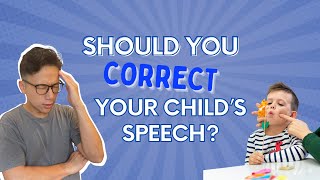
Ming from Agents of Speech explains when to correct a child's speech. Only correct if they've been taught the target and can handle it without stress. Otherwise, model the correct form and let repetition in a relaxed environment do the work.
Chapters
All right, so let's talk about whether you should correct your child's speech. So maybe your child is delayed, maybe he's not. Maybe he's on the spectrum. There's a lot of different possibilities, right? But when a child is not able to say something correctly, meaning it might be something that is of a grammatical error, that's a speech sound that is incorrect, then parents feel obliged to correct and teach the correct response, right? Then that's okay. But let's talk about, like, this is what a question I get a lot. So the answer is like, yes and no. Obviously, as all things go about therapy, there's always like, it depends, right? So, yes, if the child is confident about the thing that you're correcting about. So let's give you example. So for instance, if I've been teaching a kid about how to use the F sound on a word level, and then he's. He's been having problems when he's speaking in a conversation, and he would turn the F into a P. Let's say like fish becomes a pish, right? So then what we can do is like, yes, we can correct the kid because we've given enough training and context before, we've done the work before, and he knows exactly what we want for him, then it's going to be very easy to actually correct the child. So that's only if it's not stressful for the kids. So we talk about stress a little bit later. And the other answer is no, if the child is obviously not at that level. Meaning, let's just give you example, right? If you are learning a new language, so to speak, and you're learning a bunch of, like, vocabulary, and then whenever you say something that is incorrect in terms of grammar, and then someone just likes to tell you to repeat after them until you're correct, you would be annoyed because you want to get along. Like, you want to go ahead with your work and your, and your day and, and you know, like, anything, right? So it's the same with children. And if you going down and tell them, okay, that's not what you say. You say, give me whatever. Can you say it now? You say, give me something, and it's going to get like, it's going to drag on and everyone's not going to have a good experience. So I see a lot of parents and teachers doing this, and it feels like you're teaching the kid, right? It does. You are teaching the child. But at what, at the expense of the trust, the it's not effective way that's what I'm trying to say. They, the children will get scared of you whenever you try to approach them and tell them to repeat something after that. So we don't want to do that. So instead we should provide feedback. So what is feedback? Feedback means when someone does something wrong, we give feedback, but we don't ask for correction. All right, let's say that a child says, for instance, uses the wrong tense. So for instance, he said, like, you eat the apple, something like that, eat it or. And then what you should say instead is, oh, you ate the apple, not eat it. And that's it. And the reason why we do this is so that the child hears it, right? How many times does it take you to change your behavior after someone tells you off? All right, let's just say, okay, and I give this example a lot because, for example, for me, I learn some things. I require a lot of feedback to. I require a lot of correction as well. But, but if you correct me every time I get mad. So let me give you an example of what I do wrong in terms of like, hanging out with my, my wife and friends. So, for instance, my wife is not very good at parking. So sorry about that. But then if I keep on correcting her, she gets very stressed out. And whenever I give her some sort of, like, feedback instead, after she's done, it's actually much easier for her to absorb. And now, you know, she's a lot better, thank God. But at the same time, think about it that way. Are there any skills that you, you are currently learning and you get this kind of like, correction from. And think about as a, as a child, they're also human beings and they will feel the same as we do. Okay, so, okay, let's recap real quick. So, yes, if you've been working with that goal with the child for a long time at the table or in the therapy center, and they know what you want. And therefore, in a conversation and during social interactions, it's easy to bring them back and remind them, okay, remember what we were working on. That's wrong. Let's try again. Okay? And it could be, like, sentence structures. It could be speech sounds, it could be whatever, our social skills even, okay? And we don't correct when it's going to make the child stressful, right? We only provide the feedback. So after they get it wrong, you say, oh, that's not right. Remember that, you know, it's supposed to be like this and that's it. And they don't have to correct the behavior or the speech or language. Okay. The third thing is modeling. Modeling is a lot stronger than correcting. And the reason is because when a child does something wrong, that's already done, right? It's already done. And when you tell them to correct it, unless you create a different, like you tell them to try again, then you can restart the whole thing. Right? But what's done is already done. And when it's done you, when you correct the child and the consequence is the same. Let's say if the child says what gummy bear means. Like if, let's say a kid who speaks like Yoda, like Yoda. But that doesn't really happen a lot. Okay. What I'm trying to say is once he or she says something wrong and then you correct them and they still get whatever they want, then it becomes a whole routine of them getting it wrong, getting corrected, and then they get rewarded, Right? So that's not very effective because kind of you are actually rewarding him or her to, to get it wrong so that he, you know, you can correct them and then therefore reward, Right? So it's not very effective. That's what I mean. Modeling, on the other hand, is a lot better. So if you want a child to say what you want to hear, then you must speak as many times as possible about the thing you want to hear. So what do I mean by that? So if you see a lot of children who can learn from like YouTube videos and nursery rhymes and whatnot, the reason is because it's been so repetitive, right? So what has YouTube been doing? It's been modeling, modeling, modeling, modeling in a way that is entertaining and fun and stress free for the kid. So whatever you want your child to hear, you're going to have to model it instead of asking questions, instead of correcting the child whenever they say it wrong. Because it becomes a vicious cycle of, oh, I need to say something incorrect and then mom says something, right? And I get rewarded. Rather than that, we want to teach the kid immediately and actively and we would like, model what they should be saying instead. Okay, so what do I mean by that? So if a child wants water, then before the child even talks, you're gonna say like, I want water, right? That's easy. Or mommy, pour water. And then you demonstrate and you do it one more time. Mommy, pour water. Okay? Mommy pour water. Okay? So you pour little by little so that it's like the child keeps on trying and getting your model and trying to imitate you, right? And then when the modeling becomes like so easy and you can Fade it out and then the child can actually say it by him or herself. All right? Okay. So the last point is that you should create a stress free environment for language learning. And above all the stuff that I said just now, they all contribute towards that. So you don't want the child running away, crying or like just throwing a fit. Whatever you're trying to teach, right? What you want to do is that although it's slower, although it's, it feels ineffective and it's like indirect, what you want to do is like you want the child to feel comfortable and confident with you. And therefore what you're trying to do is like, is to give feedback, right? Is to model a lot more, is to correct. Only if you know that your child can do it in a structured environment or else you're going to, you're asking him or her to fail. Because let me tell you, if you can do something in a structured environment, but then you go somewhere else, right, on the streets or whatever, your ability is going to be different, right? So let's say you can sing, right? Doesn't mean that you can sing on the streets or sing on the stage. It's got the cognitive load or so to speak, the stress level, the nervousness is on a different level. So you cannot actually ask the child, ask the person, in fact, maybe you to correct themselves at that situation because there are other stress factors. Okay? So therefore you must create something that is stress free that you can repeat over and over again, okay. And that the only way that a child or someone will learn to correct their mistakes is through repetition. But at the same time, you need to understand children. They are free willed. They won't just sit there and stand there and let you teach over and over again until they get it right. So that's something you have to remember. Okay? So that's the end of this video. Again, this is something that you should be doing right now. If you're correcting your child, try not to stress them out. And if you haven't, please go to agents of speech.com checklist to grab a list of tools and toys to start home therapy today. Okay? Thank you. Bye bye.










