Teaching Children to Speak in Sentences | www.agentsofspeech.com/combiners-lesson
Ming teaches how to help children move from single words to sentences. Start with vocabulary, then two-word phrases, using verbs that take objects. Keep sessions short and focused at a table, use videos and play to show meaning, and get caregivers practicing 30 to 60 minutes daily at home.
Chapters
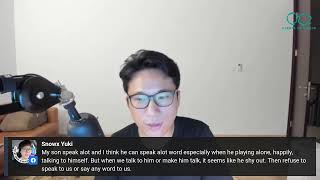
Hi, guys. Tonight, in this live, I'll be talking more about how to teach your child to speak in sentences. I know I have covered this in previous lives probably, but we also have a new thing, a new. A new free lesson for you that I deep dive in 30 minutes to tell you more about how to teach a child to speak in sentences. And you can go there. It's agentsofspeech.com combiners-lesson so you can see it in the description and also in the title. Click on it and watch it. And at the same time, I think, what I think is that to teach a child how to teach a child how to speak in sentences, there are a few things you need to learn. Okay? First of all is that can you sit your child down to teach them something? Okay. That's very important. Most recently, we had inside of our Facebook group, if you're inside of the group right now, that there was a thread going talking about how what parents learned within agents of speech. That helped a lot. One of the, one of the parents said that the most important thing she learned from us was that she could finally sit her child down to teach her something. There's like a learning time at the chair, on the chair, at the table, and they were able to go through a bunch of tedious study tasks. And especially that she was learning about how to build sentences. That particularly was a very good. Was a very good way for the child to learn sentences. Okay, then how you do it is not about, you know, what flashcards to use, what toys to use, what type of, I don't know what, what type of books to do, whatever, but. But actually is how you teach the child just like anything. Okay, so can you find, can you find a time where you can sit down with your child to teach them something? Okay. Whether it's, you know, it's just five to ten minutes undistracted time, you can do a lot within those times. Okay. And if you ask me what is the most important thing in order for you to teach your child a sentence is basically vocabulary. Vocabulary. Okay? If your child has enough vocab, then anyone will be able. Anyone will be able to put words together. All right, So I see there's a question from Nabil. Nabil. Hi. Is teaching phrases before sentences good? Well, it is. It is good. All right, so if you guys are watching this now, please say hi and tell me where you're watching from so that I know. Hey, there's people watching from Korea and Japan even, you know, and people from Africa, which is very Cool. By the way. Okay, so let's go back to Nabil's question. Okay, let me just put it up. Right? So is teaching phrases before sentences good? Yeah, it's good in a few ways. Number one is that if you're teaching phrases, especially phrases that are not grammatically correct, then, you know, as we talk about in agents of speech a lot of times, right, you have to teach one thing at a time. You cannot teach a few things at a time. So what I mean by that, I see parents who are trying to teach a child a whole sentence for I don't know what purpose, right? And when I ask more, it seems like the child is still at one word level, okay? So when you teach them to speak in a sentence, you're doing. You're teaching a few things. Number one, obviously, you're teaching the number of words inside that. If you're teaching a sentence like give me the ball, right? There are actually four words. And within those four words, what are you also teaching? You're teaching the sounds of those words. So that's another thing that you're teaching. Number three thing you're teaching is the grammar that you're teaching, right? So I want. Or give me the ball, right? So if. If you truly need to learn give me the ball, you also need to know what give means, what me means, what the means and ball means, right? And you're teaching the vocab. So once you have a bunch of those, right? We have a bunch of those stuff, you cannot proceed. That's why we teach with phrases that you know. You're just teaching them to put two words together that they know already, right? So that's one thing you have to teach. Just one thing you have to teach one at a time. I would say that you should teach putting words together. All right, So I can see someone is saying this, and I can see that's Aileen. Hey, Aileen. It's. It's pretty early over there in Texas, right? So she says he has. He had nouns down. I taught action verse with pictures. Combine nouns, slash verbs for short sentences. Example dog bar. That's excellent. Hey, by the way, I recently learned a new way of teaching verbs. I was working with a parent over the Internet, and basically. Excuse me, is that if you go to Google, you go to Google, right? Let me just go to Google. If you search something like drink, okay? And you go to images. So let me just share my screen. So it helps if the child likes looking at a screen and it thinks it's funny. So if you can See my screen right? Now, let me just go to that screen. And then you change it into, like, you go to Tools and you go to type, and you press press gif or gif, however you pronounce it, press gif. And what gif is, is a moving picture. Okay? So if we put drinking instead of drink, right? You will see that instead of getting an image, you will be able to get a video kind of thing going on. Okay, So I still need to go back. So remember, go to Tools, right? Tools, type, and then gif. So you can do this for. On your phone as well. So when you're showing your child, you're teaching them some verbs, you don't necessarily have to print it out and make it into a flashcard. So if you press onto it, you will see that, oops, that's not very appropriate for a child. So that's also not very appropriate either. But you know, if you press into it, you can see the whole thing moving, Right? What kind of culture are we living in that if I press drinking, everyone's drinking alcohol, right? So you see, this is much better. If you use video or something that's moving, it makes a lot more sense for verbs. So you can do this for a lot of things. Like standing, for instance. Standing is very hard to teach. I mean, it's just. That's why children on the spectrum, whenever they see someone standing up and you ask what's going on or what's happening, they will say, man is standing, because they cannot really understand. But then if you have, you can make it into gif, that it will make a lot more sense. Okay, that's not right. So maybe standing up. Okay, standing up. And then we can put it as a. Because this is what we usually get, right? If you're teaching a verb with pictures, you get like an arrow or whatever. This is very abstract for a kid. So what I would do is I just learned this. Just realized if I had this when I was, like, a little younger. See, this is standing, right? Standing. That makes more sense, right? If you give Even this one. Oh, this is not cool. How about this? Yeah, this standing is perfect. So if you can see. I know some of you are watching from the. From your phone now. There's tiptoeing. You can teach that as well. So, yeah, see, this is standing or sitting down, if it's reversed, right? So this is something I learned recently. And you can try to use it as well. Okay. And Aileen, the next thing that you need to do is to teach more verbs that are what we call transient trans. Whoa, what's that word? Transitional verbs. Is it all right? Yeah, sorry, I forget my technical term sometimes, but you get what I mean. I'm not going to say that. I don't want to embarrass myself anymore. So basically now you're teaching some verbs that are barked or whatever, right? So it needs to be verbs that can take an object. So for example, the boy hit the ball. Right. Or hit the table. So without the table or the ball, the sentence isn't complete. So you need to teach some verbs that you can use as a glue in between sentences. For example, drank, drink, eat. Right. Hit, throw, you know, think. Verbs that can take an object afterwards. So that's something that you can think about. Teach with either. With flashcards, with act out. Act out is the best because it's what we call in situ, right? It is right here, right now. And it makes a lot of sense for children who are delayed in any form. Yes, that's exactly how we would do. We're combining teach the words and then work only on putting the words together. If you need more help, just press on the link. Go watch that full 30 minute video that I made for you. You can go check it out if you want to. And then other than that. Oh, by the way, if you're already in, already have. We have a full course about that. And if you don't want to pay for it, it doesn't matter. You can just go watch the free one. Okay. And obviously it won't be as deep as it would be, but it doesn't matter. Right? Okay, so other than the table time, what do we need other than that? Okay, we need to introduce play into. Into teaching language. And why do we want to do that is because a lot of times children can speak in very long sentences in a clinic room. So for example, back in the day we had actually I had a child, I not I had a student. And she, when she came to me, she had no words. Okay. And she's probably now five nearly and haven't seen her for a year. Plus because of COVID I miss her a lot. And. And just before we left, she was working on really long sentences like mommy is going to the supermarket to buy whatever and super long. But she wasn't able to say. And she wasn't able to speak in three to four word sentences by herself at home. And the reason is because we need the mother or the caregiver to be able to play with the child and extract language out from them. Okay. Make maybe Extract is a very extreme term. But what I mean is, can they entice the child to say something? When the time comes, can they entice the child to talk? That's the problem here. So she can talk a lot with me, but that doesn't mean that she can do it with the parents or the caregiver. And how you do that is through play. Okay? Even if you have a table time to teach them with pictures of whatnot, if you don't have that play, there is a huge gap between what they can do and what they will do. Okay? That's a big difference. There's something what we call generalization. All right? So obviously, all children who are delayed, they all have some degree of generalization issue. That's why they have a problem with speaking with peers. Especially, you know, I'm seeing a lot of questions inside of a Facebook group and also on YouTube as well, saying not a lot. Like maybe five or six this month. And they were saying, oh, they can't socialize with other people. Can't socialize with whoever. And then, yeah, obviously, because they cannot generalize, they're under stress, right? They're under. They're what we call a cognitive load, right? Or they're nervous or they're anxious. They don't know what to do. They don't understand what other children are. And I always say, like, for children on the spectrum, in the beginning, they always view children as just, you know, animals. You know, they would go up to them and feel like they're cute and they would pet them and whatever and stay away from them. And at a time where, you know, when other children are asking them to play or challenging them to do something, obviously they get intimidated and they cannot do, you know, you cannot. You cannot even, you know, they can. They cannot operate when. When another child of the same age and whatever, challenge them to play or whatever. And that's because there's. They can't. They're anxious. Right. And the same as you and me, Right. If we were to go to a place where we weren't very comfortable, we probably just sit in the corner and just wait until the whole thing ends. Right? So that's. That's right. So Jaya J. Bella says parent needs. The parents need to create opportunities. That's right. You need to create opportunities. You need to create routines. You know, be able to play with your child and be able to make them use the words that they learned inside of the speech therapy clinic or when they're learning with you through books or whatever. Use it out in very naturalistic place settings. And it's easier said than done. Obviously, I always say it here. That's why we need, like, a lot of training, you know, and to be honest, for instance, like, Alien. Alien is saying here that, you know, his. Her grand. Grandchild talks a lot more with a speech therapist than he did at home with us. It took a while even to even it out. Yeah, of course, obviously. So obviously it takes a long time for the child to understand, to generalize that skill from the clinic to back home. Because even a change of. What's that called? A change of environment will change the ability. Okay. Just for any of us. Right. And Aileen says. She says, oh, this is not Amy. This is Noku Hanya. Sorry. She says if our speech delay. Kids are anxious around other kids. Are they happy at school? That I cannot answer you. I really don't know. It depends on how the child is. And some children who are anxious, they're actually finding it very exciting and everything. Some children are having a bad time. You know, you may ask the teacher and, you know, if you can go observe. Okay. If you can. I know everyone's working and school policies are different and so on, but. But you have to see it for yourself because sometimes teachers are too busy to tell you everything. I mean, you know, I really think that teachers are overworked sometimes. And with COVID coming along, you know, and hopefully, you know, some places are decreasing the number of children to teachers, then it will make a lot more sense for you to do so, to ask. I mean, but most of the time, I think there's just too many students to a teacher, especially for early intervention. Not even at early intervention, like maybe preschool or kindergarten. Right. So that's something you have to ask and you have to see for yourself with your eyes. Right. I don't know. I cannot read your child's mind as much as that. That would be pretty convenient for me, but that's just not something I can do. Okay, so let's see at the end of the day. All right, if you guys need more help, you can either email me. My email is mingyagentspeech.com and if you haven't, you should really go watch that 30 minute video that I made. If you're already in the word combiners course, you don't have to. It's just something I made for free for those who cannot afford it. Just to take a look and learn at least a bit of it. Obviously, I cannot go in, like super full detail, and that would take forever. You know, that's why this. There's a course, right? That's why there's like, I don't know, like 10 hours of training. Right. And if you ask me, do you need this? Yeah. At least, you know, if you have time, if you have. I know that you're working a lot, but just every day, at least like one hour a day makes so much difference. If you think about it. Speech therapists only see your child, I don't know, like one or two hours a week, and it's making a significant difference. How about you take one or maybe 30 minutes a day just to work with your child? The results will be phenomenal. Okay, so try it out. Go try out what I just told you here. Be able to get your child to sit with you, to teach them something. Okay? At the chair, on the chair, at the table, without distractions. Okay? That's number one. Number two is, are you able to play with your child? Are you able to pull them to play with you having fun whilst getting them to speak, use the language you taught them or use the language they learned from the speech therapist? Right. And that's pretty much it. And the last part is obviously language facilitation, which is, I saw someone say it's easier said than done. Yeah, obviously. But the thing is, you have to practice it. It's a skill. It's a habit. Okay? All these things I talk about here is a skill as a habit that you can learn, all right? And if you think that you cannot learn it, then how does it tell your child that? How does it feel for your child? Because they're trying to learn and pick up habit habits such as communicating and using speech. Right? And if your child cannot learn, then we need to find another way. Right? That's the whole thing about me doing this here. Because I'm here to tell you, hey, there must be a way out. You know, there must be some way that you will see your child to improve. Okay? I've seen it many times that the child's improvement is as good as the parents involvement. And I don't mean to say it, and I don't not say to blame parents, especially, you know, mothers who feel that they're not doing a great job. You know, I had this. I had a. I had a mom talk to me on WhatsApp. And then she was like saying, oh, by the way, I'm not giving out WhatsApp. Just so don't ask me. This is from. These are my physical clinic clients. The mothers that during, you know, Covid I'm just. I'm just telling them what to do. Right? So don't ask me about the WhatsApp. I'm not giving it out. I'm not gonna talk to you guys on my phone because that's super distracting as well for. For me and for you and so on, and I can't keep track. Anyways, if you need help, just email me or just put it in the comments here inside of the Facebook group or whatever. And then I was trying to say that the mom was saying that she doesn't feel that she's a good mother. She feels that she's done it too late and so on. And I don't think so. I don't think so. You know, most of the parents who stick with me, they've gone through a lot. You know, they've been able to. Sorry for the fuzziness. They've been able to learn so many skills, and it's outside of my control right now. You know, I cannot physically see the child. And to see the child improve, it means only one thing. It means really only one thing is that the mom made it happen, the dad made it happen. Right? So you guys don't feel. Don't feel like you cannot learn it, and that's it. And just before we go, I see, like Yuki asking something. I'll just finish answering this question and then that's it. Okay. My son speaks a lot, and I think he can speak a lot of words, especially when he's playing alone, happily talking to himself. But when we talk to him or make him talk, it seems like he shies out, then refuse to speak to us or say any word to us. Yeah. So, I mean, there are loads of videos about this Yuki. I mean, there's a lot of videos about me talking about. Not to stress the. The child out, why the child doesn't like to talk to you. There's a lot of videos out there, not only from me telling you how to. How to talk to children. Right? So the easiest way to tell you why is. It's probably only two things. Number one, it's not fun talking to you. Probably the whole interaction is quite stressful. And if you're. I mean, help Yuki out if you're. If you're not. If you're watching this and you can reply to a comment and tell you tell Yuki what to do at home. All right? So from. From my end, I will tell you first that you have to check if you're asking a lot of questions. Right? And although I'm not talking about the micro course here, right? You can obviously check out the micro course first. That's where all the journey starts. And go to www.agentsofspeech.com micro. Go check it out. And you got to cut out the questions. You got to cut out making him look at you. You got to cut out asking questions. You got to cut out making commands. You got to cut out repeating yourself. Okay? So he's happy playing alone. If you think about it when you talk to him, you're disturbing him. If you think about it in that way, then you know, you will have a whole new perspective. And how do you talk to him? Is basically, you have something he wants and he comes to you. That's the beginning of it, okay? Or else he doesn't know why the heck would he need to talk to you, right? He's so happy by himself. He gets everything himself. He has access to everything himself. He doesn't need to talk to you. So get something he wants and create an opportunity for him to ask something from you and then make it a good experience. So therefore, when he. The next time you talk to him, he's like, okay, Mom's not too annoying because she's a provider and she praises me. She rewards me. All right? Okay, so that's it for tonight, guys. It was very nice hangout. And that's pretty much it for tonight. And I do this every Monday night at 9pm my time, or maybe 10pm in Malaysia or 10am in New York in Eastern standard time. And sorry I was a little late today, but I will. I try my best to do this every Monday, okay? It's my promise to you guys, and it's my time to, you know, just talk about the questions I get throughout the week so I can tell everyone here and stay in touch with everyone, okay? So stay safe. I know that it's still pretty. It's still pretty scary out there, especially for us in Southeast Asia. And, you know, stay. Stay at home. You know, try your best to do so. And that's pretty much it, guys. See you next Monday. Bye. Bye.










