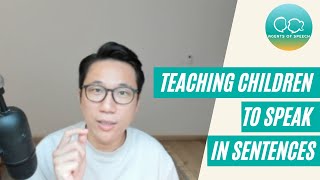
Ming from Agents of Speech shows how to teach kids to speak in sentences. Start by building vocabulary, especially verbs. Then target one or two sentence patterns at a time, varying only the words. Use sequential and imaginative play to give kids the context they need to practice.
Chapters
Hello, this is ming here from agentsofspeech.com today in this video we want to talk about how to teach your child to speak in sentences. We've had previous videos talking about some of the same topic, basically. But in this video I want to give you more knowledge about how to go about it. And first of all is that for all children, all people who are trying to learn more about language, that person should be increasing vocab, and same goes to your child. So if your child is speaking in single words, that consists of nouns and adjectives and so on, and they lack a bunch of verbs, which is very common and because verbs are a little more abstract than now what nouns are, right. So that's why it's more difficult to acquire. So that's why if you're teaching sentence building, the first thing is actually to teach the building blocks each of the words before teaching them how to put those words together. I think this is where a lot of parents, a lot of teachers, and even therapists, even when I was younger, that's what I was trying to do. I was trying to teach the whole sentence without knowing whether the child had mastered each of the words that I'm trying to teach, right? So don't need to teach those functional words like that in articles like that, the, ah, that kind of stuff separately, we don't need to. But for the most important building blocks, like the subject, the verb, the object, you know, those kind of things, you have to make sure they know what it is because it's directly referring to something in real life. And they need to know, they need to know exactly what the word is in order to be able to say the words nicely. If you have learned a foreign language before, you must know that if you know the meaning of a sentence, of the word, it's much easier to remember it, whereas just remembering without knowing the meaning is really difficult. So remember that and keep on going and keep on working on increasing vocab for a child because that's the most important thing for them to catch up in language, okay? Second of all is to target specific sentences. What I mean by that is that sometimes when we teach sentence building or word combining, however you like to call it, we jump back and forth, okay? We go left and right, we, we teach them a bunch. This sound, this sentence, that sentence, this phrase, whatever. What you need to do is to stick to one or two structures and teach them that way. If someone were to teach you a foreign language and then you open a textbook, right? You look at it, they always have different types of sentences or different grammatical structures that you're learning in a chapter. And I want you to do that for your child because it gives them a solid ground for them to learn. So if you're always teaching in verb object phrases like vo, what we call it becomes easy for them to understand at this place in the front because we're learning vo, it must be a verb, it must be an action word. Therefore, it becomes easier for them to learn. So when you're teaching anything, anything to your child, especially speech and language, always try to keep all the variables the same other than one thing. So when you're teaching a child the a new phrase structure or sentence structure, the structure should be the same. All you need to do is to mix the words in between. Okay. That makes it much easier for them to learn. Okay. The last point I want to talk about in this video is to teach your child to play more sequential and more imaginative toys. Right? How do you play with it? In general, play skills, cognitive skills, they come hand in hand. They grow together. And the reason why is because children, children learn through play. They experiment things through play. They think in play, they're using language in play as a context. Right. So therefore, if you give them better play skills, they are more equipped to learn more about the world, number one. And number two, to run simulations of how things are in the real world. And number three, gives them a strong context to put what they learned into what they learned, language wise into practice. All right, and that's pretty much it for, for what I wanted to say in this video. If you want to learn more about language sentence building, then you should go to www.agentsofspeech.com combining class. Okay, so it's a 30 minute free private class for you. All you need to do is to click inside and then just take a look and you'll learn a lot more. An expansion of what I'm trying to tell you right here. Okay, so that's it for this video. And I hope to see you in the next video soon. Bye. Bye.