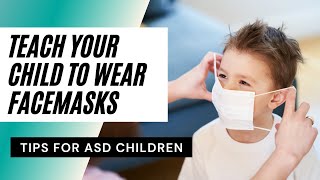
Ming from Agents of Speech explains why autistic and speech-delayed children resist masks: tactile defensiveness from past trauma. He shows a gradual approach that works: reward stickers, touching the mask first, wearing it for seconds, then doing tasks while masked, building up duration and practicing outside.
Chapters
Hey guys, it's ming here from agentsofspeech.com today we're going to answer the question of how to keep face masks on or how to teach children to use face masks even if they're on the spectrum. Okay? So the fear of face mask is actually related to something, what we call tactile defensiveness. The face mask doesn't really trigger the tantrums of fear or whatever. It's actually a learned behavior. Right? So obviously a face mask is very restrictive. It's not comfortable for everyone. Okay. But it doesn't mean that a child should be that scared of it. Okay? And usually why it happens is because of a traumatic event that made that taught the child that that thing I'm not going to touch. Whenever I see it, I'm running, run away, okay? And that's to protect themselves to having another, like another trauma so that history doesn't repeat itself. Right? So it might be a hair clipper, like this thing that you shave your head with. I don't know what the name of that is. A hair clipper, scissors, you know, the toilet bowl. It might be whatever. It even happens with adults, right? Have you seen adults who don't want to ride the bicycle because they had a really bad accident before? Or you know, an adult who doesn't want to learn to swim because they had a near drowning experience? I know a few people off my mind already. Okay? So this isn't just because they're children or just because they're on a spectrum. In fact, it's universal. So how do you get rid of it? There are two ways. Number one, you can flood them. Okay. And this flooding technique, it's a very old psychological way of doing it. It's basically just throwing a person. If you're scared of water, just throw them in water. You know, if they're scared of snakes, put them in a pit of snakes. And you've seen that in the TV show, right? You know, like all those snakes inside, if you can just hold it inside for like extended period of time, you get a big prize or something. So that's flooding. But we don't want to do that with children. In fact, it kind of sucks because I had a client who, when they came to my clinic, I used a step by step method. The child was actually okay with getting his hair cut. But then the next time what they did was they held the child in place with their hands like that, locked them down, locked him down and started shaving him. Right. And then despite whatever the child did, he couldn't get away. And it became another traumatic event. So now we are two steps back and the child has become even harder to cut his hair. And he's really scared of it. And it's irrational because it doesn't hurt him. It doesn't do anything. It just reminds him of how dad, like locked him in place. Okay, so anyways, how we deal with it, I have a video of it right now, so let me show you. Okay? So here I am actually teaching this child to use face mask, okay? And what we're using here is a token system. Okay? Don't mind the lingo. It's just basically stickers, right? I. I have six stars. And basically whenever he finishes stars, he can get a reward, okay? And I'm teaching him how to use a face mask because the mom can get his face mask to work, basically. And so what we do is like, is that after we establish this token system, telling him, hey, dude, six stars, and then you get what you want, right? So we start off with. Because this child's okay with me touching him with the face mask, if it was the mom, he would probably run away. Okay? So it depends on who you are, what the setting is, is, and how much physical contact the child has with the item. Okay? If your child would just run away seeing a face mask, just putting it on the table and giving him a star would be sufficient already. But let's keep on going. Okay? So here I put on the face mask, right? I put on the face mask. There you go. And then I tell him, after you finish, you can have whatever you want. And I tell him to do some silly tasks whilst having the face mask on to simulate everyday activity. So he goes over, touches the door, comes back, right? So you see that I've made it easier for him because I only have three stars there and he only needs three more to finish. So in his mind is like, okay, I'll game, I'll play with you if it's only three stars, right? It's like telling a person, you'll get full pay, you get full salary, but only work 20 hours a week, right? So it's kind of like that here. I'm telling him, hey, this is worth it. So learn with me, okay? And I. And at every task, because I just started, I will let him to take off his mask. So when he finishes a task, I let him take it off and I stick it. I reward him, right? After that, I'll most probably tell him to put it on again. So on it goes again. And you see that he knows. And he's leaning in, right? So he claps his hands. I tell him to do it right? Every time I do that. And I ask some silly questions, Ask him some silly questions. And whilst he's still having the face mask on. So the whole thing here is to reward him for taking on the push, putting on the face mask and taking it off upon request, right? So that's good. So after of which just one more and this one will be much longer so that he learns that by listening to me and putting a face mask on, he will need to, he will get what he wants, right? So I tell him to do a bunch of stuff off the chair so that he actually does like touching the sink or something so that he actually learns. He comes back, right Again. I make sure his hands aren't touching the face mask or else he's going to take it off. I'm scared of that still. So I asked him some silly questions again and when he's finished, I tell him to take it off himself the correct way. I praise him. Good boy. Nice. Taking it off. Give him a star. And then because he knows this thing, he takes the whole thing. Oopsies. He takes the whole thing. See, he takes the whole thing and then he gives it to his mom for his reward. Okay, after you've seen this, I hope you have a better idea of how to do at home. And you can use like anything, a sticker or like cookies or whatever and just slowly improve the time that he's in contact with the face mask, right? If you can't even put on the face mask, work on him just touching it, touching the face mask, putting it on his arms, right? Putting it on you, putting it on a doll, putting it on the pet. Like if you have a cat, put it on the cat, right? Learn that he can manipulate it, play with it, use it on other people. And it's like it's okay, it's risk free, right? As you increase the amount of touching and on and putting it on him and increasing the duration, the next step is that you can bring that sticker outdoors and help him generalize that skill outside. Okay? So this is how I teach and what worked for me and the video, that the child in the video now can use face masks outside, out and about in the mall, whatever. Okay, so that's it for today's video. If you haven't, you should go download my free home therapy checklist. It's a bunch of tools and toys that I recommend for parents who want to start home therapy and that's probably it. I will see you in the next video. Bye.