The Truth About Eye-Contact and Focus in Speech Delayed Children | www.AgentsOfSpeech.com/faq
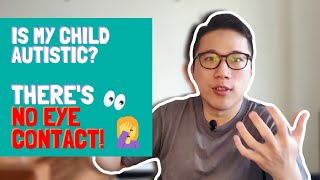
Ming explains why speech-delayed children avoid eye contact and why it doesn't mean autism. He warns against teaching eye contact as an isolated task, recommending instead that parents prioritize communication initiation within natural activities, using gentle reinforcement rather than forcing gaze.
Chapters
Hey, this is ming here from agentsofspeech.com today we're going to talk about eye contact, or what we call eye gaze in the industry. The reason why we're talking about eye contact is not because we think it's super important, but it's because many, many parents, the first thing that they talk about to me is, hey, my kid isn't looking at me, they're not focusing when I'm talking to them, that kind of stuff. So that's why we're doing it today. Foreign. So if your child has been in therapy or has done an assessment, the first telltale signs of autism is actually eye contact. And that is actually a symptom of the autism spectrum disorder. But that doesn't mean that, you know, if your child doesn't look, it literally means that they have autism. If you think about it, right now we're living in, in this time of recording, we're living in the pandemic of COVID 19. Hey, if you're gonna cough and sneeze and have a fever, does it absolutely mean that you have Covid? No. So the same should be true, right? If your child doesn't look at you or have eye contact, doesn't literally mean that they are autistic. So there is a risk of which that your child is having autism. Take it with a grain of salt and try not to be too worried. I understand that nowadays autism can be detected as early as 2 years old, especially in the U.S. they have screening tools here in Asia, where I live, we don't really do that. We usually wait till around like three years old to have a proper diagnosis. Just wait for a bit and observe your child a little more. Okay, so why is eye contact or eye gaze important? Actually in our practice, eye gaze is a pre linguistic skill. And what a pre linguistic skill is, is all the set of skills a child needs before they can use speech and language in the way that we use it. So like talking, all that kind of stuff, an eye contact can actually make a child acquire skills faster. So for instance, if it's speech skills or like language actually more of speech skills, when they look at our face, they have more information of our mouths and so on, and it helps them a little more to acquire that skill faster. So why do they not look at us? So there are a few points I want to go through first is they don't know why they should look. They don't understand why they should look. There's no reason for them to look if there isn't a Reason to do something, they're not going to do it. No one's going to do anything. That has no meaning. They just don't understand it yet. Just as before in the pandemic, people told you, hey, you don't need to sweat about face masks. Actually, the data tells us that face masks are very important and prevent the spread of the coronavirus. Same as this. The same logic goes to your child. They don't understand yet that actually looking can help them get more and ask for more and communicate more and have more fun. They just don't understand it yet. And the second point is, hey, you got to remember, you're pretty tall as compared to your child. If your child every day has to put their neck up, just look at you, then that's actually very tiring. So maybe that's why they don't look at you. The third reason is maybe our faces are already a negative stimulus. And that is not a good thing, obviously, but not to discourage you. And what I want to tell you is I've seen it many times that if you pair your face and you stuff your face into your child whilst demanding them to do something, it. It pairs and it becomes a negative stimulus. So you don't want to do that. They run away when they look at you. And let me know in the comments below. And that happens to you. If you ask your child or call for your child and, like, go down to them and put your face near them, do they kind of get taken aback and they want to, like, run away? And the next question I want to ask you is, why do you want your child to look? And most answers when I ask parents about this question, why do you want your child to look? Well, the thing is that we're still being selfish. So if you watch the video about not being selfish, I'll link it somewhere in YouTube. Just watch it. It's about us thinking that, hey, they need to look at me. They didn't respect me. It's all me, me, me, me, me. Look at me. When I call you, you gotta look. That's impolite. The thing is, they don't even know what is politeness. So remember, start from why your child needs to look at you, not why you think your child should look at you. Because it should be polite. It's the way to go. You're focusing, you're learning. They don't care about all that stuff. All right, so let's get into the meat of it. How do you teach eye contact? So the question I get a lot is hey, should eye contact be a task of its own? So there are a lot of clients that I've serviced before who are on the spectrum, meaning the autism spectrum and eye contact. Eye gaze has been a focus for a lot of applied behavior analysis, mean ABA type of therapy. And that's just because it accelerates the whole acquiring of skills. It's faster because they're not looking at us, they're more focused, it's just easier. Very good. Rule of thumb is yes, you should work on eye gaze. Eye contact. If, if the highest priority right now is a skill that requires them to look at our faces. So for instance, speech. If they cannot look at our mouths or they cannot look at our face and get information about how they should talk, then yeah, by all means you should totally establish sustained eye contact at the very least like three or five seconds so that you can actually work on it. Right. And I would say, no, don't work on eye contact as a task. If it's only language, meaning their speech is fine, it's within normal limit, and you're actually teaching your child how to communicate. If you're teaching eye contact whilst communicating, it's not that natural. So let's talk about teaching eye contact as an individual task first. Okay. So because I've worked as an ABA therapist, I've done this before and I think there is merit to it because there's just times that you really need your child's focus to do certain work. To be honest, working in a private center, a lot of times our, what we call teachers KPIs, if you're, if you know what that means, like key performance indicator from the parent, not from ourselves, is that, oh, my child's, now look at me, I should continue the therapy service. So if you think about that way, it's kind of like a customer orientated approach to therapy sometimes. But I'm okay with that. As long as the parent sees progress and continues therapy and not give up, I think it's good. So when you teach eye contact as an individualized task, you run into risk of generalization issues, which just means that they can only look at you at a certain place, at a certain time, at a certain setting, which is something that runs in the blood of a lot of ASD children. They cannot generalize and use the skills in other contexts. If you teach eye gaze or eye contact at the table, then you will only expect it to happen at the table. But you know, if you do that, you need to do generalization tasks, which is kind of hard at home. Actually, the number two point is that it takes time and it's pretty unnatural because you're taking your child out of their natural habitat and then put them at the place and teach them how to look at you. That's kind of unnatural. And the third point is you have to be careful about what we call artificial attention. And what that really means is, you know, you've tried walking down the street and a large bang happens. Boom. Like that. And everyone just looks like, like that. That's artificial attention. I've seen a lot of therapists and parents do that. Hey, look like that. Yes, maybe they will look, maybe they will look. But you're pairing the cue of like a large sound and all the stuff that you do, like hey, hey, hey, yeah, yeah, yeah, yeah, yeah, look over here. All that kind of stuff becomes a precursor to eye contact. So if your child is rigid and they cannot generalize, just imagine every time you do that, every time you want your child to look, you have to do that. You're very tired, it's very tiring and it doesn't help you with the goal at all because you want them to look without any prompt so that you can continue with like speech tasks and other tasks that will help them move forward in their life. Leave your comments below if you want a step by step video to how to do it. Teaching eye contact within language tasks or communication. When you're teaching communication, I'm a huge fan of it because you're teaching a bunch of skills in one go. You know, it might be slower, but the thing is it's easier to generalize for the kid and for yourself. There are basically two reasons why your child has to look at you. Number one, they understand that by looking they would initiate some form of communication. And it's true across all human beings. If we want to ask for directions on the road, the first thing you would do is to look at that stranger with the map and you're actually communicating that hey, I want to talk to you. That's number one reason. Number two reason is that they cannot do something and they're seeking for help. Some information on our faces that will help them. If your child has a speech sound disorder or something and they don't know how to say something and they're aware of it, they're going to look at your mouth and try to get some form of information. Sometimes if they're doing some tasks, they will look at where you're looking just to see if there's hints towards you know how to do it. These Are the two reasons and how you teach eye contact is that the first thing you should do is not to teach eye contact because the reason for eye contact is to initiate communication. That, that's number one, that's the most important one. So you should teach initiating communication through all the means that we were talking about in previous videos. You know, using gestures, using sounds, you know, tapping, all that kind of stuff to start communication. So if they don't even know how to start, then that's a problem. Okay. And using the correct way of initiating communication is also something you should work on. A lot of children take the their parents hands and move them towards something that they want whilst that's okay, but you know, that's not the most efficient way of communicating. You should start with gestures, as I always say, so that when they actually use a gesture to initiate communication, you can slowly step up and increase the requirement for initiating. So slowly, maybe just the gesture, they're not looking around, that's still. Okay, slowly, that's still shaping by the way. Slowly. When they look at our bodies and their hands are out, I will still give it to them. As their hands and their eyes move towards my face, I'm going to give them more, okay? I'm going to give them more things to play with, more things to eat so that they understand, okay, if I step up and I do more, mom and dad's going to give me more and slowly they will understand that eye gaze is a form of communication initiation. It has a language function and a use. It's not just something that we take for granted that they're being polite or anything because they don't care about that kind of stuff. Yet when they do give you eye contact, you don't need to scream or shout or anything, just reinforce them socially, give them a tickle, you know, praise them a little bit, that kind of stuff. I think that's the most natural way because if you scream and shout, you might actually scare the child off and actually eye contact becomes something negative. So at the end of the day, remember, eye gaze is not the most important thing. The most important thing is to initiate communication. Right? That's the skill that we're going for. If your child is right now the most major problem is speech sounds meaning they cannot really pronounce and they need help with eye gaze. Yes, by all means, go teach eye gaze as an individualized task so that you can get on with the most important thing. So with that said, thank you very much for watching this video. If you found it helpful, please like this video because it helps with YouTube giving this kind of information to parents who need it. And number two is that it supports this channel and helps it grow. And I can give you more information and content this way. Remember to share it to people who might need it. Comment below if you think that there are questions you want to ask or just in general, what kind of comments do you have about these videos and how it can improve? And if you haven't, you should check out our FAQ section, which is actually part of our online course. You can go to www.agentsofspeech.com faq. You can get the eight most asked questions I get as a therapist in my own clinic. I hope that's helpful. Everyone stay healthy and stay safe during these times and I'll see you in the next video soon. Bye.










