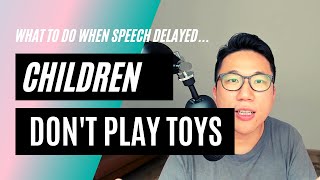
Ming explains how to engage speech-delayed children who ignore toys by building routines around what they already love, then introducing cause-and-effect toys with clear, satisfying results like lights or popping sounds. Start with the child's preferred activities, add language naturally, and skip pretend play until they're ready.
Chapters
Hey, guys, this is ming here from agentsofspeech.com today we want to talk about when children doesn't know how to play toys and does something else, like jumping around, like tearing up paper and, you know, throwing stuff around. So first of all, what you can do is not to teach the toy yet or teach how to play or whatever, is that you can make a routine out of their preferred activity. And what I mean by that is that when you can build a routine with a kid, you're building a relationship, a connection with them, right? So sometimes what I do in the clinic is that if a child likes to jump, I would jump with them and make a routine like say, 1, 2, 3, jump and keep it going. It doesn't matter if it's repetitive because it's obvious that they prefer that activity for a reason, so they're actually okay with doing it over and over again. So when you do it with them and you add some sort of routine and some suspense and some language into it, actually builds that bond together. Okay? If your child likes, like to rip up paper, which a lot of children like to do, is that, you know, you can rip it with them and create a routine, right? Maybe it's like you rip it two times and then you crunch it up and you throw in the bin. So it needs to become like a repetitive routine that it's reliable and you can do with the kid and you're having a good time together, and therefore you can actually teach some language with it. Okay? And once you have that, you have a relationship with them, you can start teaching them toys. And most of the time, I would say children start off playing toys that have a lot of sound, lights, effects, you know, stuff popping out. We call those, like, means end toy or cause effect toys. There are loads of these kind of toys on the Internet for you to buy. It doesn't matter what it is. It might be a jack in the box, right? It could be like one of those ball rolling slide stuff. It might be a car slide. You know, it might be one of those things where you press a button and spins really quickly, like a merry go round or something like that. Those type of toys are easy to understand because you press something and something happens, okay? And if you think about it, whatever your child liked or preferred to do, which is not toys, it's also something that's cause effect. You know, you tear up a paper. The moment you tear, it goes like that. Sound is also an effect, right? So if you think about it, those are the toys, are the Easiest to teach, it's easy to understand. And you also have to build routines upon it, right? Don't try to make your child talk when you're teaching your child to play, just teach them how to play. Start off with those type of toys and then slowly move up as your child likes, takes a liking to them and starts playing them instead of doing all the jumping and tearing up stuff. A lot of parents, they buy a lot of toys, right? And then they put it in front of the kids and they say, okay, go play. And they tell me, oh man, dude, they do not like the toy. They don't, they don't have any interest. They go back to doing whatever they were doing before. And the reason is because you haven't sold it to them. And with the parents own words, what I hear the most is that my kids very stubborn. They don't like new stuff. Well, yes, if you just give them something new, they won't want it. You need to show them how to play it. You know, what's fun about it in order for them to like it. Okay, so what you can do here is that you need to sell it. You need to show them different ways of playing it. You need to have fun yourself. You need to show them like for instance, for a car, you can do a lot of stuff with it. Okay? You can play it with water, you can put it in sand, you can have a ramp that goes down. You can roll it all over your body. You can play with play. D'oh. You know, there's different ways of playing a toy. You need to think of a few and show it to your kid. The reason why your child wants to interact with you is because they think, oh, you're so much more resourceful than I am. I wouldn't have thought and play a toy like that, but that's why they want to play with you. If all comes like a last resort, if all the selling doesn't work and it's not your fault, you don't know how to sell the toys. It's not your job. It's our job as therapists to know how to do this stuff. So last resort is that you should pair rewards with teaching how to play toys. And you can teach toys as a task, right? You can teach how to play toys as a task. And how you do it is like, oh, let's say that you have a piggy bank that's a cause effect toy. And then whenever they finish putting all the coins in and listen to music, they can have a snack or they can go back to tearing paper or whatever, okay? So you teach them, like, a structured task, finish playing, and then you can do something else slowly, they will like the toy. And I've done this multiple times, okay? With parents and without me there, okay? So if you pair a reward and use it to teach how to play a toy, it works. And slowly they will like the toy more than the reward, and it becomes the reward, and you can teach something else. And the last thing I want to tell you is that don't start with pretend play, okay? Do not start with those, because those are abstract. Those are hard to understand. They need to have imagination. They need to have knowledge about what's going on in a toy in order to enjoy it, all right? So don't do that. Start up with cause, effect. You know, means end. Flashy, light, you know, stuff popping out, toys. All right? And before we leave, you can go to agentsofspeech.com checklist for full list of toys and tools and toys that we recommend parents to have when they start home therapy. All right? So leave your comments and questions down below, and I'll see you in the next video. Real soon. Bye.