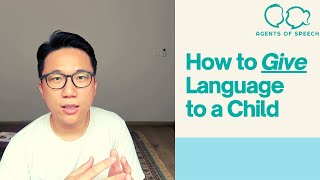
Ming argues language learning works through giving: frequent exposure at the right level and creating real reasons to communicate, often through play. Multilingual adults in Southeast Asia stay fluent because they use their languages constantly. Skip testing and instead speak at your child's level, repeat short phrases, and build communicative need through play.
Chapters
Hey, guys, this is ming here from agentsofspeech.com today we're going to talk about why language learning is actually a game of giving. And what I mean by that is that if you look at people, just human beings, adults who can speak multiple languages, okay? For myself, I can only speak two fluently. And if you look at people who are residing in Southeast Asia, especially in Malaysia per se, they can speak around like three languages, okay? And not to even count those who can speak dialects and different colloquial tongues and so on, I would say that there are loads of people who have vast language abilities much better than me and you who's watching right now. And the reason for this is because of language exposure. I think that a lot of parents have this question in their hearts is that if you have different languages at home, does it slow down the process or does it cause confusion in the child? The short answer is yes and also no, right? Because when children are delayed, especially language delayed, right. What it is is that the whole thing, the whole thing of their. Their ability to acquire language is delayed, is not working as well as it should. Therefore, no matter if it's one language or two or three, the whole thing will be delayed, okay? It doesn't matter. The amount of language, like how many languages you're teaching is about that at the base and root level, that their language acquisition skills aren't good enough. So therefore, we need a. When we're teaching, we're giving therapy, we're teaching them language. We are dealing with the base set of skills, okay? It might not look like that in the therapy room. It might look like that they're only playing. But at the theoretical side of it is that we're dealing with those base rocks, Right? I'm going to just put a link down below about an article I read from the New York Times talking about how language exposure actually helps the most with when you're first acquiring a language. So if you think about it, when we were young, okay, how did we learn so many different words? Right? Did we have a lot of tests like we do right now in kindergarten? No. What happened was that we picked up a lot of words, and we pick up words here and there just by listening. And the same goes to children who are delayed, okay? And I remember traveling to one place in Indonesia called Lombok, and I was talking to this guy who was driving us around. His English was very good. His Bahasa Indonesia was like, fluent perfect. He also spoke the local tongue and I don't know, a three, a Few more dialects. And I was like, hey, I do this for a living. I teach children how to talk. Can. Can I ask you, like, how do you learn so much language? And then he said, language is a behavior. You need it to communicate. I was very curious. So I said, okay, so what do you mean by language is a behavior? Right? Because I understand that the more exposure you have, the better you will be at that language, right? Because, you know, it doesn't matter if you can. You learn, you know, I don't know, Japanese from a textbook over and over. If you don't use it in the real life, you'll get all the. All the words wrong. You know, it wouldn't be the correct way to say something unless you. You see someone's reaction or you hear people say the same thing that you learned. That guy, that particular dude, Indonesian guy, said, language is a behavior because we need to keep on using it. It's like a habit, what he meant. So I understand that if we have a habit of, like, using a language that we're accustomed to, we never really deviate from it. So if you go to. If you're from America, if you go to, like, New York, right? If you go to Chinatown, you don't need to speak English there. They all speak Chinese for some reason. They've been in America for the better half of their lives, but they don't speak English that well. And the reason is because language is such a strong behavior that we fall back to it so easily, they will use it all the. Like, they will just use it because it's their comfort zone. Okay? So let's bring all of this back to teaching a child, okay? And what I mean by language learning is game of giving, is that you need to show that habit of using the language over and over and over again, okay? You need to teach them different words at different, different structures and so on, okay? And you also need to create a need so that they need to use that behavior on you. All right? So there are two key points. Number one, talk enough with their child. At their language level, you cannot talk too, like, too much. Because if you think about it, language exposure, like, it needs to be at the correct level so that you can learn at an optimal rate. Let's say I was trying to learn Bahasa Indonesia. Would it make sense for me to watch a movie or to listen to a university lecture? Right? Obviously it's going to be a movie because there are subtitles and it's easy, okay? So remember that when you're talking to your child, and they are already delayed. Do not speak in, like, full flesh sentences. If they only. They don't even use words, okay? You should only give them and model what you want them to use, okay? Once you give them and model what you want them to use by giving them over and over and over and talking and not asking for them to test them or whatever, the next step is to create a need. By creating a need, the best way ever is basically to teach them how to play, okay? And when you play, they're having fun. They have a need to communicate with you because with you around, it's much more fun, okay? And that's where a lot of parents fall short, because they think that they are giving value to the child by playing with them. But actually it's the opposite. They're thinking, stop doing whatever you're doing. You're annoying me. Let me play alone. All right, so you need to be at a spot where you're teaching play. And there are loads of videos about how to teach play on this channel. So go check it out. That's the end of this video. I hope it was. It gives you a better idea. Everything we do here at Agents of Speech is to change your mind. It's not to give you, like, tactics or strategies or, you know, pie in the sky theory or, you know, telling you using a textbook or whatever, that kind of stuff. No, I'm here to change your mind about what you need to do and actually trying it. Taking action every day and knowing that you are the best person to teach your child. And the best way to start, and start is being generous and giving language instead of trying to test them and get them to talk to you by asking questions and whatnot. Okay? So that's it for this video. I hope you enjoyed it. If you haven't, you can go get our checklist. All the tools and toys we recommend for home therapy. It's at agentsofspeech. Com Checklist. Okay, that's all. And I'll see you in the next video real soon. Bye. Bye.