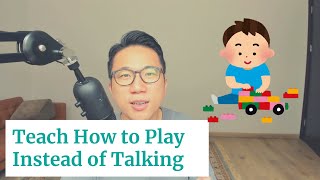
A short YouTube talk by Ming (Agents of Speech) advising caregivers of speech-delayed toddlers to prioritize teaching play routines and play skills before forcing speech imitation. Ming argues that play provides necessary context for language learning — children must understand routines and anticipate outcomes (e.g., using a piggy bank, pressing a toy) before words/sounds/gestures are meaningful. The video contrasts rote imitation games with showing and scaffolding play, and ends with a call-to-action to visit agentsofspeech.com for a recommended tools/toys checklist.
Questions this video answers
Ming @ Agents of Speech
March 3, 2021
agentsofspeech.com (checklist of recommended tools and toys)
Chapters
Hey guys, this is ming here from agentsofspeech.com today I want to talk about not teaching speech when you're teaching your child. Okay. Most of the time when you start teaching your child at home, a lot of parents fall into the trap. That's a very like an imitation game, right? I say something, you say something. I teach you how to play a toy, and you must say the words with me. With this in mind, what I want to talk about is that you should teach, but not the speech sounds, but actually to teach to play skills. All right, so why do we need to teach to play skills or, you know, teach the routine? If you're doing speech therapy for like two or three years old, a lot of times it's a lot of playing. And in Asia, a lot of parents will say, hey, that's, that's not cool. I paid so much money, you're not teaching my child how to talk. Well, the reason is because I'm also filling in explaining for some of my colleagues here is that, you know, everyone needs a context to use language. And for children, playing is the best context, actually is the most natural. They need play to understand the world. You know, they need play to develop the cognitive skills and the language skills. So even before that, you should teach play as a context. All right? And it's virtually impossible for a human to learn something out of context. Just imagine, right? Just imagine that you were memorizing all those words, vocabulary when you were learning a new language without context from a vocab list. That's super hard. And it's super difficult for a child to do it given, you know, they have limited interests, they don't like a lot of stuff, and they don't really want to play with you anyways or learn from you anyways. Right? And sometimes when we ask a speech delayed child to imitate us and they don't, parents say, will tell me, oh, they're very lazy. They don't want to do it. Whenever I tell them, I'm kind of like pushing them to say it and they don't want to. They're super lazy. They don't want to learn from me. Right? And that's not true at all. There's not, there's furthest away from the fact that, okay, the fact is that they probably don't understand the context. They don't understand why they have to talk to you. They don't understand why they have to play with you. Therefore, if you push them to talk during a place where they don't know what's happening, it's just going to be very confusing. To further the point, many parents ask me, okay, why isn't my child talking when I instruct them to? And that's because there's a lack of explaining the task. If you've played a board game before, okay, how confusing is it to try to jump in without learning the rules first or someone explaining, explaining it to you? It's the same thing for children. You might think that it's very self explanatory that you press a button and something happens. That kind of toy, you know, it should be very self explanatory, but actually it isn't for the kid. He doesn't really know what, what that is, right? So you have to explain it to him. You have to explain it to her that, okay, when you press this button, this will happen right? When you blow the bubbles, this will happen. When I close the bubbles, there's no more bubbles. You know, you need to show it and not tell it because their language abilities cannot comprehend what you're saying. You have to keep on showing them. So focus on teaching your child how to play instead of focusing on pushing them to talk, because that actually confuses them. It turns children off because they don't know what's happening and you're trying to teach them something that they're not interested in. All right, so when do you start teaching words or like sounds or gestures or whatever that correlate with the play context is that when they start to anticipate what's going to happen next. Okay, so let's say that you're teaching your child how to use a piggy bank. Okay. Or play a piggy bank, okay. And then every time they know they should pick up a coin and put it in and then press the nose for like the song to play. When they know and they're showing it to you by actually doing it, then you know that they can anticipate it. And therefore when you say the word, when they do the action, it makes 100% sense to them that, oh, I get it now. So the word like put means when I put the coin in. Okay. Or when I, uh, when I press the, the pig's nose. Oh, the word press or the word song means is correlated with that thing. And slowly they get the reason behind why they have to talk or why or, or what the meaning of the word is actually. So when you do that, they can, they can start relating. Okay. But if you did it before they understood the whole routine, you're just saying words and they're just hearing sounds and that's it. Okay, hopefully this was helpful. And please leave your comments and questions down below in the comment section, please. And if you haven't, you can go to agentsofspeech.com checklist to grab a checklist of all the tools and toys that I recommend to parents when they start home therapy. All right, so with that said, I'll see you in the next video very soon. Bye.