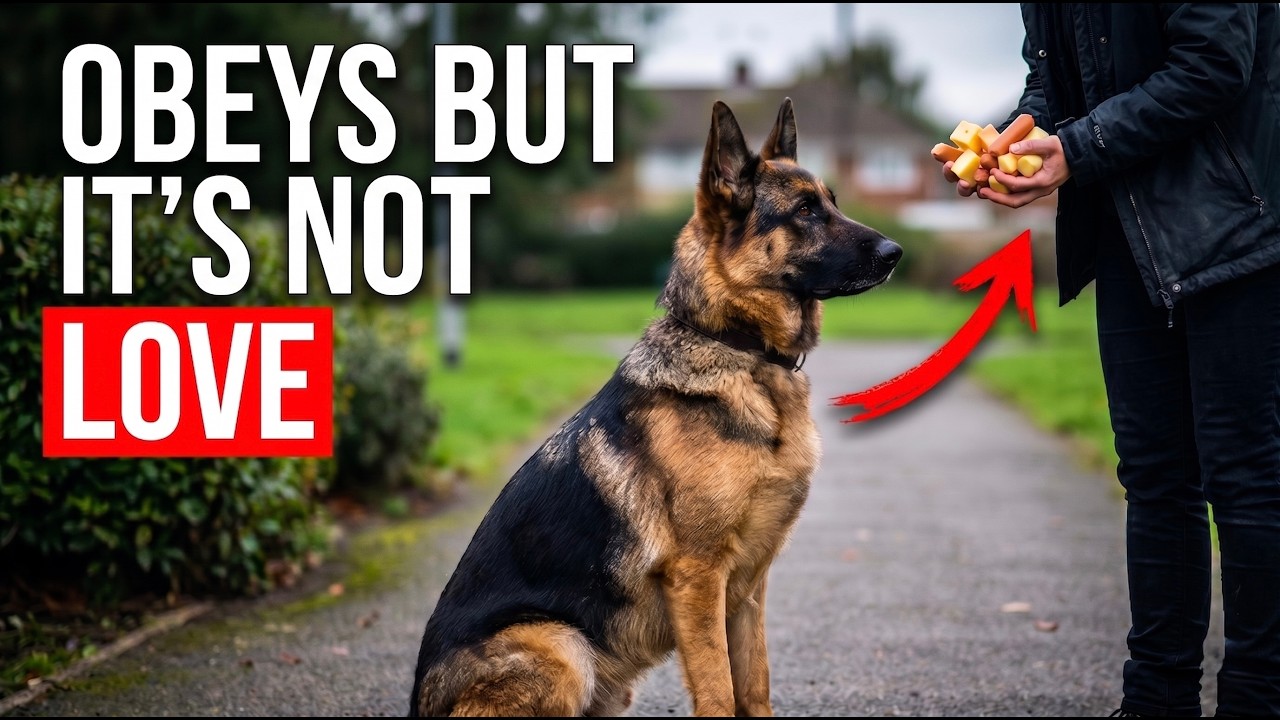
Reactive Dog Not Listening? Stop Yelling. Do This Instead

Max O'Neill explains why treats and distance don't fix reactive dogs: you have to change what the dog thinks is allowed. Use body language to show disappointment, let the dog feel the consequence briefly, then reconnect. This teaches lasting rules, not just interruption.
Chapters
If you've got a reactive dog, you've probably been told to use treats to create more distance, avoid triggers, and keep everything positive. And to be clear, those things aren't completely useless. We do use food, we use rewards, we use distance, and sometimes we need management. We do not want dogs thrown into situations that they can't cope with. But there is a part of reactive dog training that a lot of owners never actually get taught. Food can reward a better choice when the dog is able to make one. Distance can make the situation easier. But if your dog still believes lunging, chasing, grabbing, redirecting, or exploding is an option when the trigger appears, you haven't actually changed that rule in your dog's head. And that's where a lot of owners get stuck. You get told that when the dog reacts, treats are going to help, turning their head away is going to help, creating space is going to help, scatter feeding is an option. You try and train in the moment when the dog is already reacting, but you're just holding them back, maybe trying to get distance, and hoping that the trigger just passes quickly. And then the next walk comes around, the same trigger appears, and the exact same scene plays out again. That doesn't mean that the owner has failed. It means that the dog still doesn't understand that certain behaviors aren't available to them. There's a big difference between teaching a dog to do something and teaching a dog not to do something. Teaching a dog to sit is one thing. Teaching a dog that they can't chase cars, bark at other dogs, react on the lead, or exploded every time they see a trigger is a completely different conversation. And that is what this clip from our 5-day boot camp is about. I'm talking about punishment, and I know that word can sound really uncomfortable for a lot of people, so I want to be really clear before you watch it. This isn't about being angry with your dog. It's not about shouting at them. It's not about scaring them for every small mistake, and it's definitely not a step-by-step tutorial for you to copy from a YouTube video. In training terms, punishment simply means a consequence that reduces the frequency, likelihood, or intensity of a behavior. So the real question isn't, do we like the word punishment? The real question is, if a dog is repeatedly making an unsafe choice, how do we teach them that that choice is no longer on the table? The goal is not to make the dog worried about getting things wrong. The goal is a dog who understands the rules, makes safer choices on their own, and can have more freedom because of it.
How many people in this room, put your hands up if your dog can do a sit? How many people can get their dogs to do a down? How many people have behaviours that they want to stop their dogs from doing? So there's a very big difference between getting your dogs to do something and getting your dogs to stop doing something. How many people in here can interrupt their dogs while they're doing something they don't want them to be doing? Okay, so again, interruption is very different between getting your dog to stop doing it in that moment, but given the opportunity, if the same situation presented itself, the dog would do that behaviour again. You're not stopping it forever. So, when we think about, like, interruption, who got stuck in traffic yesterday? So, you got stuck in traffic yesterday, you're in a rush to get here, maybe you broke the speed limit a little bit. Well, in my story, you did. You're racing down the road, police car pulls you over, you stop. At that moment, you're no longer speeding, you have stopped speeding, but you're still going to get a ticket from the police officer because you already did the bad thing. If that police officer came up to the car and you're like, "Oh, I'm so sorry, I'm just in a rush, I'm doing this thing with my dog, blah blah blah," and he was like, "Oh, don't worry, mate, I understand, it's been a stressful morning, away you go," Given the opportunity, again, got away with it once, nothing really that bad happened, probably would speed again. If you got pulled over and fully got given the ticket, points on your licence are fine, what are the chances that you would then repeat that behaviour? So, the thing about dogs is we don't have the luxury to say to our dogs, "There are some things in life that you simply just cannot do." Like with kids, for example, when you finally start letting them be free range, you can say to them, "When you cross the road, you gotta look first, because if you get hit by a car, it's gonna really, really hurt, or it won't hurt, and that will be worse." With our dogs, we don't have the luxury of that communication, and dogs learn by association only. I can't afford for my dog to learn some lessons by association, because that lesson might be the end. So like, for my dog Rue, one of her most favourite hobbies is probably chasing livestock— sheep, cows, horses, anything. Now obviously the rules have changed loads. It was unacceptable before, but now I cannot afford for her to even think about doing that behaviour. And in the moment, if she sees a sheep, she's e-collar trained, I could call her back, but now that's too late. She's not even allowed to think about going near those sheep. So I have to have a way to communicate to her that that is simply off the table. You can never chase sheep, cows, horses because that might result in you getting shot by a farmer, getting seized by the police. That's not a lesson I want you to learn by association. A lot of people associate punishment with retribution, and it's not that. Punishment by definition is having a way to reduce the likelihood, intensity, or frequency of behaviour. It's not yeeting the dog into next year, smashing them over the head with a newspaper, beating them up. It's simply doing that— stopping the likelihood, intensity, and frequency of a behaviour. And I think people kind of think about it as like a dirty word, and it's not.
So the way we teach punishment is relying on the social system.
So we don't tend to use a lot of like excessive pressure with dogs because If you have a relationship with your dogs, and all of you guys have a pretty decent relationship with your dogs— it sounds kind of manipulative, but you can use that relationship, you can leverage it to say to the dog, hey, we're not going to be pals if you carry on doing that thing. When we are going through this punishment system, we are trying to convey a message to the dog through our body language. Essentially, dogs are masters at reading even like the smallest nuances in our body language, so they're hardwired to read it. They're one of many animals that are. So when we're going through this process, it's not about us getting angry and frustrated at the dog, it's about us conveying, hey, I'm so disappointed in you that you just did that. What felt worse when you were a kid is what I always think about— getting a smack bum and running up the stairs like this, or when your parents were like, I cannot believe you did that, I'm so dis— just get out of my sight, go to your room, I don't even want to see you. Because for me, there's probably a lot of times when I was a kid where I got a smack bum. Maybe I would still do the thing again. I couldn't probably even tell you what any of the things were for, but there are a handful of times when I was a kid where the disappointment chat came and I got sent to my room, and I can hand on God tell you I would never have done those things ever again because that hurt me way more to lose my relationship with my parents versus them just being angry at me in the moment. And you've probably all been there with your dogs. They're doing something you don't like, gobbing off at people, shouting at dogs, you're venting your frustration out, but it's never stopped them from doing it. Maybe at this point not even interrupted them from doing it. The juice is worth the squeeze. They don't really care. When we go through this today, most of you initially aren't going to be great at it, and it does have to get a little bit GCSE drama. So when you're trying to convey the message to your dog, yes, the words you use to help convey the message of disappointment might help you to express that emotion, but the words aren't necessarily important after the initial mark. It's the body language that you're using to show the dog, come on, like, we've been over this. Like, why would you do that? Why would you put your face on a chicken bone? Like, I could take you to the vets, I don't want to pay bills, whatever. Come on, going over here. You want to do charades with me? All right, so I'm not going to say anything to Kirky. I'm just going to try and convey something to him simply through using my body language. Okay. He hates hugs and he hugged me last week and I didn't know he was going to do it and it really freaked me out. I actually watched the video back and I go like this. So what initially was I doing with my body language? Showing how disappointed. Exactly that. Then what was he doing? Feeling guilty. What was the thing that I did after? Made up. So when we go through this process, one of the most important bits of it is, yes, the initial disappointment, conveying a message across to the dog. When they come back out, dogs tend to be then a little bit sulky, sad, because they are sad that they disappointed you, want to be friends again. So I want to bring them back to Not overexcited, like we don't want to go in and be like, oh my God, amazing, wow, that was a really good boy. Just like bring them back to a nice calm state, let them know we're still friends, I don't hold it against you, and then bring them out and then we represent the exact same thing. So that got you that, want to do it again? And that is the only way that we will know if our punishment was actually effective, if the dog actually wants to do it again. Most often it will take dogs like 2 or 3 goes because the initial time that you do it, the dog won't have made connection that that got me this. The reason why we practice doing this in a situation like this, for most of your dogs, you never really get the opportunity to know if whatever you've been trying before has truly worked, because most often the dog's already gone, the car's already passed, the person's already walked away. So the dog never— you never had the chance to know if what you were trying to convey actually meant something. And another reason why we practice like this is because for some dogs who are maybe reactive because they're a bit more fearful of the dog, fearful of the person, it gives us a chance for the dog to actually learn where we can take a behaviour off of the table. And up until this point, the dog has thought, oh fuck, there's a dog or a person coming, oh, better go fucking bonkers, goes absolutely bananas. In their mind, they don't know that person was walking by anyway, or we were going this way anyway. They leave the scene of the crime and they think, nice sense of relief there. Glad I did that. Better do that again next time. That worked. I'll do it again. So if that behaviour goes away, we have a window whereby the dog can maybe see, hmm, maybe I didn't need to do that. Maybe that dog, maybe that person wasn't so bad. 'Maybe they weren't coming over here anyway. It's fine. I didn't need to react that way.' And that's where learning can actually happen. And it can give us a path then to say to the dog, 'Pick something else then.' They do, then I can pay that. And then they learn, 'Okay, that was not so great. The thing maybe wasn't that bad. And if I just pick something else, this is pretty good actually.
I feel much better about that thing now.' So we do it in a low-stakes environment like this.
For two reasons. One, so that you guys can get it down. You have your mechanics, you know exactly what you're going to do, when, why. The dog can also learn the sequence. We can kind of load this word. So you know how like you've loaded your marker word, yes, or whatever it is that you're using, clicker, to convey, make the dog feel an emotion. They feel good things about that. They hear that word, they're like, oh, I'm going to get paid, amazing, cool. We do the same thing with this word to make them feel not so great stuff. It's about the emotion. And also then when the dog has seen it in like a couple of low-stakes environments, by the time we take it to things that they maybe don't feel so great about, we eliminate the risk of making that behaviour worse, whereby the dog's like, oh, I've never seen this before, and now I feel even worse because now I saw the thing and I felt bad. Whereas if we do it in a situation like this, the dog gets in there and they're like, I've seen this before. It wasn't the dog, it wasn't the person that got me this, it was whatever I was doing in the moment that got me that. So how about I just don't do that again? The goal with everything that we're really doing this week, and especially for this today, is not to be ruling with an iron fist and saying, I'm the leader, you best pay attention to me or else. Everything that we do, whether that be what we did yesterday where we're rewarding the dog, or today where we're telling the dog that's off the table, is about liberating our dogs to be as free as they can possibly be, so they are able to make choice themselves. To know there's a handful of things in life I'm not allowed to do. I've learned through association those things are off the table, so I won't do those things again. But I've got a thousand other things I can pick. I'll just go pick one of them. That allows a dog to be truly free because you can trust them to make choice on their own without constantly micromanaging them, calling them back over here, putting them into obedience get past a dog, a cow, a horse, whatever, you know, given that situation, I know my dog won't pick that because he knows it's off the table.
So hopefully that video has made the idea of punishment a little bit clearer for you. It's not about being angry at your dog or losing your temper, and it's not something we use for every little behavior we don't like. It's about serious behaviors that keep being repeated, especially when those behaviors are making your life smaller or creating risk for the dog. If your dog can't pass another dog without exploding, can't cope around traffic, can't be trusted anywhere near livestock, redirects when they get frustrated, or goes from 0 to 100 around triggers, then it's not enough to only think about getting through that next reaction. At some point, the dog needs to learn that that behavior itself is no longer an option. And that doesn't mean we stop using rewards. It doesn't mean that we stop building confidence. It doesn't mean that we stop using fulfillment, freedom, play, it means those things have to coincide with clear rules and boundaries. Because if the only feedback you give to your dog is when they're getting it right and not when they're getting it wrong, that behavior you don't want will continually be repeated. And that often means that, that your dog's world gets smaller because of it. No off-lead freedom, no calm walks, no trust around triggers, just avoiding, managing, and hoping that nothing goes wrong. And that is why this matters so much. The aim isn't a dog who's scared to make a mistake. The aim is a dog who understands what's expected, understands what's not allowed, and can be trusted with more freedom because the rules are so much clearer. If you're watching this video and thinking, we've tried treats, we've tried avoiding dogs, we've tried keeping everything positive but we're still stuck, then this is exactly the kind of thing we work through on our 5-day boot camp. If that sounds like where you're at, you can apply for our 5-day boot camp using the link in the description below. And if you're not ready for the boot camp yet but you want help building foundations that support better behavior, you can join the Behavior Bible, which is a completely free course. The link for that is also in the description. Because the goal is not just to interrupt one reaction in that moment, the goal is to help your dog understand the rules well enough that both of you can have a bigger life again.
More from Max

How to Charge the 'YES' Marker For Your Dog Training (Terminal Reward Marker Conditioning.