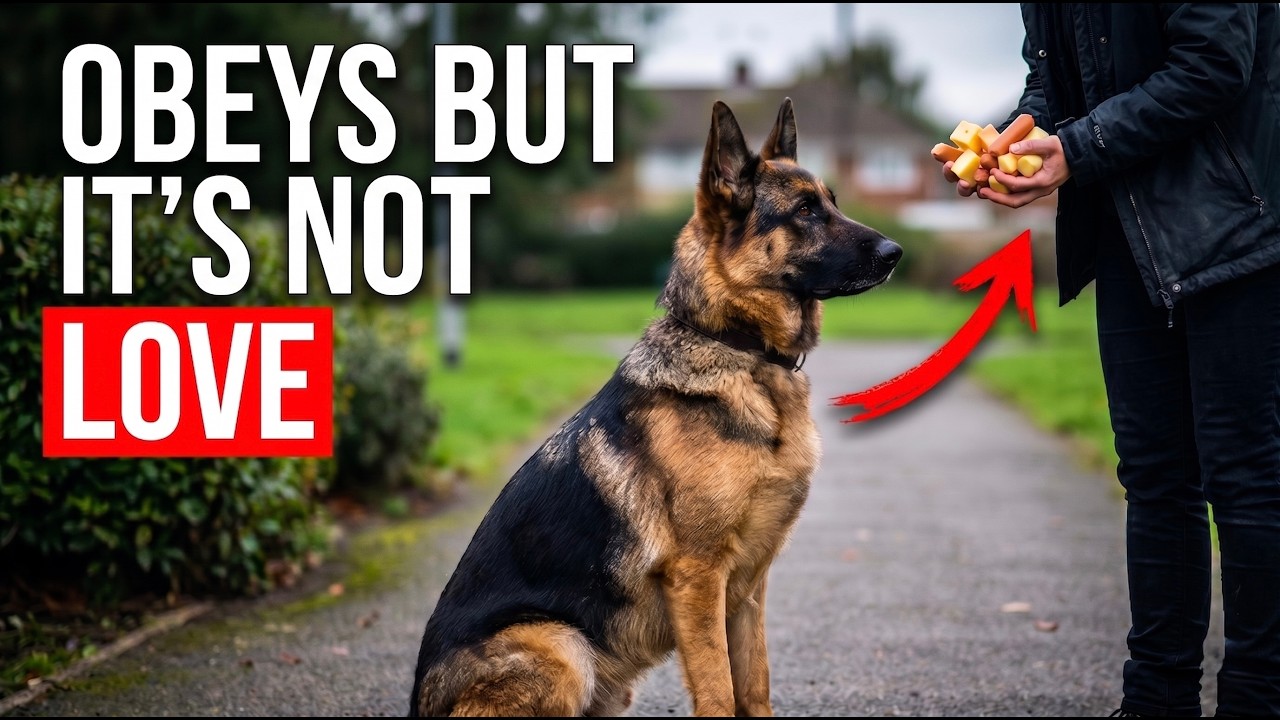
Dog trainer Max O'Neill says treating training as pure obedience turns you into a vending machine, breaking real connection. His client's dog obeyed at home but ignored her outside. He prescribes play, boundaries, and removing treats to build a bond where your dog listens because it respects you, not for food.
Chapters
You can have a dog with a perfect heel, a perfect sit, a perfect down, and you can still have an absolutely terrible relationship with that dog. I see this all the time. People think that if they just drill obedience enough into their dogs, the relationship will magically fix itself. They think that if the dog just listens to commands, the bond will be strong. That's a lie. I have seen high-level sports dogs, dogs that compete on the world stage, dogs that execute complex obedience routines with military precision, and I have watched those same dogs outside of the ring. They're kept in a crate. They're brought out, they do their routine, they do some bite work, and they go back in the crate. When they're out of behavior, when they are just existing, there is no relationship there. The dog picks up a ball, runs off, completely ignores the handler. Why? Because obedience is mechanical. It is operant conditioning. If all you do is drill commands and hand out treats, you're not building a relationship. You're becoming a vending machine. You're teaching the dog that you're a transactional dispenser of resources. If I sit, I get cheese. If I heel, I get a hot dog. That's not a relationship. That's a business transaction. Real relationship is not built in a structured training session. Real relationship is cultivated in the spaces between training. It is built on how you play with the dog. It is built on what you let them get away with and what you don't let them get away with. It's built in how you exist together in the same space when nothing is being asked of them. If your dog only pays attention to you when you have a piece of cheese in your hand, you do not have a relationship. You have a transaction. I had a client recently who was obsessed with obedience. She had spent months teaching her dog to sit, stay, and heel perfectly in the living room. But the second they stepped outside, the dog ignored her completely. It pulled on the lead, barked at other dogs, and wouldn't even look at her. She couldn't understand why. But he's so obedient at home, she said. I told her to put the treats away. I told her to stop asking for sits and downs. Instead, I told her to get on the floor and play with the dog. I told her to engage in a game of tug, to let the dog win, to build some actual drive and excitement. And then I told her to get some clear boundaries. When the dog jumped on the sofa without permission, she had to say no and physically remove him. When the dog tried to counter-surf, she had to stop him and say no and hold him accountable. She had to stop being a vending machine and start being a leader. Within 2 weeks, the dynamic completely changed. The dog started looking to her for guidance and not just for food. The dog started checking in with her on walks even when she didn't have treats in her pocket, because she had built a relationship based on mutual respect, clear communication, and shared experience. Obedience is important, and I'm not saying you shouldn't teach your dog to sit or heel. They have uses. But obedience is the icing on the cake. It's not the cake itself. If you try to ice a bowl of flour and eggs, you're going to have a mess. You have to bake the cake first. Stop trying to fix your bond with more obedience drills. Put the treats away. Get on the floor. Play with your dog. Set clear boundaries. Be a leader, not a vending machine. If you want to learn how to build a real relationship with your dog, how to use play to create engagement, and how to set boundaries that actually work, click the link below. We teach this every day at the YCA. See you in the next one.