Frits Erasmus Trading Strategy
Frits Erasmus and Alan Solarsh walk through the blue banner trading method, a risk-management approach for forex and gold using fractals, supply zones, and the ATMA indicator on 4-hour charts. The group debates lot sizing, drawdown limits, and whether blue banner trades work as insurance rather than profit makers.
Chapters
Okay, so where's the star? Where's the star for tonight? Where's Fritz? Are you ice-hedged? Let's just record. Can we ask everyone—
No.
Everyone please mute your microphone, only unmute when you're gonna speak. How does this work? Let me just see. Okay, the bottom of your screen is your microphone button. If you can all mute it, that would be great. It looks like a microphone. I'm sure you'll figure it out. Where's Fritz? Can you get him on the, uh, Cool, please. It's 7 o'clock. Anybody hedged? Is everybody cool? Yes, I did hedge much. No, not—
no blue, baby.
You guys. So does that mean you've hedged? The thumbs up. I'm good. I'm trying to say I'm not hedged, so I'm good. Okay, cool. So Kitu's hedged. Okay, cool.
Hello, Alan, can you hear me?
I can. How's it, Fritz? You can switch on your camera and then you can share your screen and you can tell us about your amazing strategy that you've developed.
Just, I'm trying, I've got that light in the background.
Oh, that's fine.
Let me just switch that one off.
Okay. That's the sign you're the star of the show. Martin, don't do that. Eliminate him. All right.
I'll not let you fight with Google.
Just listen. At the bottom of the screen there's a square with an up arrow, click it.
Okay, how do I— specific window?
To share your entire computer, it's just easier that way, because you're gonna open up your spreadsheet as well.
Yeah, that I can't do. I've got more than one screens.
You'll bring whatever you want onto the main screen.
Can you— at the moment, can you see? Ah, that's right. Now I can see.
Right. That's great. Got it. So, so just by the way, Fritz is an accountant and he's got some really interesting tax stuff to share with us as well.
I'm not prepared for that tonight, but I'll try and cover it quickly.
Okay, cool.
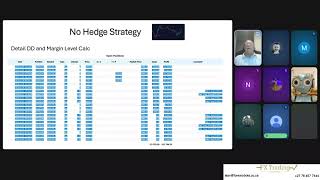
So I know Alan doesn't want to hear me saying this, but I am shit scared of hedging. So I'm using a no-hedge strategy. So rule number one is to protect your capital. In my world. And rule number 2 is follow rule number 1 religiously. So you just protect your capital. That's my motto for this strategy that I'm following. I'm going to cover the open buy trades and bot. That, that is the gist of my strategy. And then the number of bots that I have running. Uh, there is percentage that I use to calculate my lot sizes with management money, money management equity. And then I've got a tool that I've created in Google Sheets that calculates my drawdown and my margin level so that I can see beforehand if the price drops with a certain number, where will my $1,000, where will my drawdown be if it drops a certain amount? Then for manual trades— I'm sorry, then also I update my take profit settings in Section 7, and then I will show you my trading stats as well as what I'm doing when I sometimes do a little bit of manual trading, right? So So I just want to make it clear that this is not financial advice. I'm a trader like everyone else in this community, and I started trading, trading long ago while I was living in UK. That was even the days before data was readily available. So I actually did a course, and I thought, this is not for me. Things are not happening like I I don't feel comfortable doing it. And I paused my trading for a couple of years and only started during COVID again, um, trading a bit. Uh, my friend, any that was trading with me that got me into crypto, I think he's also joined the meeting anyway. So, um, and during my time of trading, I saw many guys that got, um, liquidated. So I've got my first liquidation that happened with me. My account was liquidated on the 2nd of Feb when silver dropped from $420 down to $225. That was a 44% drop, but this was a small account. I was just really just playing around with that, testing things out and see what works and doesn't work. So I realized that That, that is definitely not a good idea to be, be unprepared and over-leverage your, your account. That was a nice lesson for me, a relatively cheap lesson. So what I'm doing in my strategy, I only allow the maximum open buy trades per bot to 4. I don't let it go more than 4, and unless the price drops really far and I'm confident that the price has turned north again, then I'll probably increase this setting again. That's in section 2. Um, what, what is my percentage, uh, that I allow for money management risk? Um, I only use 3 bots. I don't use number 1 bot, and I make it 20 0.25, sometimes a little bit higher. So just to back-calculate that or reverse-calculate that, if you've got 4 bots running and you want the equivalent of 0.075, you can only do 0.019 where I'm doing 0.25. That is quite a big increase in the per-transaction profit that I make there. And this is where I control that in Section 3.
Then just slow down. Do you want to go back there and just explain that last point? Okay.
So in Section 3, there's one, one back more. This one. Okay. So in only what, number 2, 3, and 4. Is slower, but it— they, they take a little bit longer to, um, to close the trades.
So that they take longer, why? Because you've got a higher take profit.
Well, not only that, it is, um, um, so again, I, I put me on the spot. Yeah, how I set up the bot, um, the, the, uh, when the when the bot, um, when the price goes, um, comes down again and it goes on 1 minute below the 8 EMA, then the bot will close the trade.
So, sorry, in a loss?
No, no, no, no, no, it's only if it's a profit. But I mean, it, the bot buys, buys the gold and the price goes up, and when it then turns, uh, going south, it may flip. Yes, then, then it will close the trade. So, um, but bot number 1 closes it quicker because, um, it's just the way that, that the, um, regional, um, what's the settings that, that, that's provided for, for low risk Is set up because that one—
let's go look at— open up your VPS. Show me your— show me your MA reversal on charts 3 and 4. So you're saying that 2, 3, and 4, or 2 and 3, is set up one way and chart 4 is set up another way? Yes. Okay. And chart 1 is your blue banner chart?
No, I don't have a blue banner chart. I don't do that.
So what are you doing with chart 1?
I don't, I don't run it at all. That's why I've got only 3 bots running. Sorry, if I can just ask Fritz for clarity, when you say you've got 3 bots running, are you referring to charts?
Yes. Yes. Thank you. So let's just slow it down a little bit and let's get a little bit granular. Who wants to get granular? Put your thumbs up if you want to get granular to like really understand this. Okay, cool. Okay, and then I'll explain to you what the settings mean. Would you like that? And do you want me to explain the pros and cons of what those settings are? Okay, cool. Okay, so what, what— this is chart 1. Okay, cool. Okay, just don't change anything. Okay, cool. Like what I see. Scroll down one. So I'm looking at the magic numbers. That's the first thing I'm analyzing to stop there. Okay, so it's got start sequence immediately set to false. Can you explain to me why that is? Okay, so let me, let me— this is about listening to Fritz's strategy and then going through his settings and possibly helping him tweak his settings so that he can get a better understanding and possibly increase his profitability. So the last time we chatted, um, can you tell me what your percentage of profit— the, the increase of profits was as a percentage from your settings to the new TP? Sorry, do you just hold on a second? Do you have an idea of that, Alan?
I—
it's difficult to, to, um, give you a number of increase in percentage, but it has increased. Yeah, it has definitely. But what I want to say is, instead of me, um, of the bot closing trades at sub-dollar values, like sometimes a dollar value, it now closes on 2 $2.50 a trade. And I can't say that it is really closing less, maybe, maybe a 10% less trades per day less, but the dollar value per trade has increased dramatically.
Okay, cool. Okay, let's just pause. Jason, I was just thinking that if we let Fritz go through everything that he wants to say, I'm confused with I got confused. Okay, I agree with you. Can you put your hands up if you were a little bit confused when Fritz was talking? Because I got confused and that's why I paused it. Okay, so that's enough of confusion for us to pause and go through each of his settings and why he's done the settings the way he's done it. Can you agree with— anybody disagree with the way I want to do it? I'm happy to do it any way you guys want to do it. Not yet to run the call. I'm here to try and get everybody on the same page so that we can all understand it and leave the call with an understanding.
Alan, are you recording the screen or—
I am recording. Okay, thanks, Martin. Please record. Okay, so this setting here, start sequence immediately. Let me explain this to you so that everybody understands it. Okay, so it's that one. Cool. What happens is the, the, the EA has an algorithm And it will open when, when your, when your sequence closes, or if the second candle opens below the ATMA and your sequence closes, then a new sequence will open. But when will it open? Do you know the answer? Who knows the answer? Come, guys. Okay, then unmute yourself and tell me.
When the second candle opens above the 8 EMA.
Correct. Uh, no. Uh, yes, that is correct if it's at a specific distance. Yeah, so it will open on the next candle that opens. Okay, when you set it to true, when the trade hits a take profit, if you have got take profit set, then the new trade will open immediately if it's set to true. If it's set to false, then a new trade will only open when the new candle opens. So if you're on a 15-minute chart, a new candle will open then on the 15-minute chart. Are you good with that, Fritz?
I understand what you're explaining.
Yeah. Okay, cool. So mine is set to true. You can set yours up however you want. Let's go further. Okay, cool. So you've got your MM set to 0.038. Okay, so for me, this is high risk. For me, I can't do that. I don't have the stomach to do that. My risk is on 0.01 and on the very odd occasion 0.02. Um, each to their own. You just need to understand the risk. So this is where Fritz's strategy comes in, where he's able to open up higher risk settings Because of Fritz, less bots running. And what else? How many trades do you allow per chart? Sorry, say how many trades do you allow per chart?
Um, um, 4 at this point.
Can you go up a little bit? So maximum trades per robot is 4. Stop, stop. Max open buy trade limit, you've got it to 2.
That's per chart, not per robot.
Yeah, this is per chart.
If I say robots, it's the same thing.
Just one second, I just want to quickly check something. Okay, um, can I, can I open my chart number 2 and I'll come back to this one because this is This is yet again a little bit different.
Okay.
I should have opened this one. Okay. Because this is, this is the, this is bot number 2 running. Okay. So I allow 4. My risk setting is this one is 0.035.
Okay.
Probably still too high for your— for you.
For me, yeah, but that's just me. I mean, some people are running a 0.05 with $1,000, so like, it's each their own. You guys have got to work out your risk appetite according to what you can stomach and the Alan Calculator and the AI. Yep. Cool. Okay, so you got 4 open trades. Okay, mine's set to like 20. It's a different strategy, guys. Yeah. Okay, so you're saying that when— if there's like a bit of a down candle, a bearish candle, only 4 trades will open and then it pauses?
But per chart, yes.
Okay, cool. So let's say we have— let's say we have, uh, 4 trades that open and then the second candle opens below— above the ATMA after a $50 move. What is your strategy?
Then you remember I had the— I had chart number 1 open because that is something that I set up today, or triggered today, because I can see there's a slight upturn in the price. So I just started 1 extra bot that'll only allow 2 extra trades because that 2 trades Well, it should be sufficient on, on if the price keeps going north. If it then would drop further, I just leave it.
I— so, so if it drops further, so let's say the second candle opens above the ATMA, um, and we know that we're in a bull market and the bulls have taken over, do you increase your number 4 to number 5 for the robot to force a trade or not?
Not immediately. I, I want to make— probably on the third candle I will open it. But I've got— I set up chart 1 that is usually not running to allow 2 bots, 2 trades to, to keep on taking profit as we go up towards the higher open trades.
Do you start your 4 bots at exactly the same time, or do you stagger the time frame when you open your open your bot so that, so one bot will open trades, let's say at 5,150, and then you put your second bot on later when the candles, when the price has moved up and maybe you start your bot at 5,284. So like there's a $40 gap between the two different bots.
Remember, I don't switch a bot off. Okay, cool. It's limited by the number of allowed open trades. So let's, let's look at, at this, um, chart here at the right-hand side. So all the trades from there all the way here were the 12 trades that were open, and the bot didn't open anything else. And okay, cool, he couldn't open. Hence the reason I set up chart 1 the same as my bot that's taking the highest profit, which is, uh, bot number 4. So I copied all the settings exactly the same and just allowed it 2 extra trades.
Okay, so bot number 4's got 2 extra trades. So that is your cash flow— so that's your cash flow, um, bot, same settings as chart 4. It's not like 2 extra trades.
So instead of 4 maximum, 4, it's got maximum 6 on that one particular bot. Yes, but, but I don't update chart number 4, I've created a new one so I can— if it goes, if it gets into this region, I will switch off the bot so it will be— it will actually be my blue banner trades then continuing up higher.
Okay, cool. You can continue explaining your presentation. Uh, Tola has a question. I don't think—
no, no, I— yes, it was me, Alan.
Um, I—
while Fritz was explaining, but he actually answered the question. He said he's— when the market goes down and his other 3— his 3 charts that he trades with has already opened the 4 trades per chart, and the market is now at a level where he believes the market is gonna turn and go back up. Then he opens the fourth chart and he only allows two trades, which is in effect the same thing as the Blue Banner trading strategy that you have introduced to us.
Well, not exactly, okay?
So it's not exactly the same because I'm copying chart number 4, because chart number 4 gives me the highest percentage profit overall over a period of— since I've started this trading.
Because let's pause there. Let me understand why that is. Is that because it's got 2 extra trades, or is that because your take profit on your MA reversal is set higher?
Because the, the MA reversal is set higher.
Okay, cool.
Okay, so, um, just, just to confirm what you were asking, I could have gone to my chart number 4 and add 2 there as well. It would have resulted in exactly the same. But by, by using an extra chart, I will be in the position to switch the bot off for those 2 trades, and then they can act as blue banner trades.
Because you've— because you have switched it on after the reversal and it's like sort of at a low number.
Yes, yes.
All right, so this 4 times 0.019, please go back. What is that? Is that your lot size?
No, this is— I I am, I'm trading this 3 of 0.25. Well, actually it's a little bit higher in, in, in the risk. Yes.
So your risk, but your risk isn't that 0.35 or something. Yeah.
Um, this should have on this presentation, it should have been 0.35, 3 times 0.35 gives a number. And what I'm saying is if you have 4, your risk per chart is going to be, it's going to be much lower to be equal to mine being on where I only run 4 bots or 3 bots. I'm just trying to justify why I feel comfortable to increase this number.
That's why before you go any further, someone else has got their hand up. No name. Do you want to unmute yourself and ask your question? No name, please put your hand down. Okay, cool, continue.
Thanks, Alan Solarsh.
Oh, it's Vic. I think it's Vic. Vic, unmute yourself. And then you can ask your question. At the bottom of your screen is a microphone. Just make sure that it doesn't have a— across a landowner.
Can you hear me?
Yes. Sorry guys, that was my mistake, I was moving my mouse around. No, it's the— it's this other gentleman here, the no name. Yes, you sir, do you want to unmute yourself or put your hand down? Okay, continue.
Right, go on. Right, so, so we all understand now what I was doing, yeah, this is the money management lot size 0.025, but mine is actually 0.035.
Got it.
So what I, what I do is to determine how far the price can go down without me being liquidated so that I can go to bed tonight and sleep well. I run the report. So Let me just drag this over here quickly. So in the history, you just right-click on it and you run the, there's a report. And I run this HTML Internet Explorer report. And this is what I We'll get in because this, this gives me a list of all the open trades, open positions. And I would copy this and paste that into a Google Sheet that I've created. And this is what it looks like. So all those trades are just literally pasted in here. And then on that same report, that was the bottom of that previous screen, I copy all these fields and I paste that in a second page on that Google Sheet. And then I've got a third sheet with a lot of formulas in that I can fiddle around. So up to now, the net open positions will balance, balance the account balance. All these numbers in yellow will perfectly match what I, what, what I saw on that HTML report as well as on my phone. Right now the magic is if I enter a number there, let's say $500, it means the price will drop from $4,900 to $4,480. And this sheet will calculate for me what my drawdown will be. Okay, give me a second, then I'll just quickly bring it up.
Just pause a second. These are closed trades?
No, these are, these are all open trades because the, the, the goal is for me to determine how far can the price drop without me being liquidated. So am I safe?
Go back one, please go back one screen. 2 screens. Go to your VPS because you said you took this from history. So history is closed trades.
No, if I run this report, you see I'm on the history tab. Okay, report. If I run this report, let's—
that's the XML, isn't it? Was that the HTML?
I'm going to name it now so that we can easily find it. So there's the now report. If I scroll down, there's the open trades. So I literally copy this and I paste it into— yeah, let's—
I can—
Alan, I don't want to show all the numbers. But this is, this is what I do is I just paste it into that sheet. Okay. And I paste the balance in the sheet in there, and then the calculation is done for me.
Okay. I wasn't aware that when you run the report on the history tab, it actually tells you what your open trades were. That's— I've learned something. Thank you.
It doesn't matter. So Here is that sheet. So this is where I pasted those open trades. This is where I pasted the balances. This one is where the magic happens.
Now, these are your open positions that you've just pasted through. All my open positions. When you paste it, does it paste it exactly the way you've copied it, or do you have to mess around?
The only thing that I've got to, that I've got to update is the, the, the numbers here has got spaces in. So I just do, I do a find and replace.
Okay, cool.
And you move out your find, find all this, all the spaces, and I just replace it with nothing. Replace all. That's what I do. There wasn't any spaces, so there's nothing to be learned.
Something new there as well. I didn't know you could use those three dots to Do the find. I do it the slow way through edit. No worries. Educating me nicely.
So all these numbers will match 100% with that report, which was, which was taken a minute ago because it takes me a minute to get here. So at this point in time, I know all 12 trades are open.. And I, I might have manual trades as well, and I take that into account as well, for example.
And what is this? Just to go slowly, let's explain that again.
Okay, so remember the open trades that I pasted here includes trades that I— that the bot didn't open because I've got manual trades as well. I do scalping as well.
So, okay, let's pause there. Let's pause there. Trading manually on your account that's running the EA is not advisable unless you're an experienced trader. Agreed. If you want to trade manually, I recommend that you open a new GTC account, drop in your $100, trade to your heart's content. But don't— try not to trade on the same account as your EA, because what I have found in my 11 years of experience is that you bring your old habits into your trading account with the EA. You over-leverage because you think that the chart is reversed. You open trades that are too big for your boots— I mean, account. And then you blow your account, and then I lose a client. So please open another trading account and trade to your heart's content, not on your EA account. Anton, if you've got any questions, you want to comment, you're welcome to. Also, Tola, Warren, my very experienced traders, please chime in.
Hey, Alan, I agree with you. You're absolutely right there. One should not do it.
I agree. Okay. But you've been trading for 20 years. Yep.
But it doesn't, it doesn't safeguard me.
No, it does.
Let's see the drawdown. Okay, so my drawdown is 20%, and that actually matches on this particular one. This was quite a while back. As you can see, it was April the 4th. Uh, hang on. Have I now pasted today's trades? Ah, doesn't matter, doesn't matter. So, um, this, this will match all the information that is, um, on that report. So let's, let's, um, what I then do is I look at the charts and, and find, um, support and resistance lines that are, um, potential, um, places where— or prices where the, the, the gold will, will, will stop as a— for a support. Um, let's say that's, that's on $550, for example.
So that's a drop of $550.
Yeah.
So what I'm doing now is comes down to 4680.
Correct. So it updates all these prices. Got it. And it recalculates the profit. Well, it's going to be all negatives and it recalculates everything. And it tells me if the price drops with $550, the drawdown will be 80% of the balance, which might include quite a bit of profit as well. In the meantime, my profit margin will be 2,400 rand, 2,400%. So let's just, for example, if the price with that numbers would drop $1,000, I would be liquidated. Okay.
Unless my equity protector kicks in at 65%. Not unless it will kick in.
Yes.
Yes, but it'll only close your negative trades. So if you've got blue banner trades open, or if you've got a hedge open and your robot's hedged and the robot is blue, uh, then, um, you shouldn't open that one. Only your negative trades will chime in. So we'll share the sheet with you, Henry. We'll share the sheet with everybody, right?
So yeah, so this is, this is what I, how my strategy works.
How often do you fill in the sheets? What's your daily regime?
Alan Solarsh, if there's, if there's only a, if the price is, if I haven't got any reason to feel uncomfortable that the price would drop dramatically or drastically, I don't do that on a regular basis. But for example, today when I'm, I'm a little bit nervous on what the price is doing, it, there's no stability, it's going sideways. So anything can happen. I'm, I don't feel comfortable now. So I, I probably did it 4 times today just, just to see what happens because I've added those the extra 2 trades on that chart number 1 that is a replica of chart number 4. And today was the first time that I did that, so I wanted to make sure that this is safe to, to, to do, or, you know, should I worry, should I not do it?
Do you have money in another account that you've kept separate that in case it does drop by, let's say, $200, $300, that you can fund your account quickly? Yes. Okay, so let me explain that to my new people. Let's say you have a large account, $10,000. What I've told my clients to do is to not trade with the full $10,000, trade with 70% or 50%. The other 50% and 30%, uh, 30%, you open a separate account at the broker and you park that money in that account. It's not linked to a robot, it's just sitting there. So what are the advantages of that? The advantages are generally the rand depreciates by about 15 to 20% a year. The only reason the rand has gotten better this year is not because the rand has gotten better. It's because the dollar has, has weakened. Can we agree on that point? Yes. Yeah. So generally you're hedged against the rand. Do you think that hedging against the rand is a good thing? Yeah. Okay. So that's my way of saying, okay, like, I understand leaving my money in the bank in South Africa, I'm going to lose money. I'm going to lose at least 15 to 16% per year because of inflation, which is not 8%. So inflation is not 6%. I mean, if you go shopping, not your wife, you push the trolley, put shit in your basket. Can you agree with me that inflation is more like 20% to 30%. Yep. Do you disagree?
Anybody disagree? I mean, those inflation numbers are manipulated and is to mislead the people.
Yes, it is, because they change the basket of goods, uh, every time they do the analysis to— they say to make it fair, but it's— you're comparing apples with pears. You're not comparing apples with apples. Okay, it's another topic. So I'm saying rather put money in a separate account. You're going to be hedged against the, the rand where your money's in dollars. And I've been saying this for years. I don't think that the rand is going to be 20 to 1. I think it's going to be 30 to 1, especially now that Ramaphosa, our magnificent president, has taken the stance to side with Iran. Which is just fucking stunning. Amazing move. Not. So I think that the rand is going to sink shortly. Thank you, Warren. Do you disagree with me, Warren? My God, you can't disagree. So I'm agreeing with you. I'm agreeing with you 100%. Yes. So thumbs down because he's a child. Yeah. So How can you talk like that about our president? Yeah, our chop. I mean, president is just fantastic. We've just got a winner. A winner. Hold on a second. I need to close my door. My wife's home. Yeah, yeah, yeah. I'm not going to get into trouble for being political on my, on my, on my call. It's my call. I can fucking be political. So cool. So that's what I would do. I would put my money in a separate account and, and, and leave it. So what is that money for? That money is emergency money. Okay, you need to forget about it. It's emergency money that if the— what we're going through now, facts are our friend here. So what we're going through now is unprecedented. Okay. For the last year, 2 years, I keep on bringing up this word unprecedented because we've never really experienced this. Like in my 11 years of trading, this is really like the first 2 years that I've really like experienced like chaos. So we had Brexit, which was chaotic. Then we had the, the changeover of the presidents in America, Trump, era, then the toffee apple retard, and then Trump again, and now the war 2 years ago in Israel, and then the war again now between Iran, Israel, and America. So it's really like not normal what we're experiencing. Gold is not behaving normally. Everybody you speak to will say like, we can't actually chart properly Ask him to come back, Martin. So we can't chart properly. We can't really analyze the chart because we don't— like, it's not behaving normally. Like, order blocks are not really order blocks. It's just like liquidity. For those of you that don't understand, don't worry. My new traders that have just joined, I've got the Learn to Read a Forex Chart course, which I explain all of this. This is a journey, so just be kind on yourself and remain open-minded and enjoy the journey with me. So we're waiting for Fritz to come back. Maybe he had internet issues. Has anybody got any questions? I think Fritz is here, but he's muted. I think maybe he joined on two different machines. Okay.
No, I was fiddling around. Don't fiddle. Yeah, I was fiddling and press little buttons and then I got myself out of the meeting.
Stop fiddling. Okay, cool.
Anton?
You got a question?
Hi guys, yes man. It was now interesting for me to see Fritz set up in Section 2. Mine was just the other way around. At the risk setting, I was on 0.01. My manual lot sizes, I were on— on my big account was on 0.04 per chart. Just the other way around that Fritz got them. So I'd like to ask Fritz what, what is his average monthly percentage —on the FX Blue book.
I'll show you in a second.
You got an FX Blue?
No. So I started my MD5 account on the 29th of January.
Whoa, what happened?
Why is it doing that with me? Yep, here it is. I shouldn't be clicking anything. And I ran this report today with drawing, downloading all the transactions. So, and this is what I also use for to determine what bot is creating my bigger percentages. So it's 3 and 4, just by the way. So this is my total profit since January. If we deduct the 6% here, because this is my manual trades, it's about 12, 10, or 11.5%, I would say.
11, 3, 7, 35, 75, something like that. Okay, so let me pause, everybody. So I've been advertising 7 to 11% profit per month. That's what the new people are expecting to see. Yeah. So I want to ask Is everybody expecting lower percentages in the last 2 months? Okay. Previous to this last 2 months, have you guys been experiencing between 7% and 11%? Yes. No. Okay, cool. Ruby. Okay, so again, we're in a very tumultuous, worrying— I think it's fucking exciting. I'm the shit out of it. Sorry, it's not funny, but it's funny. Anton, Anton, I want to put you on the spot. And I, uh, you don't have to answer if you're not comfortable, but I want to go back to what Alan said about not trading manually on your account. Would you agree with that or would you disagree with that?
Um, after yesterday, I would agree, but part of my percentage per month that you guys have all seen were manual trades, but they were in between the EA trades. Um, but I got ID yesterday, which I don't want to talk about. It's totally traumatized. You have to talk about it.
Yeah, big ID yesterday. Yeah, sorry about that. Um, so this is— so if you didn't manual trade on your account, you wouldn't have been jacked? Correct.
My bigger problem yesterday was I went out to a site very far from town, and, uh, with no signal. And even before I left half past 6 in the morning, I was putting open manual trades. I thought they're going to be like— the price was already coming down, and I thought it will be like DCA trades.
And that turned out like a psychological level at like, uh, 5,050.
Yeah, and they dropped way past, and it was too late. By 2 o'clock, half past 2, I had the signal for the first time, and it was too late.
That's hectic. Okay, so anyway, you want to teach, uh, the new people?
Um, yeah, I think you're definitely correct. Look, it has worked for me, maybe by chance, up to now where I've done manual trades and doing the DCA trades we've spoken about previously when the price dropped. I like that every time, especially in the early morning hours. I'm up at 1 o'clock and I'd sit and do it. But, um, yeah, I'm definitely looking at my— switch my EAs off, or my charts, my EAs off since last night when I returned. Still don't have the guts to switch them on. But, um, yeah, do the manual trade separate. That will be my way from now on. I'll do them— I want to do them separate on a separate EA.
Henry? Yeah, how's it, guys? Um, how's it, man? I just wanted to say that that blue banner thing is, is brilliant, hey? You know, when you first told me about it, I thought, well, fuck, I've got nothing to lose, let me, let me go for it. And it has been, it's been insane, hey? So I started that on the 31st of January, okay? And I just had a quick look now and it's been 12, 12.48% since 30th of January. And what it does as well, it's, it really gives you this big buffer on the drawdown because you look at this, you look at this, I've had now I'm sitting at a drawdown of 3%, I think. So it's, I'm used to sitting at like 30% drawdown and quite comfortable with it.
So this is a huge mindfuck for everybody. It is just understanding the blue banner. I'm going to remake the video to make it easier for you guys to place your blue trades and when the right time is to place those blue trades. We're almost ready. It's coming. So, okay, so for the new people, how it works is, is that I will post on Discord and I don't know what time it is. It could be 1 o'clock in the morning, it could be 8 o'clock in the morning, it can be 12 o'clock in the afternoon. And I say, uh, we, we're gonna have a Google Meet and I'm going to show you exactly what I'm doing and why and how I'm going to place a strategic trade on the chart using the EA, not manual. So that I can use the EA to manipulate that trade or add take profits, etc. So it's a very, very clever strategy. So you must get ready for that. So when you hear the Discord pinging, you need to read it. The Discord is there for you. It's not there for me. It's to help you guys to understand what we're doing. Alan Solarsh—
Yeah, sorry, man. Sorry, I don't mean to interrupt. Just with FXBlue, I've just found that with MT5, I've been facing a big problem. It's not— it's not collecting the data. I don't know if you've come across that problem with MT4. Well, MT4, I connected it and I have constant updates, like live updates. With MT5, it goes— it says it's in the queue, it's looking for the numbers, but then it It gives me nothing.
I'm pinging to your phone.
No, no, no.
You know, just with the, with the FXBlue, just for your stats and stuff like that, you know, where it links to your account and it draws all your information from there.
You know what I mean? You'll share your screen just now, Martin. So on your, on your blue, on your FXBlue chart. Are you using the publisher on— are you using the FXBlue EA?
Yes.
Actually, no, no.
Let me, let me go back onto FXBlue, have a look at that. I just set up my account, but if that doesn't ring a bell though—
okay, cool. We'll, we'll sort you out after this call.
I'll have a look at that. Thanks, man.
Okay, we'll do a Google Meet. Okay. Uh, Sekhar. Yes, Alan, how are you? So I just wanted to ask a few questions, man. I don't know whether it's, uh, I mean, um, it's a silly question or what, but I'm new to this EA and then trading. And, uh, remember when, uh, that gold went from 5,500 to 4,400, my EA took about sell 4, 5 trades, and I'm running— I mean, those trades are running in minus $400, $500. How do we manage that situation? Okay. How do we avoid this happening again? Okay, cool. I'll answer your question in a little bit. Martin, take a note. Need to answer Sikorsky.— question. Asuka, you can mute yourself, I will answer your question. Yeah. Okay, cool. All right. Does anybody have any questions around Fritz's strategy? Fritz, are you finished your presentation? Yes, yes.
Okay, Anton. Thanks, Alan. Yeah, I just want to go back 2 steps to Fritz and what I've asked him, because basically he's got the same return than I do a month. But his way is better because he only opens 4, uh, 3, 4 trades per chart. 3 trades per chart, I think he said. Well, my way, I had 20, um, with the risk setting of 0.01. So, um, for the newer guys, I think Fritz's way is then the way to go with opening less, less trades per chart.
I would still open more. Let's talk, let's talk about that. Okay, so there's different ways that you can run your account. I'm not saying that, uh, Fritz's way is correct. I'm not saying that Yaku's way is correct. I'm not saying that my way is correct. We all have a different way of trading. This is where you need to go back to the original setup video for the training wheels. In that video I explained to you to start on 0.01, use the risk calculator plus the AI, take the settings of the EA, put them into the AI, and to understand what your risk is if there is a $200, $300 drop. And now we're experiencing $400 to $500 drops. So you, which we hadn't really experienced previously, this $800, $500 drops, these are new. Okay. Can you guys agree with me or disagree with me? Okay. So what we're experiencing here is not normal. Okay. We had never experienced this. That's why in my video I say take into account a $200-$300 drop because that's what we were experiencing before. I think that as the price increases, you must remember that a— let's say a drop in gold was, uh, $250. That's 5%. So if you— if the price of gold goes to $10,000 and it drops $500, it's also 5%, but it's more than $250, so it's double. So as the price increases, the dollar value that the price drops is larger. So as we're doing the calculations to understand the drawdown, We need to then factor that into the calculation with the AI. And instead of saying, what will my drawdown be if there's a $250 drop, put there, if there's a— maybe gold is a $5,000— sorry, $5,000, what would the— what would my drawdown be using this lot size if there is a 5% drop in the price of gold or 7% drop. Use percentages rather than the dollar value. I will remake those videos to make it clearer. Okay, so that we can understand. Now, I forgot why I got into this conversation. What were we talking about? Oh, the strategy. So, uh, you— this is why you guys need to go through that to understand what your risk appetite is. Now, with the maximum trades allowance, mine is set to 20 on some of my charts, and I've got them set to 100 on other charts. When I've set my trade limit to 100 I'm using a 0.01 manual lot size, not a MM where the robot works out my lot size for me based on my equity. You see, with a $100,000 account and I'm using a 0.01 lot size, I can put in 200 trades and it will do nothing to my drawdown. So why would I do that? What are the pros and what are the cons? So the pro is I'm constantly making money. Why? Because of the setting at the MA reversal. What section is that? Can I— okay, it's time for me to share my screen now.
I think it's in Section 7, Alan.
Thank you. Who's reversing?
It's my—
That was UPS.
Yeah, you're reversing, Ant.
UPS, UPS kicking in. That's my— my alarm on my cameras. Okay, so I'm not trading currently. I'm bung. I've lost money before, so I'm very risk-averse. And I've made lots of money. For me, it's not about profits, it's about preservation of capital. That's what trading is for me. It used to be about profits, But I mean, if you go to my account and we do all history, I'll show you. Okay, there, I showed you. That was my profit. Okay, okay, so I've made like 7% on my account, but the $7,000 pays for my EA for years. Like, I also pay like license fees and VPS fees and pay for this for the engineers and everything. So I'm paying much more than everybody else is paying as a, as a monthly cost. Okay. But I look at the overall picture for the year, not day to day, not month to month, etc. So on my robots, I'll tell you when I'm going to be trading. Like, my algo is on, but the robot can't take trades because of my hard pauses. So pause 1, when the second candle opens below the ATM on a 50 on a 1-minute chart, pause. Then pause 2, I don't know why it's off, uh, pause when the second candle opens below the ATM on a 4-hour chart, and then hard pause 3 when the second candle opens below the ATM on a 4-hour chart. So the reason the trades are not opening is because the candles are below the ATM on a 1-minute chart and they're below the ATM on a 15-minute chart. We've only had one candle open above the 1-minute chart, so I'm just going to pause this because my charts are wrong for some reason. Oh, I know why it hasn't opened trades. I'm such a toffee. I don't think I pressed OK. The reason it's paused is because I've got— it is set to allow. That's weird why it hasn't opened trades. Okay, all right, so To get back to what we were communicating about, which was the amount of trades that you want to have open. So if you have a higher lot size, this number here, then obviously you need to have a, a lower amount of open trades that you're going to have. So That's why it hasn't opened a trade, because I've got a 1 here for this magic number. This is my blue banner chart. Okay, do you understand that part? So the advantage is if you're using a higher maximum amount of trades— so Fritz is only allowing his robot to open 4 trades at any one time. And sometimes he changes it on chart to, to 6 trades. So he's only allowing 6 trades to open. I'm allowing a lot more trades to open. Um, just give me a second, please. I just want to close this trade out that opened. I'll just take a $2 loss. It's fine. Um, and I'll reset up my charts. I don't know why they're all wrong. I think it was when we rebooted the server and everything. Okay, so the pros are that you can have more dollar-cost averaging trades on the chart, which means that you'll, you'll, you'll be making money all the time, which is nice. It has its advantages. Because you have cash flow all the time. The, the advantage with— but you have drawdown, okay, because you've got lots and lots of trades open. Do you understand that part? Okay, I should actually ask a different question. Uh, who doesn't understand that part? Because I know I've got new traders on here. Let me ask a question before I go any further. Would it be a good idea for the new traders I'm speaking about, or maybe even some of the older traders that aren't 100% okay with the robot and the settings, would you enjoy maybe a session once every 2 weeks for me to go through a specific section on the robot, do a Google Meet so that you could understand that section, understand the pros. Okay, well, that was not enough yeses, people. Come now, not enough yeses. Right. Okay, cool. So we'll arrange that. Okay. So let me— do you guys want to go into it now, or are we done and we want to reschedule? So yes, I must continue. No, I must— we must call it. And okay. All right. So there are quite a few nos. Okay. So we'll, we'll reschedule another meeting for next week and we'll go through, um, the advantages and the disadvantages of having multiple trades, or do you want to discuss that now and then we can discuss something else next week?
I think do that multiple trades now, Alan, because that's what I'm thinking, because it's part of the strategy and it's a short session where if you could discuss the when the bot will open trades and close with profit, that is a much more involved one.
Okay, cool. So I'm gonna do it on the 4-hour chart so that you can better understand. Okay, right. So that's basically what you're looking at on your MetaTrader 4 on your phone. Okay, now Fritz has got his trade set up, uh, when the second candle opened above the ATMA. So candle 1, candle 2, robot begins. Can we agree on that point? Robot starts trading. Okay, robot starts trading. We'll do it in the same colors as what the robot does it in, so we'll do it in yellow. Okay, cool. So the robot places a trade, uh, places a trade, and then places a trade. No, it doesn't because it's going up, so it'll only place one trade. Okay, the trade opens, and then second candle opens below the ATMA, goes into profit. Second candle opens below the ATMA, trade closes. New trade opens. Price goes up, uh, second candle opens below the ATM, trade closes. Okay, because we don't have take profits. Then this is where it gets interesting. Okay, places a trade, price goes up, trade closes. I want to do this in real time so that you understand it. Then a new trade opens, let's say here at the top. I'm working on this candle here, this green candle. Let me enlarge it. This green candle here. So a trade has opened, okay, but it's not one trade for Fritz. He's got 3 charts trading, so it's 3 trades. So it's 3 trades, see, 1, 2, 3, okay. There are his 3 trades that have opened at the same time, okay. Can we agree on that point, please, people? Okay, right, so you've got 3 trades open. Then this candle comes down and then opens another 3 trades. So now he's got trade 2 in the sequence on all his charts, over 3 charts. So this is— see, this is trade 1 over 3 charts. This is trade 2 over 3 charts. Okay, then nothing happens. Take profits don't happen. Price comes down. We're working on this candle here, and then we've got another 3 trades that open. This is sequence— this is trade 3 within the sequence. And then maybe we get another trade, another 3 trades somewhere else. Okay, which is your 4th trade. 3 trades. Now the robot pauses. No more trades can open for Fritz because he's got a maximum of 4 trades per chart that can open. Do we understand that, Ruby? Price comes down to this level here. He's going into drawdown, but it's contained because he's only got a maximum of 4 trades. So the advantage here is that you can increase your risk, your MM, which is your lot size. Okay, so that's a positive. Why is it a positive? Let me explain it to you. The positive is, is that when it's scalping and when the second candle opens, uh, uh, below the ATM, and that trade is in profit, he makes a lot more profit because the size of his lots of each trade is larger than what you guys have. So his overall profit per day is higher. Yes or yes? Cool, thank you. Your profit is lower because you're opening more trades and your take profits are less because your lot sizes are less. So your overall day profits are not as much as Fritz comparatively. Yes or yes? Does anybody want to ask a question at this point? If you see a hand, Martin, tell me, or just unmute yourselves and ask.
Can I quickly just add something, ask something there? So, um, if the lot sizes are quite small and the trade is in profit and you— and the trade closes. But with many smaller trades, you'll open and close a lot faster. Yeah, let's say 3 trades where Fritz will close.
Yeah, so this is where— this is where you can convert the robot into a high-frequency trading robot instead of, let's say, a scalping swing trading type of strategy. This is what is amazing with our robot, the way I've made it. It's— you have the ability to create your own strategy, okay, which not many people seem to understand, which I'll explain.
So let me open up my Alan Solarsh, I want to just add something. I wasn't sure if, if the, if the high-frequency bot is opening 3 trades while mine is only opening 1, I'm paying spread once where the other bot will pay spread 3 times.
Yes, but you— it's relative because your spread is based on your lot size. Your spread is not based on you paying $0.52. You, you're paying $0.52 per lot, correct? If you open up a 3-lot, you're paying $0.52 times 3.
I'll have to, I'll have to get my head around that one.
Percentage of the dollar value of the trade. Yeah, so it is a percentage, but I'm telling you what the spread is.
The spread is 52 cents. Alan's correct in saying that, but I've got to get my head around the calculation of that one because you don't need to because the robot takes it into consideration. Yeah, I hear what you say, but My thinking was if I open and close less trades in the same run, then I will be paying less.
So, um, yeah, I agree with you. This is less, uh, fees to the broker. Correct. It's so— this is— it's, it's a mindfuck, folks. Okay.
Yeah, that was— that's what I'm saying.
I've got to sit down and calculate that one because So let me just show you something like amazing. Yeah. Okay. You control your profits. Okay. You're fully in control of this robot. You just need to go and watch the video. Okay. This section here in Section 5 is basically the main functionality of the robot. Okay, this is where you're making your profits and how the robot is closing your trades. Okay, did gold just tank? Yeah. So I said to Fritz, I said to him, change, activate scalping mode, pause. No, it's not the section here. So that's the pause. I'm sorry, guys, I apologize. It's even close. Thank you very much. Shut up, you're not supposed to know my robot so well. Okay, cool. So close, but it's this, this section here. Okay, in Section 7, this is where the robot— okay, this is how you're controlling your robot and how much profit you're going to be making per trade or per sequence. Okay, so the robot places its trades. Yeah, let's do an example. Robot places trades. Let's say this is, uh, uh, the 1-minute chart. Let's say, for example, this is 1-minute chart and we're only trading on one, on one chart. Okay, I'm not going to be placing multiple, showing you the 3 different, um, trades per chart. Okay, so let's say it gets to the top, price comes down, and then price continues to come down, and it's— and price comes up a little bit, and then it places a trade. Price comes down, and then it starts placing these trades. Okay, now as it comes up As you know, when, when the price goes up— I'm going to use an arrow to make it easier for you guys. Okay, price comes up. Oh God, price comes up on this red candle to there. These 3 trades here are in profit. Yes or yes? Yes. Second candle opens below the ATMA. These 3 candles close in profit. Yes or yes? Cool. Now we need to understand the profit. This setting here, okay, is the profit setting. This is the minimum amount of profit that you want the trade to close at. This is in cents. So the minimum amount of profit is 12 cents. Now the lower the number, the more frequently your robot will be placing trades. Why? Because the robot is closing the trades at low profits and it's just closing trades, opening trades, closing trades, opening trades, and you've now created a high-frequency trading robot.
Alan, I think, I think just, um, uh, I, I was thinking about what Fritz said is, and I don't think the fact that he only opens 4 trades is the reason why he's paying less spread. It's because his trades stay open for longer. So if he opens, like, properties higher, Yes, yes. So he keeps— he pays, uh, he pays spread once and he leaves the trade running for longer, where the high-frequency trading will open and close a lot of trades, and every time you pay spread.
Okay, so let me explain that to everybody so that you can understand that. Okay, um, let me do it differently. I will open up a 1-minute chart so you can see what we are talking about when we talk about the spread. Let me activate, um, properties, show, uh, Ozpraz. Cool, cool. Um, let's enlarge. Can you see the red and the white line? That red and white line? Okay, I'm going to take a screenshot here. There is 52 cents between this price and this price. Okay, that's your spread. That money goes to the broker for opening the trade. They get that per 1 lot. So if it's 0.01 that you're opening, then it's not 52 cents, it's, uh, 1/100th of that. So what is it? Maths, it's after 3. Half a cent. Thank you. Okay, so if you trade 2 lots, you're paying 2 times 0.52, which which is 104 cents, so $1.04. Okay, so when you open a trade, so let's say you open the trade, okay, trade gets placed at that price there. The trade will actually be placed over there because of the spread. So the Price needs to retract past there, then come down, second candle opens below the ATM, and then the, and then the trade will close. So what Fritz is saying is he's opening the trade there, the price goes way up because his take profit is higher. Do you understand this? Who doesn't understand? Okay, then when the second candle opens below the ATMA, this trade closes and he makes a lot more money. We think, we don't know. Why don't we know? Like, come on, Alan, this is your robot, for fuck's sakes. How can you not know? There are so many different strategies, okay? It's very difficult for me to know what the best strategy is. I've got my strategy, it works for me. I'm human, I hate change, and I'm like, I'm good at change, but I don't dig change. Who likes change? Nah, no one. Hands going up, okay? Very few of you, okay? Jason, you're lucky, you like change, okay? Very few people like change.
Most people don't like change. Alan, sorry for interrupting, but that is the reason why I had two, um, two different accounts, because I was comparing this different settings. That's the absolute only way that you can do it. Yes, you want to run two parallel accounts. Yeah, yes, correct. And, and it must both be on the same milliseconds, because if there's even a slight delay or difference That has a huge effect on the—
Yes, 100%. So it must be 100% the same. Yeah, it's got to be almost identical. Why is my robot— why is my thing running at 6.42? Fucking broker. Yeah. Okay, cool. We'll fix it. Okay, so why is this thing trading? Oh, it's a different account. It's my blue banner. It's just minimized that. Cool. It's a different account. Okay.
My VPS is 2 milliseconds.
If you want a faster VPS, hit me up. I know a guy. So this one is 8 milliseconds. So I'll speak to, I'll speak to the, I'll speak to the engineer. We'll find out why exactly the servers are slow. Martin, get all of my roof on that server group and tell him that the servers are running at 8 milliseconds, please. Cool. Okay, cool. So I told you that the price was going to tank. If you go look at the paid channel on the chart, on the Forex chart, you'll see I posted a picture and that picture was taken at 2 o'clock like 9 o'clock in the morning. Okay, we're going to post it. Okay, cool. So do you understand that part? Do you understand now how you're able to now manipulate the amount of profit that you want to make on each trade? So it's your choice. Okay, you now need to go and fuck around with the settings and go and see like what you want to do, like what works for you. Now, how do you test this? How do you do this without messing up your account and ending up in cuck? And how do you like find the best possible take profit settings? How you do it is, if your lot size— if your lot size is 1.07, take a picture of the latency, Martin. I can't. Oh, there we go. You can take a picture of mine. Cool. Um, if you're— if your lot size is, let's say, 1.07, my risk is— I can't remember, it's 0.02 or something. Um, you saw 0.07, that was for my blue banner trade. Okay, so over here it's 1.07. I would use like a lot size of like 1/10 of that, so 0.1, and then you can start playing with your take profit settings to understand what Section 7, eh? Right, uh, close positive trades on MA reversal. This is a blue banner trade, that's why it's false, Alan.
But there's a balance as well. If your lot size is 0.01 and you set it to 125, so $1.25, it's, it's not going to close any trades. But if your lot sizes are 3, 5, or 7, it's, it's almost going to be an immediate— so, so there's a, there's a fine balance. Exactly, exactly. And then also the number of trades versus risk.
Oh, you can see that. Yeah. You can see here, okay, let me change my history. So not the last few days. Okay. Yeah, you can see that generally my take profit was on $0.70. Let's go check section 7. Close positive trades on candle replacement on 60 cents. Yep, that's the minimum that I wanted to stomach. So if you're going to change the number from, uh, to 10 times less, so 0.1, then this can't be 60 cents, it must be 6 cents or 8 cents. So that it's relative. Do you understand? Yes or yes? Can't see you, okay, so you guys have disappeared. Cool. Okay, cool. Okay, so there's pros and there's cons. Your pros are your trades close out faster. The cons are if you— if your lot sizes are smaller, you get more trades. Okay, or rather, if your maximum trades are lower, you get more trades. So there's lots of different ways that you can set, set up the robot. Now, for a novice trader, this is very, very confusing. What does a novice trader do? What does even an experienced trader do that doesn't really have time or hasn't had time in the last 6 months, whatever you've been trading with me? That you— I hate to say it, but it's complacency. Okay, you're complacent, you're comfortable. Okay, so can, can I coach you? Okay, cool. Thank you. So you're complacent and you're comfortable because the robot is making money. But if you had to get out of your comfort circle and just take a little bit of time to go through the input settings, go and check the videos, come to these Google Meets. Let me explain to you each section. Do you think that you could increase your profits? Yes or yes? Okay, so here's a tip. Let's all get uncomfortable together. How does that sound? Cool. So groovy. So that's what we'll do next week. Do you have any questions in what I've told you now? Do you understand it? Do you want further explanation? Tell me where you're at. Open floor. Listen, let me explain something to you. Your feedback, hopefully negative, however, helps me to understand where you're at and helps me to be able to help you. I'm not going to end the call until I have dealt with your hedge cigar. If it's about the hedge, you can put down your— No, it's something else. Yeah, so, uh, when you said that we, we can control our profit, let's say for example my profit is set at 12%, okay? It's not 12%, it's 12 cents. Okay, 12 cents. And if that candle is, uh, is— I mean, that— I mean, if the candle is not closing, uh, up to get that 12 cents, so will it not close the trade then? Still. So how that setting works is you need to understand my trading strategy. So when the second candle opens below the 8 EMA, yeah, the trade will close as, as long as the trade is in profit by more than 12 cents. Okay, if it is not more by more than 12, then it will not close? Correct. Okay, that's 12 cents above the spread. Okay, so it's 52 cents plus 12, so it's got to be 60— 64 cents. 64. Yeah. Okay, cool. Okay, okay. That is per— I'm thinking you can unmute— you can mute yourself. Okay. So if you're trading on a 0.01 lot size, having it— any— having a take profit of 12 cents, I need to— I need somebody needs to help me with the maths. It's after 3 o'clock. I can't work it out. So if you're on a 0.01 lot size, $1 and your take profit is $0.12, how far does the price have to travel to get to the— to hit the take profit is the question. I can't work that out at the moment because my brain is shut down. So, okay, so let me help you. On a 1 lot, when the price of gold goes up by $1, your account is affected by $1. If you're trading on a 0.1, when the price goes up by $1, your account is affected by 10 cents. If you're trading on a 0.01, if the price goes up by $1, your account is affected by 1 cent. Okay, so for you to make 12 cents, the price has to go up like $12 or $13. Do you understand? Anybody not understand? Okay, so let's say you are trading a 0.01 lot size, 22, uh, that is $12. So if your trade opened at there Like, if you really think about it, that is not a very big distance. Can we agree on that part? So the chances of you hitting profit over and above the spread is high because the trade was open there, remember? Okay, you pay the spread, so the trade really opens up there. The price goes up by 12 cents, say second candle comes but drops below the ATM, the trade closes in profit. You made your 12 cents. This is on a 0.01 lot size, okay? If you're trading a 1 lot, for every dollar that the price moves, you make $1. So the price really has to move $0.12 and you've made your $0.12. Do you understand that part? Do you now understand how I get to the high-frequency trading part? So the higher your lot size and the lower your take profit, the faster the robot is going to be opening and closing trades. Okay. And you're going to be making lots and lots of money. So instead of having, let's say, 20 trades close out in your history per day, you're now going to have over 100 trades per day. Shot, you had. Okay, do you, do you understand that part? Cool. Now, for those of you that are hedged, let me explain to you what I did. So I was net long. So how do you work out if you're net long or you're net short? Ah, shit, I've got no robots. Let's pause. This is Blue Banner. Load. Blue Banner. I'll close off. Okay, cool. So yeah, you've got your lots. So buy lots net, sell lots net. So my buy lots were more than my sell lots on this account. So I had a hedge in place. There it is. This was a hedge. Let me put the comments on. Comment. Okay. Oh, I manually hedged it. If I manually hedged my account because the price dropped out of the sky, got to like 5,000, 4,822, my drawdown went to 12%, and I cucked myself. So I decided let me hedge my account manually, but I only hedged it by 30 lots, and I think I had about 60 lots open. Okay, so I was 30 lots long. So I knew that this trade was going to go into negative, but when the price retraced— when the price retraced to about here— I want to just shrink, shrink this a little bit. Right, so this is where I placed my hedge, down here. Okay, I placed my hedge there. I knew that when the price got to about here, I would have a blue banner even though I was hedged. I knew that my longs would outweigh my shorts and I would be in overall profit and I'd close out all my trades, even my blue banner trades, and I'll reset my account. Sometimes you have to do that. So I had to do that because I fucked up my account. How did I fuck it up? I placed these trades over here, 10 lot, 10 lot with the, with the bot. Okay, I was dollar cost averaging with the robot instead of placing strategic trades when the second candle opened above the ATM on the 4-hour chart. So I should have placed a— this is what I should have done, okay? I should have placed a trade, uh, candle 1, candle 2, should have placed a strategic trade there, okay? Then the second candle opened above the ATM over there., I should have placed another dollar-cost averaging trade over there. Okay, then waited for another dip. Second candle opens above the ATMA, I should have placed another strategic trade over there. What I was doing was, as the price was dropping, I was adding big lot sizes, tens Okay. By the time it got down to here, I was in shit. Or rather, today I was in shit and I had to hedge. So this was self-induced, irresponsible trading because I didn't think it was going to drop. Who knew that it was going to go down $600 or $500 or whatever it was in 2 days? Like, how do you know that? How do you, how do you prepare for that? You can't. Okay, but in hindsight, I won't do that again. Now I'll only place the trades when the second candle opens above the ATMA. Okay, for my new traders, okay, this is, this is, this is interesting. This is for my new traders. Uh, God, where are we? Who follows my strategy? On a percentage of accuracy, would you say that my strategy is 85 to 90% accurate? Yes or yes? Would you say it is lower than 85%? Fuck you, Henry. Tell me more.
No, I'm just yanking your chain, man. You bastard. No, no, it's awesome. I don't know. I've been like, I've been following it and I follow it pretty much to the T and it's the— as long as you're conservative, man, it's going to print money for you.
Print. Yeah, totally. Print. Okay, so for everybody that's come here with their new strategies and they've been trading for years, I get it, you're entitled to your opinion. I just haven't found anybody that can outperform my strategy over a long period of time, okay, with no— with zero losses, okay? This loss over here that I experienced, although it's a losing trade, I still made profit overall in my sequence. I ended up in profit. There wasn't a revenge trade that was placed here. This was strategic of what I could handle with my lot sizes. Okay, so that's how— that's what I did. And now I've reset my account. I'm waiting for the rhetoric to change. Okay, in a couple of weeks, the eyeballs of the world would have shifted away from Iran. Something else is going to go on. On. Okay. And it'll become like the news won't even feature Israel and Iran and America, this whole conflict in a couple— in about 3 to 6 weeks, it won't even be on the news anymore, although the war is still going on. Like, have you heard anything about Russia and the Ukraine? Very little. War is still going on there. Okay. Still happening. I wish there was peace, but there isn't. Not what— nothing I can do about it. Okay, so, so, go on, Nicholas, I'll take you now. So go on, you need to understand, okay, you need to understand where you are with your lot sizes. Are you net long? Are you net short? Okay, uh, like, I, I'm always net long because the stitutions on it. Long— so my lot sizes, according to my equity, it should be risk-based by the EA, right? But why did the EA took, uh, very big lot sizes of 0.39 and 0.48, which were the sell trades at that time? I don't understand that. It's a hedge. Yeah, right. So you've either set up your hedge on global or charts. So I think you need to go through the hedge videos. Once you've gone through the hedge videos, you can better understand. Come on to the hedge group, come and ask your questions on the hedge group, and we'll answer you there. Cool. Okay, but this call is not about hedging. This call was more about the strategy of the advantages and the disadvantages of the different, uh, the, the different strategies. Did you guys—
Nicholas, sorry. Yes, I just want to ask you something about that BB loop and a strategy. So if you— if the price goes down and it goes, um, 2 candles below the 8 EMA, and you say normally at strategic points you will then place your DCA trades. Will you— when the price goes down, will you put strategic places at every, say, it's like 5,550 or 5,549, or will you just look at where your demand zone is when you place your strategic trades.
The same goes for up.
Alan, you muted. So, so I get you, I get you, I get you, I get you, I get you. Okay, cool. So let us do a new one over there with a pink cerise, and we'll do that. And there is your supply zone. Supply zone there, and we don't want an outline, no, and we want zero. Cool. Supply zone, right? That's the supply zone opacity. Sweet. Cool. There's your supply zone. Okay, second candle opens above the ATMA over, let's say, here. Second candle open, candle 1, candle 2, you open your, you open your, your trade over there. Okay, yes, yes, let's move it. There's a supply zone here. Okay, yes, candle 1 and yes, candle 2. I'm going to enlarge it for you so you can actually see. Okay, can we agree that this is candle 1 and this is candle 2? Yeah. Would you open a DCA trade here when you're so close to a supply zone?
No, I think I'll wait until we get into the supply zone.
I would think I would only open a trade when we are above this candle here and a new candle opens above the, the supply zone. So when a new candle opens there above the supply zone, that is where I will place my new DCA trade.
Okay, but if the, if the price goes up now say another— say that, say that is 5,000 and it goes up to, say, 6,000.
Will you then place a— no, no, no, no, no. I'm only gonna place— okay, this is where the video is wrong and I'm aware of it and I will remake that video. I, I'm only now going to be placing blue banner trades when I have a significant drop of like $100 to $200. Okay, okay. Because me, I want to place a nice fat juicy, uh, blue banner trade.
For me, that's 20 lots. Okay, so basically you'll then place the— if you've got a big drop, you will place it Basically, the way the second candle opens up, $200.
When this— this is— this is it. It's now, folks. Fuck, it's now. Okay, if we go to the 4-hour chart, I don't want to do it on this video. Yes, 4-hour. Okay, cool. It's— yeah, so we've got this drop here. When the second candle opens above the ATMA, I think the price is going to come down to the 200 again. Yeah, it's nearly there. Exactly. Okay, and then we're gonna get the second candle opening above the ATM again. So hopefully, hopefully— oh gosh, okay, there we go. Okay, cool. Hopefully we're gonna get a nice big fat red candle like that. And we're gonna maybe peter out at 4965, 4875, 48, 4875 there. Okay, so we're gonna get a nice big fat green candle, then we're gonna get some green candles, gonna go sideways, maybe get a morning star, then we're gonna get the ATMA that's gonna follow Okay, this is the ATM, uh, like that. Okay, uh, it's not like that. We will move it like that. Very cool. Okay, and then we're going to get a green candle. Then we're going to get a green candle, candle 1, candle 2. I will then place my blue banner trade there. Candle 2. It's got to be after a significant drop. Yeah, because that's not a blue banner trade, that's a dollar cost average trade. These are not dollar cost average trades, these are strategic blue banner trades. You can place— you can play psychological trades. Okay, at let's say 5100, you can place one at 5150, you can place one at 5200, you can place one at 5250, but they're dangerous. Yeah. Okay, so how would I, how would I, how would I trade that? How would I do that? I'll tell you how I would do that. I wouldn't do that. That's for sure. Okay, cool. Where would I place my— who knows where I would place my trade? Who knows where I would place a dollar— a, a dollar-cost average psychological trade within, within— I'll draw it like that— within this area. Okay, where would you place your psychological Dollar cost average trade within this area. Give me an idea where you would do that. Above the fractal. Thank you very much. Yeah, fucking somebody's listening and watching my videos. There. Yeah, that's where I would place my psychological trade. A nice juicy candle. As soon as the candle goes above this fractal, okay, even above the high of this, of the wick, okay. Fucking well done, Martin.
I'm so proud of you, bro.
You've come a long way. Well done. Okay, there. Okay. So when the price is above the high of this wick, That's when I would place a dollar-cost averaging trade. So Bill Williams says that when the price goes above the fractal, that's when you should be placing the trade. Then you go sideways and you get another fractal. He says as soon as the price goes above the, the nearest fractal to your left, you can place a trade and you can continue doing that. To build your blue banner. I don't like to do it more than twice, especially in forex and gold where it's so volatile.
Now, say you get a, uh, supply or supply zone on top of that, then don't—
okay, cool. So we've got a supply zone We have a supply zone. Yeah, okay, that's the supply zone. Your fractal is here. So this is 4-1, it's about 5,100, 5,200, and you've got 138 pips, 128 pips of blue.
Okay, but my question is, if you go through the supply zone but you don't— the supply zone doesn't get mitigated, comes back into the supply zone, and your And your second candle opens below the—
you gotta have a stop loss on this trade, bro, $2 above the trade.
Yeah, yeah, but when the price goes then back, will you put in a— yeah, I know it's not going to work because why would you put in a trade if the price goes down? Yeah. Okay.
Now I understand, Alan. Thank you very much. Okay. Do you guys listen? I know this is complicated. You're not supposed to get this off the bat. Like, I don't expect you to. This has taken years to develop the strategy, but it works once you start following it. You saw what my clients have said, that the strategy works. Just follow it. But you need to be conservative. If you're not conservative, okay, and you use big lot sizes irresponsibly, poor wallet management, you can't dollar cost average. You can't place these strategic trades at the different levels. This is all about risk management and like pushing down the greed. There's no, like, other way of saying it. Like, I'm also greedy, child, but I'm also greedy. I also want to make as much as I can, but you've got to be clever, otherwise this business is going to chow you for breakfast.
Everyone, I just want to say, um, Like I said on, on Discord, um, this blue banner stuff, it's working because I had a drawdown on my one robot of 56%, and with the blue banner trades and stuff, well, I got it down so that it actually went back into a blue banner. You should have closed up all your trades. Yeah, because I did. Okay, I had two— I had one or two still open. After I even closed, um, used that profit to close the hedge. So it—
I can also say it really works. Thanks, Alan.
Pleasure.
Everyone who bought the robot bought the robot understanding that it makes an average of 7 to 12%, and then we hit 1 or 2 good months where we make 15 or 16%, and then we start chasing those numbers. I think if you need to make more money on a monthly basis in dollars, increase, increase your capital so that the 7% is going to cover the dollar figure that you need. It's safe. You don't need to lose money. Yeah.
Fritz. Yeah, Alan, the— I haven't— I missed that session when you discussed the blue banner, so I'm way behind on the blue banner idea. That's why when you asked me whether one of my accounts is blue banner, I said, nope, I don't do that because I don't know what the ultimate goal is. But my video, I'll do it tomorrow as soon as my WhatsApp number's blocked. But hang on. So my, my understanding is that the blue banner is to open a trade and leave it so it will cover your drawdowns. Yes, that's what it's for. Right, so what if you, if you've got a blue banner, you've got a lot of blue trades, and you, you're going towards a supply zone, um, supply zone, why wouldn't, why would you not want to close those trades, bank that, and wait for it for, for the price to retrace again?
Okay, so there's, there's two things that you can do here.
Okay, because I would say nobody win— nobody lost money by taking profits. That's my motto. And you'll see one of my charts, I've even reminded me, take profits, because I'm— I don't want to leave the blue banners because I've had that. It goes into a couple of hundred dollars profit, and then when the price retraces, I'm sitting there with $5 profit. So then my, my feeling is, should it be better to close out those trades at a high profit when it's close to a supply zone or a resistance, and then you bank the profit? I mean, that's, that's an open question.
I haven't got the answer. Honestly, that's exactly what, that's exactly what I did when I reduced my, um, my, my drawdown. Exactly. But normally that's exactly what I did, and that's what helped me get my drawdown back to basically zero.
Okay, so Nicolas, so what I'm saying then is once you've got your drawdown under control, and next time you open another blue banner leave it until it reaches a point where it will make good profit, but focus on not going into a high drawdown.
Okay, yeah, yeah, that's why that blue banner actually is working.
There's your BB, first one. Okay, this is candle 1. The red candle is candle 1. Yep. Okay, above the ATMA. The green candle is candle 2. So you're placing your BB candle, your BB trade within this candle, correct? You doing it on candle 3? Okay, fine. Good on candle 3. Okay, then you get a fractal. So the price goes up. Okay, we— let's say we get a fractal here. You can place another BB trade here when the second candle opens, if the candles are above the ATM on the 4-hour chart. You can place another BB trade at the fractal. Happiness. Go happiness. Okay. We have a supply zone in this area. You— you're— what you're saying is why not close your blue banner trades in the supply zone? Or when the second candle opens below the 8 EMA? That is your question, correct?
And take the profits? Yep. Okay, so you can do the net effect on the, on the account after you've closed the profit, after you've closed it.
Here's a strategy, okay? You can hedge by 20%. Go again. You can hedge by 20%. If you've got a 1 lot, you can place a 0.2 sell trade. Price comes down, you can bank the sell trade. Or, okay, the blue banner is here not for profit. That's not what it's there for. It's there for capital protection. So that you're not using your money to use to go into drawdown. You're using the broker's money, your profits, as your drawdown. What would you prefer? Would you prefer to use your money as drawdown or the broker's money? Alan, I hear what you say, but it is, it's, um, okay, let me do it a different way. Sure. The robot makes money, yes? Yep. Okay, so overall, you know, you're going to make 7 to 11% profit, yes? Happiness. Okay, cool. But during the 7 to 11%, you're going to go into drawdown, yes? Correct. So you're in a 20% drawdown, yes? Okay. So if you use my strategy, you would be net even, not -20%. Agree. Okay. So which way is better, having a 20% drawdown or using the broker's money and being net zero? But drawdown doesn't draw down. I'm not talking about profits. I'm not talking about profits.
I'm only talking about drawdown. Yes, I understand. But a drawdown— sorry, maybe I misunderstand, but a drawdown doesn't cost me money.
It's just capital invested in, uh, it has cost you money. It costs you— there's an opportunity cost. I'll take your questions now. There's an opportunity cost. So if you've got a 20% drawdown, can you open a blue banner trade? Yes, I can. Well, you've got to have balls to do that. You're a 20-year veteran. Okay, you guys, you wait. Hold on, hold on. Cool. You're all traders with me. Are you guys going to open a blue banner trade when you've got a 20% drawdown?
Yes or no?
There's your answer.
Oh, we're too scared. 100%. But Alan, hang on, I, I, I, you let the people to, to, to to give you a thumbs down. If, if, if the— if they can— if your, um, price— price is going north, you've got confirmation it's, it's above your 8 EMA on a 4-hour chart, why can you— you've got the capital, why do you say you have to have balls to open a blue, uh, blue?
Better go south and it goes against them. It's an 85% positive strategy. Yes, yes, yes. Oh no, no. Okay, so that means there's still a 15% chance that it can go against you.
Sure, but, but, okay, but Alan, maybe we should look at the size of a blue banner trade. Uh, you, you are saying 20, 20 lot sizes. Even on my account, I, I won't— I will never place 20 lots, uh, Right, I will probably—
let's work it out. This is how I've worked it out so that we can get an understanding of the size of the trade, because there's lots of factors that you're talking about here. Okay, cool. So on 1 lot, when the price goes down by $1, it is $1 drawdown. 10 lots is $10. 20 lots is $20. Yep. Per dollar. Per dollar. If it goes down $10, it's $200 drawdown. Correct. So if it goes down $100, it's $2,000 drawdown. Correct. What's— why wouldn't you open a 20 lot? It's $2,000. You've got $100K in your account.
It's 2%.
It's a mind thing.
Exactly.
Then open 2 tens. I'll hang on. I'll open 3 eights. I'll still be—
I'm comfortable opening 3 eights, but I won't be opening 120. 100%. I got you. Totally get it. I guess I open 3 eights. I think I do. Do you understand how even a 20-year veteran is still fucked over buy a 20 lot, but you'll open 3/8. This is a mind game, guys. The psychology is so important here. I want to open this up to the questions. Um, speak.
Yeah, I don't know, like, it's not really a question, it's more like a statement about the blue banner and the way I look at it and what it's done for me is I've taken the blue banners. So when it goes into blue, my risk is based off equity. So as the equity goes up, it's trading more and more to the profits going up the whole time.
And I don't look at the blue banner as profit. And your lot sizes are going up because your equity is increasing.
Exactly. So if I had a close at a supply zone and it drops, I'm now then in negative equity again. Well, I'm in drawdown, which is what I want. Exactly. So I don't want that drawdown. So I just, I purely use this blue banner as the buffer, as a feel-good, because at the end of the game, at the end of the day, it's still a psychological game, this, right? Exactly.
So anyway, that's how I look at it. To get through, to get through that. Okay, let me, let me ask you, let me ask a different question. So let me ask a different question. One, one second. If you were in a 20, if you were in a 20% blue banner positive equity, would you take a 20-lot trade? Fritz? Miguel, you don't have the capital for that. Oh, well, you do. I mean, you just You still knew. You still knew.
I know you can find your account to that value.
Alan, I'm still, I'm still afraid of the 20 number. Okay, cool. So then open 38. Yeah, but would it be, would it be a better mind psychology if you were in a blue banner to then open the 38?
Not necessarily, because, because I look at, I look at fair value gap, supply and demand zone, and support and resistance. And if that ties up, then I'm comfortable opening at least the first 8. And if it goes in the direction that I was expecting, I would open the second one fairly soon and have a stop loss just below the first one. So I can't make it cannot go against me. So I just keep on following it up with, with stop losses. That's why I prefer to do 3 even though I'm on a quite high drawdown, because those, those buy trades will, will definitely put money in my bank.
Okay, I want to, I want to, okay, I'm going to leave it there. I'm going to leave it there until you have a blue banner. Then you can come back to me and we can have another conversation because your emotions around it would have changed 1,000%.
Okay. I'm, I'm, I'm, I'm 100% happy to do that. I'm, I'm happy to do— I don't want to say experiment with a blue blue banner trade. I will introduce it.
I will do it. But I must— don't be confused, okay guys? Don't be confused between a dollar cost average trade and a blue banner trade.
They are different.
There's one variable though, Alan, and like, this is where it gets difficult for different people. Fritz's low risk might be my high risk. So it's going to be different for every one of us sitting on this. I'm not saying his strategy is wrong. I'm not saying my strategy is right. It's each to their own. It's just different strategies, and this conversation is for everybody to then decide what strategy they want to use. You guys must use whatever strategy you want to use. Agree. Okay, I don't say that my strategy is the be-all and the end-all. It just works for me. I schmuck my strategy. There are folks on here that have been trading for years. They schmuck their strategies. Henry's got an amazing strategy.
My strategy then complements his strategy, right, Henry? Yeah, totally.
That doesn't only follow my strategy. Everybody's got their own little strategies, and hopefully my strategy and these conversations will help you to have a better strategy to better your profits. I just don't want to be in fucking drawdown. I'm sick of drawdown. I'm sick of seeing red. I'm fucking sick of hedging. I'm fucking sick of helping you fucking get out of your hedges. That's why I created the blue banner, so I don't have to fucking deal with this shit anymore. It's tiring, it's killing me. Yokes are fucking killing me. Stop it. Okay, so like That's what I want to do. I just want you to have fucking blue banners and be profitable. Okay, look, okay, overall, okay, let's have a contest. Overall, is the blue banner better than drawdown or worse than drawdown? So there you go. I'll mark it.
I'll mark it.
All right, Oaks. Alan Solarsh. Alan, yeah, I just, you know, the— and I don't want to harp on the same topic every time, but I think with the blue banner trades, the, the hedging on MA reversal could be a useful tool and probably assist Fritz and not being scared of those blue banners. So as the market turns and the second candle opens below the ATMA, you hedge your blue banner and you still bank the profit. And then when the second candle opens above the ATMA, the, the hedge is closed and you carry on with your blue banner. Correct. In infinity. So 100%. So, so I mean, that hedge at MA reversal is an excellent tool to assist you in accumulating that blue banner.
100%. It's not a one-trade blue banner. It can be, uh, 4 or 5 trades over a period of time, uh, over a $1,000 increase in price when, when it's a nice distance from below between your first blue banner and your second blue banner, like $100, $200, and your first blue banner is in like $1,000, $2,000 profit like mine was. Okay, mine was in $20,000 profit. Okay, you can open like a decent lot size. So let me, let me, let me ask you another question, Fritz. If your blue banner was 20% profit on your account, would you feel more comfortable opening up a 20 lot? Remember that when it drops by $1,000, by $100, you're only going to be $2,000 drawdown out of your $20,000 blue banner.
Okay, let me also— let me ask you like this. The $20,000 is a blue banner, okay? So it, it, it has impact, a positive impact on your equity. Correct. So it increases your lot sizes in my case. What is the difference? Yes, on the way that mine is set up. So why not bank that money?
Why don't have it in the, in the bank? In the— I guarantee you, okay, I put money on it, I guarantee it, okay, that when you're in a $20,000 blue banner trade, there's no fucking way you're closing that trade. It's It's a psychological— it's a psychological thing. There's no fucking ways you're going to close that trade. And the reason being is because you're going to say, fuck it, this thing— if the price goes to $6,000, okay, that $20,000 trade is going to be $100,000.
You see, there's a little devil sitting on my left shoulder. He tells me that price is now all-time high. I've got a $20,000 positive. That price, if it retraces by only $100.
I'm losing a lot of that $20,000. You're not losing too—
you're losing 10%. It's $2,000, Alan. Yeah, yeah, I, I understand what you're saying. I really, I really respect what you're trying to convince me, but, um, just try it. Maybe it's because I don't come back to No, maybe it's because I've scalped for a long time and I know—
No, I want to be a swing trader. I don't want to sit in front of the charts and be hijacked to the charts.
I used to sit in front of the PC and do a lot of scalping, so I'm used to when I was— where there's $5 on the table, take it. Don't look at what happens with the price afterwards.
If there's money, take it now. Keep it. And I'll ask you a question. Yeah, go ahead. Are you a 2:1 risk-reward ratio person? Not on scalping. Okay. And ask your question.
Your hands up. Sorry, Anton.
Hi.
Sorry.
Yeah, you know, I think one's mind would change more with the blue banner trade. We've done it once, basically a few weeks ago. This strategy was, you know, Alan Davis's strategy. And it was the first time. Soon we'll have the second one, and then the third one, and then the fourth one. So there's a long-term thing, and then you can start closing them off. Let's say close the ones, but make sure you've got enough. Now, by the end of the year, we might have 5 or 6 sets of blue banner sets running. Yeah, exactly.
So it's not a once-off. Yeah, I'm not saying I won't be doing the blue trade strategy. I like it. I really like it, but I'll be— personally, I'll be very tempted to take the money when it— when there's an indication that the price will go down, or, uh, oil is— somebody discover free gold somewhere. Okay, I mean, that's a— that's a trigger. Close your bloody trades now.
I can always— let me confess, I did the same 2 weeks ago.
I closed my first round of banner trades. Um, all of them are filled with crap. Yeah.
Oh, sorry, Alan. Just, just take your finger away there if you feel that.
Okay, uh, Henry? I think it's, I think it's important to differentiate the difference between blue banner trading and, and, and opening a trade to make profit. I think there's, there's got to be, there's got to be this differentiation between Why are you doing the blue banner? Insurance. It's insurance. It's not a— and I think it's especially for the guys that are the new guys. I think it could be quite confusing. I think for me, the way I look at it is when you first explained it to me, this is how the blue banner works. It's insurance.
You're never going to close it. Done. End of story. Insurance.
It's like a hedge. Yeah. And set your $2, your $2 stop loss above the— the—
your— here's a different way of looking at it. Instead of having a negative hedge to protect your account, you've now got a positive hedge that's protecting your account.
Yeah, yeah, yeah. So I understand both sides, but, but I think it is important to understand that the blue banner is not there for trading. The blue banner is there as your insurance, as your buffer, as you increase the equity to, to, to build the profits and everything.
And it's not used to take profits.
That's how I look at it.
That's how I look at it. Not for bank. No, just when I had to close my— when I had to close my trades, I was $70,000 in profit or something stupid on FBS and I had to close my blue banners. I nearly vomited.
So, yeah, I think if we just— we just think back a little bit And we go back 18 months, gold was sitting at just above the 2,000. Okay, so just imagine, just imagine if you started doing Blue Banner at that stage. And I mean, you, you would have had one lot, um, with the way you, you know, with, uh, and that one lot would be worth so much.
Yeah, by now that, I mean, you would be Yeah, you could do anything on your account. And one lot, okay, it is $1 per $1 move. So it's $4,000 profit on a $1. Yes, $6,000.
Yeah.
So, so, you know, with a 10 lot, it's $40,000. Exactly.
And, and that's the thing, you know. So I mean, if you, if you, if you just don't take the profit, I mean, and, and with a philosophy, with a with the philosophy that gold will always go up. You know, while the constitutions are long, we know that gold will over time increase in value. So, so, you know, that just, that just confirms that there should be something like the Blue Banner strategy.
Okay, let me help Fritz. Okay, so Fritz, he has a, he has a strategy for you. Okay, go for it.
You're saying to me you'll open 3 8s? Yes.
24 lots. Happy with that.
Hundreds. Make one 9.
I see where you're going. Okay. And make the other 2 8s. Your 2 8s you can close.
Your 9 you can't. Okay, cool.
But Alan, I'm meeting you halfway. I'm not even—
I'm giving you 66%. Hang on. I'll even, I'll even send you a beer for this. Honestly, I respect that and I will do that. I promise I will do. But I— where do I get that original explanation of the blue banner?
Or are you going to repeat? I'll remake the video. It's too confusing. I see from what Warren did to his account and what some other people did to their accounts, I can see it's confusing. My presets, I fucked it up. Uh, my fault, I'll take responsibility. So I need to remake that video and show everybody again what I'm talking about.
Okay, as soon as that is available, I promise you I'll start with my blue banners. Excuse me, Martin.
Alan, sorry, can I ask for something?
That I've taken responsibility? Well, send me your wallet account, I'll send you that money.
Cool. I'll take it. Has anybody got anything else to ask, discuss?
Sorry, I can ask first a question. Yeah. Yes, go for it. First, I want to know, your buy limits are set to 4.
Let's just focus on one chart.
So it's set to 4. Yeah.
Now let's say like recently, what happened this week before the crash, let's say the prior, your last buying buy trades was at 5,400. Yeah.
Now at the price now, your, your robots are trading.
Did you actively sell your trades when you saw the drops in account?
No, no. That is why I did that, uh, that calculation to determine how far the price can drop before my account gets at any risk. Okay, so you basically increase your buy limit as you see the price might start recovering?
Yes, yes. Okay. Okay, now just—
I just wanted to ask that. Thank you. And there's one thing that I, I, I added in my presentation, but I didn't want to— I didn't share it because I was afraid Alan is going to come through the screen. I've also— I'm also using fair value gap analysis to determine when the price will turn around, and I can tell you And that has been fucking amazing how accurate that is.
So you're talking about, you get an order block, you get a fair value gap, the price comes down, touches the order block, that's your confirmation, and then it goes north.
Absolutely. And it, I mean, in gold, it clears the fair value gap on a 15-minute and a 4-hour so many times, it's just amazing.
So I like the strategy.
I know the strategy. Yeah, yeah. So, Fritz, are you going to inverse fair value gap or the normal one? So sorry, I couldn't hear. Okay, no, are you going with the inverse fair value gap or normal one? Because when it is touching the order block, obviously it will go to the inverse fair value gap, right?
No, I'm not, I'm not even worrying about inverse. I, I just check where the, the bullish fair value gaps are, and I put limited buy trades there, and I leave it there because I know at some point in time it, it will, it will, uh, um, wick down to those.
So yeah, um, what am I doing? Um, I'll do it now for everybody so that they can see what we're doing.
I've got a nice video that explains how fair value gaps are calculated.
So this is, this is what—
can you please post that, uh, the link for the video? Okay, okay. So Fritz is saying this, okay? So here's your fair value gap here from, um, that's order block. Yeah, I know that. There's your fair value gap, okay? Here's your fair value gap, but it's not— the fair value gap is being filled, and, and this candle is your confirmation.
This candle here is your confirmation. Yes, no, fair value gap is the gap between— if you take 3 candles in a row and the wicks don't cover, so it's from week to week in a 3-candle pattern.
Oh, you're doing it. Yeah, so basically there is no gap in between those 3 candles.
Yeah, yeah, yeah. So if you look at the previous day where there was a gap up, yeah, that is, that is an example of typically a fair value gap. And you can see it whipped into that fair value gap in the green candle. Well, the red as well, it went through it. That red candle mitigated 100%. Yes. So that's what I do is I put a, um, a buy limited buy in there, and I put a take profit more or less.
Okay, so let me do it differently. Okay, so your fair value gap then is, uh, is here.
Yes, your fair value gap.
Yeah, the top line a little bit lower.
Oh yes, okay. Yes, yeah, yeah, yeah, yeah. And look at that red, uh, wick.
It cleared it 100%. Yeah, so it comes into your— now you see, I wouldn't do it. I mean, I needed to actually come into the, uh, into the demand zone. So here's the demand zone. I would need the candle to come into the demand zone. You see, this is why my— I feel that my strategy is better. So give me one second. You're waiting for the price to come back into the demand zone or filling the, the FVG, and this is where your order is. I'm saying I'm placing my orders here at the, at the, at the demand zone. So I'm in a lot earlier than you. Yes, sir.
So, Alan, uh, how do you determine the demand zone? Is it based on the breakup structure, or like, like, what is the characteristics?
Um, a second candle above the ATMA. Oh, that is the demand zone.
Okay, that's my strategy. Okay, yeah, yeah, yeah. In general, ICT and all, like, demand zone means we should break the structure, then come back.
No, I'm not interested in that. I can see that there's a doji that has created the demand zone, and I've got a fair value gap, and the second candle's opened above the ATM. I'm trading.
Yes, I mean, that's the safe way to do it, Alan.
100%. So if you want to get a second trade in, um, yes, then you can place your second trade, uh, when the price comes down into this fair value gap. And then at that— at this point, at that point there, the top of the wick where the FVG started, you can put your, uh, a buy order in, like one pip above it.
Yeah, but most of the times, uh, it only touches the top side of the FVG.
It won't come to the downside most of the times.
Well, it's got a fillet. Yeah. Is that—
is, is that mitigated now?
Yes, that was mitigated. Course it went now down the second candle open below that.
Um, there it mitigated there, that at this candle here.
No, that's gone. Yeah, okay. Yeah, I think we have to see the reaction when the FVG touches, because if it is pulling back again to upside, then is the confirmation.
So the, you know, the FVG is valid. Different, different strategies how to trade it.
Yes, thank you for your input. I think, you know, we— when we start mixing strategies, it is very confusing for people that has started recently trading, because I mean, it took me years to get to this, this kind of, um, strategy and understand it, because there's, there's so, so so much information when you start trading. You must, you must, you must have a clear understanding of what the strategy is of a trade that you place, why you do it, and what you want to achieve with that. Exactly. And, and personally, I, I cannot just adopt a strategy without really understanding it. It's one thing to hear and apply, but I must understand why I'm doing it.
Yeah, I, uh, I like Alan's strategy because it's fully mechanical and rules-based.
There is no second thought. 100%, I agree with you. I mean, I've tried a lot of bots. This is the first bot that is really, I mean, really making money.
Thank you. I've got a question for Henry. Um, yeah.
Are you still in the war? Yeah, I'm in Dubai. And yeah, geez, we got woken up the night before last with a, with a big alarm going, seek shelter, the missiles are inbound. So yeah, so it's quite interesting because you walk outside and everyone's quite normal. Then you hear the fighters coming overhead and everybody stops and looks up and then you see these guys intercepting the missiles.
So it's quite surreal.
You know, are you grounded? Yeah, yeah. No, geez, everything's grounded. We— I mean, the simulator, just training all the new guys. So, you know, the simulators are still going. Well, ours is, but Emirates and Etihad and those guys have all shut down.
Are you married?
We're going to see. Yeah, yeah.
But my wife's in Cape Town, so she's— yeah. Okay, cool. Wow.
Well, stay safe, bro.
No, I will. Definitely.
Thanks.
Okay. Any of you in Dubai, you got friends in Dubai, Israel, all around the world in the, in the, in the war zone.
My prayers are with you. We just need peace. I think the ironic thing is that at home is actually Riyadh. So we're not quite sure what's safer. Do we stay in Dubai or do we go back to Riyadh?
Because they're both getting bombed. Everywhere is getting bombed. Yeah, it's bad.
All because of the Abraham Accords. Yeah.
Crazy, crazy, crazy. Okay, cool. All right, folks, I think let's— lost it. Before we go, can we all— there's like a little hand clap. Can we show Fritz a little bit of love to say thanks?
Yeah.
Strategy. Thanks for your time. Appreciate it.
Thanks, guys.
Thank you, Fritz. How do I do it?
Don't even know. Oh, there.
And then, uh, Edward's got—
Can we do one last question? Yep.
Edward, you want to unmute yourself? Edward? Did we lose Edward? Uh, I have a question. Sorry, guys. No, sorry. I just pressed the wrong button. Okay. But yeah, it was quite interesting. Thank you for that. I like that.
Sorry, can I have a quick question quickly? I might have missed the answer before, but is there a video on how to set up the FX Blue? Because I'm a bit technical slow.
I'm battling to set up my FX Blue on the MT5. Yeah, I'll make that as well. Thank you, Alan Solarsh. Okay, cool. But Alan, can't we program our exposure for MT5?
That's on the robot, dude. Yeah, yeah, I know. I mean, but you need to add up.
No, you don't. Give you—
doesn't give you net lots.
But I mean, now if you've got 4 charts, it says total global buys, total global sells. Okay, hold up, am I not sharing? Am I sharing? No, you are.
No, no, I saw that, I saw that. Thank you.
I think the thing, Al, is, uh, with iClosure on MT4, it gave you a summary, short value. So it would tell you, you are 3.5 lots short, or you're 3.2 lots long, or whatever. Yeah, you got to calculate it manually.
Okay, I can get to add that.
Shouldn't be a difficult thing. Everything's difficult when it comes to coding the robot. I've got the new robot, I just haven't had time to test it. It's like I've got order blocks in it, it's got the stop losses. I can— got so many new features, I just got to test it. Maybe you must go and leave again. Yeah, I think so. I got the ATMA indicator for you, Ox. I've got the, I've got the trade stripper ready. I like— I can't do everything. I'll give it to Andre and he can test it.
Thanks everybody.
Thanks so much, man. That was awesome. I agree. Let's do this more often. Shout out to everybody. Warren, I'll see you tomorrow. Thanks, guys. See you tomorrow. Bye.
Thanks, everyone.
Thank you.
I say thanks. Yes, yes.
More from Alan



Double bottom forming - Gold ready for $4000 #trading #technicalanalysis #xauusd