Hedging Explained
Alan Solarsh explains hedging as balancing long and short positions to control drawdown and prevent blown accounts. He uses numerical examples with lots to show net exposure and recommends MetaTrader 4's iExposure indicator to track it. Practice in a simulator first before trading live.
Chapters
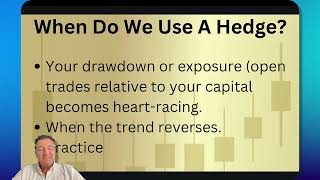
Right. So this video describes and explains what hedging is. So what is hedging? So hedging, it's a position one takes to balance one's overall exposure to the market. I. E. If you have many long positions, you can take one or multiple short positions or trades, hedge trades to balance your overall buy positions. So you take you place. Maybe the robot or you yourself have traded and you've placed multiple buy trades. You were dollar cost averaging, hoping that the price would maybe reverse. If it was on a downtrend, you'd be placing bar trades. That's dollar cost averaging. If you if the price is going up, then the robot or yourself could be placing sell trades, dollar cost averaging and hoping for the reversal with equal lot sizes, for example. So there you have it. We can say we've placed a sell of one lot and a buy of one lot. That means you're 100% hedged. So in this example over here, where you've got let's say 10 buy trades and you with one lot each equals 10 lots of bar trades. And then you've got sell trades, five sell trades, or multiple sell trades equaling five lots. So those are possibly your hedge trades. And you haven't, you're not 100% hedged. As you can see there, you're 50% hedged. So you're five lots net long. So in this example, if you've got 10 lots below buys in 10 lot cells, you're a hundred percent hedge and your net lots is equals to zero, which is basically the same as the slide over here where you've got one and one. Basically it's, it's your net lots is equals to zero. So I've got an awesome tool that it comes standard with MetaTrader 4. You can load it onto any chart, including the chart that has a robot running on it. If you just click on the navigator window and you scroll down to the indicator that says eye exposure, you can just double click it or right click it and say add to chart and then it'll come up with some variables. I like to change my color to white because I can see see the writing clearer on my chart. And in this example below, it says there that I have six deals. I've got buy lots of 0.04 and sell lots of 0.02. So I'm not 100% hedged and I have net lots of 0.02, which means that I am net long by 0.02 as you can see over here. Okay, so my buy lots are more than my sell lots. So I'm net long 0.02. I've got more bars than sells. So being hedged is a positive and you can take advantage of the hedge and there are various different mechanisms that you can take advantage of the hedge. So what are the advantages of being hedged? So one is to control your drawdown. Two is never no more blown accounts, you can never blow your account ever again once you're hedged and you and you use that hedge correctly to then get out of your hedge position. And three, you can take advantage of the trend if you know how to, if you know how to read a chart, which I explained to you on my Learn to Read a Forex chart website site. And the other advantage is you can exponentially grow your account if you understand what hedging is and how to use the hedge. So what are the disadvantages of hedges? I don't know of any disadvantages. I just find that being hedged has an advantage. And just if you don't know this, the banks and the institutions use hedging and that is why they called hedge fund managers. So when do we use a hedge? So you use a hedge when your drawdown or exposure that you open trades relative to your capital becomes heart racing. So when you feel a little bit of a heart palpitation and you're uncomfortable with your drawdown, whatever level that is for you, maybe it's 5%, maybe 10%, maybe 20, 30%, you know risk is in the eye of the beholder. So whenever you're feeling uncomfortable, then that would be a good time for you to hedge your account. And you can also hedge when the trend reverses. So let's say the price is going up and you've got sell positions, a couple of sell positions. When you feel that the price has reversed, you can then place a hedge trade, a buy trade in equal lots, the same as what your sell trades are, and then ride the trend north until the price reverses again, going south. And then you can close out your hedge again. This is all explained to me to you on my Learn to Read a Forex chart course, which you can go through in detail. And then you need to practice this. So why is it necessary to understand how and when to implement a hedge? So if you understand the concept of hedge trading and hedges, you can use it to your advantage equally. If you don't understand what a hedge is, then you cannot use it to your advantage and it will become a disadvantage. So hedging is an integral mechanism that the EA uses or you can use manually to protect your funds in times of market volatility. So when the trend is, when the trend is really like, or the chart is really cooking and the candles are large and the price is moving away from your trades against your open positions, then you would be a good, good time to start hedging and start understanding what the hedge is. So hedging can offer an opportunity to generate greater than average profits. So that is how I grow my account and that is how the hedge fund managers of the world grow their accounts, thinking clearly and acting precisely. So why practicing and simulating is critical. So it's very important for you to start practicing the hedge trading and getting out of a hedge before you actually get hedged. Because when your account gets hedged, your emotions are running high. And when your emotions run high, you don't make logical decisions. If you have traded before, you're usually going to use your old methodologies to trade and try and get out of the hedge. And most people, when they use that old methodology, they usually lose money. Now, experienced traders have got a mechanism that we use and a strategy that we use so as to safely get out of a hedge and not blow our accounts. Now, you can only know and understand this once you start practicing and once you start going through this process and learn from practical experience exactly how to do that. And that's what we're going to help you with in the next couple of slides. So in the next couple of videos, I'm going to show you exactly how to hedge your account and how to start stripping away that hedge. And we're going to do some practical examples with you, and you're going to follow along and you're going to do exactly what I'm going to be doing that we can start getting your emotions under control and start teaching you exactly how to hedge. So if you want to learn how to use a hedging situation to your advantage, I highly recommend that you take my course on learn to read forex chart.com you can go there and go and pay for the course and go and start learning how to take advantage of the hedge and how to make profit from the hedge. So with these practical examples that we're going to be doing shortly is how to strip the trade and how to get out of the trade safely, but you're not going to make profit from your hedge. You're just going to learn how to get out of the hedge. So practice makes perfect. And I want you to please follow along in the next videos and do exactly what I'm doing so that you can learn get your emotions under control, understand what hedging is, and understand what is going to happen to to your account when you get hedged. And please note that hedging is not an if. It is an absolute 100% certainty that you are going to get hedged. And again, hedging is a good thing. It is not a bad thing. And most people treat it as a bad thing because they don't know how to use the hedge and they don't know how to get out of the hedge. So let's get started. Let's start practicing. I know that you're going to love this process and I'll see you on my next videos.
More from Alan



Double bottom forming - Gold ready for $4000 #trading #technicalanalysis #xauusd