May 20th Zoom 2
Alan Solarsh walks through the stripper tool that partially closes trades to free margin and reduce drawdown. He explains the macro case for gold rising toward $8,000 before falling, why institutions are long, and why traders should hedge rather than short. Stripping should happen gradually, taking 25-50% of profits at a time.
Chapters
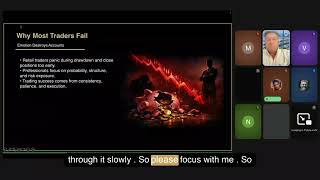
So the purpose of today is to explain to you what the robot does and why it does it. If you haven't realized, the best strategy in investing is called dollar cost averaging. And the reason it is the best— sorry, the reason it's the best is because nobody can time the market. We all think that we can read the chart and we hope that we can read the charts and we pray that we can read the chart. And we think that we've got a great strategy. So we all hope that we can time the market, but we can't. So there hasn't been an investor ever that has been able to predict the market 3 years in a row. So usually when they get it right the second time, it's usually fluke. And unfortunately, that's just the way it is. And that's why dollar cost averaging is such a powerful strategy. Okay, so dollar cost averaging means consistently investing and scaling into opportunities over time. Professional traders focus on long-term capital growth instead of emotional decisions. DCA helps lower average entry prices while positioning for reversals. So it's a lot of words, so what I'm going to do is I'm going to go to my phone and explain it to you easier. I think my next slide actually does that, so let me go on to the next slide. Uh, let me see if I've got it here. Right, so here's how DCA works, okay? So you scale into the opportunity, okay? So as you can see where the— can you guys see my slide? I hope— my mouse— I hope you can. So this is where you place your first trade, and then if the price goes against— right, place your second trade, and so on and so forth until the price reverses. And then when it reverses, all your trades go into a profit. So in a downtrend, we scale in with small positions as price moves against us. Each additional trade improves our average price. So what happens with normal institutions is they tell you to invest X amount of money on a monthly basis. And that's what you're supposed to do. So every month you've got your debit order, and you pay, and then they take that money and they invest in different instruments. Let's say they just invest in one instrument. And sometimes that instrument just goes down. They're not— the institutions are also not interested in trying to time the market by just wanting to invest your money. Because they know over time the investments that they've chosen are blue-chip investments, and the probability of those investments going up over time is high. And that's why we trade gold, because I believe, and I think everybody on this group here believes, that gold is a storage of value. And over time the price of gold is going to increase. So it's a good idea to be dollar-cost averaging. Now with us, you know, we've got finite amount, a finite amount of capital. So when you're investing, you're going to draw down. And this is where what the difference is and the disconnect is between us you guys as investors, most of you, and normal investors. So I'll give you a, a scenario. So imagine you were investing with an institution and you invested your lump sum and then you never invested again. And what happened was, is that when you invested right up here at the high, and then maybe you invested a couple of more times, and then you stopped investing, and the price still continued to go down. What would your investment look like? You'd also be in what in our environment we call a drawdown, or in their terms, your investment will be in a losing position. And this is why you pay a debit order. So imagine you had $1,000 and you invested, and every month you invest, and every month you're trading, but every month you're— every month you're trading but you're not investing. So your drawdown gets higher. So your drawdown is going to keep on getting bigger and bigger as a percentage of your capital. So let's say you were at a 50% drawdown. Your drawdown is 50% and you don't invest more money. Your drawdown is just going to get bigger and bigger. Now, if you were investing money on a monthly basis, your drawdown would not be 50% anymore. So let's say this 50% drawdown happened over a 12-month period, and every month you put in $100. That means over the period of time that you invested, from the time that you initially invested your $1,000, you would have now invested $1,200. So your capital now is $2,200. Are you with me? I can't, I can't see if— okay, cool. So if that's the case, then your 50% drawdown on $1,000, which is $500, is not 50% anymore on $2,200. It's about 30%. But that's only investing $100. If you invested $200, then your drawdown will be 15%. Do you understand where I'm going with this? The $1,000 or $2,000 that I say to you guys That's what it takes for you to get started. And that's normally the amount of money that my guys use to start making profits, where they start making between 7% and 11% profit. That was true until we had an $1,100 drop in price. I think it's more. So what was it at? $5,500. It's not $4,500. So yeah, it went to about $1,100. $1,500 drop, which is unprecedented. Was a crash in gold. It's more than 15%. It's considered a crash. So we know that gold hasn't been behaving the way it's supposed to behave. And unfortunately, that is part of investing. Nobody can predict these things. And this is why the institution make you sign a debit order. Otherwise, they won't let you invest with them. You have to be investing on a monthly basis. You can invest with other institutions like EasyEquities or eToro or these private platforms where you can invest what you want, but you're missing the big picture if you do it that way, if you don't invest on a monthly basis. So why most traders fail is because they trade emotionally and that destroys accounts. So retail traders panic during drawdown and close positions too early. Who's done that? Be honest. We all have to be honest, okay? Professionals focus on probability, structure, and risk exposure. And this is why I constantly tell you guys to be very risk-averse. Stop worrying about the profit so much. Start worrying about how to understand, how to read a chart, understand dollar cost averaging, and start investing like a professional where you're investing money on a monthly basis. Trading success comes from consistency, patience, and execution. This is a long-term strategy. This is not a short-term strategy. I know some of you want immediate gratification and you used to have immediate gratification, but unfortunately, like business, trading comes in waves. We have good times, we have bad times, we have mediocre times. And when we are— my brother always said, when it's the good times, you need to prepare for the bad times. You need to save as much as you can for the bad times because they're coming. And you need to be investing your money every single month. Okay. And it's not like you don't have the money to invest. I think what's happened is that a lot of you are scared because for a number of reasons, you're scared because You're not 100% sure what the robot does, but you actually do because you've seen a trade. Dollar cost averaging is not randomly opening up trades. The robot doesn't do that. The robot has a very specific strategy. Sometimes the strategy is faster than other times, but the strategy is consistent if you follow it, if you understand it. And if you stop changing the strategy all the time. So I think a lot of you are opening up the inputs and trying different things because nothing's working. Who's doing that? Put up your hand. Okay, so thank you for your honesty. So this is because you don't understand, number one, dollar cost averaging. And you don't understand investing, and you don't understand the strategy of the robot. And that's what I want to try and clear up for you guys to make your lives a little bit easier. So I know the slide is very busy and we're going to go through it slowly, so please focus with me. So the power of compounding— small deposits becomes massive wealth over time. Compound interest, according to Mr. Einstein, is the 8th wonder of the world. The earlier you start, the more life-changing the results. But the challenge is that you guys aren't doing it. You're not playing the long game. You're playing the short game. You're wanting immediate gratification and immediate results. And I, I get it. Sometimes that's how it is. Sometimes you don't have that spare capital. But then you can't be complaining because that's not how investing works. And I think you know that. I think we all mature enough to understand that. So exponential growth is an institutional approach, and it is— time is your greatest asset. So the longer you in the investment, the more compounding effect that you have. So small consistent deposits grow exponentially over time through the power of compounding. Institutions and hedge funds use compounding, discipline, and time to build generational wealth. And that's what I want to do with you guys. I want to do and build generational wealth. But you can't do that if you have high risk appetites. You can't be like grinding the robot on a risk of M of 3 and 5 and 1 and also 0.03 and 0.05 and then 1 and then 3. And then your drawdown gets out of hand and then you change your multiplier for your hedge to double or by 25%. And then the trade goes against you and now your hedge is bigger than your open lots, and you then have to open more buy trades to counter the hedge. So you're re-hedging the hedge and closing the hedge at the wrong time, and you're just getting more and more into trouble. Who's doing that? Be honest so I can help you, because I've also done it and I understand it. So I'm empathetic to your plight because I get it. I mean, this is Warren Buffett. Warren Buffett started with $100 on the stock market and he only made his money when he was like 60. It took him like years and years, like 30 years of investing before he had that exponential growth. So the power of compounding. Compound interest again is the 8th wonder of the world. He who understands it earns it. He who doesn't pays it. So you can either use the interest to work for you, or you can get credit cards and debt, and you can buy toys on credit, and then interest works against you. So here are the math— here's the math for you. At 10%, $100 deposited, monthly returns, okay, 51%. That's how it is. If you do it properly. So my strategy, I'm sure you know, relies on the 8 exponential moving average. Candlestick analysis is a 400-year-old strategy developed by a Japanese rice trader. He was the most successful rice trader, or trader, of all time. He developed these candlesticks, and there's so much data in this candle. It's not like a line chart or that little bar with the, the, the line to the left and the line to the right. It's the same as a candle, but it's slightly different. Okay, there's data in here, and you can start predicting when you start understanding 2 and 3 and 4 candles in a row next to each other. You can start predicting the move. So it's like having a looking glass into the future, and that's how I see it. So my strategy, it identifies momentum and trend continuation. The 8 EMA acts as dynamic support and resistance, showing the strength and direction of the trend. Entries with confirmation: we enter only when the second candle opens above or below the 8 EMA, confirming momentum. If you follow my strategy over a long period of time, you will, you'll see that my strategy works. Some of you have been with me for years. It's very seldom that my strategy fails. Again, I'm not— I cannot predict it 100%, but I think I've got it down to about 85%. I'm not asking for Don't put your hand up if you don't think it's true, but those of you who are following my strategy, can you agree with that number? That the strategy works about 85% of the time. I use it in conjunction with that moving average. It's a proven technical indicator used by institutions worldwide for decades. Not the 8 exponential moving average, that's my moving average. Which I found over many months and years of testing, that was the, the, the moving average that is consistently touched and then reversed, especially on the 4-hour chart, but it works on all timeframes. The moving averages on the charts that you guys use, which is The 34, the 50, the 100, the 200— those are the institutional, the moving averages that the institutions use. It's not something that I just baked up. That's what the institutions use. I was trained by an institutional trader and he showed me the desk, the trading desk of what the institutions were using. Why it works. Again, follow the trend. You trade in the direction of momentum. It's high profitability— probability confirmation reduces false entries. Simple and effective. Like, I don't have to draw lines, I don't have to use like lots of indicators. It's simple and easy to learn, and it's the institutional approach. Used by banks and hedge funds with disciplined risk management. So the trend— you understand how the trend is identified, so I'm not going to go through this again. I think we all get the picture. Do you all understand my strategy? Who doesn't understand my strategy? Is there anybody here that is confused with my strategy?
Alan, it's Greg here.
Hello, Greg.
Hi, it's not so much confused with the strategy, it's just what I've noticed. When you say DCA and uptrend, I don't notice that. I notice it places buys on a downtrend. Exactly, when the price is retracing. So that's, you know, that's how I got into having huge hedges, because it was placing trades as the price plummeted. And then I end up at the bottom with a whole bunch of buys.
Yeah, that's what dollar cost averaging does. Okay, now averaging, you're buying, you, you're entering trades at various different intervals, doesn't matter what the price is. Okay, the reason we're buying with gold is because the price— it's a storage of value. Can we agree on that? So do you believe that the price is going to go up?
Yes, I do. A lot indicates that way, but at the moment, we're like you say, the world events and what's going on.
Doesn't matter what the moment is. We need to look at this long term. Okay, so this is the conversation. This is where everybody's stuck. It doesn't matter. Let the prices down. If you want to reduce your drawdown, deposit money into your account. Bottom line. And I've always said that to you guys. You guys need to be investing on a monthly basis. If you go back to the training, one of my first videos, it says there, the $1,000 is proof of concept. You need to be investing money on a monthly basis. You need— you, everybody, you guys start to need to start looking at this as a proper investment. If you're investing like a professional investor and you're putting your money in at different intervals as the price is dropping, that's the clever way of doing it. Okay, imagine you do that and the price— so you put in trades, 5,000, Yeah, they stacked. I understand that. Okay, like, I get it. So they stacked and they're all close together. In the grand scheme of things, it's not the way that an institution would do it. They would do it on a monthly basis, one trade. If the price goes up, price comes down, maybe $100, $10, $50, they place another trade. That's not how we do it, because with gold, there's usually an average true range. But that anomaly has been changed. Because of the war and various other factors. So we just have to roll with the punches. And how you do that is that you invest money on a monthly basis to reduce your drawdown and carry on trading. When you're ready, you can unmute yourself.
Alan, how are you, man?
Yes, okay, and you? Good, good, Alan.
This Krishna here. Alan, what I see here, uh, dollar cost averaging— will you be able to do the video only on Section 5? How to set it up.
That's a different presentation. I just wanted to get through this and then we'll talk about that. Okay.
And then one more thing, Alan, when it's— there is a downtrend, the sell trades as well, we are a bit confused how to activate that sell trades as well when it's—
there is a downtrend. Why do you want to activate the sell trades? This is what I don't understand.
Can I chip in there, Alan?
Sure.
Greg again.
I did activate the sell trades and slowly but surely my actual account balance has been increasing. And with the lowering of the gold price, the drawdown has been, let's just say, up and down. But the balance of the account has been increasing because it's been able to take some sell trades on the way down.
Can I— let me ask some questions here, and I want you to be honest with me. Gold is a storage of value. Yes.
Yes.
The institutions are long in gold. Yes or no? Yes. Unmute yourself, Greg and Krish.
Yes.
Okay.
Yes. Okay. We can't time the market, right?
Yes.
But the institutions are long, so by you having sell trades, do you not think that you're trading against the institutions?
I, I don't— it's not about trading against the institution, it's about trading with the trend for the moment.
Okay, if you're comfortable doing that, that's fine.
Yeah, I've got the DCA trades are happening there, they've happened, so I now have to wait for the price to raise.
I understand that. So, okay, so for me, not judging you, okay, for me it's gambling. I feel that— I told you, you can unmute yourself, but this is an open forum, bro. For me, this is— it's gambling, and I feel that you are trading against what the institutions are doing. The institutions are there to trap you and to take your money. You must remember that this is a zero-sum game. So they are just lowering the price to the level that they want it, and then they're going to shoot it north. And by you placing buy trades, you're going to get stuck with buy trades. I talk about me, I would get stuck with buy trades. And then you're in the same position.
You mean sell trades?
I mean sell trades. You can be stuck with sell trades because you cannot time the market. You don't know when it's going to go north, and the institutions are telling you that they are north. Yeah, doesn't matter what the trend is. You've got to look at this holistically. You've got to look at the data, and you've got to look at the other things around us.
Okay, but then I'm going to ask you, what's the purpose of the high frequency trader?
The high-frequency trader is— it's placed lots— I'll, I'm going to show you, okay, places lots of trades, and when it reverses, it doesn't have to go up a hell of a lot for that whole sequence to go into profit, and then the sequence closes. I'm not an advocate of the HFT. I don't promote it. Martin is the one that's testing it, and he's trying it out, and he's checking it. No one's promoting it. No one ever said use the HFT preset. I've told you guys, for the moment, use very conservative lot sizes, probably on training wheels while this thing is going down until it reverses, until we've established that we're again in a bull trend.
Alan, just an observation or a comment is, if we in it for the long game and we DCA, we should never close a trade.
I agree.
I mean, that— so, you know, the fact that we are taking profits as with, you know, with in intervals defeats the object of DCA.
Correct. But you guys also want to be making money at the same time. That's why you can open 4 charts. So one of them— or 5 charts— 4 of them are your scalping and making money on a monthly basis, and then the 5th chart was your real blue banner DCA trading.
Okay, no, I'm with you and I understand that. And I think the question is then, uh, how— and I I understand exactly what Greg is saying, is that there is an opportunity to make some money when the, the ATMA, whether it's on the 4-hour chart, the 1-hour chart, whatever chart you, you're looking at, there's an opportunity to make money with sell trades to keep the, the money going or the profits going. Although Yes, you are trading against the institutions, but you will not do that with your— in your blue banner setup, you will never have a sell trade. But in your profit-generating chart, you might have a sell trade because for now the trend is down.
I'm going to go through the strategy just now to help you guys to start making money in the situation that we're in. So the hedge is there to protect your account from getting into trouble. The hedge is not there for you guys to make money. It's there to protect you, especially if POT is long and we don't know when they're going to change direction. And if you have a hard drawdown, you can certainly make money with the hedge if you have a low drawdown and let's say you get hedged when the second candle opens below the ATM and your drawdown is like 2%. 100% make money from it. But then when you remove the hedge, make sure that you don't have a ton of trades that when you remove the hedge, your drawdown spikes to 60% and then your equity protector kicks in. Or another hedge kicks in, because that defeats the purpose. Rather, when the second candle opens above the ATMA, and maybe when the price pulls back by 50%, close the hedge. Or when the third candle opens above the ATMA, close the hedge. And you know that when you close the hedge, your drawdown doesn't spike. Do you guys understand what I've just explained there? Everybody— does anybody not understand it? So the whole point of this is to contain your drawdown, to protect your account from blowing. It's to protect you from yourselves. And it's so hard for me to see you guys struggle because you've removed the hedge at the wrong time because you thought you understood how to read a chart. You think your strategy works, or for whatever reason, and then you rack up a drawdown, you remove the hedge, price goes south, your drawdown increases, you've got to re-hedge, you've now running out of equity, you can't plow in more money, the price, then it's still going down, but you think it's on a support level. You remove the hedge again and then you bank the money. You don't close out other trades and you're hoping that the price goes up. And then all of a sudden the price tanks again and now you're out of equity and you blow your account. We can't predict what the institutions are going to do. Rather remain hedged. I know it's hard, okay? I know that it's tough to do that where you've got this massive blue trade blinking at you on a daily basis in blue, just smiling at you, saying, 'Come on, the profits, I want it!' I get it. But if you do, it's a trap. You're gonna trap yourselves. I guarantee you there's maybe one person on this group if that, that has actually made money properly with their hedge? Can anybody put their hand up to say that they've done that? Just one person would be nice. The silence is deafening. That's a lesson for everybody. The hedge is not there to be toyed with. It's not there to make money from. It's there to protect you. Stop using it as a tool to try and make money from it. You can make money from it in an uptrend, not in a downtrend, especially not when we've dropped $1,100 in gold. And even then, just put a stop loss in. A stop loss where you make a couple of dollars and that's it. You carry on trading with the trend again north because gold is a storage of value. You can do the hedge trade and you can make money from the hedge trade on other instruments, but with gold it's tough because it's always going to go north, right? So you need to think the institutional mindset. You need to think like An investor, but trade like a professional. Successful traders think long term, protect their capital, and let the power of compounding and probability do the heavy lifting. The trader mindset: short term, emotional, reactive. Institutional mindset: long term, disciplined, strategic, with rules. Money rules, emotional rules, trading rules. So money rules: I'm only prepared to invest X amount. Emotional rules: don't trade when you're emotional, or understand your emotions so as to let it benefit you. And trading rules, that's your strategy of when to open trades and when to close trades. So most retail traders that lose money, they chase entries, they focus on the profit and loss— that's the screen that shows your numbers— instead of looking at the chart. I never look at my numbers. I know from looking at the chart what my numbers are. I know exactly what my numbers are. I don't have to do that. I'm not interested in the profit and loss. I know that if I watch the chart and if I trade the chart and trade the trend, I know that my equity and my P&L is going to be positive. They close trades too early. You overtrade. That means removing the hedge at the wrong time, placing a new hedge irresponsibly, placing trades at the wrong times, increasing your lot sizes. Okay, and that leads to blown accounts. The long-term trader has a plan and they execute it. They focus on process, they let the winners run, they manage risk, and they compound wealth. 3 pillars of long-term growth. Treat your account like an investment vehicle. You're not here to get rich overnight, you're here to build wealth over time. Consistency with intensity. So the short term is an emotional roller coaster, the long term is wealth compounder. That's how you need to think. Stop worrying about it. Invest more money, get your drawdown under control. If you can't get your drawdown under control and you can't invest money, relax. I have a strategy for you. It's coming. Okay. Two, discipline and capital preservation come before profits. Protect your capital first. You've heard me say this time and time again. Small losses are part of the game. Sometimes you're going to lose a little bit of money. Sometimes you're going to have to use the Trade Stripper to start stripping trades to get get rid of some of the trades that are first in, okay, and that is going to reduce your drawdown. I'm going to teach you how to do that this evening. Surviving allows you to compound, not greed, not chasing profits, okay? Slow, strategic, with a plan. Strategy equals plan. Protect capital, follow your plan, time in the market equals long-term wealth. The first rule of compounding: don't interrupt it. The first rule of making money: don't lose money. DCA and hedging create sustainable growth. DCA builds positions with low risk. Low risk, guys. Low risk. Not big lot sizes. That calculator that I created for you is there for a reason. I've been doing this for 13, 14 years. I'm a bit— but I have a bit of experience. And those lot sizes and that lot size calculator is there to protect you from yourselves, and it's there to help you to have long-term wealth and sustainability. DCA builds positions with low risk, hedging manages drawdown. Together they create consistency and exponentially grow your accounts. So it all sounds very good, but unfortunately we're all emotional beings and we now need to understand that and start using it as a tool rather than to your disadvantage. If you know that you're an emotional person— I'm an emotional person, very emotional, okay? That's why I have trading rules, because I have to save myself from FOMO, from my own greed. You're not alone. You're not doing this like— don't think that you're alone here, that you're the only one that has these challenges. We all have these challenges. I've been in this game for 14 years. I still grapple with it daily. Okay, I also want to trade. I also want to make money. I also want to make the 7 to 10% to 15% per month like we did last year. Some of us made 30%, some of us made 40% per month. So dollar cost, DCA, dollar cost averaging, layer in with small lots to compound your average. Hedging, control risk and protect your capital, balance exposure, contains drawdown. Now imagine if you had listened and you, when you got hedged, okay, wouldn't it have been a good idea if you had left your hedge and not removed your hedge and your account would be like having maybe a 20% drawdown. Wouldn't that be a better situation? Yes. No. I'm also hedged. I'm also 100% hedged. Thank you. Now, Krishna, one second. I've got a 20% drawdown. Okay, and I'm hedged. I'm hedged right at the bottom. It went into profit today. I was dying to remove it. And yes, the price went up. So this is the hard part. Shit, I should have closed it. I don't have that. I don't have that FOMO anymore. Because I know that the price is still going to come down. This is not over, okay? And then when it does come down, I promise you it's going to come down all the way down here to 4,300. I'm going to hedge again and my drawdown is going to be 35-40%. I'm going to be in a very bad position then. I don't want to be in that position. And this is my live account. My live account, not a demo account. Okay, this account is large and I've only got readability on this account because I don't want to pocket trade. I don't want to, you know, accidentally open or close trades on this account. So I'm hedged, robot's not trading, I'm waiting. It's frustrating. I also have expenses, large expenses. So the results of compounding equals freedom. Protect capital, stay in the game. Compound consistently, small gains add up. Grow exponentially, let time and compounding do the work. Financial freedom, life— live life on your terms. If you are conservative, If you control your emotions, if you have rules, rules, emotional trading, and I forgot the last one, I'll think of it just now. Okay, thinking years, not trades. The institutions don't chase trades, they execute a plan, manage risk and net probability, make them rich. Adopt the mindset, change your future. Okay, let's go here. So the final message, guys, okay? Wealth is built through discipline. Do today what most people refuse to do. The gap between where you are and where you want to be is found in your daily habits. Consistency and patience outperform emotional trading. Small, consistent actions repeated over time create extraordinary results. Strategic DCA and hedging can transform, can transform your financial future, control risk, reduce drawdowns, and allow your account to grow exponentially. Financial freedom: live life on your own terms. Financial security: build lasting wealth. Consistent growth: let compounding work. Discipline, follow your plan, start today, small steps matter. And the gold, the golden rainbow is right there in front of you. And it is a mountain to climb, but it is climbable. So I want to go on to the strategy, but I think I want to take some questions first if anybody doesn't understand what I've just explained. I don't want to talk about inputs. I don't want to talk about settings or strategy. I just want to answer some questions about my 8 exponential moving average strategy and dollar cost averaging and what this whole presentation was about. Are there any questions? Cool.
Hi, Alan Solarsh.
Yes, I got hedged at 4100.
It's been a while sitting there, and then I was stripping the trade slowly. Now, uh, do I need to change any settings to hedge again? What—
how it works?
That's it.
I'm going to explain that in my strategy now. Okay, okay, cool. Right, so, uh, what's happening here? Cool. It's gonna close out all my trades and show you a strategy. This robot, I've got two, I've got two charts running. And they run very fast. Okay, please mute yourself. Uh, yeah, okay, so I just want to switch off my hedge because I was testing something. You can see how fast it is. Okay, um, here's a strategy for you guys, okay? Very simple strategy. Take notes, take screenshots. I'm not saying that this is what you should do. I'm saying it is, it is one of the strategies. What a lot of you are doing is you're doing lots of different strategies without really understanding what's happening in the markets. You're trying different things all the time. And I think everybody needs to go back to basics. And this is the basics. Your lot sizes needs to be small, either on risk of 0.01. You can do risk of 0.01 now, Fritz. That's fixed. So when I open it, it'll default to a 0.01. I think my start lots is false. Let me just check. Okay, there it is, 0.01. Okay, so if you put in a multiple bigger than what it's supposed to be, it'll default to the smallest lot, which is 0.01. Okay, so if you have no capital to invest and you can't lower your drawdown, then you need to start with a 0.01 lot size. Very simple. And then you need to start chipping away at those lot sizes. So what I would do is I would start on the smallest lot size of 0.01. Go and use your calculator or manual lot size.
The—
I'm going to actually load the training wheels here. Because it'll be easier for everybody to understand, and it's there for you. Your distance between trades is worked out for you. Leave it alone. If the distance between trades is too close, increase this number here. This will increase the distance between each trade that opens. Especially if you're in a downtrend. You can open— so when the second candle opens above the ATM and you want to carry on DCA trading, maybe increase this number to have less trades opening. So I get it that you want to DCA and you want to make money, but we're in a downtrend. Is it clever to be opening up large lot sizes at this stage if you don't have money to inject? Is that a clever idea? So we got to be strategic here. We can't be greedy. You guys can't be greedy with this. You got to, like, learn to contain it. This is a tool. The tool will work for you. It'll work against you. The tool doesn't— some of you think the tool doesn't work and it's broken. It's not broken. The tool works. You need to figure out the strategy that's going to work for you. There's lots of strategies built into the robot to help you. You need to figure it out. So if you don't want— if you want the, the space between distances to increase when the second candle opens below the ATMA, then, then increase it. I can't add more like inputs in here because I add inputs and then it confuses people. So the more inputs I add here, the more confusion a lot of the traders have. So somebody will say to me, why don't you add a new input here that when the second candle opens below the ATMA, let's increase the trade distances? I've got a better strategy for you and I'll show it to you instead of doing that, okay? So pause DCA trading. Some of you don't want to pause DCA trading, and that's fine. So you don't have to pause DCA trading. So we'll set it to false. Pause DCA trading when the second candle opens below the ATM on a 4-hour chart. I would definitely put that on true. I would definitely not switch that off. When the second candle opens below the ATM on a 4-hour chart, we are south. You're just going to incur more drawdown Okay, and you're going to be in— have pain if you don't have capital to inject, then pause. Is that not the obvious thing to do, guys? So this is where— this is where discipline comes in. I never said this was going to be easy. I said this was simple. The easy and hard part is here. It's the 6 inches between your ears where you have to grapple with your emotions and FOMO because you want to make money. And I get it, I really do. But when the second candle opens below the 8 exponential moving average on the 4-hour chart, pause the robots. It's a good time to take a breather anyway. Take a breather, move away from the chart, okay? Have a break. When the second candle opens above the ATM EMA again, you can start trading. Hard pause when the price is at the 200 moving average. Absolutely, that is where the institutions are going to trap you. It's a red line for a reason. It's a red line because the institutions can go either way and we don't know what way it is. So rather pause, take a breather. Hard pause at the, at, uh, all-time high. We know we're near the all-time high, but definitely pause at the all-time high because the chances of it reversing at the all- time high are very hard. It's a high probability because we're at a resistance level. We don't know if it's going to break through. Rather, you can pause or you can reduce your lots at all-time high. We'll get to it. Okay, reduce lots at time. I would definitely do that on a Friday. I would set Fridays to true from about 12 o'clock. Who's experienced chaos on Fridays? Put your hands up. It's crap. So reduce your lots. You guys have got to start being conservative. You've got to start learning from the past because history repeats itself. If you're not learning and you're not implementing from the errors of our ways, I reckon you're going to come back to earth. You're not going to move up the ladder. Here's the kicker, okay? Reduce lots on doji, true. Reduce lots at MA reversal, absolutely. Okay, so when the second candle opens below the ATMA on a 1-minute chart, let it reduce lots to a manual lots of 0.01. If you're not on 0.01, I'm talking about, okay, if you're on 0.01, then you need to be focusing on the pause strategies when the second candle opens below the ATMA in a 1-minute chart. Maybe pause, maybe only do scalping. Okay, so I don't have money, can't invest, what's my strategy? Okay, let's go back. I don't have money, I got high drawdown, don't have much capital in my account to equity, and I can't invest money into the robot. What's my strategy? It's Who wants that strategy? I think that's where we need to focus on. Okay, right, cool. Okay, so there's one person here on this group that I agree can't invest money. The rest of you are shitting yourselves. Who agrees with that statement? Okay, so toughen up, grow a set of balls, and start investing some money here because the robot does work. What's not working is you guys. Let's be honest. Can we be honest with each other? Everybody can put money into their accounts. If you want to make money and you want to treat this as a proper investment, then pull yourselves towards yourselves, start investing money, okay, and start trading properly like professionals, because that's the only way this is going to happen. Again, there is only one person on this group that literally cannot invest money. So if you don't have a job or you don't, or, or you're above 65 or 70 and you literally don't have an income. Okay. And you're— you've invested this as your last resort and you don't have any other ways to fund your account. I understand. But that is only one person on this group that I know of. That is in that situation. The rest of you, you've got income, you're working, you just packing yourselves through you because you've lost— I don't know, you don't trust yourselves. I don't think it's even I don't trust the bots. It's I don't trust myself. Can we agree on that point or not? Am I talking out of my ass? Some of you agree, some of you don't. Okay, cool. So here's the strategy that I would do. When the second candle opens below the ATMA, I would pause DCA trading. When the second candle opens above the ATMA on a 2-minute chart, okay, DCA trading resumes. That's it. So let's do that. Let's close out all these trades. And let's do that, let's—
Hi Alan Solarsh, what post function was that? Was that the hard post one?
No.
Was it the top one?
Give me a second. So this is no cache, C1. Cool. Okay, okay. And then, Load. No cache. So this is 3 or 3, 3 or 4. Save. No cache. C2. Oh. So what are my lot sizes? Shit, man, why is it opening a lot size so large? It doesn't make sense. And what is it? It is 1 and— are those not replacement trades? 3, they're short 3, short 3 properties. What's my lot size here? 0.01. Confused. Okay, cool. Okay, uh, let's go. So 2 minutes, let's just open up a 2-minute chart. Okay, so that you can understand why it has paused. Candles, consecutive candles or below the 8 EMA in a 2-minute chart? Can it open trades, people? Okay, you need to understand the strategy that you've chosen and be happy with the strategy. You can't choose a strategy, understand it, and then be pissed off that it's not making money. That would be, I don't know, craziness. Okay, unmute yourselves, let's have a conversation. Okay, so are you starting to understand the strategy that we, that we're choosing here? I can't see thumbs. Okay, cool. Okay, so let's go back. So we got no money to invest, we've got little equity, we've got to be conservative. We're doing MM of 0.01. If you're not comfortable with MM and you've got a huge account, then I would still use the Alan calculator and then still use MM. What's the reason for that? Why would I say that?
Well, as soon as your equity increases, the lot sizes will adapt.
Exactly, thank you.
You'll slowly making more money if you have money in your account.
100%, okay. So let's go here. You can limit your lot sizes if you want to. You can say maximum lot per trade equals, okay, and then it won't open more trades bigger than what it's supposed to. I'm not sure if it's going to open a trade if it's going to cap it at 9.99. I'm not 100% sure. I think it's just not going to open a trade. So that's it. That's a programming issue. It's not like a major thing. You guys don't use it, but if you start using it, you can let me know and you can say, please, can you just fix up the section here? And I'm using it. I wanted to open the maximum trades of 9.99 and it's not opening trades. I haven't tested it. Okay, so if I've got an echo, please check who's echoing and then please tell that person to mute. Okay, cool. Okay, so where were we? Activate scalping mode. Activate scalping mode.
True.
I want to pause on the 1-minute and I want to deactivate on the 2-minute. Okay, there we go. Because the second candle is open, probably above the 2 minutes. I've messed this up somewhere. That was a forced trade, Alan Solarsh. I wasn't— yeah. Oh no, it's a forced trade. Oh, okay, cool. Okay, so it's a forced trade because my forced trade is on in section 1. Okay. And what did it open at? At 0.01. Cool, we'll leave it. Okay, cool. So I just want to go back to my settings. Yeah, activate scalping mode, pause, pause on the 1-minute, deactivate on the 2-minute, right? Hard pause on the 2— on the 4-hour chart, 100%. Hard pause on the 200, 100%. Ignore reduced lots on a Friday, 100% reduced lots on a Friday. Okay, so let's do this. Okay. Pause on Friday. Okay. Reduce lots on a Friday at about 10:00. Cool. Okay. Deactivate reduce lots on— let's deactivate. Okay. Deactivate. At 23:59. So then on Monday morning, it can resume. Or if you're not comfortable, especially if there's been like a massive like dip on a Friday, then you need to come into this preset and you need to change that. And you need to keep— you need to have your reduced lots activated until Monday or Tuesday. Are we clear? Cool. Okay, I reduce lots of ATR, reduce lots of doji. Absolutely, 100%. So you can choose what time frame you want the doji to happen. I normally only like check the doji at— on a 4-hour chart. But if you don't have cash, maybe it's a good idea to put it on the 1-minute chart because you are trading on a 1-minute chart. Okay, manual lot sizes. No, we want to do it at M. Cool. Reduce lots at MA reversal, true. So when the second candle opens below the 8 exponential moving average on a 1-minute chart, okay, reduce your lot sizes. Sorry, Alan. Yes, sir. Can you just go back up a bit there and Okay, there where you put in your reduced, um, um, your reduced lot size, there at M, just go down a bit, go down, down, down. Okay, you see that 0.5, mustn't that be then 0.1? It's on M, brother. Okay, but it is on in. Yes, which is 0.01.
Okay.
Right, okay. I thought that maybe if you, if it change back to, if it, but where is it where you say that you put it, where it says manually that will, it will reduce manually? Say that again, Nick. So I think what Nicholas is saying is if you're not using money management, you're using manual lot sizes, then the 0.05. Okay, only if you use manual lot sizes.
Okay, yes.
If you read— all right, I understand. If you read the label, Nicholas, you'll see it says reduce risk manual lots doji. So that's only if you're using manual, not MM. Okay, all right. Okay, Alan Solarsh, I understand. No problem, brother. Okay, cool. So reduce lots at MA reversal 100%. You want to— you, if you want to do that, okay, if you want to reduce that drawdown, you can reduce that drawdown 1, you can reduce that drawdown 2, you can reduce that drawdown 3. All right, so as your drawdown increases, you can start reducing your lot sizes. So if you're not using a zero, let's say you're using a 0.01 M and you want to do it at drawdown, then you'll reduce 2 and 3 and 4. 2 will be 0.01, 3 will be— oh, it's at drawdown. So sorry, it's at drawdown. So drawdown, you'd reduce it to— also you can say manual or M, and if you're on a 0.01 on MA reversal, when your drawdown increases, you can say 0.01 over here on number 2, 0.01, and on number 3, 0.001. Are you understanding? Cool. Reduce lots, deactivation. So the deactivation, when the second candle opens above the ATMA on a 1-minute chart or a 2-minute chart, whatever you prefer. Okay, so not 100% sure if it'll deactivate. Okay, cool. So forced trade, buy, both forced trades. I'm not sure why it hasn't opened a trade yet. Let me just check out what I've done to my settings. Activate scalping mode, true. Second candle, 2 minutes. Oh, I know why. Who knows why it's not opening trades?
Buy limit?
Nope. Because you set your moving average to be above the 8 EMA on a 4-hour chart, correct?
Oh, I missed that.
So we've got PAUSE DCA trading. PAUSE 2 is active. PAUSE 2 is active. Isn't it?
That's right, yes.
It's only one candle above the ATMA on a 4-hour chart. You've got to— like, you can't have your cake and eat it, lick your fingers, steal the plate, steal the fork, steal the sugar and the salt, maybe the tablecloth. You want to, like, decide on a strategy and be comfortable with the strategy. It's fucking paused, Alan.
Is it not because of the 200 MA?
Is also right, nothing to do with it. The 200 moving average is miles away. It's because of the— this over here. If I deactivate this, trades will open. Just waiting, maybe the second candle is below in a 2-minute chart. I think you pressed the wrong one. I pushed the hard one, the hard stop. Hard pause, false. Uh, no, that one shouldn't— that one should be true. False and false, correct. Thank you. Okay, why is it not opening a trade? I just— 2-minute candle looks like That's what I'm thinking, that the 2-minute candle— oh yes, the 2-minute candle's open below, but we're still north. Maybe it's the doji that has stopped it. I think it could be a doji. Oh, there we go. Okay, it's open to trade finally. Okay, cool. Okay, because I know why. Start sequence immediately is false. That's why it had to wait for the new candle to open for a trade to open. Okay, so I don't want to set it again because it's just going to open up another trade. No, I'm going to leave that on and I'm going to force a trade. I'm going to say none. Okay, cool. Let's continue. Okay, can we continue? Are we all understanding where it went wrong?
Yes, sir.
Even I have to check the settings, understand what the hell— why isn't it opening a trade? It's not just you, it's me as well. And it's after 3 o'clock. I don't do well after 3 o'clock. I need to sleep. I shouldn't be trading after 3. You know that. I make mistakes. Okay, cool. So what have we got here? Okay, reduce lots, close positive trades on candle retracement. If you want lots of trades to open and close and bank profit, use this setting. I can't tell you what is a better strategy. If you use the setting, I think you're going to make less money. Why? Because every time the trade closes and a new trade opens, the trade gets open 53 cents above market price. So you've lost 53 cents of profit. Do you understand that part? Yeah, anybody not understand that? Okay, so I think you're shooting yourself in the foot by using the strategy. You can use it on another chart, but don't overtrade this. Okay, so close positive trades on candle retracement, set it to false. I think a trade because it closed because of Candle retracement. We're going to have a look and see why that trade closed. Close positives of candle retracement, which I've now switched off. Okay, cool. Um, close positives on candle retracement, false. Close positive trades on MA flip, 100%. Bank your profits. Okay, close when the second candle opens below the ATM on a 1-minute chart, and then when the 1-minute— when the candle opens second candle opens below the ATM on a 1-minute chart, the robot's going to pause anyway, and then no trades are going to open. Be comfortable with that. This is not the time to be risky and gung-ho. You've chosen a strategy, stick to it. Stop double and second-guessing yourselves. Be comfortable with the strategy, okay? Pause on doji, true. Okay, um, no, we don't need that. Okay, so you want to remove take profits? Yes. Don't want to take profits? Okay. If you want daily profits, then have one trade, one chart, same setup, trading with remove profits. Remove, remove take profits, and the other one with don't remove take profits. So it's got take profits. That way you're making money on a daily basis. So the way we had it previously, if you can remember, we had two charts that were scalping that had the setting of remove take profits and two charts that didn't have remove take profits. That way you were making money on a daily basis. Do you remember that? Cool. So go back to that. Have your 4 charts. 2 have take profits, 2 don't have take profits. So you're riding the wave. Okay, so yes, question? No question. Cool. Okay, so, Alan, here again.
Greg, I don't understand that section at all.
Okay, cool.
So those 4 phrases, I just don't get them at all.
Remove take profits. True.
Does that mean we're going to take a profit or we're not going to take a profit?
It's not going to use the profit-taking strategy. Okay, so when this is false, it's not going to have profit taking, it will— the strategy that we're using currently, we're going to let the trend ride as much as possible. When the second candle opens below the ATMA, then the trades will close. If you set this to true, you're going to shorten your profits.
Okay, I'm with it now. I didn't get the actual phrase. That's the strategy it's talking about.
Okay, cool. Okay, secure profits. This section here, guys, was developed specifically for the blue banner chart so that you could lock in profits and protect your trades when the second candle opened below the ATMA, so that when the price came down instead of those trades going into negative, they would close out. Then when the second candle opened above the HMA, you can then open new Blue Banner trades. And then when the price moves by $50, you can then secure your— you can then add this back and make it true. If you use it, you're just going to be closing out your trades early and you're not gonna— you're gonna make your 12 cents and that's it. Do you understand that part? Cool. Not many hands going up, I'm quite concerned.
Sorry, I was a bit distracted. Just repeat that last section you talked about.
The Secure Profits is specifically designed— Secure Profit and Stop Loss. It is specifically designed for the blue banner chart only. That's what it was designed for.
Okay.
Okay. So when the price— so we said that we wanted to create a blue banner. So when the second candle opened above the ATM on, let's say, the 4-hour chart, we would place a nice big blue banner trade, right? Do you remember that?
That's correct.
So the price goes up by $30, $40, $50. You then set this to true and you say add the stop loss $2 above entry price.
I get it. Okay, thank you, Alan Solarsh.
And that's what it does. It adds the stop loss $2 above the entry price so that when the price— if the price comes down, instead of your big blue banner trade of 5 lots, 10 lots, whatever you've placed, goes into drawdown and you start racking up a drawdown, the trade closes. And then we wait for the second candle to open above the ATM again, and then we then place a new blue band trade. Okay, are we all understanding that?
Yes.
So don't use it. Okay, so do you— are you seeing that there's a strategy here? Are you seeing that I have a strategy? This is not random. Okay, so manual take profits. The— this here, these 3 settings, 4 settings should not be here. They should actually be here. I'm going to move them, okay, because it affects these, the take profits that are here. That this influences this. So if this is true, then this becomes live, okay. So we're not using it, so I'm going to skip it. All the chart profit sections, all the take profits, and then we're going to get to the edge set. Section. The hedge, okay, so Greg, that hedge setting works perfectly, brother. Don't know what you did, but it works and it hedges 100% on chart. I checked it myself this, this afternoon, um, and I did post a screenshot of it. Not sure what you did. We'll have to go through those settings. I, I'll analyze your settings later.
Okay, I don't think it was me with the hedge setting fault though, or problem. Oh yeah, I, I've, I'm— mine has been hedging all along, but I've been taking profits.
Yeah, it's my own problem. So I like to hedge my trades on chart. I like to hedge chart trades. I don't like to have a global hedge. Because my charts are set up differently. And then I want the, the chart to hedge at different times so I can manage them differently. I want to manage one big hedge trade. Okay, um, right, so you hedge when the second candle opens below the ATMA. What is this? Hedge at drawdown. Hedge at moving average, 4-hour. Okay, the rest of the settings are for sophisticated traders. When or if your drawdown gets a little bit larger and you want to hedge at different drawdowns, you can start hedging at different drawdowns. Just hedge when the second candle opens below the ATMA, and then that's it, end of story. Sometimes you're going to lose money on your hedge. It is what it is. Okay, close hedge trade. Don't use it, use it manually. You can do it if you want to. You can say close hedge trade true, close hedge trade at MA reversal, and you can say positive. So hedge percentage to remove, 1. But it was 100 and it was working. No, that is 100. It's the multiplier. Okay, cool. Okay, insurance hedge. So the insurance hedge is if the candle goes below the low of a specific candle, then you can get it to hedge again. I've just put it false. You need to go and watch those videos for the insurance hedge to understand it. Disable hedge equity protector, true. Show alerts before activating equity protection. Um, close positive trades— you don't want to close your positive trades, you only want to close your negative trades so that your positive trades ride and make you more and more money so that you can claw back some equity. Do you understand that part?
Yes, sir.
Everybody? Cool. Okay, right. Okey-dokey. Change time frame. Okay, so this is based on— if we're trading on time frame, we don't need this. We can actually set it to— yeah, leave it at true, it's fine. Okay, to avoid hedge. This is fantastic. Okay, so I'm going to save this. I'm going to say chart— oh gosh, no, no, no cash. Save. Yes. Okay, now I'm going to show you something amazing. Okay, right, um, what did it hedge? Second candle below the ATM. On triple 2. That is hedge 1. You just need to go and understand why the robot hedged. Hedge second candle open below the ATMA on a 4-hour chart, obviously. Okay, would have hedged. Why? Second candle's below the ATMA on a 4-hour chart. So it's correct, it hedged. Yes, be comfortable with it. That's the decision that you chose. You can't second-guess yourself and say, ah, fuck it, the hedge chased. Oh no, well, oh my God, what am I gonna do? It's like, that is what it is.
Alan, can I ask you something about that setting? Yes, on that hedge setting, because mine, I got it on charts, right? So that, that's on MA reversal. Do you manually just put a stop loss like a dollar To close it when the price goes back up again?
Where?
In your Section 10, you got to hedge at MA reversal on the 4-hour.
Yeah.
So if it hedges, how do you close it? You close it manually, like in a dollar profit, or—
yeah, when the second candle opens above the ATM on a 4-hour chart, I'll close it in profit or loss.
I see, depends what the price is doing, the chart, what the charts are showing.
Or you can use the close hedge Remove hedge, close hedge, which is this one over here. True. And you can say, uh, both positive or negative. So when the second candle opens, the hedge must close 100%. Okay, cool. Okay, cool. I'm going to save this again. Uh, no cash short one. Cool. Now what I'm going to do is I'm going to load my half-week trading. Okay, now watch carefully.
Alan Solarsh, if that hedge now closes, but your drawdown is still below that threshold, will it then kick in another hedge or must you then purely work on 8 EMA?
Say that again.
You just showed how to, how the setting will work so that the bot will close the hedge trade when the second panel opens.
Okay.
So if that trade now closes and your drawdown is below the threshold that you set up earlier, what, then immediately kick in another hedge?
Yes.
So what's the point in closing it then automatically?
Uh, it's for people that fund their accounts. So if you're funding your account, then your equity doesn't spike. Your equity, your drawdown is actually reduced. Also, if you're still trading and you've left the EA to trade after the hedge, the robot is still going to be placing trades and your equity should be coming down— sorry, your equity was going up and your drawdown is coming down. Yes, Chris. Chris agrees.
It doesn't make sense.
It doesn't make sense. I didn't hear you. Are you saying it doesn't make sense?
No, it doesn't. For me, it does not make sense.
Let's say you hedged. When you hedge, in the hedge section, there's a setting there that says carry on trading off the hedge. Are you aware of that?
Agree.
Yeah, I know about it.
Okay, cool. So when the EA— so, okay, so the hedge happens, everything above the hedge is hedged. Correct. Then the EA carries on trading. Yep.
So it's gonna make you more—
candle has opened below the ATMA, that's where you've hedged.
Yes.
Okay, so the EA carries on trading and those trades go into profit, they close, more trades open, more trades opening, closing. Is your equity going up or down?
Obviously equity is going to go up, but it is also possible that you're going to have the bots going to open trades, but the price keeps going south unless you've—
Yes. Okay. So if the price goes south, if the price goes south and then your hedge is negative, now your hedge will be positive.
Um, your drawdown will increase. So potentially it's going to open another hedge.
Yeah, potentially it's going to open another hedge. You're correct.
So the caveat is, when you hedge, you must make sure that your, that your dollar-costing average is paused during the second candle still being below the ATM.
What's your point?
Then it won't open more dollar-costing averages going down.
That's what we've set it to. When the second candle opens below the ATM, It's not going to open up more trades. It's going to pause.
Now those two must be— I mean, that is, one must make sure that you have got those two working together in tandem.
Yeah. Okay, so let's go back here. Let's switch off Close Hedge.
I agree with you.
Close Hedge false. Okay, save. Short one. Yes. Cool. Okay. Load. High-frequency trading. Yes. Cool. Okay. I want to show you something amazing. Right. Okay. To avoid a hedge. Stripping. Okay, true, true, stripping both directions. So strip if the trade is positive or negative. Okay, so you've made profit and now you want to use profits to start stripping trades. So you want to strip both. Strip based on magic number. No, we'll— you can strip by a magic number And you can strip via trade level. So if I want to strip, let's say, trade level 3 only, it'll only strip trade 3 if you set it to true, which is cool because now you can control what you want to strip. Okay, strip amount, strip now, and strip a maximum of, let's say, say I want to strip $100, there's only 17, there's 1,700. This is okay. This number here is not in dollars, it's this, it reads it exactly the same. So if you say 1,000, it's going to strip 1,000. If you say strip both buy and sell, it will strip from both your hedge and from your first trade equally. But it can't strip from the first trade, I don't think. So that's why it's not going to strip. Let's check and it'll give us an answer in the experts of why it didn't strip. Hedge trigger threshold triggered, yes. Short trade only triggered, no. Short trade only. Trying to figure out why it didn't hedge. I think I know why. There's not enough money on that one trade. I'm still working with this. I'm still getting it. Was that on that first trade of that 4 cents one? Just hold on. Broker response. Hedge trigger. Hedge trigger check. Drawdown. 13 triggered. It didn't, uh, did it hedge? Did— no, it didn't. Let me work it out, give me a second.
Yeah, can I suggest we actually look at this when you fine-tune the version 3.250 or the subsequent ones and it works correctly?
It does work. Okay, strip at drawdown, strip at percentage, no, strip now, yes. So it should actually strip now. Okay, there, it's stripped. Okay, because I've stripped only one side. Okay, I haven't stripped both sides because the one trade isn't big enough for me to strip buy and sell. That's why I know what's happening. It just doesn't tell me in the print. It's a, it's a comment that I need to adjust. So if I go to the history here, it'll say, yeah, that I stripped almost 1,000, okay? And I stripped 2.46 lots of the 3.97, exactly what I said I wanted it to strip. Okay, so if I lower the strip amount over here to, let's say, 10, and I say strip by and false— uh, true and true, it should strip. There, it's stripped. Okay, so now it's stripped both sides, buy and sell. Okay, so there It took out a little bit of the hedge, 0.01, and there it's taken out the, um, um, some more of the bar, and it's remained 100% hedged. So it only stripped 0.01. Are you understanding? Yes, no? Are you getting it? So the point here, guys, okay, is that as you're making profits, start stripping your first in first out and your hedge trade and start getting it reduced while you're dollar cost averaging. That's the point of dollar cost averaging. You guys aren't closing your top trades where they opened at like, uh, 5,500, you're stuck with those trades. You need to be reducing them. That's what you need to be doing, using new profits. That's why we leave the robot on the trade— on the chart to trade so that it can make profits so that you can start stripping your hedge and your other open trades. Do you have any questions regarding that?
I assume that stripping will only work on bot-opened trades.
I'm sorry, repeat that.
I assume that strip will only work on bot-opened trades, not manual trades.
Um, I don't know.
So will it see a hedge or will it see a cell?
Cell. Okay, cool. Let's go back and let's go and test. Strip. I want last in, first out. So it didn't strip from there.
But there's no profit to strip.
Doesn't have to have profit. Doesn't have to be in profit. I've changed the code, so I wanted to strip whatever, whether it's prop— in profit or not in profit. I want to get rid of those trades. I'm not 100% sure if it strips manual trades. I'll have to check and see. If it doesn't, I will program it tomorrow and hopefully by next week the stripper will be 100% that I can strip both buy and sell. That is exciting.
That will definitely guarantee you a bottle of wine or a case of beers, whatever you put on order. You know why?
Okay, so you wanted to strip manual trades.
Well, personally, I would like to be able to match sell trades that are intended— that are actually hedge trades that are in great positives at the moment. If so, if it can match my buy trades and reduce the buy trades, that'll be kind of good.
But I'm not sure. Do you know how to partially close a trade.
Yes.
Okay, so, okay, but you wanted more automated?
Yeah, if it's possible, but we can have a chat separately.
Um, the problem with the manual trades is that there's no comment. Yes, and no problem, but the point is, folks, the Stripper works. Okay, start using the tools. They're there for you. You need to like figure it out and like work it. Okay, so now we can start stripping. Okay, so now we've got lots of trades. What we're going to do is going to— I'm not 100% hedged. So what I'm going to do now is I've proved my point. I'm now in CAC. So we want to do this, we want to do that one, and then we want to do Sorry, I want to slow this one down as well. Uh, load and No Cash. And now we've paused. Okay, so now the robot has slowed down from— this is where you guys are, okay? You've got big drawdown, you're panicking, now you want a strategy. So now I've loaded the No Cash strategy. So now we've made profit. Yeah, there's the profit. 48, 481. Okay, on the one chart I've got my stripper, and now it's happy days. Now it's happy days. Okay, I want to strip buy trades and I want to strip sell trades. Strip both. I want to strip now, and I want to strip $100, and I want to save my preset. As number 1. Yes. And I want to say okay, and then I'm stripping. So let's go back to the history. Okay, so 48378. Okay, so we're going to take a picture. So it's not— it's first in, first out. So it's like Way up at the top up there. No, I don't know where it is, but it did strip. Strip now fired. Um, I don't know what it stripped, but it stripped. And you can open the EA again. And you can say okay, and it should strip again. If it can't strip, then we've set it up incorrectly and you need to go through the experts, or you need to get on the group and you need to ask and say, why didn't it strip? What does it say? You need to go find it. Don't rely on me. You need to come to me and say, strip now, fire target $100, eligibility blah, and so strip zero pairs for zero. Of 100 target remaining pair would exceed— pair would exceed. Okay, so it can't strip 100 on the top trade, doesn't look like.
Alan, I've just got a question on the whole strategy of stripping. It's based on the fact that we say, okay, we're expecting the institutions are long and we're expecting the price to increase. So stripping is using money you've gained to get rid of money you've lost. So to be— that's a zero thing again. So why not just—
you don't have to use 100% of your profits to close out all trades. You can use 50% of your profits. That's why you're thinking that this is a zero-sum game.
Okay, but what I'm getting at is, why must I strip it all when I can wait for the price to rise?
Because you're hedged. It may be a 60% drawdown. If you remove your hedge, your drawdown is going to spike. Unless you wait for the price to come all the way back to your hedge, which may be at 4,900, okay, which may be in a year. Okay, so what you want to do is you want to start removing your profit, your hedge, and old trades with new profits generated, but don't use all your profits. Use 50% of your profits, use 25% of your profits, but start reducing. Okay, okay. This is what you need to do. There are 3 things that you need to do. Number 1, you need to start trading and you need to start switching on your robots and start trading with small lot sizes. That's the first thing one needs to do. The second thing one needs to do is you need to start depositing money into your accounts so that you can start reducing your drawdown as a percentage of the account. That's the second thing that you need to do. And the third thing that you need to do is you need to have a strategy. You need to decide on a strategy and you need to stick to that strategy. Yeah, bo. And unmute yourself, Ant.
And Alan, can you maybe just quickly show us again how do we hedge or make it smaller? Let's say there's a 9 lot and I want to take 1 lot away. I can't remember how to do that.
You can't— this new strategy, you can't remove it per lot. I want to remove dollars only. Okay, so the hedge functionality— I don't know what happened. Sorry, Al. Anton, are you meaning You want to close out a partial trade manually?
That's correct.
Yeah.
Oh, okay. Fritz, how do you do that? You right-click, you're right, you got that one, and go, uh, edit the trade.
No, no.
Yeah, so you double-click on it and it's 399 and you want to trade, you want to close out 0.01, you say 0.01 and you want to close, you hit this one, you don't hit buy or sell. Yes, sir, correct. Okay, and then the trade— and then 0.01 of the trade closes. Okay, slightly different on the MetaTrader 5 to MetaTrader 4. MetaTrader 4, you right-click, you modify, and on MetaTrader 5, you double-click. Okay, so I'll do it on my manual trade over here. So you double-click, it's a 1 lot, I want to close out 0.5 of the trade, I say close, and then that 1 lot becomes 0.05. Boom.
Great.
Thank you. When I go to the history, it should say there 5 of 1, 5 of 1, 0.5 of 1. Yeah. So where's the volume? Maybe I need to do it at time. There. Okay. 5 of 1. Okay.
And it will give you, and it will give you the cumulative profit or loss. So if you close another 0.2, it will add the the previous lot, previous loss that you made, plus the new lot, plus the new loss that you or profit that you executed.
Any other questions?
Alan Solarsh, just maybe a comment in relation to the question that Greg asked is why you should strip. I mean, you want to strip because you want to increase margin, correct? Because you don't have the, the capacity to just keep on entering trades. And as you reduce, as you strip, you increase margin. And by increasing margins, it enables you to place new trades.
I'll put it to you, I'll put it to you differently after I hear what Alan Solarsh to say.
Sorry, it was me. If you close out two trades by stopping them, you're not increasing your equity. You're not.
No, you're not. You're lowering your drawdown.
You're lowering your drawdown, correct, but not really, because remember the two trades that were contra each other, so they locked your drawdown in as well as your equity.
Fritz, nothing else happens except that your margin increases.
Yes.
So all your margin decreases. So that enables you— because say for instance you've got 5 buy trades and 5 sell trades, okay? So therefore, because the— your margin is calculated on the 5 buy trades, okay? So now if you take one buy trade away and one sell trade away, then now you've only got 4 trades open to both sides, which decreases your margin by 1 out of 5. And that enables you to then place another trade to— of one, if you want to call it that— to get to the same margin at a different level where it's more favorable to you.
You're right, I— you, you probably said margin, but I heard equity. I do apologize.
No, no, margin, just margin. And margin enables you to, to trade or not trade, or be able to open more trades or not trade.
Yes, I agree.
Alan, can I ask something?
Yeah.
Okay, in my situation, I think if I understand the stripping properly In my situation, my hedge is below. My hedge is at 4,200 because I was clever enough to leave my robot off on the day when the price was dropping so bad that I actually mainly placed a sell hedge right at the bottom just when the price was shooting up. But I left it and I didn't have a chance to close and I left it. So for me, if I want to strip, I should focus only on the positive, on the buy trades, not to close the hedge yet. Leave the hedge in case the price drops further.
No, you need to close. Have you got trades at 4,200 and trades at like 4,900?
Yeah, buy trades. The only sell trade I've got is the one stuck at 4,200. That's a sell each.
You need to be— you need to be—
I need to accumulate profits and it's not really doing much, but I think it's because my buy limits is too low. I must get some bulls and increase it. Because my limit's only set to 6, and all my DCA trades is set on true, so I'm not really generating profits. And after tonight's session, I must just, you know, change a few things on the DCA trading.
And limiting your trades to 6 is like—
yeah, because I'm being too cautious, you know. It's not—
that's way too conservative. Yeah, yeah, you can do that if your lot sizes are huge.
No, no, I'm small, like 0.01.
So then you're shooting yourself in your foot and you're not making profits to be able to then make enough profits to remove— to reduce your buys and your sells.
Yeah, so I need to just—
that's what you need to be doing. You need to be reducing your buys and your sells at the same amount. Okay, so the hedge is there to lock in your profit that you've already got. Okay. Fritz, Tola. Yes, not single profit that you've already made, right?
Or loss.
Okay, if you want to put it like that and be negative, I'm going to kick you off my group now. Okay, just stop it.
Did you ask me to be honest?
Okay, so, um, so you use new profits to then close out those trades and get rid of them so that you can start opening trades at a lower price, which is the clever thing to do.
Yeah.
Fritz?
Yes. You just— you swap your high buy trades out for low buy trades.
That's what it is. Okay, so when would you close a trade? At what loss do you close a trade, Fritz? Trying to understand the thought process. Well, are you a hedge trader? I don't think you do.
You shouldn't be closing your buy trades because it's— eventually the price will meet it.
Yeah, but we don't know if the price is ever going to go back to 5,000. It's speculation. Okay, so you heard what I said, like yesterday. I said I didn't want to spoil it. So this is my thought process right now. Firstly, we've got a new Fed chair, so we don't know what kind of a loose cannon this animal is. Secondly, when there's a war, and I've told you guys on the group many times, What happens in war? War boosts economy. War restarts an economy. So when a country is really in shit financially, they usually have a war. So why do I say it restarts the economy? Because the government then issues tenders and instructs companies to create war machine. Bullets, radar, drones, ships, uniforms, helmets, the mess, knife and fork, and all that stuff, the case, the bags. Okay. And that creates economy, that drives economy. And then they to technology. They learn new technologies and they too, and that new technology then drives economy. So this is all inflationary. So what happens is now the government pays private industry for this equipment. That private industry employs people. When people are employed, They earn money. The people now have got money and they go out and they spend that money. And then prices go up. Why? Because there's demand for product. When the prices start going up and inflation gets out of hand, the Fed then increases interest rates. The Fed increases interest rates, institutions take their money out of risk assets like gold, and they then put that money into dollars because it pays a dividend. So right now there's a war, and the institutions have taken their money out of the banks and put it into a safe haven, which is metals— gold, platinum, silver, etc., copper. When the war ends, you'll see that there's going to be— it's going to be inflationary. Lots of people have got— going to have money. And I think the opposite of what everybody thinks what's going to happen is there's going to be inflation and the price of goods are going to go up and the Fed is going to increase interest rates and then gold is going to tank. That is what I think is going to happen. I don't think that the price is going to go to 5,000, 6,000, 7,000, 8,000 for the next 2 years. I think that this is going to be a slow, gradual move to the 8,000. I'm not interested in what the other people think and what they say. I'm looking at this thing logically and usually I'm right. So that's what I think is going to happen. That's why I'm saying to you guys, don't get excited about the war ending, because I don't think that the price is going to go back to 6,000, 5,600 for at least another 2 years. So start using the Stripper tool, start trading. And you know, the other part of it, you guys thinking, yeah, but that's contradictory to what you're saying, Alan. Like, why don't we then just open sell trades? Because the institutions are still long at the moment. They are showing that they long. When the institutions change direction and they move their money out of gold, and we can see that they've moved their money out of gold by reading COT data, then, uh, you can start shorting gold. I would start shorting gold then, but for now I definitely would not be shorting gold other than a hedge. So that is what I think is going to happen. Does anybody want to get into a conversation about that?
It's Greg here. Then if the stripper, like let's say I've got $100 that I've made in profit over the last few weeks. If I can use that to strip away some of the high buys that I've got, can that, can you walk us through the stripper method again, based on that scenario? I've got $100. $100, I want to strip away the buys at a high level.
Sure. So I need to open trades. So I'm going to just open up my high-frequency trading chart just to get it to start opening trades and create drawdown. I haven't got much profits left, $196 profits.
Okay, you don't have to actually do it. It's just if you walk us through the steps of the settings in the bot.
Okay, cool. So yeah, you would set it to strip on first in first out. Okay, then you would strip both buy and sell trades, and then strip both, which is your whether the trade is positive or negative. Okay, so strip both. So it doesn't matter whether the trade is positive or negative, doesn't matter if your profit and loss here is positive or negative. So that's the other reason why I created and I changed the Stripper so that if you have got blue banners open, it doesn't work only on drawdown. So if you wanted to strip trades that were in black positions but you had trades right at the bottom, okay, that were in profit, but you also had trades right at the top you wanted to strip those trades right at the top and then leave your blue banner trades alone. So that's if you had a blue banner over here. Okay, so then strip amounts in your account base currency. Okay, so strip now. Yes. And then strip like 100. And then let's just—
and then, sorry, the amount is in dollar value. So you put it in dollars.
Not in dollar value. It looks at this number.
Oh, okay.
100 of that number.
Oh, I see.
Oh, you're on 2,000. It'll become 1,900.
Okay.
Alan, just a quick—
I can't strip both because I don't have both. So I'm going to change mine to only strip at— I'm only going to strip the buy trades, not sell trades, because I don't have a sell trade open.
Okay, Alan, before you carry on, if you just go back to those settings where you— the first settings, the true, and where you selected the both right at the top of your— of the stripper.
I am at the top of the stripper.
Okay, so that setting that says strip both, that should be—
that's the polarity of the trade, that's the profitability of the trade.
Okay, that is not in our current settings. That's not in our current settings.
No, it's not in your current settings. Okay, cool.
No, I just want to confirm that.
So it might be, it may be.
No, it's not. Not in 2.4.5, 1.2.4.5. I've got one open and I'm looking to, as you go along, I try to refresh your—
did you refresh your chart today?
Yes, version 1.2.4.5.
That's the version I'm looking at as well.
Yeah.
So that hasn't got that, um, okay, cool.
So I only built it like today, later afternoon. I'm still busy. Like there's a few other challenges that I have. I ran out of tokens. Did you see the profit? Did you see a take profit there?
I saw something massive disappearing there. Yeah.
I wonder if that was— no, made profits. Yes. 139 to 220. If you set up the robot properly with a strategy, okay, it makes money. You just got to understand the strategy. You got to go through this and like think and really focus. Yeah, I think my problem is I want to be spoon-fed. It took profit somewhere.
While you thinking there, Alan, I've now enabled those both. I've got a account that I'm testing, so on. And I've got a sell trade of 1 because I— 10 buys open.
Sorry, it's stripped. Here it is. So there wasn't enough profit available somewhere for that trade to strip in the first in, first out. That's why it didn't strip. Carry on.
Okay, so I, I've now set those— I've enabled the stripper, um, and it doesn't work, I don't think. Okay, so, okay, now then I— then, okay, cool, then I'll wait for the new version and we can— I'll test it then.
So the new version works on drawdown. It's like badly made. This is a much better version because it doesn't matter whether you're— you've got drawdown or you've got draw up. Doesn't matter whether trades are in profit or loss. This is a lot more versatile.
Okay, cool. No, I'll test it then once you've released the new update.
Okay, cool. All right, so I think, guys, I'm shattered. I think I'm gonna call it. It's already been 2 hours. I had a question. I have any other questions?
If I can just—
not a question.
I just did that manual stripping that I asked about in Fritz Schröders, which worked. But it takes the wording away, the edge from the comments, then you don't have that wording there anymore, just in case somebody wants to do that.
Okay, put that on the snag list and I can then understand what I need to fix.
Sure.
Thank you. Oh, cool, thank you. All right, I'm excited, I really am, okay? I'm excited about what I've done to the robot, I'm excited about the new changes, I'm excited about the dollar cost averaging. I'm excited for you, Oaks. Okay, do you like the strategy? Do you want me to— now the reason I did this, okay, is because while I did this with you guys, I created the strategy for you. There it is. The next question is, do you want it? Yes, please, please, yes, please. Okay, so you can see the strategy works. Okay, the whole point of today was to show you a strategy, and you need to stick to the strategy. Don't change it and change things and like play. You got to like understand where we are in trading right now. If you want to make more money, put more money in. Bottom line, you can't expect to be making— you know, people saying not covering costs, don't know what to do. You're not covering costs because you're not putting money into your accounts. Do you agree with that point? Yeah, got nothing to do with— it's It's got nothing to do, okay, with the robot. This has got to do with your own fears that you don't believe the robot works, that it's broken, or like, you know, like you don't know how to use it. Can we agree on that?
Yeah.
Yes, Alan Solarsh.
Alan, I think there's— I think the robot is now so versatile and versatile, that's the problem. Maybe, but at the same time, it gives us as users the opportunity to actually test the sections and see what it does. And I know, I mean, you don't want to, you don't want to do it with lots of capital or anything like that.
You can do this, folks. This is what I would do. Okay, I would say pick a setting and say, okay, I'm going to trade Manual lots. I'm going to trade 0.01. I'm going to change my magic numbers. I change my magic numbers to— so I can know what I'm doing, I'm going to change it to 999 and let's say 9999, okay? Or 888, 888 and 9999, and then 9999.
Sorry.
Let's say 777 and then 666. Not a great number. Okay, those are my testing numbers. And then I'm going to go and say, okay, what does this setting do? Okay, what does this do? Like, how does it work? Press okay and then watch the magic numbers. And then say the robot supposed to do this. If I click on OK, did it do it? No, it didn't. Why didn't it do it? Then you need to come onto the group or ask Alan AI and say, these were my settings. So you save it, right? You save it, going to load, going to right-click, going to say open, uh, edit. There, your settings. You take your settings You copy it, you go to Alan AI, you paste it in, you say, these are my settings, ah, this is what I wanted to do. I changed the settings in this section. You close this down, you say, okay, where did I change the settings? All right, I changed the settings, uh, hard pause, or took that off, was expecting a trade to open, or close positive trades at X. Okay, that's what I changed. I was expecting this to happen but it didn't happen. Why didn't it happen? And then the AI will answer you. It's got the settings. It'll tell you why you didn't do what— why it didn't do what you thought it was going to do. But start playing and understanding what it's doing so that you can then start manipulating the robot. So Anton's right, or Zetola, the robot is versatile. You have lots and lots of different settings, sometimes too many settings. Those settings were created for the more experienced traders. The basic settings, start with training wheels or go on to this new setting that I've created for you, of which I'll share with you tomorrow. I'll drop it in your folders tomorrow. Cool, cool.
Thank you, Alan Solarsh.
Do you have any other questions, guys?
Alan Solarsh, I've got a question. Back to Section 5, where you said you talked about the new strategy about deactivate on the 2-minute chart. Does it mean when we load this new settings that you're on your VPS, your chart must be open on a 2-minute?
No, you can be on any time frame because this strategy is working on candles. Okay, of the candles of the settings, not candles of the chart. Okay, so it's not looking at the charts, it's looking at the candles of the settings.
Okay, got it. Thank you.
Cool. It's only— you only need to be on a 15 or 30-minute time frame.
That's right.
When you are— have got your take profits activated.
Okay.
Then it'll read those, those charts. And even then, I don't even think you need to be on those timeframes. Just remain on a 1-minute chart. It'll still trade. Okay, cool. Thank you, guys. I've done a lot of work on this robot to make it more and more, um, palatable, user-friendly. I've changed the words. I'm like trying to make this a product where It's enjoyable. You guys now need to go and learn the settings, implement the strategy, and start making money and fund your accounts. Who's going to fund their account this month? Commit, commit, start funding your account. Start treating this like a proper investment. Okay, like Martin and I. Are spending a lot of time out of our days to have these meetings to help you guys to— so that you can make money. I understand that some of you can't be on those calls because you work and you've got some monster looking over your shoulder, and it's difficult for you to be on the calls. And that's why we've committed that once every 2 2 weeks or so, we'll do these calls to help you to get better and better at your trading. Are you excited? Yeah.
And then can I just add one thing from a personal experience I had?
Yes, please.
I did fund my account, and let it be known, it was a big lesson for me that when you fund your account, make sure you've got your edge settings on or the robot is on, because in my case My robot was off. I left it off. I thought I was going to be clever and I funded my account when the price was dropping so heavy. I need to see that, you know, it doesn't matter how much you fund your account. If you don't have hedge in place, it's going to eat into your capital.
You're going to blow your money.
Yeah.
So that's the advantage. That's the advantage of the, of my robot that's unique. Okay. This hedge functionality, if the price tanks and you're hedged, you can fund your account safely. Okay. You're not going to hemorrhage money. You're not going to blow your account. Other robots, you're just going to blow your money. Yes. No, true. I mean, yes, yes, exactly. So, Angie, I know this was a little bit much. Not really. This was not really a basic training strategy. You're the newest. Yes. So welcome. And yeah, so you'll have to watch this a few times. You need to start asking questions on the Discord community so that we can help you. Don't be shy. No question is a stupid question. Guys, please look after Angela. She's from Kenya and she's just an amazing woman. So I'm looking forward to doing more business with her. Cool. Oaks, anything else that you want to discuss? Oh yes, there's MMI. So there's Millionaire Mind in July. I've got some free tickets if anybody wants. Martin, if you can just paste the date of it, and I highly recommend that you go. Okay, like, you guys are where you are financially because of your mindset. You are running your robot the way you're running it because of your mindset, and you need to start changing that mindset.
Yeah, I think I'm gonna need a free ticket.
Yeah. Cool. So thank you, Alan Solarsh. Sure. So you need to go. This is a life-changing event. This is not a raw— Angie, why don't you unmute yourself and tell us your experience of MMR?
Hey.
Hello, everyone.
So first, tell everybody what you do, who you are, and then you can tell us about MMR.
Okay, so my name is Angela Opondo. I'm from Kenya. I'm doing my PhD here at Vets University in Geography and Environmental Studies, and I met Alan Solarsh at MMI, and it was awesome. The main thing is because I've been working on how to be able to trade in the forex market, but I had not found anyone there's too much noise out there. But I went there even before I came for my PhD. I was like, South Africans have traders, I need to go there, maybe I'll meet someone. So when I met Alan and he just summarized what he does, I was like, I might be jobless, but I will get that money. So MMI did that for me. It doesn't— it's not about the money, it's about the mindset. And like he said, the robot, like, this is another level. And I've just— today at least I've understood some things because I went in there and I'm writing every single thing down, so they're starting to make sense. So yeah, I'm just looking forward to be able to every month pay that fee. Like you said, it's an education and I'm a student, so every month I'm there in that and eventually, like, I'm taking up also that suggestion of just funding my account every month. It doesn't matter what it is, so making that habit. And I'm just looking at next year, at a time like this, I'll definitely be in a different place. So thank you so much, Alan, and I'm happy to be here.
Awesome, thanks, Angie. All right, folks, um, love you all. Thanks a lot.
Thank you, Alan Solarsh.
Good night, guys.
Thanks a lot. And we'll see you soon. I'll see you on the groups and then we'll have another chat next week. Cool.
Thank you.
Love you. Long time.
Thank you, guys.
Bye-bye.
More from Alan




Double bottom forming - Gold ready for $4000 #trading #technicalanalysis #xauusd