Removing hedge manually and LIFO VS FIFO
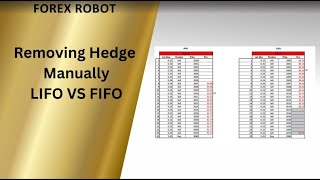
Alan Solarsh shows how to remove hedged trades in MetaTrader 4 using FIFO or LIFO methods. FIFO closes your oldest positions first, LIFO your newest. He compares how each affects drawdown and profit, then walks through when to use spare capital or restart robots to get back to normal trading.
Chapters
This video tutorial is going to explain to you the difference between removing trades on a first in, first out basis or a last in, first out basis. Okay, so let's get started. So this is Basically what your MetaTrader 4 looks like. If the trend is going up, if the trend is going down, then these sell positions will be buy positions. So currently, if we look at the chart on gold, the price is trending and some of you, your trade started at a price of 2,000. So let's just say for example, that the robot started to open a 0.05, 0.25 lot size sell position and it carried on doing so for 24 trades. And then the robot hedges. Now you're in a hedge position, which I've explained to you previously. This is a very good.
Strategy. If you follow my learn to read a forex chart strategy on how to remove the chart, you can exponentially grow your account, your account a lot faster and make a lot of money with the hedge, provided you do it correctly. Now. Now let's say, for example, you close your hedge, okay? You feel that the price is reversed according to my strategy and that buy trade is blue, okay? Even if it's in red, a slight loss, it's not the end of the world because the price has reversed and you know that your drawdown is going to get a lot less. So sometimes it's better to lose on the swings and make up on the roundabouts, okay? So sometimes it's not so bad to close a trade out in a loss, get rid of the hedge and then you can carry on trading and let the robot do its job. Now if you've closed this trade in profit, okay, the fastest way to get this, your account back to normal, there's a couple of ways and this is one of the strategies that I'm going to explain to you. So let's say for example, you close this trade in profit, that profit. What I would do is I would use that profit to start removing my trades on a, on a last in, first out basis. And I'm going to explain to you in this video why it's better to use last in rather than first in. Okay, so let's say you closed $250. All right? Now what I would do is that profit, okay? So we're going to remove that profit on the side and we're going to remove the profit on that side. So generally when you remove the profit, your drawdown increases. In this case it's decreased. I can't get it to increase okay, so your, your, your balance increases and your equity decreases because you've closed the profitable trade. And your drawdown then then increases in value because it's not offset against the profitable trade. If you don't understand that part, just rewind the section and relisten to it. Now you've banked the $250. Now we need to get into our mind sometimes that, that $250 doesn't belong to you. It's there to help you, to protect you, to get your account back to a normal trading rate regime. So now let's remove four trades to the value or let's remove these trades to the value of $250, which is seven trades. At the bottom here you can see that I can remove seven trades and the value is $250. That is on a first, first in, first out basis. Okay? Now let's do the same on the right where I remove trades on a last in, first, first out basis. So we're going to calculate here up to $250, okay? Which is eight trades. So it's one trade more doing it this way than doing it the other way. Now here are the advantages and the disadvantages of doing it first in, first out versus last in, first out. The the disadvantage of closing trades on a lost in first out basis is that you'll need to open up two new charts with two new magic, with four new magic numbers. So 15 minute chart will have two unique magic numbers for buy and sell. And your 30 minute chart will have also unique numbers for your buy and sell different to your 15 minute chart as per the setup training videos. And then you'll use those profits to start then removing your trades also on a a last in, first out basis. Okay? And as you start removing these trades, the lot sizes on your two new charts that you've set up will start increasing in value. And within two to three months you would have basically removed all of this, all of the, these trades and gotten back to a normal trading pattern and you can continue making your 10 to 30% profit per month. Okay? So the disadvantage is, is that your take profits lines on your original charts start if, if you, if you have removed the robot. So once the EA is removed from the chart, your take profits are removed. So you can't restart these charts until you remove all of these trades from your drawdown. Okay? Because if you do put your robot back on, you'll get a gap between this trade. So let's say we remove these eight trades. Okay, let's remove the trades here to $250. Then you'll, when you restart the robot, your new trade will start here, here. So let's just copy and paste. So there will be your new trade over here, and there's this big gap over here between your trades, your old trades and the new trades. And your take profit line will probably be round about here. Okay, Remember, the Robot has a 7030 win ratio, which means that 70% of your trades need to be in profit and 30% of the trades will be in loss for the sequence to close in profit. In a profit. Okay? So if you've got, let's say 16 trades, your TP will maybe be over here. Okay? So that's the disadvantage. You won't be able to restart your robot on these two trades until you remove all of these trades. Okay, now let's go back to the first in, first out chart and let's remove $250 here. So there's the amount of trades that you can remove, which is seven. Okay? So it's one trade less than doing it last in, first out. Okay? And then also if you read what had the advantage here is that your take profit as you closing out trades here, okay, your take profit starts to move up with the price. That's the advantage. Okay? So your take profit will now be at a higher place. And your robot is continuing to trade. It's continuing to trade. The disadvantage is, is that if the robot continues to trend, okay, you will continue to get these new trades within the sequence. Not a bad thing. It's just something for you to take note of. All right? So it all depends on you and how you want to do this. There's no right and wrong here to put depends on you in the way you want it. I believe that removing the the most amount of trades after your hedge is the best option because when the price starts to continue with the trend, these are the open trades that are going to continue to create a drawdown, a big drawdown on your account. And it's not necessary to have that amount of trades open and negatively affect your drawdown. When you can have less trades open.
Than this over here. So you'll have more trades removed than less trades removed. So what would you prefer? Would you prefer to have more trades removed from your drawdown or less trades removed from your drawdown? Okay, so if you have less trades removed from your drawdown, your TP will follow. But there is the the possibility that the trend can continues. More trades open and your drawdown continues to get bigger and Bigger because you didn't remove enough trades from your open profit and loss section. So this is why I prefer, this is just my opinion and what I prefer. I prefer to remove on a first in, first out basis in, in case it starts to trend. I like to get my drawdown under control. So let's say for example, you have a 30% drawdown. Your robot hedges, you're able to remove let's say eight trades, okay? Your drawdown will drop probably from 30% down to 20%. You fund your account with 100% capital. Your drawdown is now 10%. That is a more respectable drawdown. And for you to get back in the game to start then with new new charts, new magic numbers, new lot sizes. And you can start then removing the drawdown in a very calm fashion. This is why I also tell you that when you start, you need to have 100% capital or a minimum of 50% capital in a separate FPS account that is there for you to fund your main account in when the when your charts hedge so that you can get out of your drawdown as fast and your hedge as fast as possible. So what's the advantage and disadvantage of that? So people say to me, yes, but I've got money in a separate FPS account doing nothing, not earning any money. But the account is in dollars. Now we are in South Africa and if you're in another part of the world other than America, then that that money in your FPS account is actually increasing in value. So in South Africa the rand depreciates at about 18 per year and you that money that is in the FPS account is actually increasing in value by 18 per year. So it's not doing nothing. It is increasing value. It's just not just the amount of dollars isn't increasing. What you can do is you can take a separate robot. You can connect that robot to your spare capital at a risk of 0.03 or.04 and you can then start generating income from that spare capital. When the currency trends 2, $300, the drawdown is very very low. And you can take a portion of that capital, put it into your main account and remove trades from a either a last in first out or a first in first out basis. All depends on what you want to do. So I hope that this video helps you to now understand the difference between last in, first out and first in, first out. The advantages, disadvantages and gives you a better idea of of what you should be doing. Thanks for watching and I'll see you on the next video.
More from Alan





Double bottom forming - Gold ready for $4000 #trading #technicalanalysis #xauusd