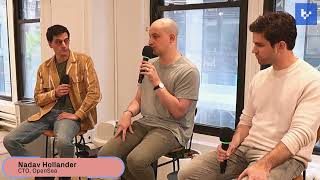
In this interview, host Sabrina Halper talks with Alex Atallah, CTO and co‑founder of OpenSea, about the rapid rise of NFTs, why they matter to creators, and how OpenSea was built. Atallah explains that NFTs give digital artists and musicians a way to monetize directly from their most dedicated fans, offering true digital ownership that isn’t controlled by any platform. He defines an NFT as a unique, scarce digital good whose ownership is recorded on a blockchain, contrasting it with company‑controlled assets like social‑media handles. The story of OpenSea’s origin is recounted: after seeing the CryptoKitties phenomenon, the founders pivoted from a router‑software startup to create a horizontal marketplace for all non‑fungible assets. Atallah outlines OpenSea’s mission to “marketplace‑ify” any internet community, envisioning a future where every site can sell digital memorabilia. He then discusses the biggest barrier on Ethereum—gas fees—describing how OpenSea has introduced gas‑free minting and is working to subsidize transaction costs. To address scalability, OpenSea is supporting Layer‑2 solutions and alternative chains such as Polygon (formerly Matic), zkSync (referred to as Clayton), Binance Smart Chain, xDai, and Flow, aiming for a multi‑chain ecosystem where users need not worry about underlying chains. The interview concludes with a vision of low‑cost NFTs enabling democratized membership tokens, art, and game items at scale.
Chapters
Hello, I'm Sabrina Halper, and I'm here with Alex Atallah, who is the CTO and co-founder of OpenSea, which is the largest NFT marketplace. And today we're going to have a discussion about NFTs, the future of the ecosystem, and his entrepreneurial journey. And I'm so glad he's joining us. Hi, Alex.
Hi, Sabrina. Thanks for inviting me.
Thank you so much for coming. I know that you are so busy right now. I feel like NFTs have had this huge explosion in the past 4 months or so. They're all over the news. They've become a part of daily conversation. And I'm curious, do you have any thoughts about, you know, why this is happening now?
It's kind of a long story that built up with a bunch of different parties contributing to it. One major force was digital artists. In March of last year, right when the pandemic struck, you know, like they were thinking about what kinds of new opportunities, new ways of driving revenue. Digital artists didn't have any ways of monetizing their work for a very long time. You were just, you know, making something in Photoshop that looked beautiful, posting it on your Instagram, trying to drive inbound to yourself, getting design gigs, getting illustration gigs, and just building up a profile for yourself to, to generate leads. And that was, that's just really tough. It's not.
Totally. So could you, could you tell me a bit about what NFTs offer artists, both artists creating NFTs and artists creating NFT pairs?
Yeah, NFTs allow digital artists to get their work valued directly by their true fans. So before NFTs, like a musician even, you have to get a million people to pay you a small amount of money every year on Spotify to hit sustainability. And that can be really rough, especially when you're starting out and doing that every year too. But with NFTs, you just have to get your 1,000 true fans to buy your NFT, or maybe even fewer. And not only are they getting your product, they're also getting a share of your career and they grow when you grow and they, in a way, invest in culture, the culture that you kind of are building around your brand. And it's a much more direct way of interacting with your fans. You can, it doesn't matter what platform they're on. If you're a musician or a digital artist, you'll have fans following you on Instagram, Facebook, Behance, Dribbble, a whole bunch of platforms, but it's hard to get them to do anything because they're split up. And there's also no difference between follower number 1 and follower number 20,000. They're really treated identically by the platform. But with NFTs, there's a huge difference between follower number 1 and follower number 20,000, and it benefits the fans. So you get, I mean, a ton of things that you don't get with the status quo. And we are seeing— we saw digital artists figure this out first. We're seeing musicians figure it out. We're seeing digital good creators like calligraphers figure it out, like font licenses, ridiculous market. Now you can distribute font licenses as NFTs. And that's, that's just starting.
What is the simplest way to explain what an NFT is?
An NFT is a discrete, unique digital good that is attached to media. And you can prove its scarcity in some way. So I don't have to worry. It's not— the ownership is not hosted by any company. There's no single company like Facebook or Google or Apple controlling who owns it. It's tens of thousands of computers on a blockchain. And that provides this new concept, true digital ownership, which every— no one has ever like really looked for before because no one knew it was possible. But now, like, now that true digital ownership is possible, you can have things in the digital world just like you own things in the physical world where only where you have full control over it and you can sell it and give it up, or you can keep it. You can use it in multiple websites. It doesn't— it's not tied to any one website or platform in particular. It's like it's an actual good. And we kind of— we have non-fungible. We've been working implicitly with some insecure non-fungible tokens for a while. Like your Twitter handle is sort of like a non-fungible token, but it's owned by a company, so you don't have freedom to trade it. Or an Instagram handle or a domain name, no one— people can figure out who owns them, but you don't have freedom with that asset.
Totally. That's, that's so interesting. I had never heard that, but that it's like, yeah, it's the only one of its kind. Technically it belongs to you, but, but not really. It belongs to a company and they could take it away from you. Everyone is talking about NFTs now, but you got into this world almost 4 years ago. And at that point, how did you first come across NFTs and what drew you to it and what made you think like, oh, there's something, you know, really big here?
Yeah, my co-founder and I were doing something completely different for a while. We were building a route, like software for routers to use. And then we got into Y Combinator and on the very first day we pivoted to building OpenSea because something pretty crazy was happening. Suddenly people were buying these digital game items in a game called CryptoKitties that they were looking at not just to speculate on some cryptocurrency, which is all that anyone had been doing in 2017. It was actually because they wanted to play the game. And that was the first time I saw people like actually get, you know, the first time Ethereum, the network went down. And that was the first time that my friends started to try to figure out what crypto is, friends who weren't just trying to speculate on it. And I thought that was pretty encouraging. Not only that, but there were tons of developers who were looking at making something similar. It was a brand new asset class. It was like, oh, there aren't just currencies in the world. There's also things. Actually, currencies are the odd one out. Most digital assets that we play with are non-fungible. They're unique and they're only owned by a discrete number of people and they're attached to media. And those are a lot more interesting to me. So I we pivoted and started building a marketplace for all of the CryptoKitties-like things that would emerge. And for a while, we didn't know what it was going to be. It could be game items, it could be art, it could have been virtual world goods. There were phases where it was each of those things. So we built OpenSea to be horizontal and support all the different types.
What's your vision and mission of OpenSea today? And just where do you see it going in 5 or 10 years? How do you think that the market will broaden? Are there other parts of society that, you know, could become NFTs?
First of all, at a very high level, anytime information is being transferred in the internet, value can be transferred too. Just imagine every website having, getting marketplacified, where there is some sort of memorabilia or some sort of digital goods that make sense for that community being sold in tandem with the information being exchanged. Every newspaper, every subreddit, every community on the internet, like, has members that want to exchange value. And it's just a question of figuring out what that value is. Now that we have a really easy way of building that value, it's just about creativity now and figuring out what's going to stick. And there's so much incentive to figuring, to answering that question and figuring out what sticks to your favorite community. And there's, you know, there's kind of an easy way of finding product market fit. You don't have to get everybody to buy it. You just have to get the most passionate people to show support and help you develop it and help you market it. At a high level, I see the internet moving in that direction and then more near-term. Not everything has to be on Ethereum. I think there's going to be— Ethereum is very tricky to scale.
Can you explain why that is?
Yeah. The— there's this concept called gas, which is the, the money that you pay to get your transaction included in the blockchain and you have to incentivize the blockchain's miners to accept your transaction. When you buy an NFT, that's a transaction. Even when you set up your account sometimes on some decentralized apps, that's a transaction. So that provides— that becomes a huge user barrier. And the worst part about gas is that the more people are using Ethereum, the higher— the more expensive it is to use Ethereum. It doesn't scale. It's the opposite of scaling.
Yeah.
So we, you know, we pay for gas as much as we can for users. And we, you know, we've built the marketplace in a way to remove it. Like we, in December, we launched the ability to make NFTs for free so that you don't have to pay any gas to mint them.
That's awesome.
And that's helped a little bit, but there's still a lot to go, especially when you buy like a small price collectible. That's like $5, $10 and you're paying a $20, $30 gas fee, then people just— their minds are blown in the wrong way.
Yeah.
So we have been for the last couple of months building developer tools and teaching developers to move to other blockchains called Layer 2 blockchains. Yeah.
And which blockchains are those?
Matic and Clayton. Matic is now called Polygon. But Matic, their blockchain is being used by a couple dozen developers right now. And for a good number of developers is enabled on OpenSea. And Clayton, which is mainly or has picked up some traction in South Korea. There's a couple others like Binance Smart Chain, xDai that some developers are using too. And we want to support as many good ones as we can. There's also Flow made by the team behind CryptoKitties, Dapper Labs, which is what powers NBA Top Shot.
Oh, very cool. Do you see— so you see the future being probably a mix of different blockchains?
Yeah, there's going to be a mix of different blockchains, just like there's a mix of different databases being used to power websites. And no, users don't need to know. Necessarily what chain it is. Maybe users will care, but what we are going to be able to do for these cheaper Layer 2 solutions is pay the gas for everybody. So you will be able to not worry about any fees on OpenSea, which you can now for a good number of collections. And probably whenever this comes out, it'll be enabled for everybody, but it'll enable low-priced NFTs, which means that you could you know, have really democratized membership tokens and art and game items that work on a very large scale.
Yeah.
That scale with your user base. And that I'm really— that I think is going to be the single thing that changes NFTs the most.