Ayurveda, Abuse & Awakening | Jeanne Chilson’s Journey Back to Herself
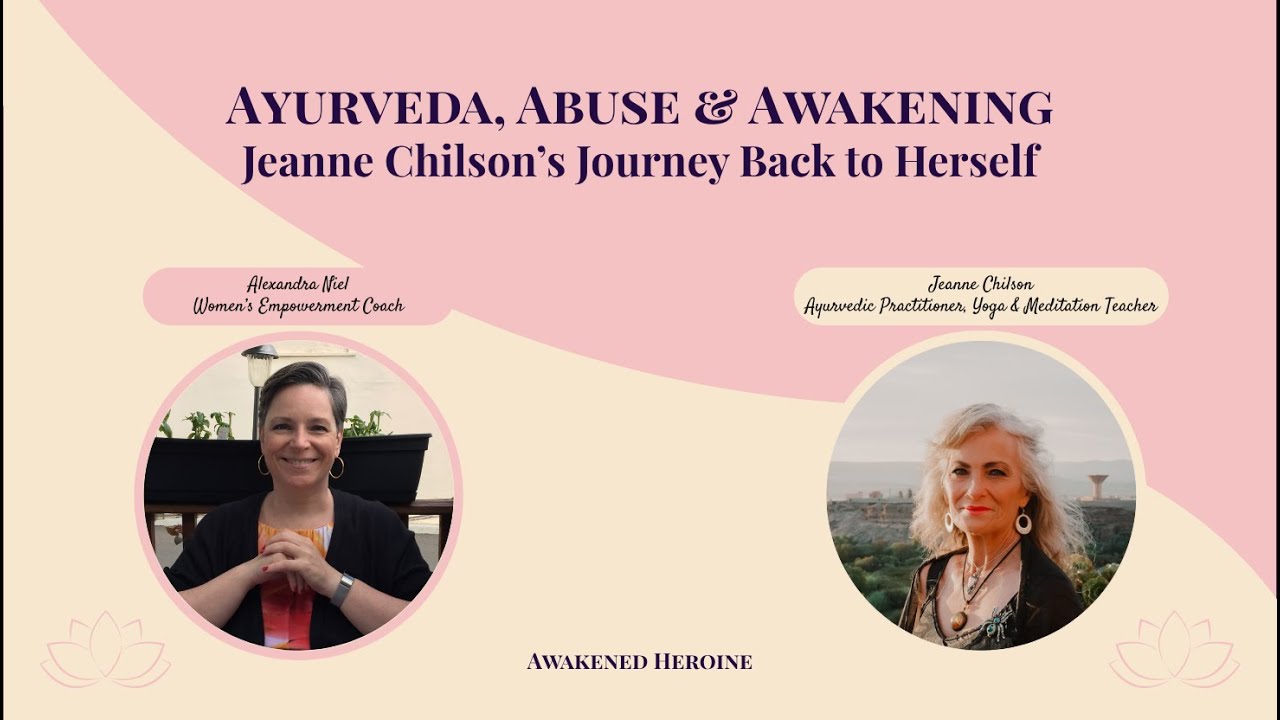
In this candid interview, host Alexandra Niel talks with Jeannie Chilson, an Ayurvedic practitioner and survivor of military service, sexual assault, and abusive relationships. Jeannie recounts her early life in a large family, the trauma of being raped at 18, her enlistment in the military, a damaging first marriage, and a second marriage that left her feeling inadequate. A turning point came when her granddaughter’s birth sparked a search for holistic healing, leading her through real‑estate, self‑help books, Neuro‑Gym, Mindvalley, and Kundalini yoga, eventually discovering Ayurveda. She describes Ayurveda as a science of life that integrates food, mind, body, and spirit, emphasizing that mental and emotional patterns manifest as physical disease. Jeannie shares practical advice for women who have lost their voice: find a passion (her own was gardening), practice self‑love, and create personal “patchwork” healing plans rather than following generic advice. She outlines her consultation process, which involves an in‑depth personal history, menstrual and dietary review, and a protocol focused on food‑first changes, stressing that lasting transformation requires commitment and personal responsibility. Throughout, she stresses nature as a source of answers, the importance of individualized treatment, and the empowerment that comes from standing on one’s own two feet.
Chapters
Hello, heroines! Welcome back. Happy Tuesday. Today I am here with the lovely Jeannie Chilson. Jeannie has an interesting background in Ayurveda and also a very personal story of her own heartbreak. So hopefully we can dive a little bit into that today, if you feel up to it. But welcome.
Thank you. Thank you, Alex.
Thank you. Thank you.
I appreciate it.
My pleasure. Oh, it's good. It's good that you're here. Good that you're, you know, we're going to be sharing. So let's just start right off the bat with what do you do and where are you from?
Hey, well, I'm from Houston, Texas. Well, not from. I currently reside for the last 38 years in Houston, Texas. I've been trying to escape for years now. Um, yeah, but I'm an Ayurvedic doctor, um, I guess a spiritual life alchemist.
I'm—
I really love to take, well, women, but really all people on this journey of self-discovery to actually come back to, to home, to who we really are. And I like to do that through Ayurveda, not just through Ayurveda, but through Through nature, just knowing that in nature we have all the answers that we need.
So very cool. And I love what you just said about coming home to ourselves, because I think that's the genesis, right? That's where it all starts. If internally, if our inner world is at peace, chances are our life will be at peace, even if there's chaos. We will be at peace in, in the chaos.
Totally agree.
So tell us, how did you get started doing this? Like, tell us a little bit about your story.
Well, with Ayurveda, I've always been a plant lover. I've always loved the outside. Um, I've— the reason why I, I have done more holistic, why I started off just doing holistic, is because Growing up as a young adult in my 20s in the military, and, you know, in my 30s and, and forward, there was things that, you know, physical things that were happening to me that doctors could never figure out what was going on. And to this date, I still don't know. Um, And I began to feel this feeling of— and, you know, if there's doctors out there, sorry, please don't take this personal— but I just began to feel like doctors were quacks. And I don't say that in a bad way, but I just feel like now I'm totally educated on the fact that they're not educated in a lot of these things. They're only educated in the medicine, but they're not really educated in the root cause. Anyways, so I've always done things holistically, and I've always felt like being in nature is something that really brings us back to, to connect to ourselves because there's so much beauty out there. Um, but I think what really brought me here was about 15 years ago when my granddaughter was born. I wanted to be the best grandmother ever. Wanted to go, and I'm just going to make this a real quick story, but wanted to go and be able to make some money. So I went into real estate. Real estate led me into Think and Grow Rich, which was the book that led me into Neuro Gym with John Assaraf, and then into Mindvalley with Vishen Lakhiani, and then into Kundalini yoga with Jai Dave. And that's where I really found my balance, was when I started doing the yoga. And started doing the meditation and really started thinking about the words, the things that I was telling myself. Because I got to a point to where my older kids really didn't like being around me because I wasn't a very pleasant person. I was always self-pity, feel sorry for me. So yeah, I started this journey and I went to a yoga session one time and seen a girl doing her homework and said, what are you doing? And she said, are you Veda? And I said, can you give me the name of the school? So she did. And like 2 years later, I joined.
So you were drawn to it right away?
I was, I was, because it's, it's has to do with yoga, meditation. It's the mind, body, spirit. Ayurveda just means the science of life. It's not really just medicine. It's knowing that food is medicine, or food can be poison. Knowing that most everything that happens to us in life is caused by the mind, not by the body or the physical ailments, but the mind starts it and then it turns into a physical ailment. Um, so it's what we call krumi, which is parasites, whether it's metaphysical ones or whether it's the real ones.
I just, I love this stuff. Like, I find it fascinating. I could never remember. I could never, you know, study it. But I just, the whole idea around it, I think is fascinating. And I'm having, I guess, a bit of a hard time reconciling military with Ayurveda. Like, how does that happen?
Well, I came from, I come from a family of 7. There was 7 of us. 4 were older than I am. My mom had 4 children and then she waited, and then so I was— my oldest sister was 17 years older than me, and then my oldest brother was 15 years, and then 13, and then 12. Um, the military came in because there was always a lot of family drama. What happened Um, New Year's Eve on my— when I was 18, after I graduated, I went out by myself because my friends went out all together, and I ended up going by myself that night. I ended up getting raped. And of course, when they took me to the doctor, nobody believed that it happened. Of course, it was— it's at those times, it's always something that we bring on ourselves. Um, and months later I found the perpetrator when we were in the airport. I told the police about it and they just kind of dismissed it because he didn't have an accent when they interviewed him. And this is months later, so they let him go. So my mom was worried about me, so she sent me from Washington State to California to my brother. And then my oldest sister got jealous and she said, why are you there? So I went down to my sister and then just drama started happening. I said, look, I just got to get away. So I went down to the recruiter and I joined the military. Well, I tried to join and my sister called my brother and said, talk her out of it. She can't go. And, um, so he gave me a call because he spent 2 tours in Nam. And, uh, about a week later, I went to the recruiter. I signed up. I did everything in silent, didn't tell nobody nothing. Did all the physicals and everything. And, and I called my mom and I said, Mom, I'm joining the military. And she said, what? When are you leaving? And I said, tomorrow morning at 4 AM. So I went into the military and Spent 3 years in the military, um, and just loved it. I wanted to be a lifer. However, um, I made a mistake of getting married and to the wrong person, and, uh, that kind of destroyed my military career. So I got out, um, and then just started raising my children— started having children and then, you know, started raising them. So I kind of lost myself for about 30 years, 35 years, maybe 40. Wasn't sure who I was, what I was meant to do. And the girl that I knew at 16, 17, that was just a really outgoing, fun-loving kind of a person, um, I kind of lost her. And one day I looked in the mirror and I was like, who the hell are you? Who are you? Where is that, that outgoing, fun-loving person that everybody used to know? So I, I felt like, okay, now is the time to change.
And it's, you know, I resonate so much with what you're saying because I also got to a point where in my marriage, or especially like when I came out, I was like, I didn't know who I was or what I wanted. I asked myself a lot of the same questions that you, you know, that you asked yourself. So for you, what, what were some of the biggest lessons in what you went through?
Well, in my first marriage with— and that I had 4 children in— he was very abusive and very jealous. Um, And, uh, you know, I, I couldn't talk to anybody, and I'm, I'm a social butterfly. I like to talk to people. I couldn't talk to guys. He pulled me out of a, a casino in Las Vegas by my hair and began to beat me up. And when my mom met, met, met him, I had two black eyes and two black arms. Um, so I kind of lost my voice there, and then he began to instill in me that you are a piece of shit, nobody's gonna want you. And so that just kind of stuck with me. Then when I left him for my second marriage, which was being a second wife in a Muslim relationship, um, it wasn't so much he was very good about taking care of me, it was more of um, I would say it was just more of just not, not feeling like I'm not enough because we didn't stay together, and always just wondering that, you know, what's wrong with me. So losing my voice and then realizing and changing my whole entire wardrobe— of course I changed everything that I did. I no longer went swimming. I no longer shorts. I no longer did all kinds of stuff and left that girl behind. But in all of that, I started realizing that I really needed to find my voice again, and I really wanted to teach other women that I seen in the community that I was in that didn't have a voice, and I really wanted to give them that. But the biggest lesson, I think, is just I had to be me. I had to learn how to be me all over again. And I learned how— I had to learn how to find out who I really was and what I really wanted in life. And I had to come back home to myself. And that's been my journey. And of course, I'm still on it. I'm, I'm not completely through that either. It's a journey that we take every step of the way. But those lessons that I've learned have brought me to this point, because without everything that has happened in my life there, I wouldn't be here. I wouldn't be wanting to help not just women, but other people that feel lost, other people that feel alone, other people that feel like they don't have a voice. And, and that's where I'm at, you know. I'm just this compassionate person that I can feel, I can see when people are not feeling right or when they're feeling down. And I can feel that deep inside of me like it's my own feelings. And sometimes it ends up incorporating itself into me and I'm like, oh, wait a minute, why am I feeling this way? But through the process of learning how to ground myself and how to take care of myself ayurvedically and holistically and just really knowing what energy is mine and what's not.
So I'm sure, and I know, this story will resonate with the women in the group. Um, so for women who feel like that, feel like they've lost their voice, they're coming out of a divorce or coming out of an uncoupling, and they're like, now what do I do? What would you What's the first simple thing that they can do to get them started on that, that journey to rediscover their voice?
Find something that they love to do. I mean, really find something, because my release was like gardening. I love to, to garden, and I owned my own landscaping business, and just gardening was my release, you know, it was getting out with the plants and getting out into nature and just feeling into my own feelings. And, you know, realizing that, why is it that I'm so attached? You know, why is it that, you know, and it's such a big misconception why people stay in abusive marriages, and they think it's because women love to. No, I mean, it's just we don't know what to do. We don't know where to go. We don't know if we're going to be protected or if we're not going to be protected.
And there's also not a big history of support. No, from society and even from our own, from our own families.
I mean, my family was very supportive of me getting out of it, the first marriage, because he almost killed me at that point. And I really just had to decide, okay, this is, this is it, this, I can't do this anymore. And, you know, because my first thoughts were, I've got to stay because of the kids. And that was the worst thing that I did, was stay because of the kids, because they got exposed to it all. Um, but yeah, find something that you really love to do and, and learn how to love that so you can learn how to love you, you know? Because it's not easy to just say, okay, I love you now. It's not that easy.
It's a lot of ghosts.
It is. Yeah, it's a lot of ghosts. So I had to love something, to do something, to feel like I was of use somewhere, you know. I mean, my kids are all grown up. My oldest one just turned 40 and my youngest one is 34. And, you know, they're all on their own, so it's like mom is not a priority at this point. Um, so I really had to do something that I enjoyed to be able to come back to say, okay, I can start loving myself again. And it's been a journey and it's been hard.
Yeah, no, it's, it's not, uh, it's not easy, but it's definitely— I fully agree with you. It's when people ask me that same question or similar questions, it's like the first step is learn to love yourself. Learn to be okay with even just being okay with yourself and who you are. And just because that's where it all starts.
Yeah, I had to look and see what is it that this is teaching me and what is it on the other side? Because I'm such an optimist, I always know that there's something on the other side of every situation. And so, um, I was just in a call with Lorna and said that situation where I got raped when I was 18, had it not been for that, I wouldn't have went into the military. I wouldn't have married the wrong person to give me 4 beautiful children. You know, I wouldn't have then met the spouse that I had. Where we built businesses, and I learned how to do so many things, and I learned how to be on my own two feet and, and to be able to stand up on my own. Because that's the one thing that this last marriage taught me, was to be independent and stand on my own two feet and do things for yourself, because you can't count on nobody.
Yeah, the only person we can truly count on is ourselves, you know, and It brings up something to my mind about— this is why I have a love-hate relationship with Disney, because up until very recently, what Disney taught the girls was that you were a damsel in distress and your Prince Charming was going to come to save you. Yeah, there is no Prince Charming. We are our own. Yes, Prince Charming. And we have to be, because that is the only way we know that we will be taken care of because we will take care of ourselves.
Yes, you're absolutely right there, Alex. Having that, that thought that we're only here to, to be rescued, and, and, you know, women are frail and they can't do this and they can't, you know, and I'm like, no. I used to work on cars with my brother. My son and I tore apart a diesel engine and fixed it, you know. I mean, there isn't anything that I wouldn't try, you know, at least to do myself. When my house flooded, I fixed almost the whole thing, you know. We had a contractor for just a few things, but you know, you really, when you get pushed to those limits, you have to try. Otherwise, you get too comfortable and you don't try.
And even if you don't get pushed to those limits, you have to try.
Yes.
Because you don't— we don't— you don't know what's coming. You know, it could be your tsunami just hasn't hit just yet. Right. And you need to be prepared to be able to not just survive it, but then thrive on the other side of it.
Yes. And I mean, we're living in that world right now.
Very true. Very true. So, um, let me ask you this. What is something that you and I haven't really touched on yet that you think is important for our heroines to hear?
Um, you know, just, I, I am such a nature-based person that I just feel like all the answers are in nature. And I listen, I am an avid book reader, and if I'm not reading the book, I'm listening to a book. And, um, I get so many different perspectives on a lot of things, but you really have to take only what feels good to you and leave the rest behind, because you're going to hear so many different people tell you, you got to do this, you got to do this, you got to do that, except for everybody has their own experiences and no two people are alike. And you can take little bits and pieces from so many different people and put it together in a, in a big, you know, collage and say, okay, this is, this is my way to go. Because not everything that I'm going to say is going to resonate with everybody out there, and not everything that you're going to say or anybody else. But there might be little bits and pieces, so just look for those nuggets that that feel good, that really feel good to you, you know, that, that, you know, makes your soul sing, and use those. Everything else, let it go and stop giving a sorry fuck about what anybody says or does, you know. Just do your own thing and stop caring about what everybody else thinks.
Yeah, it's, um, the image that came to me as you're talking about taking pieces here and there is patchwork quilt, right?
Yeah.
The images that come from little scraps of fabric here and there are beautiful, and we can, we can be that for ourselves. Everything, nothing is like, uh, I'm losing the word right now.
Nothing's linear in life.
Nothing.
You know, there's nothing that's linear. There's nothing that, there's no manual that says you got to do it this way.
Yeah. And it has to feel congruent, right? That's the word I was looking for before, is it has to feel congruent because what works for you isn't going to work for somebody else. Just like what doesn't work for me might work very well for somebody else. So we have that ability to choose how we want to build our quilt.
Yes. And, and it's that same way in Ayurveda. It's It's no one medicine is good for everybody, you know. You can hear everybody out there say get some ashwagandha and take it, and that's, that's what you hear— ashwagandha, ashwagandha, ashwagandha. But little do people know that ashwagandha is not good for everybody, you know. There are some people that you should not be taking ashwagandha, but it's, it's It's when you listen to everybody's direct, you have to take it because this is the result you're going to get. No, realize that you are a significant one-of-a-kind human being that has your own particular makeup, your own particular DNA. And there's nothing out there, not one formula that's going to be good for everybody across the board, because we're not made to be the same. So yes, you, you've just really got to deal with things in a way that feels so good to you. Forget about what everybody else thinks.
So I'm going to ask you this. I meant to ask you before and I totally spaced out. When you work with someone, take us through a little bit, if you've got maybe in a minute or so, what does that look like when you work with someone?
So when I have a consultation with somebody, I'm not like a regular doctor that brings you in for 15 minutes and you're gone. Um, I'm really thorough, and it takes me about an hour and a half to 2 hours depending on the person. The consultation is about your whole background. It starts from when you're a child, any traumas that you've had as a kid, foods that you used to eat as a child, things that you used to do. Um, if you're a woman, when did you start your menses? What were they like? Did you go on the pill to control your menstrual cycle? You know, was it Was the menstrual cycle something that wasn't mentioned in your, in your household? Was it considered taboo? You know, so I go through the whole entire background, what medications you're on, what food you eat now, all of these things, because all of that contributes to what's right here. And this right here, 98% of the time, contributes to what's inside here. And then that manifests the dis-ease in the body. So then we go through what we call a protocol, is trying to work it through, through food first, and seeing if, if we can get a change in the body through a food. But my recommendation is always when somebody comes to see me, if you're not ready to change your lifestyle, if you're not ready to— and I hate to say diet But when you are ready to put your health and, and your life in front of what gives you short-term feel-good, you know, the foods, ahead of that to create a life that you want, which one are you going to choose? And it's up to you, no judgment. I mean, if however you want to do it, but if you want to do this let's do this, and I'll be here for you every step of the way. If you want to dabble and go in and out, I can't guarantee any results because there's no miracle pill. So it's, it's just a matter of, for me, really talking through everything because I feel like your mental an emotional being is what causes your physical being to be sick.
Yeah, I, um, I, I have, I have a— I agree, and at the same time, like, there's a part of me that says, well, it's got to be, you know, it— so it's— I don't know how to explain it. I, I believe it and I see it, Yeah. Um, but there's always a, a part of me that says no, it's not. Right. But, and I know that it is. Yeah. But there's a, a little bit of resistance.
Lipton and Gregg Braden have already proven that we're not hardwired, that epigenetics change, that your DNA changes according to your environment and according to the foods that you eat. Yeah. So when you— it's a lot more complex than, uh, it's a lot more complex than what we think that it is, but we make life a lot more difficult than what it should be.
That is true, because this little guy up here likes to make mountains out of molehills. Yes. So, all right, Jeannie, I just want to say thank you so much for being here and sharing with our heroines.









