Breaking Free from Expectations | A Woman’s Journey Through Divorce & Rediscovery
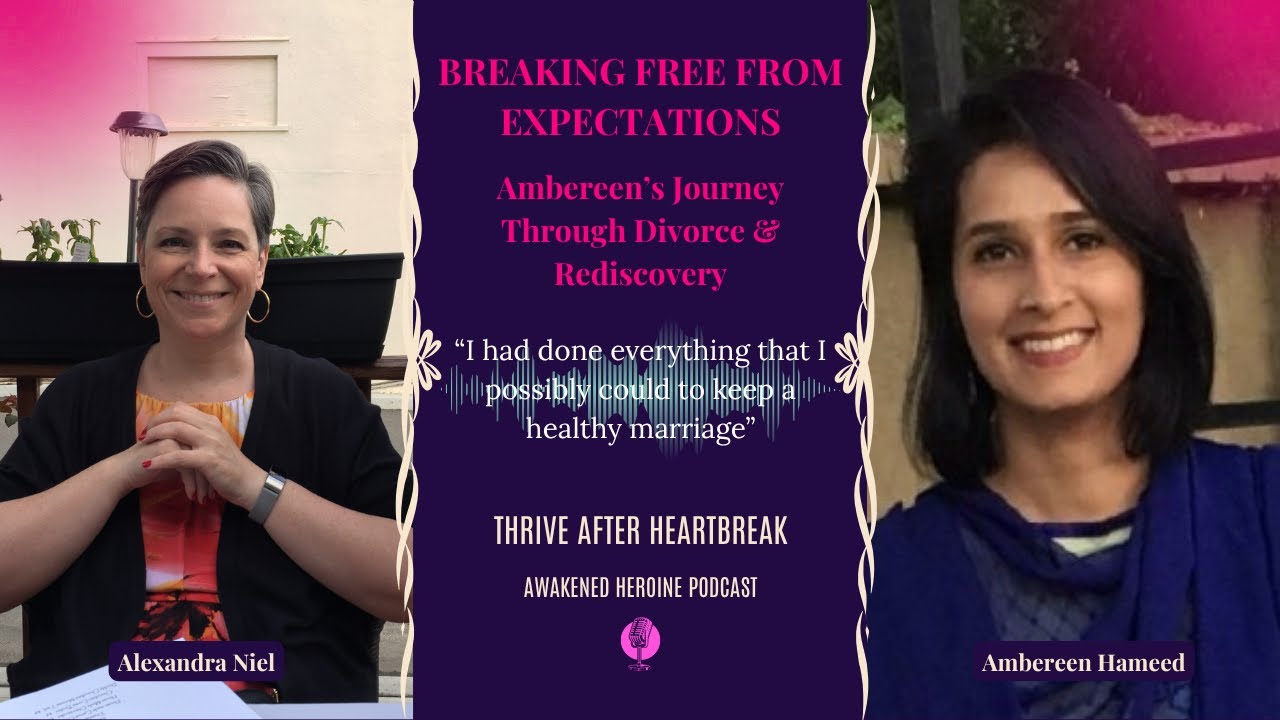
Ambreen, who immigrated from Pakistan at ten, left her marriage in 2018 after realizing cultural expectations were suffocating her. She rebuilt her life as a single mother of three using daily prayers, intentional parenting, and the Five Love Languages to deepen her children's bonds.
Chapters
Hello, heroines, and welcome back for another interview. Today I feel like I am running a bit of a marathon between Tammy and now Ambreen, and it's just, it's a little crazy, but I love it and I wouldn't have it any other way. So I wanted to bring Ambreen in today because she has a little bit of a different perspective in that, um, you know, she really looks at the impact of like about raising children and how we do that and things like that. And I thought for those of you in the group who are single mothers or now single mothers, um, her perspective might bring you some, some good, good perspective. So, Ampereen, welcome.
Thank you so much for having me, Alex. I appreciate it.
Oh, it's gonna be fun. So let's just start with the basics. Why don't you tell everyone who Ampereen is?
Well, Ambreen is a free spirit first, first and foremost, a conscious human second, and on a mission to be one of the world's best mothers. So that's Ambreen in a nutshell. Um, my purpose and kind of how I want to really serve the world is through coaching, and I think I also have found that to be my calling, um, similar to yours, um, Alex, and You know, for me, family is it. There's nothing that's more important than family and our home. Such a reflection of how we raise these little people, the relationships that we have within the home, which then facilitate everything that happens later in our lives and into the world.
So talking about that, tell us a little bit about what your story is. How did you get here?
Um, well, there's a lot to the story. Um, we migrated, you know, to America from Pakistan when I was 10 years of age. And in order for our parents to kind of preserve the culture and not kind of have us go astray and really assimilate, they overdid everything. So much so that after a bit, you know, um, at one point in time, my ex-husband said You're more Pakistani than Pakistani girls, right? Like, you're way too conservative. And we didn't know because we grew up in the bubble that our parents had put us in, thinking that was the norm. And yeah, it's very traditional in our culture that the woman never leaves the home. So my dad said to me, straight-A student, rocket, like amazing. I could get into any college I wanted to. And I told him I wanted to go to, you know, the specific one. And he goes, how far is that from home? I'm like, 4 hours. He goes, great, you can apply to it. You're never going to go to it. So we're like, oh. So we were raised in this, in a very cultural mindset, when in reality, for me, um, the shift began to happen when I began to take more of a spiritual route. So there's so many rights that we have, you know, within, within my religion, within spirituality, that we have just being humans. Whereas culturally we don't have those. There are so many simple things like a woman has to serve her husband a fresh meal every day and she has to kind of kill herself to take care of the family and she has nothing of her own. You know, she's, she's her home. She's the mother, the wife, the daughter-in-law, the sister, all these things. And so I kind of fell into that. And because my mom was such a great role model, in many elements, like one of the most remarkable women that I know to this, this day is when I say if I can be half of her, I'm good. You know how in some ways the culture was so embedded in her that we couldn't really tell it apart. And so I went on my own life and began to see that I played narratives that were far deeper than hers because I've always been the obedient daughter that does the right thing. Because I don't want to displease anyone or bring shame on the family. So yeah, that took me on a spiral downward where I essentially kind of lost all of me. And, uh, but my children were the kind of the awakeners, you know, for me to tap into my own, you know, heroine, or to tap into the, you know, my own queeness, I say. And, um, you know It was at that time that I remember that I recognized that I don't really remember anything of me. Like, the essence of Ambreen is— doesn't exist. And then, you know, you begin another development journey, you know, because now you're not the person I used to be. You know, I'm not the person I used to be. And before I had gotten married, even though I knew all these things and the cultural ways of being, I was very much against the cultural injustice. So I would tell my uncles, right? I would be like, I was like, my aunt still comes to me this day, she's like, you're what, 17, 16? And you came to him and said, why is it okay for her to like polish your shoes but not okay for you to iron her clothes? And my uncle—
That must have gone over like a lead balloon.
But the thing is, he had never thought about it because it wasn't something you'd think about. Of course, like, she's the maid, right? Or I even said, like, not even a maid, because a maid gets paid. I'm like, we're all your slaves, right? Like, we are literally doing it all for free. And so I had always been a champion for women, you know, growing up. And then I actually went into my own, um, you know, own deviated path, which, um, which was, I would say, one that was really profound because there was no way that I could be this person that I am today without all of that.
So I want to go back to what you said before about keeping the culture, right? Because as you were talking, it reminded me of something I haven't thought of for a long time, is that when we first moved to the US, um, And, you know, we would speak English at school all day long, and then we'd come home and we'd have to switch to French. And it was just so much easier to just keep speaking English. And my dad would charge us a quarter every time, or he tried, because it didn't last very long, but he would charge us a quarter every time he heard us speak English at home. So it's just funny to just hear your story because it's such a mirror. Of my own story when I came to the US.
Yeah, the fun part is that, um, forget the quarters, my, my mom would literally pretend like no one is talking to her. And my mom is completely fluent in English. In Pakistan, she went into a remarkable Catholic school, and she knew how to speak English fluently, the full British accent. But in my, in my house, that my dad was like, there's no way I'm gonna hear English in the house. And he was kind of the decider of the rules. So she, if we're like, hey mama, like, did you get it? And she's literally like still like chopping her vegetables or like doing whatever. Like, ma, we're talking to you. Nothing. Ma. And they're like, sundre ye? And then she's like, oh, you say something? And so she did that. And the rule in our house, which you're talking about, that shift between English And, you know, French, we would go to school in, you know, normal traditional pants, shirts, right? Really loose clothes. We would come home and we were expected to change into our cultural clothes. The funky part is where we grew up in Karachi, it's hot. It's southern Pakistan, it's hot. They don't make clothes for the winter of Chicago. Yeah, my dad is like, I don't care, wear a thermal if you need to. But I'm never going to see my daughters in pants in the house. So it was like such a bizarre thing because you would wear 3 outfits in a day. It was very normal because my dad—
it's like, it's like this dissociation. Like you ended up being like 2 or 3 different people.
I would say I was the same person, but I knew I had to modify myself. And that, I think, is a really beautiful quality that everybody should have to be able to be flexible. Yeah, I think flexibility is something that is understated. It doesn't mean you lose yourself. Like, if I'm wearing kurta-shalwar, if I'm wearing pants, I'm still me at the end of it, right? However, if doing that brings joy to my dad, if doing that brings my— makes my mom's life easier, if doing that tells my parents that we really respect your wishes then so be it, you know. And I was probably the most obedient. My sisters were probably not as much. My younger sister is like, what are you talking about? I never grew up with that rule. I'm like, yeah, you came last, girl, we know.
Yeah, she got lucky.
Yeah, because they did assimilate to the culture by that time a bit more than they did when we moved here.
So yeah, so you talked about, um, you know, being the obedient one and losing yourself to who you were expected to be, and then going on this journey of, I guess, rediscovery in some ways. Did that gradually happen over time, or was there like a triggering event that's— that made you all of a sudden be like, this doesn't work for me? Something's got to change.
Yeah, so I think there was an evolution, but I do remember a shift, a moment in time in my life when that shift happened, and it was in 2018, um, when I had lost all of me. I had done everything that I possibly could to keep, you know, a marriage, try to maintain or keep a healthy marriage However, things were not going my way, and things were not going in a healthy way for over a decade. And I was kind of putting patches on, one after on top of the other, bigger ones, harder ones, like more, you know, like sturdy ones to kind of repair something that in my heart I knew was irreplaceable. And it was a conversation, you know, with my ex where I literally am listening to you just do what you do and I'm not responding. Forget reacting, you know. I say that my marriage, my, you know, my marriage has taught me a lot of things. It taught me the art, which I think is not like a superpower, right? Like, in my mind, I could be like, God, I see right through you. Oh my God, you're so frustrating. Dear Lord, people have to put up with you, you know? Like, oh, that's how you think about life? I'm thinking all this? Not from a place of judgment, but from a place of awareness that this is a person you're choosing to be. Yet in my face, I'm totally like engaged, like, oh, okay, that's what's up. Because in reality, I do want to be able to understand humans as they are, as they're revealing themselves to be. And it was a 45-minute, 50-minute full-on session where I'm just completely relaxed and chill. And I thought, well, I've done the last thing The last thing that I had held on to, which was me— like, if you knew anyone, if you asked, hey, who was Ambrayn? They would say, that's Ambrayn. I even removed that. So in my own aura, I stood naked. And when that wasn't enough, and when the conversation just— there was no shift in it, I was like, okay, so I get it. This is what I have to, like, not put up with, but this is the reality of my life. That I can do everything for someone who will not appreciate it, who will not recognize it, who will still find flaws with me, who will still say, oh, last month I wanted you to be a drama queen, this one month I want you to be a submissive wife. Great, flipping it, flipping it. You just tell me what the agenda has, I'll do it, right? And so what I realized is it isn't me, you know. And in our culture, it's always a woman. This is the default.
Wait, wait. So, so help me reconcile those two things because they feel like worlds apart.
Yeah. So in our culture, a woman cannot raise her voice to her husband. A woman cannot say no to her husband. A woman, um, must obey his request and his requirements. A woman must mold herself. Like, if he says, hey, I want you to dress more modestly, you must do it. If he says, hey, I want you to dress a little bit more like fit in, you should do it. This is all culture, not religion. This is all culture. Um, if he says, I don't like your hair short, you need to grow it out. Grow out your hair. You know what, I love it when you paint your nails, let's start painting your nails. You know what, um, red lipstick I don't really like on you. Okay, no red lipstick. So it's like you don't really keep the things that make you happy. So when I had done all those things and still there was a 45-minute on and on session about— well, you're just talking to a wall basically at that time in my head. I'm like, I'm gonna— like, I— you have given me this beautiful ability to no longer react. Now I respond, and I respond so consciously that you can't even try to provoke me because I know it's your intention. You've said it many times. So when between a husband and a wife, when there is a mutual respect, that relationship is doomed. I'm somebody who will tell you respect over love, because I told my ex, I'm like, listen to me, I am lovable. Like, if there's something I can guarantee you is you will do your best not to fall in love with me. That's who I am. Because I know what my intentions are. I know how positive I am. I know what I read. I know how, how divine I am, right? So when you know who you are and then you lose it all, only to at the end of the marriage start to kind of go back on that, like, hey, when I was 21, I knew this. Like, when I was 21 I'll be damned if a man came up to me and talked to me disrespectfully and I— and he just got away with it. I would just look at him, be like, you done lost your mind, is it still in your head, or you want me to go grab it for you? Like, I would just look at you like that. And he knew. They were men who I was friends with, and they knew, like, don't touch me and don't come in my vicinity. I'm not that girl. I'm not available to you. And they would try to kind of even get close, but like next to me. But they knew, don't you dare even like get like within a foot of her. She has like some sting bomb that'll just like make you like evacuate, you know. And I wasn't saying anything, Alex. This was, this was something that my aura, that my energy was carrying, which was I am far too sacred to be available to whoever shows up. With their lust or with their desires. If you're really that serious, then that takes a very different kind of a caliber. I'm talking about when I'm 21 years old, like, I'm not playing around with boys. And if you're man enough, I have a full script on how you can actually see what's possible. So that kind of, that umbreen that I had known, that I had kind of kept tucking away for 15 years, began to like literally you know, it was like a volcano slowly erupting. And they were my— they were my kids who were the ones— they were like, Mama, you've been marinating for 15 years. Let's see how much lava can start to spill out, right? And that's why I say it's so beautiful, because without my marriage, I wouldn't have had my 3 kids. Yeah. And without my marriage, I wouldn't have learned such valuable lessons in life, because we did grow up in a box. You know. So does that help kind of bridge the gap of what you're talking about?
Yeah, it does. And I'm glad you brought in the kids because after you went through your divorce, you found yourself with 3, I assume, little ones. Um, so how did you manage all of that? Because it can't be easy. I don't know because I never had children of my own, and when my beau's eldest daughter came to live with us, she was already 16, so it was a different dynamic. Um, so tell us more about that.
Yeah, so my youngest was 7, my eldest was 11, and it was like God had been preparing me, Alex. I don't know how much of your community, you know, relies on faith, but for me, I really do believe the divine and a higher power that knows before me that the trajectory of my life will change. And it kind of prepares me slowly, slowly. So 2018, that breakthrough happened. I was like, Ambreen, you know, a divorce is coming. You know it's coming.
How is that even possible, though, because of the culture that you came from?
So the thing is, the culture says that But the more I've been back to my old roots, like the, you know, the Ambreen that I was pre-marriage, I was very religion-forward. Islam says clearly, if two people try and they try their best to stay together and they're not able to, part ways with respect and with peace. Okay, can you believe those were the conditions for divorce? If you are someone who is not sure this is the right person for you there is like an 8-9 month long process that happens in your private home to be able to come to a decision where like a year later you're like, you know what, the both of us really feel that divorce is the right solution for our family. Um, versus the culture, it's very much like you as a woman with 3 kids, you're dead. You might as well feed yourself to the dogs because you can't survive without a man. It's so different, right, when we really go back to the roots of what it means to be humans and the, and the fact that we are invincible, the fact that we could do it all. And with Faith Forward, for me, my ex was never an active parent, so that worked out for me. My ex was never active in the house, that worked out for me. Towards the end of our marriage there was nothing that he was supporting with except for picking up his own plate and putting in a dishwasher, re-washing it. So it was like God was telling me, oh, he lost his job. Oh, he doesn't want to go back to work. Okay, now I got a budget because now it's one person's income that's gonna have to earn enough. Well, we're living in Orange County without the kids really knowing that life is completely flipped upside down and dad doesn't want to go back to work. And there was no logical reason except for the reasons that he had created. I was like, okay, you know what, if you want to focus on a business, I'm fine with that. I'll support you with that, right? Because if that makes you happier and if you're committed to that, I know that wealth will come in when it's meant to come in. So surrendering with faith forward really helped me. So, you know, everything that a home needed before the divorce, God was just stacking it up. You know, like we talk about habit stacking as like high performers and like, you know, people who are like, yeah, we love— like, it was like just habits after habits. Oh, he doesn't throw the trash? That's fine, I got that too. Okay, he doesn't clean the bathrooms? I got that too. He doesn't take care of the house? I got that too. Like, whatever they want. Oh, he won't get the groceries even if there's no milk at the house? I got that too. So when you as a woman recognize that we play more hats than any other role in the world, especially as mothers, you tap into superpower that most people can't even see. However, the challenge that's happening now is we look at life as a burden, not as a blessing, because it builds resentment, right?
Because you have an able-bodied other human in the house who chooses I totally not to participate. And that's the difficult narrative, right?
And then, so the thing is, every night before I'd go to sleep, I would make a prayer. I forgive those who have hurt me today, and I ask you, Lord, to forgive me for my shortcomings. So when I wake up in the morning, I'm not carrying the baggage of yesterday. Do I know you're a competent, capable being? Yes. Do I also see that you've tapped out from this family union? Yes, and I'm gonna respect that. I would rather you be tapped out, do you, and reach for your happy instead of insert yourself into a situation that's gonna make 5 more people miserable. So I accepted that, and I would really say what helped me was faith forward and then acceptance. I've always been somebody who sees people, sees people's potential through optimism, sees people's goodness and exaggerates it. What I began to then do is I'm like, accept the situation as it is, not as your pure radiant mind and heart wants it to, as it is. He's a father, fully capable, who doesn't want to provide. He's a son, extremely healthy, who doesn't want to serve. He's a brother, very, very loved, who doesn't care. And it was actually his sister who mentioned that to me, where she said, start to notice his patterns. And this sister adores him beyond any— like, she has probably put him on the same pedestal as her own kids. That's how high it is. I was like, what do you mean? What does that even mean? And she goes, I'm not saying anything more than that. And so I began to notice the patterns, and when the patterns began to speak volumes about the character, the personality, the behavior, the priorities, it was so much easier for me to let go. Because again, our culture enforces a man to get married. Religion doesn't. You force him to get married, then you have this whole like list. You're married within a year. Like, I remember my mother-in-law made a comment that I had my— like, I know I was menstruating, and she's like— this is like a month and a half, 2 months into my marriage— she goes, she's not pregnant.
And right, it's a lot of pressure, huh?
And that's the thing is like, and, and I was like, I didn't know that was like, that was an expectation that you're expecting me to have a kid within a year. But that's it. Okay, now you have a kid, 2 years later pop another one out. And then like there's a whole script that you're supposed to follow culturally, whereas religion is like, hey, if you want to get married, if you find the right person, get married. It's not obligatory upon you. Hey, if you want her to stay home and work— I mean, if you want to stay home and take care of the kids, great, do that. However, if the woman works, that's hers, it's her possession. Don't expect her to pick up after your shortcomings. As a man, your job is to earn, to provide, to lead, to be the conscious leader of this family, to teach your children about responsibility, about the world. So in a way, if you really look at it, it's like the Divine Masculine meets the Divine Feminine in a sacred union of marriage. However, when we regret, you know, when there is, um, when there is this sense of like, you know, like, hey, you're capable of doing it all and you're not doing it, You're an able body, like you said. In all honesty, Alex, that view only takes us down. It drains our energy, lessens our motivation, disconnects us from our heart, keeps us away from faith, makes us into parents that we don't even like. Forget the kids, like, we don't even like if— and so I want to ask your, you know, I want to ask the ladies in your communities, like, Are you a parent? Are you the parent your child needs? And every one of my kids need a different mom. Every one of them. Like today, my daughter actually came to me like, oh, let's go do this, let's go that, like 2, 3, 2, 3 days ago. And I was like, no, baby girl, I gotta like schedule these things. And she goes, God, Mama, you and your schedules, right? And I was like, yes, you're right. For you, it's a summer break. For me, I'm still working. And, you know, it was like simple stuff. Like we went for a mani-pedi. We haven't gone together for a while. Then we went to a simple store and I was like, okay, would you like to get some lip balm? And she was like, what's the budget? I'm like, there is no budget. And she's like, and like the small things that excite us, you know, that as parents, if I do the same thing with my son, he's like, what, mom? Why don't you just come outside, bring a ball, and we'll just kick some, you know, we'll just kick the ball around. And then my other one will be like, I'm going through a lot, I'm processing a lot. If you can just hold space for me, you know. And it's a ton of work to be a remarkable parent. And I think we live in a culture now, or global society, where parenting isn't done as responsibly as it's required to be. Our kids are misusing technology. We are misusing screen time. We don't take intentional effort to connect with our kids and even ourselves. Yeah, how many parents sit there and they say we have dinner together but everyone's on a device? You know, what if you sat down at dinner and like we were like, hey, what are you grateful for? What's the challenge you face? What's What was something you learned today? Maybe a minute, a minute and a half, yet it's a conversation starter for you to tap into everyone else's worlds to see what's really going on. And you can gauge it, you can gauge the energy that everyone brings in. Where my kiddos will tell me, if they ask me like, hey mama, what's going on? I'm like, I'm super frustrated right now. I'll be like And then they know, they know that I won't be talking right now because I'm processing, because I don't want to give them information that's just like vomiting emotions. And so they will— they have the same exact leverage when they're going through something like, hey, you want to talk about it? They're like, no. Great, well, I'm available when you are. Okay. And then it comes up, simple stuff like go on a walk with a kid, you know, like start to celebrate moments and create moments throughout the day, throughout the week, that really foster that bond. Because the world is a place where you can be in the same physical room with someone and be disconnected.
Yeah.
Versus it's a human desire to connect with other humans. Our spirit, our soul wants that. Our hearts crave it. You know, like, think about a simple time when you connected with even a girlfriend and went out for some coffee or maybe some lunch or something, or went out for an activity like a pottery class. That class or that— those moments will mean so much to you, and they will fill up your cup to be a better person to yourself, because that self-talk will tear us down, to be a better mother, to be a better daughter, to be a better whatever else there needs to be, because we are not doing the things that uplift our heart, that bring joy. And honestly speaking, that doesn't really cost a lot of money. Yeah, it doesn't. Yeah.
So how did your kids experience your divorce? Like, what, what did you see? How did you kind of How did you help them through? Like, tell us more about that.
Yeah, so, and like I said, like, like I was in preparation already. Like, God was like, you have no idea what's happening. These 3 kids may not be close to their father. However, their father is physically there every single day.
Yeah. And he's still their dad.
Yeah. You know, and so we were in a different situation. I kind of had to leave with the kids because he left. I mean, like he divorced, but he wasn't leaving the house. And so I had to physically, you know, pretend play or going on vacation at summertime to my side of the family while he was still occupying the space. And he asked me, when are you coming back? I said, as soon as you leave, we'll come back, we'll come right back, you know. And he wouldn't leave. 4 months had gone by almost until God did his magic and made things happen in such an abrupt way. Within a week It was gone. So when we came back, we came back to a home where a whole table was just filled with goodies and things that he left behind for the kids, that he purchased and left behind for the kids. And then the house is empty. So it was such a challenge because they're looking and they're crying and they're screaming and they're yelling and they're angry at me and it was like a one-time thing. It was— there was years of, of unfolding. And they blamed me for the divorce because I left with the kids. They, you know, kind of— they had a lot of emotions, like we as adults do as well, but we like learn the difference between emotions. We learn how to cope with them. But these little people, right, like 7 years of age, how are we gonna be equipped to deal with so much anger that you don't even know it's anger, or maybe it's hatred, not even anger. So my kids had full range to express themselves however they felt. Before that, in our house, you could not use the word hate. You could not use the word stupid. There are a lot of words that don't only have positive, you know, connotations that I'm just like, that's a, that's a no-go word in our house. And during that time, they said to me, I hate you, I hate you, Mama, so much. And so I told them that, you know, I get it, I understand, I understand that you hate me, and it's under, you know, it's not something I'm gonna go ahead and shy away from. But a lot of my stories also on my website, you know, of how this actually began and why for me the future generation and serving them is so important. Because when we become parents for our kids that they need, we start to grow. Imagine my growth is tripled, because I've got 3 different kids, and then it's my own journey I'm taking too, versus somebody who isn't growing as a parent, who isn't learning that your kid 6 months ago is not the same kid now. They're not. So being able to listen first, not dictate, not tell them what to do, who to be, how to be— listen. And the answers will literally awaken you. I asked my 16-year-old recently, I was like, hey bud, why do you love me? I was like, huh? Because you're my mom. And I was like, oh, come on, you gotta give me more than that, man. And he's like, I've never thought about that, right? And he said something like, because you're here with me. And I'm watching his mind like, what is this?
You're watching the gears turn.
Yeah, literally. And he's like, What kind of stuff does this woman take me on, right? And I literally am staying calm. The old version of me would have been like, how do you not know how to love me? Why do you not know how to love me? And but my eldest doesn't, doesn't think about that. Why? Because for him it's innate, it's within. So he's never thought about why I love my mom. So now I'm asking him questions. I'm like, so if I physically left and went to Spain for a 6-month project, you would stop loving me? I'm not physically there in front of you. He goes, no, no, no. And then I was like, well, what is it? And in this 10 minutes, while the gears are turning, while he's thinking and connecting, what came up was, is you are present as a mother, you are nice, you take the time to listen and understand. I can talk to you about anything. Versus my daughter whose answer was very different, and my other son was very different. So when we can understand that, okay, he feels loved when I'm present with him in this moment, nothing matters except for me and him, nothing else matters in this moment. If he's saying let's explore a new recipe, then that's it, that's the mission that we have to invest into. You know, and so understanding how we feel loved, communicating that to our family members, and also understanding how they feel loved and doing more of that, we're really— sounds like the limits of relationships.
Yeah, sounds like the Five Love Languages and knowing what they are and, and, um, being able to communicate with our loved ones in a way that makes it relevant for them. Yeah.
You know, because maybe someone likes gift giving and you've been giving them connection and they're like, well, my mom doesn't really love me, my dad loves me more. Why? Because you're like, oh, because dad's getting a gift. And I'm like, what? Dad's loving you more? What's going on there? So when you're the women in your, you know, in your community, many of them are divorced, like you mentioned. I honestly have practiced this art. I've read this book, you know, The Four Agreements, and it changed one of the books that changed my life because I began to practice them like religiously. That take nothing personally will bring so much ease into your life.
So much peace. Agree.
So much peace. Yeah, because regardless of what your ex is saying, you know who you are, right? So that really like lets go of so much that we don't have to process. Like yesterday my kids made a comment and I was like, my husband's like, wait, he talked to you about that? Because yeah, you know, like he drops things, like, you know, after the rant with you and like the insulting and like, you know, just drop things. And in my mind I was like, this is like a shallow move, like with the kids. And then I had to be like, I told the kids, I'm like, okay, I, I need to leave. And they're like, Mama, we're so sorry we made you upset. I'm like, no, no, no, I'm not upset at you, I just need to figure out How do I deal with this? And I went to the bathroom, I was like, God, what's going on? God's like, he's just being himself, what's your problem? Like, you know that, right? I was like, all right, it's not personal, I'm just— he's being himself, okay, got it, you know. Came out of the bathroom totally fine, I'm like, great, this is great, you know.
Yeah, yeah, kids are, uh, kids are definitely, definitely funny. But, um, what would you say is the biggest lesson that you learned from going through your divorce?
You cannot change someone else, but you cannot change someone who does not want to change. You know, I think the more that we focus on our own selves and the desires that we want to accomplish in life And the more that we lead by example, the more that I've seen in my own life, things just fall into place, you know. Um, like, um, we, you know, we have guests come over and sometimes I can't attend at the door and my kids do. And then when the guests tell me, tell me how they attended, my mind is like, fuck. Like, I'm like, what? My— I like my— and they were like, yeah, they asked us for water, they greeted us with love and respect, they asked us to sit down, they asked us if they can do anything for them. I'm like, wow. So I'm not sitting them— they're telling them there's a script, like when someone comes to the house, you just, you do it because we are monkey see, monkey do. Yeah, you do the right things. And they'll definitely show up, you know. And I really do, I want to encourage all the women in your community to take advantage. I'm going to drop a link down actually to just book a call, right? And it's just a conversation. Like, for me, I'd love to get to know your story. I'd love to get to know what those dreams are, and I'd love to figure out ways where we can be of service to each other, you know. Because I think at the end of the day, if I'm doing something that you're like, how did she do it? I'd love to equip you with that. And if you're doing something where I'm like, I never thought about that, and I would love to add that on to my own life and my own, I guess, you know, my own ammo kit.
Yeah, yeah, I hear you, I hear you. All right, Ambreen. Ambreen, I said it wrong again. I'm so used to calling it the way that I see it. Ambreen, thank you so much for being here with us today. Heroines, I want to thank you for watching. If any of what Ambreen said really resonated with you and you'd like to connect with her, she'll throw her links underneath in the comments, so feel free to go ahead and reach out. I'm sure she'd love to hear from you. And for the meanwhile, I'm going to thank you again for watching, whether on replay or live. Ambreen, thank you again for being here and sharing your your wisdom, and we'll chat soon.
Yeah, truly an honor. Thank you so much, Alex, for having me. Appreciate it. And yeah, by all means, any single— any one of you who just wants to even hop on a call, learn more, just go ahead and reach out. It would be an honor for me to, to have that conversation, to have that connection.
Very cool. Thank you.









