Breaking the Pain Pattern | A Journey from Trauma to Healing through Hypnotherapy
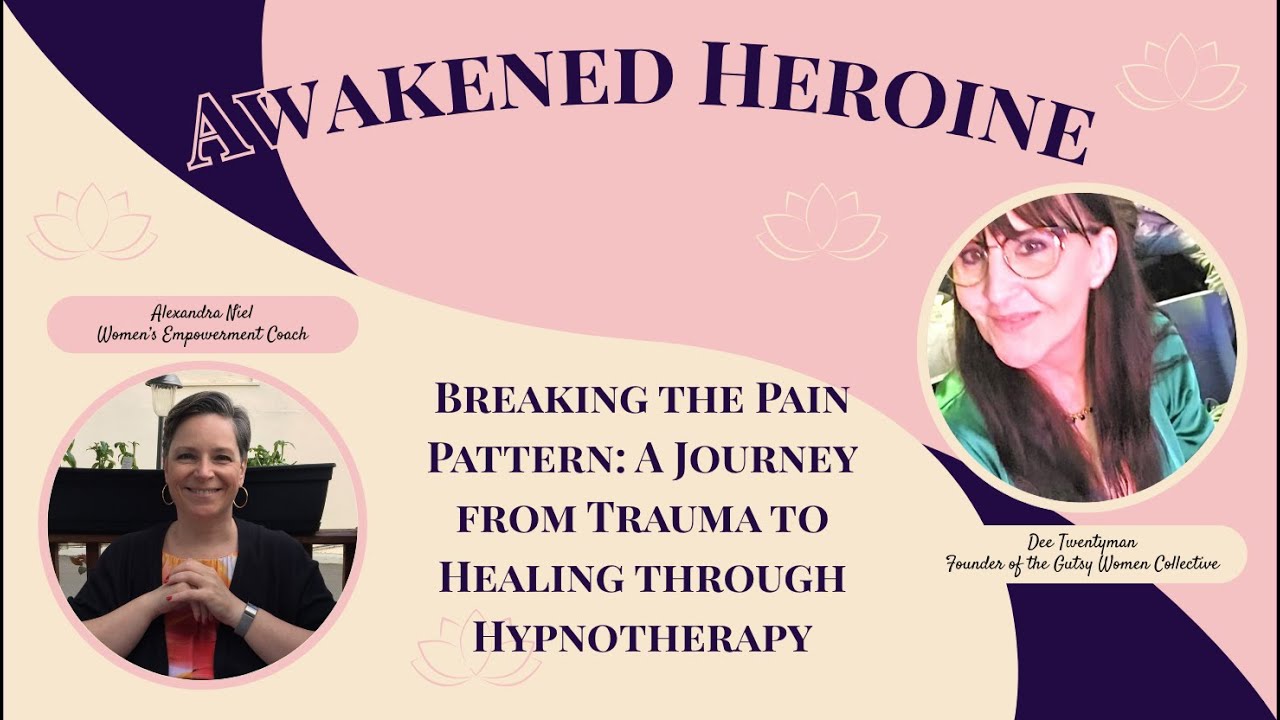
Hypnopsychotherapist Dee Twentiman describes how childhood trauma, bullying, and grief created a "pain pattern" that manifested as IBS, migraines, and fibromyalgia. She explains how hypnotherapy can interrupt this loop, with most clients seeing improvement in 6 to 12 weeks.
Chapters
Hello, heroines! This is Alex. I hope everybody's having a fabulous day today, and I know I'm going to be having a fabulous next 15, 20, 30 minutes because I am with Dee. And I wanted to bring Dee on because of her story, a very inspirational story, but also the work that she does I think is critical, especially as we are transitioning from heartbreak into our life, to really remember that, you know, we need to take care of ourselves because we have a lot of stuff going on. There's a lot of emotions, and all of these things are related. So I wanted to bring Dee on to really share her wisdom. And Dee, why don't you get us kicked— kickstarted with, you know, who are you, where are you from, and what do you do?
Thanks, Alex. That's lovely. Okay. Yes, I'm Dee Twentiman. I live in the United Kingdom in the north, the cold part. And, um, I am—
Oh, you wouldn't know that today based on what you're wearing.
No, no, it's actually quite nice at the moment. So we're making the most of it over here in the UK before it goes back in again for the rest of the year. Um, So yeah, I, I'm in the north of the UK and I've lived here a lot of years now, a lot of years. And, um, I'm a hypnopsychtherapist and I work with women who have chronic pain conditions. And I look at the, my focus is really around the mind and body connection. So when we get stressed, when we get tense, when we get angry, when we get frustrated, when we're not being our own best friend, all of those things, the body will hold on to those thoughts and emotions and create a chronic pain condition. And quite often it's the same kind, it's the same set of symptoms that tend to show up most of the time in women when that happens. So if you've got a chronic condition, you can guarantee that that will be the thing that shows up when you're stressed. So that is what I do. A hypnopsychotherapist is a psychotherapist who uses hypnosis to speed the process of healing and wellness up. So what normally would take years with psychotherapy alone can take months. What would take months takes weeks. What takes weeks would take days. So hypnotherapy has been a passion of mine for the last 26 years, and I do incorporate it in my work now with women with IBS, SIBO, gastroparesis, fibromyalgia, chronic migraines, you name it. All of these life-limiting conditions, they limit the life that you have if you have a chronic condition, and you're not living your best self. And you're not being the best you that you can be with these conditions in place. So that's what I do. You want to know why I do it?
I do want— it was going to be my next question, was going to be tell us a little bit more about your story and why you do that.
So, Alex, what a great question, by the way. I do it because I suffered myself through a lot of trauma and upheaval in my life from a very young age. I was diagnosed with a nervous tummy by my doctor when I was about 7 or 8 years old. I was being bullied at school. I had some stuff going on at home where I couldn't tell anybody what was happening to me at home and It really just got buried inside. Although I did try and tell my mum what was happening, but she wouldn't believe me. And when I wasn't believed, I felt isolated, I felt alone, I felt unworthy, I felt unseen. So there was lots of things going on there. I basically just kept burying stuff. I couldn't go to the toilet. I had to have, um, certain things that my mum would give me to help me go to the loo. So back in the day, it was something called syrup of figs. And I actually don't— I didn't mind it because it tasted quite nice. But it was the thing that would make me go to the toilet. And I, I've, I've can't remember a time in my life up until my mid to late 30s that I didn't have a toilet problem. Constipation, diarrhea, bloating, pain. It then developed into migraine. Exactly. Yes. That vicious loop that we keep going around all the time. And so it did develop into migraines as well. So migraines just hopped on the train and came along with it. And so there was the three of us going through life. And none of us were great friends with each other. And so in that respect, things just didn't, didn't, you know, work out for me. My job suffered, my home life suffered, my children suffered because I was in bed for about 4 days of every month with migraines and bloating, and IBS. And a lot of that was again down to what happened when I was a child and when I was a young adult, because those experiences made me, or caused me, to choose relationships that were not right for me. And so when I was going through all of these things, I was trying to what's the thing, I was trying to make the relationships right. It's kind of like, you know, when, when you make a dress and you've got a pattern, and if your first pattern is wrong, doesn't matter, everything else is wrong. So it doesn't matter how many dresses you try to make, how many relationships you try to make work, you can nip and tuck as much as you like, it's not going to happen. You've got to tear that pattern up throw it away and get a new pattern. And I didn't realize that that's what was happening in my life. I was just trying to be the best wife, the best mum, the best daughter, not rock the boat, you know, be the stoic person and, you know, do everything you possibly can for everyone else. But I was actually really hard on myself. And it, it just escalated from there. And I became really, really unwell and couldn't eat much. I was thinking, oh, I can't eat anything now. There's, you know, I was eating like a bird and I was still unwell. And so it, it came to a point where I thought, there's something's got to give here. And I decided to go into therapy.
Myself.
And that therapy really, really worked for me. It really helped me out a lot around my mindset and what was important in setting boundaries and not putting up and shutting up, but actually having the confidence to stand up for myself. And, and that's what I did. And when I did that, I seemed to have broken the pattern of the past. And I met my late husband shortly after I came out of therapy. I'd known him 14 years. I didn't see him as a romantic prospect. He was far too good for me, which is what many of us women who have had traumatic experiences with our father or brother or whoever. We then start to choose relationships that mirror those relationships. So I didn't, you know, the relationships for me were only right when they were wrong.
So, oh, that hurts.
That was the pattern. Yeah. So I met my husband, my, my late husband. He was an absolutely amazing man. He's— I can even say now, I know I'm in a relationship at the moment, but This man was the love of my life, and we were together for 12, uh, for 4 years as a, as a couple after 14 years of being friends. We lost touch for about 5 or 6 years, got back in touch again, and we started to see each other as romantic couple. We got together, we were inseparable, and then 6 weeks after we married, he died very suddenly in front of me. When I was on stage singing and he collapsed. And that trauma put me right the way back to where I've been before. And so I started having IBS symptoms again. I started pushing myself, trying to make things work. Nothing worked. Everything was going wrong. And then I decided that enough was enough once again. 7 years it took me to actually feel like I could function. And within that 7 years, I had a couple of short-lived relationships with men who were back to the old pattern again, you know. Even, even the good man couldn't stay around for me. He had to die. So I ended up going back to the old ways. And so, cut a long story short, I then spent the next 17 years of the last 25 single and celibate, finding myself, trying to find out who I was, what I wanted in life. And I started to grow my business. I started to look at mental health. I started to look at what it was that was causing me so much pain. And I— it just grew from there. I studied for my— I went to university and did my psychology, and it was kind of a combined honors degree, sociology relationships, you know, you know, the, the relationships that control us in life. So that includes politics and all, all kinds of things. So I did that, and it was a psychology side of it that really, really hooked me in. And I'd been working in mental health for a lot of years anyway, and I decided to qualify as a psychotherapist, which I did. And then I went into hypnosis. As well, because people weren't getting well quick enough for me. And that's what happened. That's where I'm at now. That's why I do what I do, because these conditions, these illnesses, these dis-eases, if you like, can be embarrassing, can be shameful. People don't want to talk about them. People find it's difficult to talk about them. And we start to make excuses for why we can't turn up, we can't be present, we can't do this, we can't do that. And that's my mission now in life, is to get as many women— because there's billions of women out there, 65% of IBS sufferers are women globally— and so it's about time that these women had a safe space to actually feel like they can open up and get the support and the help and the nurturing from other women who are going through the same, same thing. So yeah, that is my story, what got me here.
What an amazing story of resilience and strength and just absolutely amazing, Dee. Thank you so much for, for your vulnerability, and thank you so much for, for sharing. I wanted to go back to something you said about Um, the, the— our relationship reflect our past in a way. You said something along those lines, and it brought me back to my marriage because I realized after I got divorced that I married my father. And it wasn't until I went through my own journey that I realized that That was the pattern, and that's what I did. And not only did I marry my father, but I mirrored my mother's behavior in her marriage in mine. So it's just interesting to, to hear your perspective as well, because that was also your That was also your experience.
Yeah, yeah, that was, that was my experience, definitely. And I think for me personally, I, I was looking for the father figure that I didn't have in that respect. I was looking for somebody who would hold me and nurture me in the way that your father would, in the way that my friends' dads were with them. And so as I was growing up, I think I was— that's what I was looking for. I was looking for anyone that treated me with— that, that I was like this, you know, person that was worth loving, if you like.
Like a princess.
Yes, like the princess, like the Yeah, something precious that needed to be looked after and cared for and nurtured and, you know, supported. And you think you get that at the very beginning because people wear masks, people, you know, we all put our kind of best, best face forward. And, and then it's only later that we realize actually Oh, what have I created here? What, what's happened here? You know, and you know, the, the, the— I've been married 4 times and 3 of them were abusive in different ways. And it's, it's only when you go through that that you start to see what you've just said, those bits of connections from those old early childhood years. And so in, in that respect, it's, it's repeating the pattern of the past because of that feeling of self-worth and self-esteem and all of those things. And I did do what you, what you said about like you behaved like your mum at certain times, and that didn't make it any better.
Yeah.
So, so when you start to get the chronic pain condition coming in because of all the stress and anxiety that you've been through, then you start to, you start to notice that there's, there's a hell of a lot of work to be done here, Dee. Yeah, you know, and that's when you go through it. And being— going into that training of being a psychotherapist and having to go through all of that therapy myself to undo all of that before I could sit in front of somebody and say, I am now capable to help you. Yeah, you have to undo all of— unravel a lot of that. Um, and you still need a supervisor to keep coming back to and saying, is there anything within this therapist-client relationship that, you know, is triggering you, pushing buttons, blah, blah, blah? You have to work through those things and, you know, and then if, if there is, then you have to learn how to refer that person on to people who can help them better than you can at that point. And that's another level of learning. Being another, it's a bit like being a beginner again in certain ways.
Yeah, because you're, you're not in a place where you, because you haven't dealt with your own stuff, you can't help somebody else deal with theirs.
Not in the, not in the way that they want to. You can help them with loads of other things, but if that thing that they've come to you for is a catalyst for you to go back into the past at any point, then that is, we don't want any transference going on here. We need to have a clean relationship with the client, with the client. So it's, I think I'm not the right person for you. Now that this bit's come up, I need to refer you on to someone else.
Which, which makes sense, right? Because the whole point of us doing the work that we do is to serve. And if we can't serve to the best of our abilities, then we're not the right person for, for them. And I want to go back to what you said before because you used the very specific word, which I think people don't always recognize, and that is the word create. Because you used it in the sense of what is it that I am creating here in this relationship with with this person. And until we do the work, and until we have those moments where we either talk to a therapist or we do the work in some other ways through a coach or somatics or whatever the case may be, um, we are unconsciously creating those things in our life. And it may feel like why does this keep showing up? Or why is this happening to me when in fact it's like we've planted our garden and the seeds that we've planted are now coming up. So if you don't like the fruit, if you don't like the vegetable, you've got to change the seeds.
100%. Yeah, because we do create that thing. We don't realize we're doing it.
Yeah.
We really don't realize we're doing it. It's— these are all subconscious patterns. And this is where hypnotherapy comes in. It's so powerful to look at the subconscious patterns because it's subconscious for a reason. Mm. You don't— conscious means it's a— you're aware of it. When we're conscious, we're aware. When something subconscious, we're unaware. And so these are patterns that we don't even realize that they are, they are, um, our modus operandi, if you like, when certain things happen. And these events might be completely unrelated, but the emotions and the thoughts that are triggered by these individual events that might never have happened before but the emotions and everything associated with those events feel the same as that thing way back when. And your, your mind doesn't know what's real or what's imagined, so it's going to engender that response, that physical response. So it's really important that we get mind, words, and feelings aligned. Yeah, it's a big thing that I, I go into this with every client. Let's get this all aligned up. And some people take longer than others, but 6 to 12 weeks is usually— yeah.
And, and, you know, it's, it's, it takes the time it needs to take, right? There is no— nobody's keeping score. Nobody's looking at their clock and their watch to say this, you know, you 'You should be over this by now.' No. Yeah, right. It takes— I think part of it depends on how deep the hurt and how deep the pattern is, I assume. I don't know. And the circumstances around really the situation really make it that each person's journey has to be different.
And it is. And like we say, we all have very similar things happen to us, but they're not identical because we aren't identical. We aren't. We are unique, you know. And you will work with women who are coming out of relationships or have lost a partner or whatever, you know. And that's going to take as long as it takes. And for me, when I When I went through the grieving process of my husband dying very suddenly, people thought that I should have been well over it after, you know, a couple of years. It took me 7. It took me 7. And I don't even still think we ever get over that. I don't think anyone ever gets over a bereavement of any kind. It changes you fundamentally. And we learn to place that thing, that emotion, that situation, that event, we place it in a part of our lives where it, we're comfortable with it, you know? And so you can, you can move, you can move through it, but I don't think anybody ever gets over a bereavement. And I don't believe anybody should get over a bereavement. I think we should be able to have a life and bring a new person into our life and love them. But again, the length of time that takes for one, one person to the next is unique to them. You know, some people do have a level of, of strength and resilience and understanding. They may be more spiritual, they may be more, they may have a deep faith that helps get them through it. Other people may not have that, and that, that loss feels immense for a long, long time. I've, I've worked with people who've lost somebody, and 30 years later they're still in a state of grief. It's a, it's a, a blockage. It's a, um, stuck, a stuckness. And so we have to allow ourselves that process and get the help that we, that we really should be getting because, you know, yeah.
And, and that's one thing that I would like to reiterate, piggybacking on what you're saying, is if you're coming out of a divorce and you feel like you're really stuck and you can't get beyond where you are, you can't process the grief, you can't— please talk to somebody. Please get the help that you need. There's nothing wrong with that. Um, if that's what you need to be able to move on with your life, then do it. Just— you deserve to be happy. You deserve to grieve, to understand the lessons, and to then move on so that you can live a life that is going to be congruent and aligned with, with who you are. So, T, before we wrap up, any final words of wisdom you would like to share with our heroines?
Um, I would just like to say, trust in yourself, trust in your own intuition, your own knowing. And if something rings true for you, whether it's socially acceptable in your circle or not, if it rings true to you, that's the steps you need to move towards. Because we can stay stuck in a place that we don't need to stay stuck in. Purely because of other people's opinions of us.
So yeah, yeah, that's, that's another discussion entirely. So thank you so much for sharing so vulnerably and so beautifully with our ladies.









